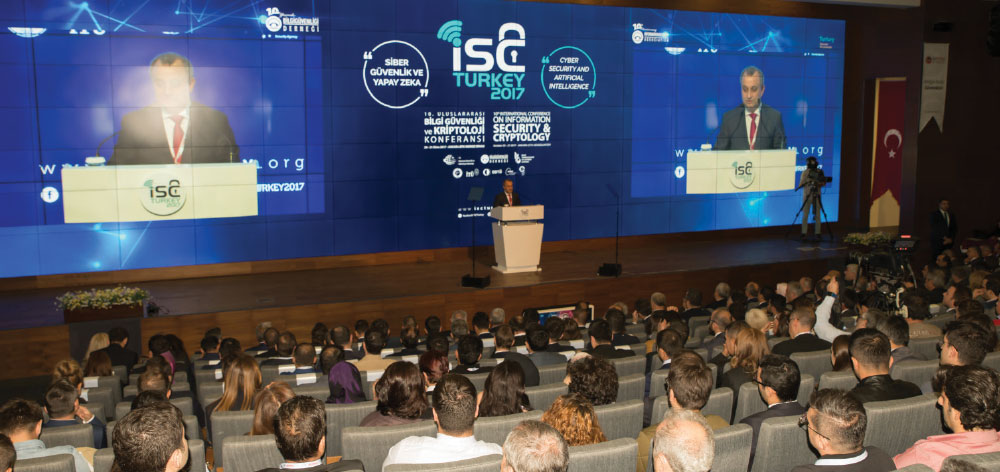
10th International Conference on Information Security and Cryptology Held in Ankara
The 10th International Conference on Information Security and Cryptology was held in Ankara on the 20th - 21st October, 2017 at the headquarters of the Information and Communication Technologies Authority. Prime Minister Mr. Binali Yıldırım, Minister of Transportation, Maritime Affairs and Communication Mr. Ahmet Arslan, Chairman of the Information Security Association Mr. Ahmet Hamdi Atalay, President of the Information and Communication Authority Dr. Ömer Fatih Sayan and many invitees attended the conference. This year’s main theme was “Cyber Security and Artificial Intelligence”.
Artificial Intelligence becoming an Inseparable Part of Cyber Security
In his opening remarks at the Conference, Chairman of the Information Security Association Mr. Ahmet Hamdi Atalay stated that they were celebrating the 10th anniversary of the conference and added, “Back then we gave the conference a thematic title of information security because in those days the problem was perceived merely as related to information security. Yet today, the size of this problem is greater and now we refer it as cyber security. Information security is currently one of the sub-components of cyber security. 51% of the people in the world are users of the internet. We are immersed in the information infrastructure from trade to education and banking transactions. While increasing the effectiveness, efficiency and speed of our lives, information brings with it threats and danger at the same time. We refer particularly the protection activities against such threats and dangers towards critical infrastructures as cyber security. We have been conducting various activities in order to create social awareness ever since our establishment. We can say that we have been creating an essential amount of awareness both within society and among the decision makers. Turkey used to be in the top ten among the list of countries that faced the most cyber-attacks in the past. In the last two years, we can now we can say that Turkey is no longer amongst the aforementioned ten countries, but we still remain within the top 20 countries and we need to change that.
Today, there is a strategy paper established by Turkey and we have a national action plan, the second edition of which was issued this year by the Ministry of Transportation, Maritime Affairs and Communication. We, from the user level to decision makers, still have certain missions to accomplish. Today we will include these missions into discussion within the scope of this event. We identified this year’s theme as “Cyber Security and Artificial Intelligence”. Now artificial intelligence is being actively used in the cyber security area similar to every area of our lives. The total number of daily threats has exceeded 230 thousand. The destructive power of malicious software has reached an unbelievable level. With malicious software costing just $100, one can cause more destruction than a war plane and destroy critical infrastructures. In a cyber-war it is possible to affect the entire infrastructure of a country through this $100 software, independent from time and location. The human factor is of vital importance in order to prevent this but in cases where human beings fail to suffice, artificial intelligence has to step in. It reacts so rapidly against a multitude and vast array of complicated attacks, it is not always easy to react and achieve this with just human beings, therefore, this year we selected the utilization of artificial intelligence in cyber security. Many academic and international studies will be accomplished throughout the event. Numerous domestic and foreign academicians applied to present their declarations, and following various screenings presented around 30 declarations here. On the other hand, we provided a variety of training to approximately 700 people throughout the event.”
President of Information and Communication Technologies Dr. Ömer Fatih Sayan stated that they strived to fulfill the tasks assigned to them as part of the cyber security organization founded in 2013 and added, “We inaugurated our operations in 2016 with this facility we launched. We founded the 5G Turkey Forum, 5G Valley and the BTK Academy in order to get prepared for new generation communication technologies and 5G technology. We prepared the real-time map of our country’s fiber infrastructure, our 1285 security experts who are members of the USOM (National Computer Emergency Response Center) cyber communication platform are constantly in touch with us to respond to the cyber incidents.”
Minister of Transportation, Maritime Affairs and Communication Mr. Ahmet Arslan expressed that presently social life, business life and critical infrastructures become information-based, and that finance centers, power plants, transportation and communication systems, hospitals depend on this information infrastructure and that they proactively cooperate more toward preventing potential losses, in coordination with all institutions.
Prime Minister Mr. Binali Yıldırım: “Turkey needs more than 30 thousand Cyber Security Experts”
Telling that they established the Cyber Security Council in 2012, Prime Minister Mr. Binali Yıldırım continued, “In that period, there were many countries that were aware of the severity of this issue and taking the required precautions. We need to carry forth with these activities that we started so that we can further levels of prevention. Today, Turkey needs more than 30 thousand cyber security experts. We have approximately1000 qualified staff, so we are speaking of a severe gap at this point. We are talking about the Industry 4.0 revolution. This revolution will fundamentally change our habits and Industry 4.0 will accompany us in all aspects of our lives in respect to technology. All the objects that we use as part of our daily lives are becoming smart devices. The objects will start to speak with the human beings in the near future. Experiments with driverless vehicles through smart transportation technologies are underway. 3D printers are now part of our daily lives. Nowadays, manufacturing without labor and only through machines is possible in factories. All machines in a given factory will be able to communicate with each other. With artificial intelligence, all this improved technology and implementation has become natural. Protecting these technologies in our lives is also crucial; we need to be aware of the fact that each cyber security threat against these aspects should be regarded as a threat against our lives. Cyber-attacks are generated at low costs; therefore, we need a lot of qualified people for the protective measures and deterrence against them. Each attack that we face in the cyber area today should be defined as an attack towards the national security of the affected countries. Currently, there are 5 billion people and 5 billion machines connected with the cyber world. This figure is expected to go beyond 20 billion in 2020. Therefore, we have to adopt our measures in advance. The cyber-attacks have severe destructive effects over the economies of countries.”
Stating that the information and communication technologies market in the beginning of 2000s reached $21 billion, Prime Minister Yıldırım underlined that currently this figure has exceeded $100 billion. Pointing out that 77 million mobile and 11 million fixed wideband subscribers exist in Turkey, Yıldırım continued, “Uninterrupted internet access is essential in the information society. Issues emerged with the extension of the utilization network in information and communication technologies. Therefore, we must adopt the required measures here. We have to be proactive and identify the potential issues that we may face in the future. Within 5 years, there will be a need of 1.5 million cyber security experts in the world. In Turkey we need 30 thousand cyber security experts. An infrastructure and a legal foundation are imperatives for the management of these human resources. We identified the Ministry of Transportation, Maritime Affairs and Communication as the supervisor. We need to focus on indigenous technologies such as national software, national hardware. As the government, our most primary objective will be to integrate national security with cyber security. Identification and elimination of the threats prior to the cyber - attacks are of critical importance, we took critical steps to that end. Our Information and Communication Technologies Authority, Ministry of Transportation, Maritime Affairs and Communication and Havelsan Company have been conducting crucial activities within this context. We identified our road map that is composed of the necessary steps to be taken by 2019. The test process as part of the ULAK Project (4G/LTE Communication System Development Project) that we launched in order to efficiently maintain Cyber Security is on its course. We need to increase such examples. Domestic Micro Electronics industry, domestic chip production, domestic software and technologies should be multiplied.”
Underlining the need to protect governmental data in a high security environment through the launching of the national governmental data integration center, which is considered to be one of the components of cyber security, Prime Minister Binali Yıldırım added that they are continuing the activities to train cyber security experts in collaboration with the Universities and YÖK (the Council of Higher Education).