9th Air & Avionics Systems Seminar Held in Ankara
The 9th Air & Avionics Systems Seminar was organized with the support of the Presidency of Defense Industries (SSB), METU-BILTIR, AFCEA-Türkiye, DASA, Elektronik Vadisi and TDI News, and sponsored by ASELSAN as the main sponsor and Defence Türkiye as one of the media sponsors. In addition to representatives of domestic and foreign companies such as HAVELSAN, ROKETSAN, KAREL, TAAC, LEONARDO and TARGET, representatives of the SSB, representatives of user authorities and representatives from universities attended the seminar. Through information sharing provided by the 9th Air & Avionics Systems Seminar, which hosted the leading actors of the industry, the aim was to increase national and domestic production regarding aviation and space systems, while contributing to the production of the Turkish Fighter (MMU/TF-X).
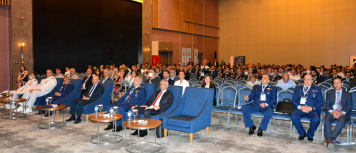
On day-1 of the 9th Air & Avionics Systems Seminar, which attracted nearly 500 applicants, started with opening remarks, followed by speeches by Air Pilot Colonel (Ret.) Berna ŞEN, Türkiye's first female F-16 Pilot, and Dr. Şener YILMAZ, Avionics Software Design Manager at ASELSAN. The first day of the event continued in the afternoon with panels organized in two separate halls (Karadeniz 1 and 2). In addition to the opening speeches, a total of 17 presentations were made within the scope of the seminar, and 16 companies opened stands in the foyer area to present their products. The 10th Air & Avionics Systems Seminar is planned to be held in early June 2024.
Delivering the opening speech on behalf of the Organizing Committee, Naval Engineer Colonel (Ret.) Zafer BETONER thanked the attendees and participating organizations that provided financial and moral support for the seminar, especially the Presidency of Defense Industries, despite numerous defense industry events organized after the COVID-19 pandemic. BETONER stated that they aim to help keep track of the developments in the Land, Naval and Air Defense sectors with the seminars they organize, and said, “We are trying to bolster our country’s defense capabilities and serve to create added value for our economy.”
In his speech at the seminar, Abdurrahman Şeref CAN, Head of the Aircraft Department at the Presidency of Defense Agencies (SSB), shared significant information about the Turkish Fighter (MMU/TF-X) and the ÖZGÜR Projects. He said that during the period when F-16C/D and CN235 aircraft were manufactured in Türkiye, LRUs (Line Replaceable Units) and components, the design activities of which were finalized and were installed on the aircraft, and that these activities were very effective and informative for that period. Noting that critical indigenous modernization projects that complemented this process were carried out afterwards, CAN emphasized that the launch of the ERCİYES, ARI and ÖZGÜR Projects were very important for the Turkish Defense and Aerospace sector, and paid his respects to and thanked those who contributed to the preparation of the Project Definition Documents of these projects. Stating that the ARI Project has been completed, and the delivered T-38M Aircraft are now in service, while more than half of the aircraft in the ERCİYES Project have been completed, CAN said, “Our learning curve has also improved, consequently we are able to put C-130s into service in a shorter time, both at the military factory in Kayseri and at TUSAŞ.” Stating that the ÖZGÜR Project, which was initiated for the modernization of F-16C/D Block 30 Aircraft with indigenous systems, has entered the serial production phase, CAN said, “If we have developed our own avionics for the HÜRKUŞ, if we are making our own avionics for the HÜRJET, if we are developing our own avionics for the Turkish Fighter (MMU/TF-X) with a dozen defense industry companies, the importance of those modernization projects is really great.” Noting that the HÜRKUŞ is flying today and will be delivered to the Turkish Air Force as an air-to-ground aircraft, that the production activities of the HÜRJET are underway, that two prototypes are currently being manufactured on the HÜRJET production line for its maiden flight in 2023, and that design activities for the Turkish Fighter are ongoing, CAN said, “We are continuing our activities for the first engine run on March 18, 2023 for the MMU/TF-X. Our engine has arrived, and the design and production of the subsystems have been completed to a great extent.”
Under the National F-16 Block 30 Avionics Modernization (ÖZGÜR Program) Development and Prototype Phase PO-III, which was initiated with the Defense Industry Executive Committee’s (SSİK) decision dated December 15, 2010, within the framework of the requirements of the Turkish Air Force, the aim was to equip and certify one of the 37 Block 30 F-16C/D Aircraft (F-16C type, with tail number 87-0019), which had previously not been subjected to avionics modernization, with an indigenous mission computer with national Operational Flight Program (OFP) and an indigenous avionics suite solution. The number of aircraft fell to 35 due to accidents/incidents over time. The contract worth US$46 million was signed between the SSB and TUSAŞ on March 6, 2012 and became effective on May 24, 2012. The project schedule was initially planned for 52 months, then was revised to 80 months. It was planned that the mission computer (central computer) to be used within the scope of the modernization would be developed by ASELSAN, the OFP software would be developed by TUSAŞ, the HUD system to be used in the national avionics suite to be developed based on the mission computer would be purchased (off-the-shelf) from abroad, and the color MFDs would be developed again by ASELSAN with domestic capabilities. Thanks to the national mission computer, the Turkish Air Force would have a thorough control over the OFP and there would no longer be any reliance on the United States for the integration of national weapon systems on aircraft. The 4th phase of the ÖZGÜR Project, which was planned to be executed under 4 phases, included the Digital Moving Map, Data Link, and Air-to-Air/Air-to-Ground Weapon Integration activities.
Within the scope of the National F-16 Block 30 Avionics Modernization, which was announced that the Serial Production Phase has started, F-16C/D Block 30 Aircraft will be equipped with the National Mission Computer, System Interface Unit, Cockpit Up Front Integrated Control Panel, Fuel Hydraulic Display, Engine Instrument Display, Emergency Prime Indicator, Secure Voice Device (for HF/VHF/UHF Radios), National Identification Friend or Foe (IFF) System, Multi-Mode Receiver, Inertial Navigation System, Interface Blanking Unit, AVCI Helmet Mounted Display/Targeting System, Center Cockpit Display, and Color Multifunction Displays.
As you may recall, the Phase-I Protocol of the F-16 AESA Fire Control Radar Development Project was signed between the SSB and ASELSAN on December 4, 2018. The Protocol covered the development of the AESA Nose Radar, prototype production, verification through factory tests and preliminary work required for its integration into the F-16 Block 30 Aircraft. In Phase 2 of the project, the aim was to integrate the prototype radar into the F-16 aircraft and demonstrate its performance on the aircraft, and to start serial production of the radar if the results were satisfactory. GaN-based T/R modules are used in the antenna unit of the AESA Fire Control Radar. The ASELSAN F-16 AESA Fire Control Radar (named MURAD), which will incorporate over 1,000 antenna elements, is claimed to be a product that can compete with the AN/APG-83 SABR used on F-16V Block 70 Aircraft and will go far beyond the AN/APG-68(V)9 Radar used on F-16s in the Turkish Air Force inventory in terms of performance. According to open sources, the GaAs-based AN/APG-83 SABR AESA Fire Control Radar has a maximum range of 296.3km (370.4 km according to another source), it is able to detect fighter aircraft at a range of 120 km, lock on at a distance of 84km and track more than 20 targets simultaneously. In response to a question that I asked Abdurrahman Şeref CAN, Head of the Aircraft Department at the SSB during the seminar, he stated that new systems and equipment such as the AESA Nose Radar and the AVCI Helmet, as well as new national munitions, will be integrated into the aircraft within the scope of the ÖZGÜR Project when the related development activities are finalized