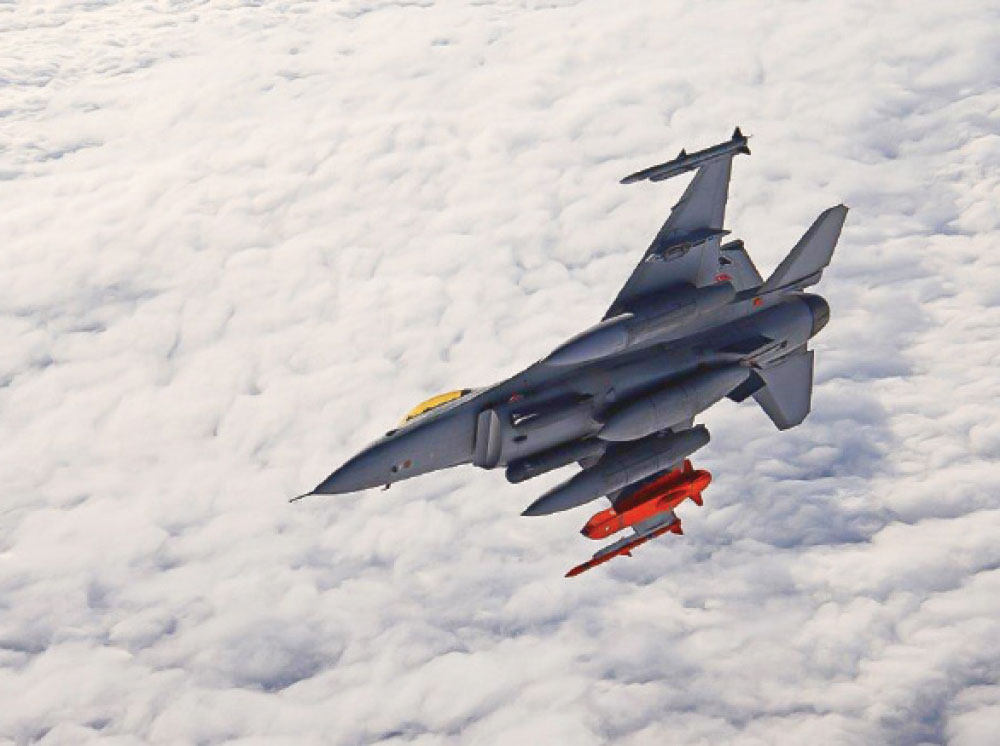
A Look at Indigenous Air-to-Ground/Surface Missile Projects

SOM ALCM Serial Production and Localization Contract Signed
On October 26, 2018, President of Defence Industries Prof. İsmail DEMİR announced via his social media account that the Contract for the Serial Production of the Precision Guided Stand – Off Munition (SOM) Project was signed between the Presidency of Defence Industries (SSB) and Roketsan. Within the scope of the Project, activities on the localization of certain subsystems and components on the SOM will be accomplished in addition to the serial production of SOM missiles.
Since the contract signed in 2013 covered the Serial Production of the SOM-A and SOM-B1 missiles, we estimate that the new contract will include the procurement of additional SOM-A and SOM-B besides the serial production of SOM-B2 missiles.
In the press release published by the SSB Press Office on 26 October, the following information was given about the signing ceremony and the scope of the contract, which was attended by representatives of the Presidency of Defense Industries, Roketsan and TÜBİTAK SAGE: “The SOM Project was launched in order to fulfil the procurement of precision guided munitions required by the Turkish Air Force Command for use in neutralizing fixed and mobile land/surface targets of critical importance without getting within range of enemy’s air defence systems. Within the scope of the contract, serial production of SOM munitions of various configurations and localization activities regarding the certain sub – systems and components will be accomplished. Roketsan A.S. will be conducting the serial production of the munitions while the development and localization activities will be carried out with the contributions of TÜBİTAK SAGE”.
Within the scope of the Project, the contract of which was signed on 31 March 2006 valued at US$80 Million, development activities were launched by TÜBİTAK SAGE in April 2006 and after the qualification activities and the successful completion of ground and flight tests, SOM prototypes which are Turkey’s first indigenous Air Launched Cruise Missiles (ALCM) entered the inventory of the Turkish Air Force (TurAF) in 2012. SOM’s (SOM-A and SOM-B1) product qualification efforts were completed in 2012 and it was rendered available for serial production. The first tender opened for serial production of the SOM was assigned to Roketsan by the Ministry of National Defence (MoND/MSB). The activities in accordance with the contract signed between the Turkish MoND and Roketsan in the beginning of 2013 were launched in July 2013. Roketsan conducted the first batch delivery of the SOM-A in the second half of 2015 and the Project was transferred to the SSB in December 2016. On January 4, 2018, the SSB announced via its official website that seven SOM-B1 munitions forming the first batch as part of the main package were delivered to the TurAF. In addition to the SOM-A and SOM-B1 missiles, in accordance with the contract, Roketsan accomplished the delivery of items such as the Training Missiles (SOM Mechanical Training Missile and Electronic Training Missile) and Test and Programming Component (TvPC). Besides its mass production activities within the scope of the SOM Project, Roketsan continued its improvement and development activities. The activities executed to this end were grouped as bringing data link and moving surface target engagement (ASuW) capabilities to the SOM ALCM. The aforesaid activities were conducted by TÜBİTAK SAGE, which assumed the role of the subcontractor as part of the Mass Production Contract.
The SOM Missile System is defined as a long-range Air-to-Ground/Surface Cruise Missile Family capable of conducting tasks under all climate conditions autonomously with low visibility and high precision. The modular design of the missile allowed the development of a Missile Family composed of four different configurations (SOM-A, SOM-B1, SOM-B2 and SOM-J) which support operational flexibility. Currently there are over 50 domestic and foreign supplier companies within the supply chain of the SOM Missile System.
KEMENT Project Factory Acceptance Tests Completed Successfully
In August 2018 Meteksan Defence completed the Factory Acceptance Tests (FATs) that were conducted with the participation of representatives of the TurAF and the SSB within the scope of the KEMENT Project signed with the SSB at the end of 2013. Platform Integration and Site Acceptance Tests (SATs) are still being conducted as part of the Project. A two-year long schedule was planned for the testing process including live firing tests. With the availability of the SOM-B1 and B2 munitions, the test process schedule is expected to be launched by the end of 2018 upon receiving the required permits.
The Design Verification process in which environmental conditions specific to the platform and EMI/EMC requirements were verified for five different munitions (SOM-B1, SOM-B2, ATMACA-B1, ATMACA-B2 and x?) and various Naval (I Class Frigate) and Air Platforms (such as the F-16, S-70B, P-235 and ATR72/600) designed for KEMENT terminals were accomplished successfully. In the aftermath of the Factory Acceptance Tests, it was verified that such terminals were capable of conducting high-speed tactical data communication from long distances, resistant to electronic warfare.
Upon the successful completion of the Factory Acceptance stage, Platform Integration and Site Acceptance Tests were launched. In this stage survivability and flexibility of the cruise missiles will be verified. Thanks to the tactical data link terminals operating on the network between the air-to-air and air-to- ground/surface systems, there will be an increase in the action strength of these missiles.
The tactical data link terminals developed within the scope of the project and operating on network infrastructure are planned to be used primarily within the cruise missiles and relevant air platforms. Upon the completion of the Project, the KEMENT Tactical Data Link Terminals will reach a structure enabling their utilization in many applications and platforms that require long range, electronic warfare resistant, high-speed tactical data communication. On account of the KEMENT Project, a national communication infrastructure could be formed where many different components such as naval and air platforms, cruise missiles and command control centers could exchange instant data. As part of the KEMENT Project, Meteksan Defence accomplished the Prototype Demonstration Phase in May 2018, with the participation of representatives from the Air Forces Command and the SSB and thereafter Factory Acceptance Phase were initiated.
Within the scope of the KEMENT Project, executed by the Meteksan Defence as the Main Contractor; in the network topology between the air to air and air to ground components, a Munition Data Network System (MDNS) will be developed that could update the command control data and information regarding the target throughout the course of the munition from a minimum distance of 250 km, transmit an image with sufficient resolution prior to the firing during the terminal stage of the munition, and could support a 512 kbps data transfer.
The KEMENT Project will be accomplished in two phases. Within the scope of the Phase – I consisting of a 38-month schedule;
KEMENT-S: 2 MDNS SOM Terminals (MST) that could be integrated on the SOM ALCMs and 2 MDNS Air Vehicle Terminals (MAVT) that could be integrated to the F-16 aircraft.
KEMENT-A: ATMACA Data Terminal (ADT), Ship Data Terminal (SDT) and Relay Data Terminals (RDT) that could be integrated to the Surface-to-Surface Anti-Ship Missile (ATMACA) and to the other relevant platform or platforms within the utilization scenario, operable under the relevant environmental conditions, will be developed.
Phase-II activities will be launched upon the completion of the Phase-I, if approved by the SSB. And within the scope of Phase-II, MST’s integration to the SOM will be completed, and External Load Certification and External Load Certification Firing Test Activities of the SOM-B1 and SOM-B2 munitions with MST to F-16 Platforms will be executed.
TÜBİTAK SAGE and Roketsan serve as the Main Contractors while the 1st Main Maintenance Factory Directorate (MMFD/ABFM), TÜBİTAK UEKAE and MilSoft perform as the Sub Contractors within the scope of the Project. DLP is being developed by MilSoft and the encrypted module is being developed by TÜBİTAK UEKAE within the scope of Phase-I. The 1st Main Maintenance Factory Directorate will be developing the MAVT’s integration to the F-16 platform.
On account of the SOM MDNS Terminals to be developed as part of the KEMENT-S which is the first Phase of the KEMENT Project, the SOM-B1 and B2 Missiles will gain RF based, two-way and encrypted data link capability. Therefore, they could be utilized against mobile land and sea targets, and the task/ target of the missile could be changed depending on the instant changes at the target zone. Target reference point corrections could be transmitted in real time over the data link and the mission abort command could be sent when required.
The MAVT to be developed under the KEMENT Project and integrated to the F-16 fighter jets and it will enter into the TurAF’s inventory. It will not be in the external pod configuration like the AN/ASW-55 data link pod procured for the Popeye missile or the AN/AWW-13 external data link pod ordered for the SLAM-ER missile. Instead, it will be in an internal terminal configuration similar to the MIDS terminals. The MAVT, which is claimed to be incompatible with the Link-16 system will be RF based and encrypted and it will utilize the national network infrastructure.
Meteksan Defence, at the same time, is conducting production of the Link-16 Tactical Data Link Processor’s Card, which will be used in the SOM-J missile that was designed by Roketsan in order to be utilized against fixed and mobile surface targets (ASuW). To this end, the ‘Link-16 Data Link Card Procurement Contract’ was signed in December 2016, between TÜBİTAK SAGE and Meteksan Defence. The related equipment will be delivered in a closed box by Meteksan Defence and the munition will feature the requirements addressing environmental conditions. Due to NATO criteria, Link-16 data link utilization was preferred in the SOM-J munition instead of the indigenous KEMENT data link. Compared to Link-16, KEMENT is claimed to feature additional capabilities such as image transfer capability. With the integration of the KEMENT terminals to the UAV platforms in the future, missile control and image share capabilities could be acquired as well.
Recent Status of the SOM-B1 Export to Azerbaijan and the Search for an Alternative Turbojet Engine for the SOM-J
In June 2018, at the military parade organized at the capital Baku’s famous Azadlık Square with the participation of the Land, Air and Naval Forces, as part of the celebrations for the Azerbaijan Armed Forces Day and 100th Anniversary of the Establishment of the Azerbaijan’s Army, the SOM-B1 Air Launched Cruise Missile’s (ALCM) mock-up manufactured by Roketsan was displayed on a military tactical wheeled vehicle. Thereupon, it was presumed that the SOM-B1entered into Azerbaijan Air Forces’ inventory during those dates.
According to the information we acquired from the Turkish and Azerbaijani authorities during the ADEX 2018 Exhibition, no official agreement on the sale of the SOM-B1 has been signed to date by Roketsan and the Ministry of Defence of Azerbaijan. Roketsan has been conducting marketing activities to this end for the last four years and has been executing bilateral negotiations. According to the latest information from Azerbaijani sources, the SOM ALCM was integrated to a modernized Su-25M Frogfoot aircraft, and the firing tests were successfully performed. The SOM fired as part of the tests directly shot the fixed target on the ground. It is claimed that SOM can also be fired from the MiG-29 aircraft within the inventory of the Azerbaijan Air Forces, yet it is underlined that for this, the aircraft should receive avionic modernization and their existing mission computer should be either changed or updated and at least one MFD should be integrated.
On the other hand, for the sale of the SOM ALCM to Azerbaijan, export licenses are required for the foreign origin subsystems as well. For instance, regarding the TR-40 turbojet engine, which is one of the most critical subsystems and manufactured by French Safran Power Units, an export license was requested from the French government in 2017, however the French Defence Procurement Agency DGA did not approve this request. In line with the information we gathered, the negotiations on the engine are still being conducted with the French authorities. In case a new turbojet engine is selected, Roketsan will have to perform some design changes on the SOM ALCM with TÜBİTAK SAGE. Since TÜBİTAK SAGE is the designer and developer of the SOM, it is underlined that Roketsan will not be able to go through any alteration in the design of the SOM and conduct a qualification activity again, for that matter.
Roketsan has been in search of a U.S. built alternative turbojet engine for the SOM-J in which the improved version of the TR-40 engine will be used. Within this scope, Roketsan previously negotiated with the Williams International and Teledyne Turbine Engines Companies in 2017 yet could not reach a result as one of the company’s asked for an R&D expense of US$ 10 Million for its engine’s proper modification to meet the SOM-J missile requirements. According to what we heard, as of September 2018 Roketsan has been executing negotiations with another engine manufacturer company located in the U.S. for the development of a new turbojet engine featuring a ‘oil lubricated’ bearing system and to be compatible with the SOM-J. No official contract was signed as of September with this new U.S. turbojet engine company.
In both the TR-40 turbojet engine, which uses JP-10 fuel and is being used on SOM-A/B1/B2 ALCMs and the Improved TR-40 turbojet engine, selected and ordered for the SOM-J missile, the bearing system is lubricated by fuel rather than a separate oil system.
The SOM-J missile prototypes utilized during the Captive Carry Test and Secure Ammunition Release Test conducted in July 2018 by an F-16C belongs to the 401st Flight Test Squadron of the 1st Main Jet Base (MJB) Command, offshore at Bartın, did not have a live Improved TR-40 turbojet engine. The first firing test with the SOM-J with a live engine is expected to be conducted in the beginning of 2019 from an F-16 jet. Compared with the fuel lubrication method, even if the oil lubrication technique results in an additional volume (in order to lubricate the bearing system a separate/external oil system should be installed) and weight on the missile, nevertheless it both increases the engine’s service life/run time and extends the range of the missile considerably (from 150nm+ to the level of 200nm+) due to the lower consumption of fuel. According to the information we acquired, the utilization of a new engine that will allow reaching a longer range by the SOM-Js came up on the agenda as part of the U.S.’ criteria on achieving longer ranges. Moreover, with the use of a U.S. built new turbojet engine with an oil lubricated bearing system assuring longer ranges, Roketsan will be able to increase the U.S. industry’s involvement in the program while strengthening its position against JSM competition that is expected to arise in the international market.
Roketsan presently competes with KDA offering the Joint Strike Missile (JSM) solution to the F-35 JSF. According to KDA, JSM will be able to achieve a range of over 300nm while flying at a hi-hi-lo profile, and in excess of 100nm flying a nap-of-the-earth/sea-skimming lo-lo-lo profile. The JSM is powered by a TR-40 turbojet engine but in order to increase the involvement of the U.S. industry KDA turned to Williams International for an alternative engine (claimed to able to provide >1:1 thrust to weight ratio) in the shape of the WJ38-7K turbojet. As of October 2018, Norway is the only declared customer for the JSM. According to the Norwegian MoD, JSM integration onto the Lockheed Martin F-35A for the Royal Norwegian Air Force (RNAF) will take place with the Block 4 software update and Full Operational Capability will be achieved by 2025.
Upon Roketsan’s launch of negotiations with a U.S. company for an alternative engine with the oil lubrication type fueling system, which ensures lower fuel consumption and longer endurance, the Safran Power Units offered the new turbojet engine developed for the GEZGİN Cruise Missile with the contributions of TÜBİTAK SAGE. Featuring the oil lubrication type fueling system, the new engine’s power capacity is defined as “far superior than the TR-40’s performance”. According to this, SOM-J production will be accomplished in two separate stages (versions) composed of the TurAF and the U.S./International market versions. In the first stage, the TurAF version will be manufactured and is to be powered by the Improved TR-40 engine. The U.S./International market version manufactured in the second stage will be equipped with a more powerful engine and will have a longer range (200nm+) compared to the TurAF version. There will be certain differences in terms of design and performance between the two versions.
In fact, the turbofan engine can also be utilized on the SOM ALCM, yet in that case modification in the design of the avionics and sub-system layout inside the missile would have to be conducted. According to the information we received, the turbojet engine was selected since there were no suitable turbofan engines in the market during the development process of the SOM. Even though the turbofan engines are more expensive compared to the turbojet engines, they feature 30-40% lower fuel consumption and a longer operation duration. For instance, while the unit price of the AGM-158A JASSM missile powered by a Teledyne Turbine Engines J402-CA-100 turbojet engine with 3kN (680lbF) thrust capacity, weighing 48.5 kg (107 lb.) is at the level of US$850,000 and has a range of 230 miles (370 km+), the AGM-158B JASSM-ER missile with the unit price of US$1.38 million (the figure at FY2019 is US$ 1.66 million) missile powered by a F107-WR-105 turbofan engine with 3.4kN (750 lbF) thrust capacity, weighing 66 kg (146 lb.) manufactured by Williams International and equipped with larger fuel tanks is capable of reaching a range of 620 miles (1.013 km+). Both missiles are 4.27 meters long and 450 mm high, yet the air frame width of the JASSM is 550 mm and its wing span is 2.41 m (during flight) where JASSM-ER’s air frame width is nearly 635 mm and its wing span is stated as 2.7 m. The launching weight for the AGM-158A JASSM is indicated as 1,023 kg while the launching weight of the AGM-158B JASSM-ER missile is estimated in open sources to be approximately 1,200 kg (2,465 lb.).
On the other hand, the KTJ-3200 turbojet engine (formerly known as Kale-3500) with 3,200 N (3,2 kN/680 lbF) thrust capacity is being developed locally by Kale ArGe (R&D] within the scope of the Turbojet Engine Development Project for the SOM-A, B1 and B2 Missiles. According to project schedule two operational KTJ-3200 Turbojet Engine prototypes should have been delivered to the SSB in June 2016, yet this schedule was updated first at the end of 2017 and then in the first half of 2018. According to a representative from Kale R&D with whom we seized the opportunity to talk with at the SAHA Expo 2018 Event held in Istanbul on 13-15 September 2018, the delivery of the KTJ-3200 to the SSB will be accomplished at the end of 2018 or in the beginning of 2019. And in line with the information we gathered from a Roketsan official during ADEX 2018, positive results were obtained in the tests executed with the Kale KTJ-3200 engine and the vibration problem that came up on the agenda previously had been solved. The first live flight/firing test on the SOM ALCM is expected to be conducted within the first half of 2019. Though it was designed in compliance with French Ecole like that of the TR-40, since the KTJ-3200 does not feature the characteristic allowing it to be fully modified with the TR-40, a series of modification activities must be executed as part of the KTJ-3200 integration on the SOM. There is a series of basic differences in the U.S. and French Ecole’s in the design of the turbojet engines. As there is no separate Engine Control Unit (ECU) in the turbojet engines designed in line with the U.S. Ecole, the power package is in the form of a single part/unit, while in French discipline the power packages are composed of two separate units since the engines own separate ECUs. As the control algorithms of the turbojet engines in the U.S. discipline are embedded in the missile mission computer, their manufacturers develop the control algorithms suitable for the missiles. Although, in respect to the turbojet engines designed in line with the French discipline, for example as a separate ECU remains in the TR-40 utilization of an engine, different than the U.S. discipline, the missile is in question and a series of modifications are required in the avionic equipment of the missile, its design and internal layout.
ATMACA Surface-to-Surface Missile Serial Production Contract
The contract on Serial Production of the Surface-to-Surface Guided Missile Procurement Project (ATMACA) has been signed between the Presidency of Defence Industries (SSB) and Roketsan. In the signing ceremony announced via the Press Bulletin published on November 2, 2018 and held at the SSB, President of Defence Industries Prof. İsmail DEMİR and representatives of the Turkish Armed Forces (TAF), Roketsan and Aselsan participated.
In the Press Release published by the SSB Press Office, the following information about the Project was given; “The ATMACA Project has been launched to fulfil the demands of ship to ship cruise missiles to be deployed on the MILGEM platforms of our Naval Forces. The ATMACA cruise missiles were developed indigenously by Roketsan while the fire control systems and other equipment were developed indigenously by Aselsan. Within the scope of the contract signed, serial production of the missiles will be conducted by Roketsan and Aselsan will be manufacturing the fire control system and required equipment and spare parts. The manufactured systems will be integrated to the I Class Frigates. The ATMACA will be Turkey’s first naval missile”.
ATMACA Anti-Ship G/M Project
The activities as part of the ATMACA Surface-to-Surface Guided Missile (G/M) Development Project was launched in accordance with the contract signed in 2009 in order to fulfil the Turkish Naval Forces Command (TNFC)’s RF Guided Indigenous Anti-Ship G/M requirements. The Main Contractor is Roketsan, cooperating with TÜBİTAK SAGE and Aselsan.
It was stated that successful results were achieved during the firing tests conducted in 2016 with the ATMACA G/M prototypes with the anti-ship and coastal target suppression capabilities. They were fitted with Aselsan’s active RF Seeker and a range over 200 km was achieved. In his speech at the 8th Naval Systems Seminar, the then TNFC Naval Technics Commander Rear Admiral Ahmet ÇAKIR (who retired in August 2018) verified that the initial firings were conducted with the ATMACA Anti-Ship G/M and stated that the first fire from the naval platform was to be executed in 2018. Rear Admiral ÇAKIR said, “The status we reached regarding guided missiles and the targets we achieved within a short period herald that our country will be one of the most advanced countries in this area in the international markets. We also closely follow the ATMACA Project. We accomplished the first firings. Next year, firing from ship platforms will be realized. We aim to have the ATMACA Guided Missile with which we plan to replace the Harpoon, to have more superior capabilities than the Harpoon SSM, to have a longer range and more superior capacities. I have no second thoughts about this. We will be realizing it as soon as possible.”
With the addition of the ATMACA Data Terminal (ADT) being developed under the KEMENT-A Phase of the KEMENT Project, the ATMACA Guided Missile powered by a Safran Power Units’ (formerly the Microturbo) TR40 Turbojet Engine (250-340 N/2.5-3.4 kN/560-750 lbf) will also gain the two-way encrypted data link capability in addition to the RF Seeker + GPS/INS Guidance System and Radar Altimeter. The ATMACA G/M, the cruise speed of which we assessed was between Mach 0.85 - Mach 0.95, has both stand-off anti-ship and land attack capabilities similar to the RGM-84L Harpoon Block II in the Turkish Naval Forces inventory.
Previously a number of ground-launched firing tests of the ATMACA G/M were conducted both at Karapınar and Sinop (towards Black Sea) firing ranges. A series of firing tests with the ATMACA G/M from a naval platform were planned to be executed in 2018 however no information has been publicized about these tests yet. But on November 2, 2018 the SSB shared an ATMACA G/M video, which shows several launches from ground-based launchers and includes a video recorded by a SNIPER targeting pod (via MFD) while the ATMACA G/M prototype performs a low-altitude flight over the Black Sea.
Depending on the test results, the Development Phase was completed and a contract for the Low Rate Initial Production (LRIP) Phase was signed. Under the LRIP Phase a total of 64 (32+32) ATMACA Block I G/Ms to be deployed at the I Class Frigates will be procured. If the activities proceed as planned, the deliveries as part of the LRIP Phase will be launched in 2019 and they will be completed in 2020. The TCG Istanbul Frigate (F-515), first vessel of the I Class, is planned to enter the Turkish Naval Forces service in 2021 (but can be postponed to 2022). The ATMACA G/M Development Phase - II Project is expected to commence in 2019. The ATMACA Block II G/M will feature an improved seeker (dual mode RF+IIR type seeker) and can be launched from submarines in a capsule like UGM-84L Harpoon Block II. The submarine Harpoon is contained within a capsule and is called ENCAP for encapsulated.
We assess that the ATMACA G/M, resembling the Harpoon SSM in terms of its external size will be a 200+km class Anti-Ship Guided Missile with a diameter of around 350 mm, 6 m long, 800 kg weight and 1.4 m wingspan. The Teledyne CAE J402-CA-400 Turbojet Engine used in the Harpoon SSM has 2.92 kN thrust power and operates for a period of 15 minutes. Whereas the TR40 Turbojet Engine has 2.5 kN - 3.4 kN thrust capacity and operates 25 minutes (its maximum run time on a missile is 50+ minutes depending on the lubrication system and its service life is 20 hours and 50 cycles).
The RF Seeker manufactured by Aselsan is used on the ATMACA G/M. Instead of the Travelling Wave Tube (TWT, utilized on the Harpoon G/M), Aselsan accomplished the delivery of over 20 Ku-Band RF Seekers with a mechanical gimbal steerable antenna with ‘solid state’ technology to be used in the prototype missiles (used in live firing tests).
The National Penguin Anti-Ship Guided Missile Project
The Penguin Mk2 Mod7 Anti-Ship Guided Missiles (G/M) in the inventory of the Turkish Naval Forces (TNF), with a service life that is to expire in the 2020s, will be replaced with an indigenously designed, new generation G/M.
According to the information we received, Turkish Naval Forces Command has negotiated about this demand with Roketsan a while ago and allowed Roketsan engineers to examine the Penguin Mk2 Mod7 G/Ms in its inventory and shared its expectations from the new G/M to be developed through national resources by Roketsan. Within the scope of the identified specifications, the company has already started working on a new generation G/M concept, which will be powered by a turbojet engine rather than a traditional rocket motor, compatible with the network centric warfare concept, equipped with a two-way encrypted data link and can be launched from helicopters, aircraft and naval platforms. The new generation indigenous naval G/M, which will be powered by an indigenously developed turbojet engine, is claimed to feature similar capabilities with the SPEAR-3 G/M developed by MBDA yet would be longer and heavier than SPEAR-3 and it will be armed with a heavier warhead for higher lethality/effectiveness against warships.
The next generation air-launched surface attack weapon SPEAR-3 is fitted with latest generation multi-mode sensor, composed of millimeter wave active radar operating at 94GHz band and semi active laser seeker (SAL). The mini cruise missile measures only 2m in length, 0.180m in diameter and will have a weight of around 100kg. Its multi-effect tandem warhead weight is estimated to be around 15kg-20kg. The missile is powered by a Pratt & Whitney TJ-150-3 turbojet engine generating 150lbf (670N) of thrust. Able to perform high subsonic flights up to 140km range, the SPEAR-3 is equipped with a two-way encrypted data link. For midcourse guidance, the missile uses both an INS and GPS to track its location and trajectory. The SPEAR-3 will enter service in the mid-2020s. The indigenous new generation naval G/M is expected to feature only an IIR seeker but can be fitted with a dual mode seeker in the coming stages of the project.
During 1970 - 1972, a total of 60 Penguin Mk1 anti-ship missiles (surface to surface version, the first customer was the Turkish Naval Forces, entered the inventory in 1971 and the first live firing was performed from the TCG Meltem [P-235] FPB on 25 September 1972) procured from the Norwegian Kongsberg Defence & Aerospace AS (KDA) company. The Penguin Mk1 missiles were deployed on Kartal Class FPBs in the inventory of the TNF. Under the S-70B SeaHawk ASW/ASuW Lot 1 Helicopter Project, covering 8 S-70B SeaHawks, Turkey placed an order for 16 (two per each helicopter) third generation Penguin Mk2 Mod7 Anti-Ship Guided Missiles with a value of US$37.49 Million. The negotiations launched in the first half of 1997 could not be finalized since the Norwegian Government refused to grant export licenses. The contract signed upon the Norwegian Government’s sale approval on 22 December 1999, entered into effect on 24 March 2000. In accordance with the first contract, the deliveries were launched in October 2001, an additional contract was signed for the procurement of a further 9 Penguin Mk2 Mod7 Anti-Ship Guided Missiles between the SSB and KDA company on 5 November 2001. The second contract valued at around NOK120 Million (approximately US$41 Million, this figure was stated as NOK283.724 Million in the SSB’s 2009 Activity Report) announced by KDA on 28 March 2008 covered the Depot Level Maintenance (DLM) service procurement of the 24 Penguin Mk2 Mod7 G/Ms in the inventory in addition to the procurement of an additional 16 Penguin Mk2 Mod7 missiles. The DLM of the Penguin Mk2 Mod7 G/Ms was carried out at the facilities of KDA in Norway. We assess that at least 39 of the 41 Penguin Mk2 Mod7 Anti-Ship G/Ms procured from KDA Company are in active service since the images shared by the TNF shows the Penguin G/M firings on different dates from two different S-70B SeaHawk Helicopters with tail numbers TCB55 (the first firing was conducted on 16 February 2006) and TCB71 (in May 2014, as part of the Military Exercise White Storm - 14).
The Penguin Mk2 Mod7 Anti-Ship G/M is 3m long and weighs 385kg (indicated as 392kg for the AGM-119B) and features a semi armor piercing (SAP) type warhead weighing 120kg. The fire and forget type Penguin Mk2 Mod7 is equipped with Inertial (INS, cruise stage) and infrared (IR, terminal stage) guidance systems. Able to perform high subsonic flight, the Penguin Mk2 Mod7 was originally designed for use against enemy landing craft and escort vessels including FPBs but can be also effectively used against small warships and surfaced submarines. Tailored for use in littoral waters the Penguin Mk2 Mod7 has a range of 35km. Thanks to its sophisticated high-resolution passive infrared seeker, the missile is able to conduct target search, detection, tracking and attack missions autonomously at the terminal stage. The fixed-wing aircraft version of the Penguin is classified as the Penguin Mk3. The Penguin Mk3 Anti-Ship G/M with a 3,2 meter length, wingspan of 1m, diameter of 0.28m, total weight of 370kg and warhead weight of 130kg was integrated to the F-16C and F-5B (for the tests) in the inventory of the Norwegian Royal Air Forces. The operational range of the Penguin Mk3 is stated to be 55+km.
In fact, I would really like to see the nationally designed new generation G/M to be a Delilah-like cruise missile. Developed by the IMI Company based in Israel, Delilah has been serving on the F-16D and F-4E Phantom II Aircraft in the Israeli Air Force (IAF) since the beginning of the 1990s. It was most recently used in the destruction of the Pantsyr- S1 (SA-22 Greyhound) air defence system of the Syrian Air Force during an air attack conducted on the Mazzeh Air Base near the Presidency Palace at Damascus on 10 May 2018 by the IAF and the images taken on the moment of the impact have been shared in social media.
The Delilah has a length of 2.71 m, a body diameter of 0.33 m, a wing span of 1.15m and a launch weight of 187 kg. The missile has a maximum range between 250-400 km and carries payloads between 30-54.4 kg. Initial versions of the Delilah Missile were powered by British Noel Penny Company’s NPT 151-4 turbojet engine with 165lbF (734N, 0.73kN) thrust capacity. Afterwards, the BS175 with 200lbf (0.89kN) thrust power manufactured by the Bet Shemesh Engines Company (established in 1997) and the Williams J400-WT-401 turbojet engines with 170lbF (0.76kN) thrust capacity were utilized in the missile as well. The ground- and ship-launched variants are also equipped with a solid propellant boost motor. The Delilah Missile is able to accelerate up to a maximum speed of 900km/h and conduct flights at an altitude of approximately 32,000ft and is able to hit its target with 91cm CEP. The missile can modulate its speed between Mach 0.3 and Mach 0.7 to extend its loitering time over targets.
The IIR/CCD E/O Seeker with a high resolution and GPS antenna remain at the tip of the missile while the Flight Control System, avionics, two-way data link and GPS/INS device are located right at the back. The fuel tank and warhead are located in the middle part of the missile, and the turbojet engine, alternator and control surfaces are at the tail. Following its launch from the aircraft, the Delilah Missile is capable of approaching the target area autonomously at subsonic speed (between Mach 0.3 and Mach 0.7) by following its previously planned flight profile/route through the internal INS/GPS system. It activates the seeker with automatic target tracking capability at a distance of 16km to the target. It’s stated in open sources that Delilah is capable of engaging mobile targets with a speed of 50km/h. The missile, operating in accordance with the ‘Man in the Loop’ principle in case the target is not at its location or if there are civilians nearby during the final approach to the target, with the single click of the operator, could abort the attack of the target and move onto the loitering mode over the target area. According to open sources, the Delilah Missile is able to loiter over the target area at low speed (Mach 0.3) up to five hours. The unit cost of the missile was declared as US$200,000 with the figures as of 1995/96. The cruise speed of the Delilah Missile is Mach 0.75, which increases to Mach 0.85 during terminal phase.
Later, the ground launched (Delilah-GL), sea launched (Delilah-SL) and helicopter launched (Delilah-HL) versions of the Delilah Missile were also developed. A 60cm long booster weighing 43kg (95lb) is being used in the Delilah-GL, Delilah-SL and Delilah-HL versions. According to the product brochure, the maximum range for Delilah-GL is 250km, launch weight is 250kg, cruising altitude is 28,000ft, cruising speed is Mach 0.3 - Mach 0.7, target diving speed is Mach 0.85, length is 3.31m (with booster), CEP value is below 1m. Delilah-HL can be used in S-70B/SH-60 SeaHawk and AH-60 Arpia helicopters.





