A Look at Turkey’s Air and Missile Defence Capabilities
The main air and missile defence capabilities of the Turkish Air Force (TurAF) are composed of over 30 fixed and portable 3D air surveillance radar sensors that provide a real-time air picture of Turkey’s Airspace. They are deployed under the Air Control Group Command, 7 Control Warning Centers/Posts (KIM/KIP), 4 E-7T Airborne Early Warning and Control (AEW&C) aircraft serving under Airborne Warning Control Group Command and accepted as force multiplier, ground based air defence missile systems (MIM-14 Nike Hercules Missile Systems operating under four active Nike Hercules Squadron Commands and four HAWK XXI System Batteries) under the 15th Missile Base Command and Tactical Data Link Systems that provide the command and control between such systems. Currently, the TurAF - which does not have a new generation long-range air and missile defence system capable of intercepting ballistic missiles, is one of the few countries in the world and the only member of NATO meeting its air defence requirements with the F-16 Fighting Falcon fighters.
The operational requirements defined for the Long-Range Air and Missile Defence System that Turkey has been trying to procure since the beginning of the 1990s have been aimed at providing two important objectives. First and foremost is the interception of conventional (air breathing) threats that may be directed to Turkey from the longest distance. The second objective is the interception of Tactical Ballistic Missiles (TBMs).
Turkey, which has made several attempts to procure a Long Range Regional Air and Missile Defence System (UMBHFSS/T-LORAMIDS), finally decided to initiate the T-LORAMIDS Project during the Defence Industry Executive Committee (DIEC) meeting held in June 2006. The DIEC is the highest decision-making body on defence procurement in Turkey. The contractual negotiations were started as per the DIEC decree dated September 26, 2013 between the SSB and the successful bidder Chinese CPMIEC Corporation (US$3.44 Billion) and then the tender was cancelled in November 2015 after 26 months due to the unsatisfactory progress in contractual negotiations. As may be recalled, if the contract was signed, 4 FD-2000 Air and Missile Defence Systems, composed of 12 batteries, 72 launchers and 288 (+ spare missiles) missiles would have been procured from CPMIEC for the TurAF.
In the Ministry of National Defence’s (MoND) statement issued on 17 November 2015, through which the cancellation of the T-LORAMIDS Project was announced, it was underlined that the activities for fulfilling the requirements in question would be actualized through national facilities. Thus, the Enhanced Long-Range Area Air and Missile Defence System (GUMS/UMBFSS) Project was initiated to this end by the SSB in 2016. The Deputy Prime Minister Fikri ISIK (former Turkish MoND) announced that the GUMS/UMBHFSS Project to be executed by the main contractors Aselsan and Roketsan with national facilities had a five to seven-year schedule. In parallel with the activities conducted for the GUMS/UMBHFSS Project, the SAMP/T, Patriot PAC-3 and MEADS Systems came up and bilateral negotiations between the related parties and representatives of the SSB and MoND were held in various meetings in Turkey and abroad. Finally, as of October 2016, the talks on the S-400 Triumph Air and Missile Defence System was launched with Russia, and developments such as the signing of the contract in July 2017 and accomplishment of the down payment (valued at over US$100 Million) in September 2017 were disclosed with the public. With the deployment of the S-400 Batteries in 2019, the mission load on the F-16 Fighting Falcons that currently are enduring pilot shortage issues would decrease to a certain degree.
Unless an adverse development occurred, and the project gets cancelled in some way, Russia will deliver the first of two 4+ generation S-400 Triumph Systems (each with two Batteries) to Turkey in July 2019. The delivery of the S-400 Batteries had been brought forward from the first quarter of 2020 to July 2019.
The United States (U.S.) is threatening buyers of Russian-made weapons with economic sanctions as part of its general pressure campaign against Moscow. The sale of the advanced S-400 Triumph System is of particular concern in Washington. The U.S. has already expressed concern that Turkey’s deployment of the S-400 could risk the security of several U.S.-made weapons used by Turkey, including the F-35 Joint Strike Fighter (JSF). On August 1, 2018 the U.S. Senate approved the National Defence Authorization Act (NDAA), a defence policy bill, for the fiscal year 2019, which includes an amendment that would bar the transfer of F-35 fighters to Turkey temporarily until the Pentagon submitted an assessment within 90 days of the measure’s enactment on U.S. - Turkish relations, the impact of Turkey’s planned acquisition of the Russian advanced S-400 Triumph Air and Missile Defence System, and the ramifications for the U.S. industrial base if Turkey is dropped from the international F-35 JSF Program. U.S. President Donald TRUMP approved the bill on August 13, 2018. Turkey is not the first foreign buyer of the S-400. China finalized a deal with RosoboronExport in late 2014 to procure S-400 Systems and Russia’s official news agency, TASS, reported in May 2018 that China had taken delivery of its first S-400 Regiment. Turkey probably would not be the last U.S. partner to frustrate Washington with an S-400 purchase. India’s Defense Minister said in July 2018 that New Delhi’s plan to buy the S-400 Triumph Systems was at an “almost conclusive stage.” According to Indian media, India is expected to inform the U.S. during a top-level meeting to be held in September 2018 that it will go ahead with a deal to purchase the Russian S-400 Triumph Air & Missile Defence System, which is estimated to be worth US$5.6 Billion, despite the threat of U.S. sanctions.
In the first part of this article we will focus on the procurement process of the S-400 Triumph (SA-21 Growler) Air and Missile Defence System, which is expected to considerably contribute to the air and missile defence capabilities of the Turkish Armed Forces (TAF). We will share the information we have on the battalion configuration of the S-400 Triumph System and its technical features, and finally we will make assessments on how to integrate the S-400 Systems to Turkey’s existing Air and Missile Defence network that is already integrated with NATO and on which types of capabilities it may provide the TAF depending on the type of integration. In the second part of this article we will focus on other air defence weapon system projects that are currently on-going in Turkey and provide a status report about them.
Part I: S-400 Triumph Air & Missile Defence System
Signatures and Down Payment Made for the S-400 Triumph
Within the scope of the S-400 Triumph (NATO code named SA-21 Growler) Air and Missile Defence System procurement process that was launched upon the negotiations held between Russian President Vladimir PUTIN and President of the Republic of Turkey Recep Tayyip ERDOĞAN in Istanbul as part of PUTIN’s official visit to Turkey on 10 October 2016, a critical step was taken with President ERDOĞAN’s statement regarding the signing of the contract for the procurement of the S-400s and the down payment on 12 September 2017.
On account of the good relations between the Russian President PUTIN and President ERDOĞAN, following China making the down payment in March 2016, Turkey became the second customer of the 4+ generation S-400 Triumph Air and Missile Defence System within such a short period, as the tender for the procurement of the S-400 was completed rapidly compared with the T-LORAMIDS Project which was cancelled in November 2015.
Brief Story about the S-400 Procurement Process
The rupture of relations between Turkey and Russia upon a TurAF F-16 fighter downing a Su-24M1 type jet of the Russian Air Forces on 24 November 2015 were rebuild swiftly after the July 15 Coup Attempt and an air of peace covered the two countries. As part of this process, the procurement of S-400 Triumph Air and Missile Defence System from Russia arose. Actually, Turkey and specifically the TAF were quite familiar with the S-400 and had been interested in the system for a long time. Within the scope of the UMBHFSS/T-LORAMIDS Project, the Russian Federation was asked to offer the S-400 yet as the production rate at that time fell short of meeting the demands of the Russian Armed Forces, the Antey - 2500 (S-300VM) System was offered to Turkey
With the revelation of certain truths, especially after the July 15 Coup Attempt and success in resolving the issues between Turkey and Russia through mutual executive level visits and talks, the relations returned back to normal. As mentioned above, the procurement of the S-400 Triumph System from the Russian Federation initially came up on the agenda on 10 October 2016 in the negotiations with President ERDOĞAN in Istanbul during the Russian President PUTIN’s official visit to Turkey. Immediately after the visit, the news on receiving a price quote from Russia for the S-400s started to appear in printed and visual media in October, and the news on the launch of the negotiations regarding the S-400 Triumph System with the Russian Federation was disclosed to the press in January 2017.
In his statement issued on 21 February 2017 during the IDEX 2017 Fair, Russian Minister of Industry and Trade Denis MANTUROV mentioned that there was a chance of delivering new S-400 missile systems to Turkey in case the contract is signed by the Almaz-Antey company. In respect to the S-400s, the then Turkish MoND Fikri ISIK said on 22 February 2017, “Turkey requires a missile and air defence system. We are currently fulfilling this through NATO support. However, Turkey needs a permanent system to protect itself against missile attacks. We made certain progress in the negotiations (conducted with Russia on S-400s). I believe that the U.S. and NATO will appreciate this. Some of the NATO member countries own non-NATO systems as well”. Russian newspaper Izvestiya published the sale of the S-400 Triumph System to Turkey and it came up on the agenda during the negotiations held on 10 March 2017 at the Kremlin between Russian President PUTIN and President ERDOĞAN and claimed that the talks reached the final stage which was the procurement. Russian Federation Defence Minister Sergey SHOYGU expressed that the signing of a potential S-400 contract with Turkey was among the issues considered during the negotiations between President PUTIN and President ERDOĞAN at the Kremlin.
Making evaluations to members of the press on the procurement of S-400s on 12 March 2017 President ERDOĞAN stated that they had a quite positive negotiation on economic and military issues with Russian President PUTIN and added that they discussed the procurement of air defence systems (S-400) from Russia. President ERDOĞAN continued: “If we could not seize such opportunities within NATO, then we surely have to take care of ourselves. We have certain joint activities in the Defence Industry with Russia. The initial step to this end was taken when I was the Prime Minister. The U.S., France, China and Russia placed some offers (regarding the missiles). Then the highest bid was from Russia, yet the price was lowered and the negotiations with Russia continue. We are striving to finalize as soon as possible”. Confirming the news on 15 March 2017, Kremlin’s official spokesman Dimitry PESKOV declared that President PUTIN and President ERDOĞAN reached an agreement on the S-400 during the negotiations held in Moscow on 10 March 2017, noting that Russia was not against cooperating with Turkey on defence systems PESKOV said, “Both parties are working on this issue, our negotiations will continue”.
CEO of the Russian Governmental Defence Industry Corporation Rostec, embodying the Almaz-Antey Company manufacturing the S-400s, Sergei CHEMEZOV, made a statement to a TV channel on 14 March 2017 and stated that negotiations for arms procurement were being held between Ankara and Moscow and that Turkey demanded credit for purchasing the S-400 Missile Defence System from Russia and the Finance Ministers of the two countries were discussing the issue. CHEMEZOV said, “We will sign the contract for the delivery of the weapons including the S-400 when the contract is signed, and a decision is made on the amount of the credit.” According to the news the S-400 talks conducted with Russia were executed under the coordination of the Turkish MoND, Ministry of Foreign Affairs and the Presidency of National Intelligence Organization.
The then MoND ISIK, commented in his statement on 16 March 2017, “There is progress in the negotiations, but we are not at the ‘the signing point yet’ at this time. The talks continue”, then in his interview with a private TV channel on March 19 he noted that the S-400 Triumph Air and Missile Defence Systems would not be integrated with NATO adding that national systems would be utilized. Moreover, ISIK stated that the activities towards the development of an indigenous system for Turkey (GUMS) continued and a five to seven-year project schedule was envisaged for this project. In his speech on 12 April 2017, ISIK underlined that they reached the final decision stage regarding the S-400s and said, “The final decision will be made by our President and our Prime Minister”.
On 5 May 2017, the Russian TV Channel RBK claimed that Moscow demanded US$500 Million from Turkey for each S-400 Battery, citing the Russian Federation’s Ministry of Defence as its source. On 11 June 2017, the Manager in Charge of International Cooperation and Regional Policy of the Rostec Corporation Viktor KLADOV announced that Russia and Turkey reached an understanding on the technical specifications of the contract for the delivery of the S-400 Triumph Systems. Then on 29 June 2017, Vladimir KOJIN, Russian President PUTIN’s Secretary in Charge of Military and Technical Cooperation expressed that though an understanding was reached among Russia and Turkey on the contract considering the delivery of the S-400 missile systems, an agreement on the amount of the loan was not made yet.
Speaking as a guest on TRT News on 4 July 2017, the then MoND ISIK shared striking information on the ongoing procurement of the S-400 Triumph (SA-21 Growler) Air and Missile Defence System from the Russian Federation and the GUMS Project to be conducted through national facilities as part of the Long-Range Air and Missile Defence System requirements. On the latest status reached in respect to the procurement of S-400 Systems, Minister ISIK said, “The technical activities by both Turkish and Russian parties have been fully completed. Currently, we are at the final decision stage and continuing to work on the financing method. I presume that we will bring this to the decision phase in the days ahead. This financing method may surely be determinative. Yet, there are no problems considering this issue for the time being”.
The news in the Izvestiva Newspaper dated 13 July 2017 read that an agreement was reached between Turkey and Russia on the delivery of the S-400 Systems. The news also claimed that Turkey would be paying US$2.5 Billion for the procurement of four S-400 missile defence systems from Russia. On July 18, the CEO of RosoboronExport Company Alexander MIKHEEV noted that the understanding was reached with Turkey on the S-400 contract, adding that they believed that the contract would be launched MIKHEEV said, “The signing might be accomplished until the end of 2017”.
In his remark on 25 July 2017 at the AKP Group Meeting at the Turkish Grand National Assembly (TBMM) President ERDOĞAN said, “Presently, we have taken the related steps with Russia to this end, the signatures are placed. Hopefully, we will see the S-400s in our country and we will operate the process regarding the joint production of these systems as well”. Considering the procurement of S-400 System, in his interview with a TV channel on July 28, speaker of the Turkish Presidency Ambassador Ibrahim KALIN noted, “We may easily claim that the great part of this work has been completed. A few minor details remain regarding the contract. Still, we may say that the outline of the contract is completed. One of our most critical acquisitions in S-400 is that it would not only fulfill Turkey’s security demands and defence system, but it would also simultaneously enable the transfer of technology. This issue is clearly put forth within the scope of the agreement we made with the Russians and during the negotiations held with Russian President PUTIN, and Russians accepted this notion as well. This should not be regarded in Turkey merely as a defence system as it will be the start of a significant technology transfer and transformation. Presently, we reached a great point in respect to the S-400 and we expect this process to be finalized soon. Besides, the argument that ‘It could not be integrated with NATO systems technically’ is not a quite an accurate argument”.
In its broadcast on 22 August 2017 the channel Russia Today claimed that the contract on the sale of S-400 systems to Turkey was signed and cited Russian state arms exporter RosoboronExport Company. Moreover, the news in the Russian media organ Sputnik, CEO of RosoboronExport MIKHEEV expressed that the activities considering the delivery of the S-400 Systems were being conducted by the two countries and underlined that although the contract was ready it was still not in effect. MIKHEEV added, “We are working on certain technical details”.
To the question ‘Is the S-400 Contract signed with Russia?’, on 25 August 2017, Prime Minister Binali YILDIRIM replied, “Yes, we reached an agreement” adding that they reached an agreement on the procurement of S-400 yet the final decision was to be made by the Defence Industry Executive Committee (DIEC).
A down payment must be made to the Russian Federation in order for the S-400 Triumph System Procurement Contract, of which the signing was declared in July 2017, was to enter into force. The second applicant for the S-400 System was India and though the initial contract between the Indian and Russian Federation’s governments were signed in October 2016, due to financial difficulties India failed to accomplish the down payment in September 2017. Therefore, the country will be receiving the S-400 Systems later than Turkey. India is expected to make the down payment in 2018. Replying to questions from journalists on his way back to Istanbul after his visit to Kazakhstan on 12 September 2017, President ERDOĞAN declared that the down payment required for the procurement of the S-400 Systems has been made. President ERDOĞAN said, “Speaking of S-400, our colleagues have placed their signatures. As far as I know, they also made the down payment. The following process is the one that will operate with the loan to be transferred to Turkey from Russia. Both Dear Mr. PUTIN and I are determined to accomplish this Project. I believe that no one has the right to discuss Republic of Turkey’s principles or its independent decisions regarding its defence industry or its defence in general. We adopt our decisions on our independence alone; we are obligated to adopt the protective measures as well as the security measures in order to defend our country. If we face any difficulties in procuring a defence component at any point or if our attempts are hindered, then we will have to take care of ourselves”. Russian President PUTIN’s Secretary in Charge of Military and Technical Cooperation KOJIN noted in his statement on September 12, 2017 that they have signed the contract regarding the delivery of the S-400 Systems with Turkey. In his statement to the Russian press, KOJIN said, “The contract has been signed and it is being prepared for execution. As you may know, S-400 is a highly complicated system containing a series of technical devices. Therefore, there are many fine details here”.
In his statement to the British news agency Reuters on 21 September 2017, President ERDOĞAN commented on the project, “After all these developments we took our step towards the finalization of the process and signed the contract on S-400s. The road map related to the contract has been identified and according to this road map, we will be procuring the S-400s unless an extraordinary incident occurred. In other words, we are determined to purchase the system unless Russia adopts a negative stance. The process has already started for the time being. Our colleagues should be making the down payment within this week. The contract has already been signed, now we are making the down payment to them. With this down payment the payment programs start. As these payment programs continue, their process at the production point will start”.
Speaking at the Planning and Budget Committee at the TBMM on 22 November 2017, the then MoND Nurettin CANIKLI stated that two S-400 Systems for US$2.5 Billion will be procured from Russia. Minister CANIKLI told that the interception range of the S-400 Triumph System was 360 kilometers. Minister CANIKLI also underlined that the second phase of the Project would include the development activities containing technology transfer. He added, “Two S-400 Systems, one being optional, will be procured in line with the contract. The initial system is planned to be delivered in 2019. When these systems are received, our country will have gained a crucial air defence capability. This solution developed towards fulfilling an urgent requirement will not interrupt our determination on the path of developing our own systems.” According to Minister CANIKLI Turkey’s total Air and Missile Defence System requirement is 12 Systems.
CEO of Rostec Corporation CHEMEZOV, confirmed on 27 December 2017 that Turkey will receive the first Russian-made S-400 Triumph System in March 2020. According to CHEMEZOV, Turkey has purchased four S-400 Triumph Batteries for US$2.5 Billion and would pay 45% of the cost of the agreement up front, with Russia providing loans to cover the remaining 55%. At the end of negotiations Turkey has finalized a credit deal with Russia to purchase the S-400 Triumph Air and Missile Defence Systems.
The deal was signed by Ankara on 29 December 2017 Friday. The US$2.5 Billion deal covers the purchase of two S-400 Triumph Systems with four Batteries. Instead of US Dollars, Turkey would borrow the loan in the Russian currency (Rubles). According to President ERDOĞAN, purchasing on ruble, Turkey will save up to 3% of the total debt.
Issuing a press release on 29 December 2018 the SSB provided following information about the S-400 Triumph System Procurement Project: “The negotiations held as part of the Long Range Area Air and Missile Defence System Project, which launched to meet long-range air and missile defence system requirement of the Turkish Air Force Command have been finalized and two (one optional) S-400 Systems (Batteries) will be procured within the scope of the Project. The control of the S-400 System that effective against both air vehicles and ballistic missiles will be entirely at the TAF and S-400 Systems will be operated independently without any connections to external components. The utilization, management and IFF systems of the S-400 Systems will be accomplished through national facilities. In respect to this Project in which the first delivery is expected to take place in 2020, cooperation for technology acquisition and partner development commitment are included in the contract. The contract of the Project has been signed and the down payment has been made, additionally the loan agreement concerning the part of Project which will be covered with the credit provided by the Russian Federation has been signed”.
On 3 April 2018 President ERDOĞAN and Russian President PUTIN said in Ankara that they had agreed to shorten the duration of the systems’ delivery. “We decided to shorten the duration of S-400 missiles’ delivery (to Turkey) during our meeting,” PUTIN had said. On 6 April 2018 the U.S. introduced sanctions against seven Russian businessmen, twelve companies (including RosoboronExport) under their control and 17 officials. Turkish Foreign Ministry spokesman Hami AKSOY, on the same day, disclosed that the new U.S. sanctions against some Russian companies and individuals would not affect Turkey’s contract with Russia on the acquisition of S-400 air defence missile systems. On 13 April 2018, Russian President PUTIN’s Secretary in Charge of Military and Technical Cooperation KOJIN declared that they will be sending the S-400 Systems to Turkey towards the end of 2019. Russia has started production of the S-400 Triumph Systems for Turkey, CEO of RosoboronExport Company MIKHEEV said on 25 April 2018.
In late April, the U.S. Assistant Secretary of State, Wess MITCHELLM, told the House Foreign Affairs Committee that Turkey could face U.S. sanctions if it goes ahead with plans to purchase S-400 missile defence systems from Russia and that it could also affect Ankara’s participation in the F-35 JSF Program. Turkey has dismissed Washington’s threats of imposing sanction on Ankara over its planned purchase of Russian S-400 Triumph Systems, insisting that it will not be deterred by such threats.
In an interview published in National Defence Magazine and which was distributed during the EuroAsia 2018 AirShow, held during 25-29 April 2018 in Antalya, Turkey, Director General of Federal Service for Military Technical Cooperation (FSMTC) Dmitry SHUGAEV has underlined that contract with Turkey for S-400 Systems was signed in April 2017, prior to the enactment of the Countering America’s Adversaries Through Sanctions Act. SHUGAEV stressed that the first stage includes not only shipping of the equipment, but also training of local experts and setting up of maintenance facilities in Turkey for S-400 Systems. “However, the talks are underway to discuss the second part of our Project, namely, development of technological cooperation. Our Turkish partners have come out with an initiative to launch the production of the S-400 System’s units in the Turkish territory” SHUGAEV said.
On 4 May 2018, the U.S. House of Representatives proposed a bill, which threatens to halt foreign arms sales to Turkey over Ankara’s planned purchase of Russian S-400 surface-to-air missile systems. The US$717 Billion annual defence policy bill, includes a measure to temporarily halt weapon sales to Turkey. Turkish Foreign Affairs Minister Mevlut CAVUSOGLU, on the other hand, said on May 6, that the country would retaliate if the U.S. enacts the proposed law.
On 1 August 2018 the U.S. Senate approved National Defence Authorization Act (NDAA), a Defence policy bill, for the fiscal year 2019, which includes an amendment that would barred the transfer of F-35 fighters to Turkey temporarily until the Pentagon submitted an assessment within 90 days of the measure’s enactment on U.S. - Turkish relations, the impact of Turkey’s planned acquisition of Russian advanced S-400 Triumph Air and Missile Defence System, and the ramifications for the U.S. industrial base if Turkey is dropped from the international F-35 JSF Program. U.S. President Donald TRUMP approved the bill on 13 August 2018.
On 21 August 2018 Russia’s state arms exporter, RosoboronExport, announced that it would begin delivering its advanced S-400 Triumph Systems to Turkey in 2019.
The Configuration of the S-400 Triumph Batteries
The 4th+ generation S-400 Triumph is the most advanced long-range air defence missile system that went into service in Russia in April 2007. It is designed to destroy aircraft, cruise and ballistic missiles, including medium-range missiles, and can also be used against ground objectives. The S-400 is two-times more effective than previous Russian air defence systems and can be deployed within five minutes. According to open sources, the S-400 System is composed of four main components: the 30K6E Combat Management System, 98ZH6E Fire Units (up to six), various Surface-to-Air (SAM) missiles and 30TS6E Logistical Support System. The 30K6E Combat Management System comprising the 55K6E Mobile Command Post (on an 8 x 8 Ural 532301 tactical wheeled vehicle) and the 91N6E Big Bird Target Acquisition and Combat Management Radar (on a MZKT-7930 tow truck). On each individual 98ZH6E Fire Unit, there are 92N6E Grave Stone Multimode Engagement and Fire Control Radar (based on 8 x 8 MZKT-7930 tactical wheeled vehicle) and up to 12 TELs (Transporter Erector Launcher/TEL, carried on 6 x 6 BAZ-64022 tow truck or MAZ-79100 series tactical wheeled vehicles). The threats detected by the 91N6E Big Bird Radar are being tracked by the 92N6E Grave Stone Multimode Engagement and Fire Control Radar. Every S-400 Launch Vehicle (TEL) is capable of carrying four big missiles or 16 small missiles. In this context, for instance, eight 9M96E Missiles and 40N6E Missiles could be loaded on a Launch Vehicle. The missiles are launched through the Launch Vehicle vertically with the cold-launch technique. The 30TS6E Logistical Support System is composed of spare missile carrying and loading vehicles (based on 8 x 8 Ural 532301 tactical wheeled vehicle), missile depots and test and maintenance equipment.
According to the Russian sources, the 4+ Generation S-400 Triumph System Batteries to be procured for the TurAF within the scope the US$2.5 Billion S-400 Triumph (SA-21 Growler) Area Air and Missile Defence System Procurement Project will have 9 Launch Vehicles/TELs and the two TurAF S-400 Systems/Battalions will be composed of a total of 36 TELs. According news published from Turkish media agencies on 4 January 2018, the S-400 Systems/Battalions and Batteries will be formed under the title of S-400 Regiment Command. According to this news, the S-400 Regiment Command will have two S-400 Battalions/Systems and each Battalions will have 2 Squadrons/Batteries. As every Squadron/Battery will have 9 Launch Vehicles, there will be a total of 36 Launch Vehicles/TELs in 4 Squadrons/Batteries service. Thus, the TurAF S-400 Regiment Command (main headquarters is expected to be established at Murted/Akıncı Airport Base Command in Ankara) will be able to simultaneously engage up to 72 different targets with 144 missiles within 400km range (thanks to the 40N6E missiles). Within the scope of the air engagement doctrine, two missiles are launched in order to secure 100% destruction of every target.
Moreover, in Battalion configuration the C-Band 96L6 Cheese Board 3D Surveillance and Tracking Radar and 40V6M (24m) or 40V6MD (4om) Mobile Radar Towers (their Masts enable the antenna to rise to 24m [78ft] or 4om [127ft] in order to increase the low altitude acquisition performance of the radar due to the world’s round shape for the 92N6E and 92L6E Radar antennas.
On the other hand, we assess that the TurAF S-400 Battalions may also feature undisclosed number of Pantsir-S1/S2/SM Short Range Air Defence Missile Systems and 55Zh6ME NEBO-ME Multi-Band Long Range Radar System comprising the VHF, L and S-Band radar components and a data fusion system/Command Post component all carried on high mobility 8x8 BZKT BAZ-6909 series 24-tonne tactical vehicles. According to open sources the NEBO-ME Radar System is capable of detecting aerodynamic and ballistic targets up to 600km range in a 360-degree scan mode and up to 1.800km in the sectoral scan mode up to the height of 600km and 1.200km respectively. The NEBO-ME is capable of simultaneous tracking of either 200 aerodynamic targets or up to 20 ballistic targets in the sectoral search mode.
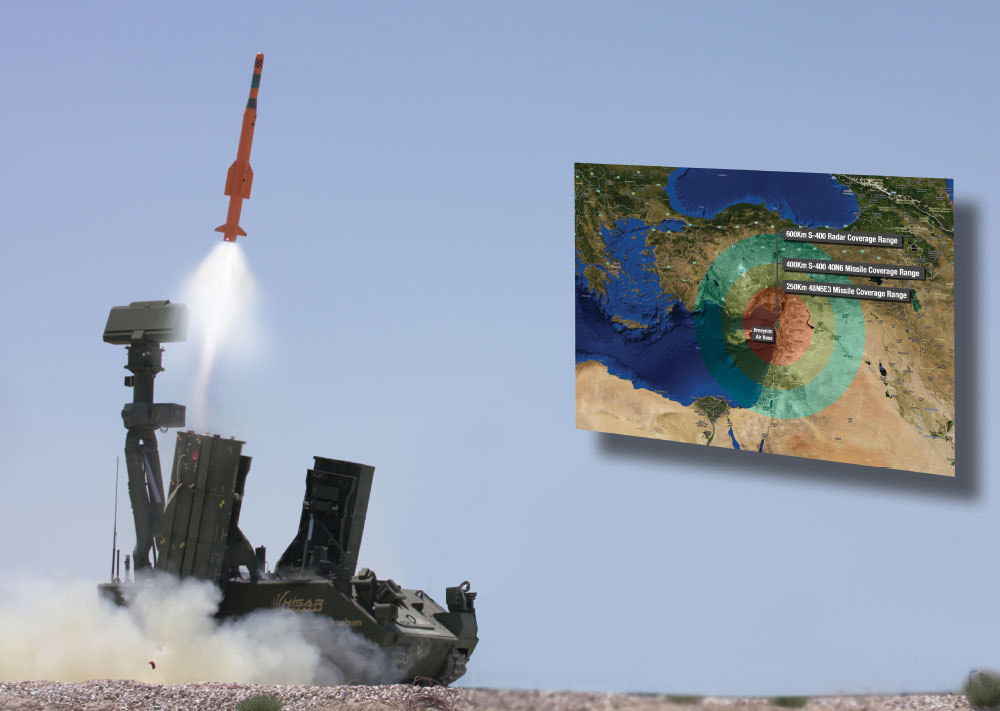
The S-400 is based on the S-300PMU2 air defense missile complex. It differs from its predecessors by its extended combat range and the capability of using new surface-to-air missiles (SAMs) with different ranges to cover its entire performance envelope. Capable of detecting and destroying low-observable (stealth) and fast-moving aerial targets the S-400 Triumph System uses four new missile types in addition to the missiles of the S-300PMU System. The first missile inducted for the System was the 48N6DM. It is an improved variant of the 48N6M with powerful propulsion system. The missile with semi-active radar homing head can destroy airborne targets within the range of 250km. The 40N6 ultra long-range missile with active radar homing head and Mach 7 speed is capable of destroying airborne targets at ranges up to 400km (216nm). With the 40N6 missile the S-400 can hit air targets up to the height of 185km. Russia has completed trials of the 40N6 ultra long-range missile in July 2018. The 48N6E2 missile is the improved version of the 48N6 for the S-300PMU-1, capable of shooting down tactical ballistic missiles at incoming speeds of 4.8km/s or hypersonic targets flying at 3.0km/s at 150km altitude. The S-400 Triumph also launches 9M96E and 9M96E2 medium range ground-to-air missiles. The 9M96E2 (Fakel) is an extended range missile, which is capable of destroying airborne targets at ranges up to 120km (65nm), flying at the altitude of 5m to 30km. It has the highest hit probability against fast, maneuverable targets such as fighter aircraft. Having a weight of 420kg and designed for direct impact, the missile is equipped with an active radar homing head.
The news that the export version of the 40N6 Missile (40N6E) of which the acceptance tests were said to be completed in 2015 would be delivered to China were reflected in the international press in January 2016, yet no statements were made by the Russian Federation in this respect. While whether the 40N6 missile’s delivery to Turkey is still not clear at this stage, due to its superior features its sale out of Russia would not be possible in the near future. Therefore, we assess that at first phase Russia would be supplying the 9M96E series missiles with 40 to 120km of range and missiles of the 48N6E series missiles with ranges varying from 150 to 250km to Turkey.
The Users of the S-400 Triumph System
The delivery of the S-400 Triumph (SA-21 Growler) Air and Missile Defence Systems to the Russian Federation’s Aerospace Defence Forces [the Air Forces and Aerospace Defence Forces under the auspices of the Russian Federation’s Armed Forces were merged on 1 August 2015 and the Aerospace Defence Forces was founded] started on 28 April 2007 and upon the successful completion of the acceptance tests (the System successfully destroyed two different targets moving with 2.8km/sec [Mach 8] speed at 16kms altitude) executed in July 2007, the official activation ceremony of the first Regiment nearby Moscow was held on 6 August 2007.
Russian Armed Forces has been deploying the S-400 Triumph Systems in Regiment status and every S-400 Regiment has two Batteries (named as Battalion) each composed of eight Launch Vehicles and a total of 48 Missiles (of 32 on Launch Vehicles and + 16 for spares). Additionally, the S-400 Regiment contains 55K6 Mobile Command Post, 92N6 Grave Stone Multimode Engagement and Fire Control Radar, 91N6 Big Bird Target Acquisition and Combat Management Radar, 30TS6 Logistical Support Unit, 96L6 Cheese Board Surveillance and Tracking Radar (carried on 8 x 8 MZKT-7930 tactical wheeled vehicles), 40V6M and/or 40V6MD Mobile Radar Towers and Pantsir-S1/S2 Systems. Russian Federation’s Aerospace Defence Forces aims to deploy a total of 28 S-400 Regiments (56 Battalions and 448 Launch Vehicles) each composed of two Battalions by the year 2020. The 98ZH6E Fire Units can be located up to 100km from the 55K6E Command Post. The Launch Vehicles can be located at a distance of 120m from the 92N6 Grave Stone Engagement and Firing Control Radar, the 92N6 and 96L6 radars can be located 500m away from each other and up to 10-15km from the 55K6 Mobile Command Post. It is claimed that every S-400 Regiment is able to engage 36 targets simultaneously within 400km range with 72 missiles.
The manufacturer Almaz-Antey Company endured certain difficulties in the timely delivery of the S-400 Triumph Systems to the Aerospace Defence Forces of the Russian Federation in the past years and in order to overcome these difficulties, the company started to build two great factories in Nijniy Novgorod and Kirov for the production of S-400 and S-500 Systems in 2011 with an investment of 65 Billion Rubles (as of September 2017 figures approximately US$1.13 Billion). The company launched the factory at Nijniy Novgorod in March 2016 into service and the factory started operating in full capacity in 2017. The Kirov Factory focused on the production of the S-500 Systems started preproduction in December 2015. On the other hand, the construction of the Northwest Region Center, which contains three factories and three institutes including the new S-300/S-400 production line was launched in St. Petersburg in May 2014 and the construction activities are expected to be completed in 2017. In this way, Almaz-Antey Company has reached the sufficient production capacity required for fulfilling the demands of both the Russian Armed Forces and the export customers.
The People’s Republic of China became the first customer of the export version of S-400. Actually, China declared its will to purchase the S-400 System in 2011 but the Russian Federation notified the country that they did not favor the export of the S-400 System before 2016 and until the demands of the Russian Armed Forces were fulfilled to a certain extent. However, after the Ukraine crisis in 2014, the relations between the two countries developed and Russia gave a green light to China for the export of the S-400 and the contract on the S-400 Systems was signed by the two countries in September 2014. The contract worth US$3 Billion, said to cover the total of six S-400 Battalions under two Regiments was announced to the world in April 2015 and the contract was officially launched upon China’s accomplishment of the down payment in March 2016. According to the information from open sources, the delivery of the S-400 Systems can be started within 12 to 18 months upon the accomplishment of the down payment. Russia started shipment of elements of Chinese first S-400 Regiment in January 2018 and the deliveries were completed in May 2018. In July 2018 China officially accepted the delivery of first S-400 Triumph Regiment from Russia and signed an acceptance certificate. The systems passed over to China’s ownership once the document was signed. China is preparing to carry out its first test of the Russian built S-400 air defense system, according to Russian media outlets. News of the test was reported on July 27, 2018 by TASS, a Russian media outlet. The first S-400 Triumph Regiment of China is expected to declare Full Operational Capability during the second half of 2018. The delivery of the second Chinese S-400 Regiment is expected to take place during May - June 2019.
India was the second applicant of the S-400 Triumph System. The contract between the governments on the procurement of the S-400 Triumph Systems was signed in October 2016 between Russian President PUTIN and Prime Minister of India Narendra MODI. According to the information in the press, India will be purchasing a total of five S-400 Regiments composed of 15 Batteries. The total cost of the Project is expected to reach US$6.1 Billion (400 Billion Rupees). Yet, as India failed to accomplish the down payment required for the launch of the contract due to budgetary difficulties, Turkey became the second client of the S-400 Triumph System following China. India is expected to make the down payment in 2018 and the delivery of the systems is expected to start in 2020.
How Effective and Lethal is the S-400?
Despite the fact that it is the recognized as one of the most sophisticated SAM Systems in use in technical terms, the S-400 Triumph System has not proven itself in a combat yet. The S-400 Batteries deployed at the Hmeymim Air Base and near Masyaf (second S-400 Battery was deployed at a Syrian air defence complex in mountainous terrain 13km northwest of Masyaf during the second quarter of 2017 and is made up of four Transporter Erector Launchers (TELs), a 92N6 Grave Stone Multimode Engagement and Fire Control Radar and a 96L6 Cheese Board Surveillance and Tracking Radar) in Syria and the S-300 Battery deployed at the Tartus Port have not posed an obstacle regarding the air attacks conducted by the U.S. and Israel against this country since November 2015, due to various reasons.
For instance, an Su-22 aircraft of the Syrian Air Force conducting air assault to the SDF/YPG forces supported by the USA was downed by an F/A-18E Super Hornet aircraft which took off from the USS George H.W. Bush Aircraft Carrier at the Tabka (Al-Thawrah) district in June 2017. Moreover, the U.S. Armed Forces attacked the Sayrat Air Base at the Humus district of Syria’s Humus city on 7 April 2017 (at 03:45 in Turkish Local Time) with 59 Tomahawk Cruise Missiles (23 missiles are claimed to have hit the Air Base) and destroyed 20% of the Syrian Air Force’s air- mobile fleet. Reportedly, at the Base with two 3km long different runways, MiG-23, Su-24 and Su-22 fighter aircraft are deployed at 40 hangars. Both Tabka (40N6) and Humus (48N6E3) were within the engagement range of the S-400 Battery deployed at the Hmeymim Air Base but the Russian Federation was not involved with any of the attacks. As a matter of fact, the Tomahawk Cruise Missiles launched towards the Sayrat Air Base from the Arleigh Burke Class destroyers (USS Porter ve USS Ross) cruising in the Mediterranean passed very close to the S-400 Battery deployed at the Hmeymim Air Base (part of it from its right side and other part from its left side) and reached their targets. Technically, it is not quite possible for the radars associated with the S-400 Battery and the Pantsir-S1/S2, BUK-M2 and Krasuhka-2 RF Jammer systems deployed at the Base to protect it to be able to detect Tomahawk firings in advance. This case strengthens the allegation claiming that the S-400 and S-300 Systems were deployed in this country by Russia directly for mainly protecting its interests in the country and therefore that it was ignoring the air attacks that would not harm its own interests and military staff in Syria in order to prevent the risk of a severe conflict with the U.S. and Israel, within the framework of the agreements between the two countries.
TurAF’s Air Surveillance Capability and Air Radar Site Commands
Within the scope of the system integration, the real time air picture of Turkey’s Air Space is being formed through the transmission of the radar traces obtained from over 30 ground based radar sensors in fixed and mobile configurations under the service of the Air Radar Site Commands procured through the utilization of the national funds and NATO funds and the four E-7T Airborne Early Warning and Control (AEW&C/HIK) aircraft operating as part of the HIK Group Command to the Control Reporting Center (CRC/KIM) and Control Reporting Post (CRP/KIP) performing local real time tactical air picture generation and control tasks in seven different regions across the country via the Tactical Data Link (such as Link 11B and Link 16) Systems within the scope of the network based operation concept.
Through the real time air picture obtained by processing the data captured via the ground-based radars and E-7T HIK aircraft, the civilian and military air platforms cruising in the Turkish Air Space and across Turkish borders are tracked with all their detailed information. This information is composed of the geographic location of an aircraft, its altitude, speed, direction, task type in addition to the information on whether it is military or civilian type, its country of origin and the landing and take-off airports. The air picture formed by the CRC/KIM and CRP/KIP is transformed into an identified air picture with the diagnosis of the Combined Air Operation Centers [CAOC/BHHM] located at Eskişehir and Diyarbakır. This real time tactical air picture in question is evaluated and valued at the Air Operation Center that is the combat and command & control center of the Combatant Air Forces Command under the auspices of the Turkish Air Forces Command and is presented to the situational awareness of the decision-making command committee. In this way, the air operation could be monitored real time via the CAOC and the inputs could be logged instantly when required. The air activity and operation are being executed via this system 24/7 in the same degree of efficiency by trained staff from the beginning of peacetime. In addition to the Turkish Mobile Radar Complexes (TMRC) procured nationally for air surveillance in the inventory of the TurAF and delivered during 1994 – 2000, there are five different types of early warning radars operated by the Air Radar Site Commands and procured in various periods as part of the NATO Security Investment Program – NSIP.
Part II: Ongoing Air & Missile Defence System Programs
HISAR-U and GUMS Projects
The Enhanced Long-Range Area Air and Missile Defence System (GUMS/UMBFSS) Project was launched in 2016 by the SSB to meet the Turkish Air Force (TurAF)’s long-range air and missile defence requirements via locally designed and manufactured, indigenous solutions. Aselsan has been tasked as Prime Contractor to cooperate with Roketsan and TUBITAK-SAGE as main local subcontractors.
In order to provide an update on the current status of Enhanced Long-Range Area Air and Missile Defence System (GUMS/UMBHFSS) Project, the SSB published a press release on June 3, 2018. At the press release the SSB disclosed that as part of on-going efforts/studies under the Project, with the participation of high-ranking officials from partnering companies a meeting was held on May 30, 2018 in Ankara.
Under the GUMS/UMBHFSS Project, EuroSam has been selected as the technical support provider and on January 5, 2018 Aselsan and Roketsan signed an agreement with EuroSam to jointly conduct an 18-month definition Concept Definition Study for the ‘preparation of the development and production contract’. This contract award followed a ‘Heads of Agreement’ and a Letter-of-Intent signed by Turkish, French and Italian MoNDs in July and November 2017, respectively.
The Concept Definition Study is expected to be delivered to the SSB at the end of 2019. According to the press release, conceptual studies are being carried out on an air and missile defence system that is more advanced than SAMP/T of EuroSam. According to Aselsan officials, GUMS/UMBHFSS will be equipped with a Ka-Band RF seeker and would be able to intercept incoming ballistic missiles at 30km and over altitudes with hit-to-kill concept/capability.
Within the scope of the contributions for the protection of Turkey against NATO’s potential missile threats, since June 2016 two Sol-Air Moyenne Portée/Terrestre (SAMP/T) Firing Units, a ground-based, road-mobile air and Tactical Ballistic Missile defence systems, developed by EuroSam Company have been deployed in the region (Kahramanmaras) by the Italian Land Forces. On February 8, 2018 President ERDOĞAN told reporters that Italy has agreed to extend its air defence system in the southern Turkish province of Kahramanmaras against possible attacks from Syria until September 2018. And on July 12, 2018 the Italian Government decided to extend its SAMP/T Firing Units deployment period until July 2019.
According to the sources, before the procurement of the S-400 Triumph Area Air and Missile Defence System came up on the agenda, Turkey considered leasing (under a wet-leasing approach) the two SAMP/T Firing Units deployed in Kahramanmaras (in order to meet staff training and urgent long range air and missile defence system requirements) and then to increase the number of SAMP/T Batteries to 8 with the procurement of new production SAMP/T Systems under a contract to be signed with EuroSam. But, according to sources, when the procurement of the S-400 Triumph System appeared on the agenda this option was laid aside.
The Aster 30 Block 1 missile with the inertial mid-course guidance system manufactured by Sagem (capable of receiving the updates of the target data over data-link) and active radar guidance system for the terminal phase (MBDA production AD4A Ku-Band [12-18GHz] RF seeker head), depending on the type of the target (ABT or TBM), executes destruction through Hit-to-Kill such as PAC-3 or through explosion or demolition by bursting into pieces nearby the target. The Aster 30 Block 1 missile could be utilized against the ballistic missiles with the range of 600km+, and the Block 1NT missile of which the development program commenced in 2016 is aimed to have an interception capability against the ballistic missiles with ranges up to 1,500kms. The initial delivery of the Block 1NT missile is expected to be conducted in 2023. The Aster 30 Block 1 missile (able to reach a speed of 5,200km/h within 3.5sec) is capable of conducting interception at altitudes of minimum 3,000m and maximum 22km, whereas the Block 1NT missile, which will feature the Ka-Band (26.5-40GHz) RF seeker head will be able to execute interception at altitudes up to 30km. Aster 30 Block 1NT System will reportedly feature comparable capabilities with the PAC-3/PAC-3 MSE. Additionally, the interception altitude of the Aster 30 Block 2 missile which is expected to intercept ballistic missiles with ranges up to 3,000km is aimed to be increased up to 70km.
During May and June, 2018 the then Turkish Minister of National Defence (MoND) Nurettin CANIKLI and President of Defence Industries (SSB) Ismail DEMIR provided details on the HISAR-U National Long Range Air Defence System Project. Speaking at a televised interview on June 12, 2018 the then Turkish MoND CANIKLI disclosed that the HISAR-U National Long Range Air Defence System would not be effective against ballistic missile targets and can only be used against air breathing targets including fighter jets, UAVs and cruise missiles. He also disclosed that HISAR-U would have an effective range of 70-90km. In a TV interview with CNN Turk held on May 13, 2018 the President of the SSB DEMIR disclosed that the HISAR-U National Long Range Air Defence System would be ready for serial production during 2022-2023.
The HISAR-U National Long Range Air Defence System Project contract was signed between the SSB and Aselsan, Roketsan and TUBITAK-SAGE Business Partnership on January 15, 2018. On January 16, 2018 Aselsan announced that its share under the HISAR-U Program was TL869 Million and Euro279,257 Million and that the company would complete deliveries in 2021.
According to Aselsan, the HISAR-U National Long Range Air Defence System prototype will consist of a single HISAR-U Squadron with a single battery and to include; Squadron Control Center, Long Range Search Radar (based on TEIRS), Fire Control Center, Fire Control Radar (based on CAFRAD), Missile Launchers, HISAR-U Missiles, Communication Systems, Missile Transport & Loading Systems, Support Vehicles and Training Equipment. According to a HISAR-U System Architecture visual published in Aselsan Magazine - Issue 98, June 2018, each HISAR-U Squadron will have a Long-Range Search Radar, Squadron Control Center and will consist of two batteries. Each battery will have one Fire Control Center, Fire Control Radar and four Missile Launchers.
Meanwhile, on June 6, 2018 the SSB issued an info graphic on Air Defence Systems of the Turkish Defence Industry, which provides lots of details about previously completed and on-going short, medium and long-range air and missile defence system projects.
In addition to GUMS/UMBHFSS and HISAR-U Projects, under a layered air and missile defence capability approach, Turkey is also carrying out a number of very short, short, medium and long-range air defence system projects including; S-400 Triumph, HISAR-A, HISAR-O, HISAR-O+, HISAR-G+, HISAR-G, HISAR Nokta (Point), HISAR Air Base/Seaport, National MANPADS, KORKUT and KORKUT-D.
KORKUT SPAAG and FNSS ACV-30
The KORKUT Self Propelled Anti-Aircraft Gun (SPAAG) System project covers the procurement of 42 Weapon System Vehicles (SSA, will replace existing aged M-42A1/A2 Duster Walker systems) and 14 Command and Control Vehicles (KKA) all based on the FNSS ACV-30 Armored Combat Vehicle (ACV) chassis. On June 25, 2011, Aselsan the Main Contractor of the KORKUT SPAAG System Program, awarded a Tracked Carrier Vehicle Development Contract to FNSS for the design, development and production of one Command and Control Vehicle chassis and two Weapon System Vehicle chassis prototypes to be based on ACV-30 in two years.
After an extensive mobility and firing test campaign that was launched in 2015 and carried out with the participation of the SSB and Turkish Land Forces (TLF) representatives, acceptance of these vehicles was carried out on August 24, 2016 and KORKUT SPAAG prototypes (2x Weapon System Vehicles and 1 Command & Control Vehicle) entered the service of the TLF. The systems made a strong impression during the ‘Fire at Will 2017’ Operation on October 20, 2017 by achieving direct hits to target drones.
Following the successful completion of the prototype development and qualification phase, the KORKUT SPAAG Series Production Phase, covering the production and delivery of 40 SSAs (Weapon Systems Vehicles) and 13 KKAs (Command and Control Vehicles) was launched with a Euro467,767 Million contract signed between the SSB and Aselsan in May 2016. Aselsan then signed a Euro84 Million contract with FNSS to procure a total of 53 ACV-30 tracked vehicles. According to the contract schedule FNSS will deliver the first batch of ACV-30 chassis in May 2018 to Aselsan, who will then convert them into KKA and SSA configurations. Meanwhile MKEK, responsible for 35mm GDF-003 twin guns, has completed the manufacture of the first batch of 6 guns to be installed on 3 KORKUT SSAs and carried out acceptance tests at the test range on April 26, 2018. According to the SSB Strategic Plan Document 2017-2021, under the Serial Production Phase, 4 KORKUT SPAAGs will be delivered in 2019, 3 in 2020 and 3 in 2021 to the TLF. Aselsan Deputy General Manager, Mustafa KAVAL, disclosed that Aselsan would start deliveries under the contract in late 2018.
Series Production and the delivery of 40 KORKUT SSAs and 13 KORKUT KKAs to the TLF will be completed by 2022. Each KORKUT SPAAG Team will consist of 1 KKA and 3 SSAs so that with 42 SSAs and 14 KKAs the Turkish Army will be able to establish 14 KORKUT SPAAG Teams.
The KORKUT SSA vehicle is equipped with an unmanned turret, which is armed with two 35mm Oerlikon GDF-003 automatic cannons produced in Turkey by MKEK. The vehicle has the capacity of carrying 400 35mm ammunitions in total, 200 of them (100 for each barrel) within a remotely operated unmanned turret, equipped with automatic ammunition loading system, and 200 of them within the chassis. The system is also equipped with the capability of firing 35mm ATOM air burst ammunition, similar to AHEAD, which is designed and developed by Aselsan in cooperation with TUBITAK-SAGE and produced by MKEK.
The crew includes a gunner, commander and driver who are seated in the chassis of the vehicle. The 35mm guns have a rate of fire of 1,100 rounds per minute. There is also a Ku-Band, 3D Fire Control Radar with 30km instrumented range and mounted on the rear top of the turret along with a thermal imager and a day TV camera at the right side. The KKA uses the same chassis, ACV-30, but is equipped with a turret including X-Band, 3D Mobile Search Radar (MAR), that provides fast and accurate detection and tracking of low altitude airborne targets up to the maximum range of 70km.
ACV-30 platform chassis is provided with a unique, space laminated armor system combining steel and aluminum technology for protection against the firing of small arms and mine blast. Powered by a 600hp diesel engine, coupled with fully automatic transmission, the 7.07m long, 3.62m overall height and 3.9m wide ACV-30 can reach 65km/h on the road and can swim at 6km/h with 2 water jets. Having a combat weight of 29.5 tons the ACV-30 has a cruising range of 500km.
KORKUT-D Close-In Weapon System
In order to meet the Close-In Weapon System (YHSS/CIWS) requirement of the Turkish Naval Forces Command (TNFC) through national facilities, installation of the 35mm KORKUT-D YHSS (KORKUT-D CIWS-35) to TCG Sokullu Mehmet Paşa (A-577) training ship and execution of the firing tests at Karadeniz Ereğli was planned. The new production of KORKUT-D CIWS was displayed behind the stand for the first time at the signing ceremony for the 35mm Air Defence System Modernization and Particulate Ammunition Procurement Contract, held at the facilities of Aselsan on January 15, 2018.
The integration activities of the 35mm KORKUT-D CIWS to the TCG Sokullu Mehmet Paşa (A-577) training ship at the Golcuk Naval Shipyard were completed at the beginning of March 2018 and the KORKUT-D (replaced the 100mm artillery at the back) was integrated to the ship and the initial navigation test was accomplished on March 5, 2018. The target tracking and firing tests of the KORKUT-D CIWS were executed at the beginning of May through the utilization of Banshee Jet 80 Twin-Jet target drones.
At the live firing test which were executed on May 4, 2018, the Banshee Jet 80 High Speed Target Drone, acting as an sea-skimming anti-ship missile and conducting flights in several patterns (including parallel and cross flights), was hit successfully despite the unfavorable weather conditions. TCG Sokullu Mehmet Paşa returned to the Naval Academy at Tuzla on May 6, upon the completion of the tests. The additional firing tests are expected to take place in the coming days, in light of the data acquired through the initial firing test.
KORKUT-Fire Control System [FCS/AIC] and FCS Air Defence Platoon
Within the scope of the KORKUT-FCS Project for which Aselsan was selected as the Main Contractor, 57 Aselsan KORKUT-FCSs will be procured to replace the aging D-IX Super Fledermaus FCSs that fulfils the target acquisition and tracking requirements of the 35mm GDF-001/003 Oerlikon modernized towed air defence guns in the inventory of TLF. The KORKUT-FCS is designed for effective low altitude air defence of military bases and critical assets against modern threats of today’s battlefield. In addition to the equipment to execute the command control and fire control functions, three dimensional (3D) active phased array and electronically scanned Mobile Search Radar (MAR), fire control radar, EO sensors and communication units exist on the FCS. The design, production and integration activities of the KORKUT-FCS Platform Prototype weighing nearly 10 tons have been carried out by Nurol Makina ve Sanayi (NMS) Company under an agreement signed with Aselsan. It was announced that a separate contract would be signed for the production of an additional 56 KORKUT-FCSs if the prototype phase turned out successful.
The KORKUT-FCS will also assume the fire and command & control functions of the Towed Low Altitude Air Defence Missile Launching System (TLAADMIS, HISAR-A), which is being developed by Aselsan within the scope of the HISAR Program. Every KORKUT-FCS System will be able to simultaneously perform the Fire Control and Command & Control functions of up to three 35mm Oerlikon modernized towed air defence guns and a Low Altitude Air Defence Missile Launching System.
The live firing tests that compose the final stage of the FCS development activities and executed in the context of System Integration and Test Phase were conducted at the Firing Test and Evaluation Center (ATDM) Group Command of the MoND in the Karapınar province of Konya in September 2015 and on 1 December 2015. During the live firing tests, the 35mm Oerlikon modernized towed air defence gun systems with 35mm ATOM airburst ammunitions and integrated with FCS successfully hit the TURNA Target Drones manufactured by Turkish Aerospace (TA) Company and DT-45 type High Speed Target Drones produced by the Airbus Defence & Space (ADS) Company.
Typical KORKUT-FCS Air Defense Platoon is composed of one KORKUT FCS, two towed air defense guns and one Low Altitude Air Defense Missile Launching System. Similar to the KORKUT SPAAG, the KORKUT-FCS Air Defence Platoon is capable of accomplishing all functions required for target acquisition, friend/foe interrogation, target tracking and neutralization merely through utilizing its own subsystems. The FCS Air Defence Platoon will be able to form a layered air defence structure with the air defence guns and a Low Altitude Air Defence Missile Launching System integrated to it. The KORKUT-FCS Air Defense Platoon can execute Coordinated Operation with Higher Echelon C2 Units via HERIKKS. The acceptance of the prototype system was accomplished, and it entered the service of the TLF in 2016. The contract for the mass production of the additional 56 KORKUT-FCSs was signed between Aselsan and the SSB on December 29, 2017.
35mm Oerlikon Air Defence Artillery Modernization
The electronic sub-systems on the 35mm GDF-001/003 Oerlikon Towed Air Defence Guns in the Turkish Land (118 units) and Air Force (42 units) inventories are being replaced with the new systems that align with the current technology and required mechanical improvements; these activities are being accomplished. Indigenously designed and produced 35mm Air Burst Ammunition (Particulate Ammunition [ParM/ATOM]) firing capability is being added to the modernized guns. The 35mm Air Burst Ammunition is a smart ammunition equipped with a programmable fuse. Modernization program upgrades the 35mm towed guns in the inventory to be effective against modern threats such as air to ground missiles, cruise missiles and UAVs with the use of ATOM 35mm Air Burst Ammunition. Together with the ability of precise time counting and the ca¬pability of being programmed during firing by taking muzzle velocity into consideration; ATOM 35mm Air Burst Ammunition provides high hit probability against various types of air and land targets. Containing a lethal payload of spin-stabilized tungsten cylinders (there are around 160 sub-projectiles inside the ammunition weighing 1.750gr and having a length of 387mm) the ATOM 35mm Air Burst Ammunition (35mm x 228mm, 90 caliber) significantly enhances the combat effectiveness of 35mm GDF-001/003 Oerlikon Towed Air Defence Guns.
The Design and Development Phase (Phase-I) Contract as part of the 35mm Oerlikon Modernization and Particulate Ammunition Procurement (OMPMT) Project was signed on March 11, 2010 between the SSB and Main Contractor Aselsan. The contract amount was announced as TL71.354.693 (subject to escalation) and €10.586.000. Within the context of the 35mm Particulate Ammunition Project with a project schedule of 61 months, Aselsan cooperates with MKEK and TUBITAK-SAGE .
The production line, which is a contractual liability as part of the OMPMT Project, was installed, the production line qualification activities were completed with the tests were accomplished with the participation of representatives from the SSB, Land Forces Command and Air Forces Command and systems were availed for mass production. Due to immediate requirements, a certain amount of 35mm ammunition effective against rockets (C-RAM configuration) and modernized 35mm Oerlikon Towed Air Defence Guns were deployed in Kilis within the last quarter of 2016 in addition to the KORKUT-FCS to provide protection against potential missile attacks.
The Short Range and Low Altitude Air Defence System Contract signed between Aselsan and the SSB on December 29, 2017 covers the Mass Production of the 35mm Air Defence System Modernization, KORKUT-FCSs and ATOM 35mm Air Burst Ammunition. The activities under the contract were launched with the signing ceremony held at the Aselsan premises on January 15, 2018. The systems to be manufactured within the scope of the Contract worth €122.422.715 and TL1.011.395.262 will be delivered to the Land Forces Command and the Air Forces Command.
Within the framework of the 35mm Air Defence System Modernization and ATOM 35mm Air Burst Ammunition Procurement Project, the mass production of the 35mm Towed Air Defence System which was developed by Aselsan and the initial prototypes of which were delivered to the Land Forces Command in 2016 as well as the ATOM 35mm Air Burst Ammunition will be executed. Additionally, Battery Command Control Center for the Turkish Land Forces Command (TLFC) and a Battery Command Control Center (BCCC) for the Air Forces Command (TurAFC) will be delivered as high-level command control components of the aforesaid systems and their mass production will be accomplished as well.
The twin barreled GDF-001/GDF-003 Oerlikon Towed Anti - Aircraft Guns which is an effective Low Altitude Air Defence Weapon with high fire power featuring radar control, electrical and mechanical deployment and displacement capacity, capable of operating with remote and close command, which has high rate of precision and automatic self-loading capabilities is capable of firing targets electronically and mechanically.
As part of the Tirano Projects for the Turkish Armed Forces (TAF), nearly 100 GDF-001 Systems were procured with the D-IX Radars in the years 1970 - 1985. The production of 20 GDF-003 was accomplished at the MKEK- ÇanSAŞ facilities built as a result of a great investment under license and were delivered to the TAF in 1993.
The Oerlikon twin-guns which are powered by a generator apart from the weapon are being used by a crew of 6 people. In every Oerlikon set, there is normally one D-IX Fire Control Radar/FCS, two GDF-001/003 twin-guns and three power supply units. The main differences between the GDF-001 and the GDF-003 systems are observed in the fuel supply systems, lubricating systems, power sources and improved targeting/sight systems. The XABA Optical Sight System is being used in the GDF-001 system where the GDF-003 system utilizes the Ferranti Sight System.
HISAR-A and HISAR-O Air Defence Missile Systems
The Design and Development Period Contracts for the TL278.371.000 + €193.000.000 worth Low Altitude Air Defence Missile System (LALADMIS/HISAR-A) and the TL250.720.000 + €132.113.000 Medium Altitude Air Defence Missile System (MALADMIS/HISAR-O) which would enable the national development of the Low and Medium Altitude Air Defence Missile Systems were signed on June 20, 2011 between the SSB and Aselsan - assigned as the Main Contractor.
Aselsan is the Prime Contractor responsible for the development of radar, command-and-control and fire-control systems and Roketsan is the Main Subcontractor, responsible for the development of HISAR-A (Low Altitude) and HISAR-O (Medium Altitude) Air Defence Missiles. The passive Imaging Infrared (IIR) seekers and data links (encrypted RF Data Link) that will be used in the missiles are also being developed by Aselsan. The Missile Transport and Loading System and the Training Center will be developed by Aselsan as well, as the support equipment for HISAR-A Systems (Towed and Autonomous).
The Requirement Identification (Stage-1) and System Design (Stage-2) stages were completed successfully in both projects, and the activities (Radar, Command Control, Fire Control, Missile Launcher and sub system tests of the Missile units) regarding the Sub-System Development and Test Stage (Stage-3) continue. The completion dates for the projects were identified as October 2020 for the HISAR-A Project and May 2021 for the HISAR-O Project. According to the Ministry of National Defence’s Activity Report for the year 2015, the initial HISAR-A System was planned to be included in the inventory in October 2020 and the first HISAR-O System was planned to be included in the inventory in May 2021. The completion of the projects was planned to take place respectively in 2025 (HISAR-A) and in 2024.
An Air Defence System in a distributed architecture is being developed as part of the HISAR-O Project. Battalion Fire Control Center, Battery Fire Control Center, Medium Altitude Air Defence System Radar, Early Warning Centers Link-16 Interface, Electro-Optical System, Missile Launch System (MLS) and Missile Transport and Loading System will be developed and produced within the scope of the Project and the product/production line qualification will be accomplished.
The HISAR-A is designed to neutralize the air threats (helicopters, warplanes, UAVs, cruise missiles) in low altitude and at short range, featuring an IIR seeker will have two different configurations: Towed and Autonomous. Every Autonomous HISAR-A will be able to operate on its own autonomously or will be capable to execute a connection directly with the HERIKKS. The Towed HISAR-A is an MLS composed of the launcher hardware featuring the missiles and a launcher carrier platform. The Fire Control and Command Control functions of the System will be provided by the KORKUT-FCS System developed as part of a separate contract signed between Aselsan and the SSB.
The first ballistic tests as part of the HISAR-A Project were conducted at the Tuz Lake Test Center founded at the southern part of the Tuz Lake in Aksaray with two test missiles (Ballistic Test Missile/BTF) on October 6, 2013, following the establishment of the required infrastructure and adoption of the measures regarding flight safety. HISAR-A BTF did not feature an IIR seeker and TVC. The Ballistic Test Missile (BTF-1) firing, which were the initial flight tests of the HISAR-O Project, were executed at the same test center on July 23, 2014.
The test fires of HISAR-A’s Controlled Test Missile -1 (KTF-1) with autopilot control and Ballistic Test Missile - 2 (BTF-2) with dual pulsed engine (which is a first in Turkey) were successfully accomplished by Roketsan on June 19-24, 2015 in Aksaray with the participation of the representatives from KKK, the SSB and Aselsan. During the tests, HISAR-A Missiles successfully left the launching platform with the first pulse engine and after firing the second pulse engine in the air, in control of the missile autopilot in its body, accomplished the programmed maneuvers and completed their flights. The National Air Defence Missiles HISAR-A and HISAR-O that will feature dual pulse engine technology are aimed to take part in the list of Air Defence Systems with the most superior technology in the World in 2021 – the year their mass production will be launched. As part of the HISAR-A and HISAR-O Projects, execution of the additional Controlled Test Missiles (KTF) is planned for the upcoming period. According to the information we acquired, during November 23 – December 5, 2016 4 HISAR-A KTF and 3 HISAR-A Guided Test Missile (GTF, vertically launched) firings performed (in July 2017), the additional GTF and Active Guided Test Missile (AGTF) firing tests are expected to take place in 2018. According to sources, in December 2016 and July 2017 3 HISAR-O KTF and an undisclosed number of HISAR-O GTF firings were performed. The first round of firing tests planned for 2018 were carried out during January 22 – February 4, 2018 and the second round of live firing tests are scheduled to take place during July 23 – August 17, 2018 at firing ranges in Aksaray and Şereflikochisar, Ankara.
Under the HISAR Low and Medium Altitude Air Defence Missile Systems Program, the first live firing tests planned for 2018 were carried out during January 22 – February 4, 2018 at a firing range at Aksaray province. The Turkish MoND announced that Roketsan and Aselsan had successfully test-fired the jointly-developed HISAR-A short-range surface-to-air missile (SAM) system on February 1, 2018. In a statement, the then MoND Nurettin CANIKLI said, “The HISAR Project, which was developed using national facilities, provided 100% success in the tests.”
Within the scope of the Low and Medium Altitude Air Defence of the mobile units and critical facilities, HISAR-A and HISAR-O Systems will fulfil the task of neutralizing fixed/rotary wing aircraft, cruise missiles, UAVs and air to ground missiles. The Self – Propelled (S/P) Autonomous HISAR-A, which is based on the ACV-30 track armored vehicle chassis with six carrying wheels and a combat weight of 31 tons, will feature capabilities such as multiple engagement and sequential firing, three-dimensional search radar, four missiles ready to fire and vertical missile launching. The S/P Autonomous HISAR-A will be capable of conducting its tasks in three set teams in addition to its capacity of autonomous execution of tasks (target acquisition, recognition, tracking and missile firing). Another launcher system configuration, the MLS (referred as the towed system at the same time) also developed by Aselsan, will own capacities such as remote control over the Zetros 6x6 Mercedes Tactical Wheeled Vehicle, automatic levelling, maneuver capability at tactical site, six missiles ready to be fired and vertical missile launch. The Fire Control and Command Control functions of the System will be provided by the FCS, which is being developed in line with a separate contract signed by Aselsan and the SSB.
Within the scope of the HISAR-O Project, in which the domestic development of a Medium Altitude Air Defence Missile System that will be capable of neutralizing the air threats in medium altitude and medium range and with vertical launch characteristics, the qualification of the production line is planned to be launched in December 2018. The HISAR-O System will feature operational characteristics such as distributed architecture design, flexible arrangement, acquisition/ tracking and an IFF System with a 3D search radar, multiple engagement and sequential firing capabilities, maneuver capability in tactical site, rapid deployment, command control capacity in HERIKKS coordination, communication capability via Link-1, Link-11B and Link-16, communication capacity via wireless, wired and radio link communication infrastructures.
Radio antenna and RF Data Link Antenna required for encrypted communication with the missile in addition to six canisters for HISAR-O Missiles were placed over the prototype MLS formed over the Mercedes Benz Zetros 6x6 TTA. The deflector behind the MLS, which is said to feature a two – person crew and sequential firing capability, is being used for removing the ‘plume’ effect emerging after the firing of HISAR-A or HISAR-O Missiles. The canisters emptied after the missiles are fired are being replaced with the spare and full canisters by the Missile Loading and Transport System with a lifting crane over it. Since every canister is loaded (removal of the empty canister and loading of the full canister to the launcher) to the MLS individually, the refill process takes time.
When loaded with the HISAR-A Missiles, the MLS is connected to the FCS – produced by Aselsan- with the two modernized 35mm Oerlikon Air Defence Guns for the Low Altitude Air Defence. In the role of Medium Altitude Air Defence, the MLS is connected to the Battery Fire Control Centre (FCC). According to the information we acquired, this configuration will utilize three MLSs, KALKAN Air Defence Radar (ADR) – (KALKAN ADR for target recognition and the tracking radar will be used in HISAR-O configuration and Aselsan has been working on a new version of the radar named ‘KALKAN-G’), Erimay Link-16 Vehicle for maintaining correspondence with the HvKK and the Electro – Optical System (EOS) formed over the Land Rover Defender TTA used for the kill assessment on target hit/not hit identification.
Different than the other missile systems, the targets of the Air Defence System are composed of quite speedy systems with high maneuver capability. On account of this characteristic, the Air Defence Missiles have to feature quite different and superior technologies. The HISAR Missiles being developed will own high technology components such as intermediate guidance and dual-pulse thrust system via Infrared Imaging (IIR) Seeker, Thrust Vector Control and RF Data Link for fulfilling the Air Defence requirements of the future.
Roketsan assumed the responsibility of missile development which is one of the most critical components of HISAR-A and HISAR-O Systems. To this end, two different missiles in which many sub-systems that are compatible with the present low and medium altitude range requirements and are being jointly used in an integrated manner are being developed by Roketsan. The HISAR-O Missile having similar sub-systems (i.e. cooled type IIR seeker, TVC and RF Data Link) with HISAR-A, has a longer fuselage compared with the HISAR-A (due to solid fuel addition for increasing the range) and a different nose design (in order to increase the flight range in the missile’s nose part and there is a protective lid/aerodynamic cover separated from the missile during the terminal stage for protecting the IIR seeker from aerodynamic heating effects during a part of the flight period). TUBITAK-SAGE assumed the responsibility for developing the Missile Warhead and Thermophile as part of the HISAR Projects. The Imaging Infrared (IIR) Seekers and the Data Link to be used in the missiles are being developed by Aselsan and also Meteksan Defence Company is assigned regarding the Data Link issue. The missiles will feature the launcher for target data updates during flights (for obtaining the data on the updated location, speed and distance) and RF Data Link capability. Due to the TCV feature existing in the tail, the missiles will have a high maneuver capability.
With a length of 4m and weight of 230kg, the HISAR-A would be able to engage air-breathing targets up to an altitude of 10km and a 16km+ range, whereas HISAR-O with a length of 4.5m and weight of 300kg can be used up to an altitude of 18km and a 25km+ range. Featuring a solid propellant dual-pulse rocket motor and TVC capability HISAR-A and HISAR-O missiles are equipped with an IIR seeker and a two-way encrypted RF data link.
In 2017 Aselsan secured a contract to develop Ku-Band active RF seeker for the HISAR-O missile. The RF seeker is scheduled to be ready for live firing tests on the HISAR-O missile in 2019. So, the HISAR-O missile would be available in two major versions HISAR-O IIR and HISAR-O RF.
According to infographic on Air Defence Systems of the Turkish Defence Industry, that was issued by the SSB on June 6, 2018 TUBITAK-SAGE’s short-range (with IIR seeker) GOKDOGAN (Peregrine) and medium-range (with RF seeker) BOZDOGAN (Merlin) Air-to-Air Missiles (AAMs) are also planned to be deployed at HISAR-A/O launchers.
Delivering a speech at the briefing given to the members of the National Defence Committee on January 7, 2016, the then former Deputy President of the SSB Köksal LIMAN extended the following information on the HISAR Projects: “HISAR-A is a project developed for eliminating the low altitude targets up to 10km. The BTF and KTF firings were successfully accomplished as of June 24, 2015. The Sub System Design and Development Stage at low altitude and a range up to 40km is currently continuing.”
GOKDOGAN & BOZDOGAN AAMs Ballistic Flight Tests Performed
Ballistic Flight Tests of indigenously developed GOKDOGAN (Peregrin) and BOZDOGAN (Merlin) Air-to-Air Missiles (AAMs), from land-based launchers, were successfully carried out at the Sinop missile test range during March 24-25, 2018. The Ballistic Test Missile (BTF, without seeker and with self-destruction capability in case of emergency) versions of the short- and medium-range GOKDOGAN and the long-range BOZDOGAN fired at their targets in the Black Sea.
TUBITAK-SAGE also plans to fire missiles at moving targets from stationary launchers and conduct a series of tests of air-launched missiles later this year.
Both missiles have been undergoing development since 2012, under the GOKTUG Project led by TUBITAK-SAGE (Defence Industry Research and Development Institute). Equipped with a high-resolution dual-colour Imaging InfraRed (IIR) seeker designed and developed by TUBITAK-SAGE, with a comprehensive off-boresight capability, along with advanced counter-measures GOKDOGAN (Peregrine) is a Within Visual Range (WVR) AAM has a range of 25km. Equipped with Aselsan’s solid-state, single source Ku-Bant active RF seeker with a mechanical gimbal BOZDOGAN (Merlin) Beyond Visual Range AAM, with advanced counter-measure capability and data link update has a range of 65km. GOKDOGAN (Peregrin) is equipped with TVC capability for superior maneuverability and off boresight launch capability. Both missiles are powered by smokeless solid propellant rocket motors and will have a High Explosive (HE) warhead with blast/fragmentation effect and a laser proximity fuse.
The GOKDOGAN and BOZDOGAN missiles were unveiled during the 13th International Defence Industry Fair held in Istanbul in May 2017 and are expected to be ready for serial production in 2019 and 2020, respectively. The Serial Production Phase is expected to be carried out by Roketsan.
HAWK XXI and the TurAF
The Turkish Air Force (TurAF) gained the HAWK XXI capability with the transfer of eight I-HAWK Firing Units to Turkey as part of the SRA aid from the U.S. Within the scope of the project with the financial size reaching the level of US$270 million with training and support expenses, the systems were elevated to the HAWK XXI level and eight MPQ-64 Sentinel 3D air defence radars were included to the system.
Moreover, 175 MIM-23B HAWK Missiles were granted as part of the project. There is a total of 24 launchers within the Turkish HAWK XXI System, the deliveries of which started in November 2005 and reaching the Full Operational Capability (FOC) in the beginning of 2007. Turkish HAWK XXI System is taken into service within the auspices of the 1st HAWK Fleet (Call Sign: Mızrak) and 2nd HAWK Fleet (Call Sign: Avcı) located in the Asian and European sides of Istanbul, connected to the HAWK Group Command established under the 15th Missile Base Command.
Turkish HAWK XXI System is composed of 2 Battalion Operation Centers (BOC, 1 per each Fleet), 2 Ballistic Fire Distribution Centers (BFDC, 1 per each Fleet), 4 Batteries, 8 Firing Units, 8 MPQ-64 Sentinel Search Radars, modernized Continuous Wave Target Acquisition Radar (CWAR), 8 AN/MPQ-61 HPI (High Powered Illuminator) Lighting Radar with modernized LASHE antenna and eight Fire Distribution Centers (FDC) and a total of 24 launchers (12 launchers per every Fleet). Two HAWK XXI Batteries remain in every HAWK Fleet Command, and in every battery there are two Firing Units (3 launchers per each Unit). One Firing Unit is composed of 1 AN/MPQ-61 HPIR Lighting Radar with LASHE antenna, 1 AN/MPQ-64 Sentinel 3D radar, 1 AN/MPQ-62 CWAR radar, 1 FDC and three M192 launcher.
In the current configuration, every HAWK XXI Firing Unit has the facility and capabilities able to execute the operations autonomously. To this end, for instance one of the Firing Units was deployed at the Kale Village in Hatay near the Syrian border at the end of 2009. The low altitude, short range air/ surface protection of the aforesaid HAWK Firing Unit under the auspices of the 14th HAWK Battery Command was provided with 1 Zıpkın PMS System. Currently, the HAWK Firing Units are located in cities such as Hatay (Ziyaret Mountain, [21st HAWK Battery Command] and Kurtnasır Hill [12th HAWK Battery Command]), Şanlıurfa (Kaşmertepe/Arat Mountain) and Gaziantep (Almalı Hill, 13th HAWK Battery Command) in addition to Istanbul. The 13th HAWK Battery Command previously located at the Almalı Hill was moved to the Şehit Mehmet Border Post Base Zone in Kilis due to the emerging needs.
Three MIM-23 HAWK Missiles with the Semi Active Radar Guidance System are being carried on the modernized M192 launcher with 360 degrees rotation capability and the missiles could be fired in every three seconds. The MIM-23B Missile with Semi Active Radar Guidance system is effective in 1.5km – 40km horizontal and 60m – 20km vertical ranges. The AN/MPQ-61 HPI Lighting Radar used in HAWK XXI system, with a range of 70km, capable of transmitting the target data to BFDC by tracking the target in azimuth, rising, speed and distance aspects, is capable of actualizing simultaneous engagement to 12 different targets [in the Turkish HAWK XXI System this figure is 9 due to the number of the launchers] depending on the number of launchers with the help of the LASHE (Low Altitude Simultaneous HAWK Engagement) antenna it owns. However, the simultaneous engagement could not be accomplished at the 360 degrees coverage area. It could merely be conducted at the 60 degrees coverage area at the front of the HPI Radar. It is stated that without the LASHE antenna, simultaneous engagement to two targets could be executed without the LASHE antenna.
The old and faithful MIM-23B HAWK Missiles used in the Turkish HAWK XXI System frequently misfired during the firings executed in the last period and due to this problem, the missiles could not leave the launcher despite the fire command. It is assessed that this problem emerged due to the electronic jamming applied in the task zone or due to the semi active radar guided MIM-23B Missiles that expired rather than a technical problem in the HAWK XXI System. In addition to the MIM-23B launched into service in 1971, MIM-23K/J and MIM-23L/M Missiles that were launched into service in the middle of 1990s with more improved features could be utilized in the HAWK XXI System, but these Missiles are not included in the HvKK inventory.
National ManPADS
A modern and mobile Air Defence Missile System (ManPADS) is being developed through national resources by Roketsan as the Main Contractor in order to replace the Stinger POST (FIM-92B) and Stinger RMP (FIM-92C) short range Air Defence Guided Missile Systems in the inventory of the TAF. The National ManPADS to be equipped with Imaging Infrared (IIR) type seeker head and is expected to be effective up to the altitude of 4km and a range of 6km. The National ManPADS under development is assessed to be ready by the end of 2018.
As can be recalled, within the scope of the Stinger Air Defence Guided Missile System European Joint Production Program (Stinger Basic, Stinger POST and Stinger RMP [Reprogrammable Micro Processor]) models were manufactured) of which Turkey is the greatest participant with 40.5%, 4,800 Stinger Missiles were procured for the TAF and as part of the Program, the drive system composed of Stinger’s launching and flight engines was manufactured at Roketsan’s facilities while the Guidance Electronics and the Guidance Kit composed of the Seeker with both infrared and ultraviolet detection capabilities were produced in the facilities of Aselsan. Within the framework of the Project, the deliveries started in the second half of 1991, and in response to the Turkish MoND’s additional Stinger requirement (around 1,000) a follow-on contract was signed in 2001 and the deliveries were completed in 2003. Most of the missiles in the inventory of the TAF consist of the Stinger RMP [Reprogrammable Micro Processor].
The Stinger Weapon System with the passive IR/UV Seeker (in the ‘rosette scan’ type scanning patterned cap there is an ultraviolet detector in addition to the infrared detector) consists of the Missile Launcher, Internal Correspondence Cable, IFF Identification, Battery Cooling Unit, Dispatchable Carriage and Reprogrammable Micro Processor Module. In the Fire and Forget Missile with a warhead weighing 3kg, the cooling of the seeker is maintained with the Argon gas. According to the open sources, the FIM-92C Stinger RMP Missile System’s effective firing range is 6km, its maximum range is 8km (if the missile fails to hit the target, at the end of the 17th second the timer clock explodes the warhead and in this way the missile destroys itself), its weight is 15.73kg (the weight of the missile is 10.13kg), its length is 1.52m and its diameter is 70mm and its flying speed is 2.2+ Mach (the maximum speed of the missile is claimed to have reached a speed of 2.6 Mach for a few seconds in flight). The shelf life of the Stinger Missile is stated as 10 years according to open sources.
Within the scope of the Pedestal Mounted Stinger (PMS) Project launched for fulfilling the TAF’s Low Altitude Air Defence System requirements, and in line with the contract signed with Aselsan on November 9, 2001, 70 Atılgan Systems (with eight Stinger Missiles based on the M-113A2 APC) capable of launching Stinger Missiles and 88 Zıpkın PMSs (four Stinger Missiles based on the Land Rover Defender 130 TTA) Systems were procured and put into the service of the TAF. The PMS Systems are capable of operating connected with the HERIKKS. The National ManPADS is expected to be integrated to the PMS Systems and to the Attack Helicopters in the inventory of the TAF in the upcoming period.
Air Defence Early Warning and Command Control System: HERIKKS (Skywatcher)
HERIKKS, designed in a way to enable the execution of the Air Defence and Command Control activities in the tactical area at the level of a brigade, an army corps or army, establishes a real time data communication and Command Control purposed computer network via the secure and rapid communication infrastructure provided by the Tactical Area Combat System (TACS/TASMUS) among the Air Defence components at the tactical field. The HERIKKS System with distributed architecture is capable of operating in hierarchic, autonomous operation modes. Presently, with the help of the HERIKKS Air Defence Operation Centers, the control of the Air Space at the level of an Army/Army Corps/Division/Brigade can be provided.
HERIKKS was used actively in the field for long years and it proved itself and now new software capabilities and decision support algorithms are being gained to HERIKKS by taking the user experiences and end user requirements into consideration. As a result of the improvement / updating activities implemented in a way to complement each other to this end, HERIKKS was equipped with the high technology command control software and hardware infrastructures and integration capabilities, therefore the System’s accomplishment of the Air Defence task in the best way was secured. According to the Aselsan’s Air Defence and Missile Defence Systems Road Map, during the evolution process: HERIKKS System’s HERIKKS (1998/2002), HERIKKS-II (2004/2007), HERIKKS-D (2005/2008), HERIKKS MSYS (2008/2011), HERIKKS-V (2008/2012) and New Generation HERIKKS (2015) configurations were developed. The next version of the HERIKKS System will be the Integrated Air Defence Command Control System (HERIKKS-VI).
Continuing its activities towards the Integrated Air Defence Command Control System, Aselsan aims to develop a solution by considering the Air Defence Systems owned by different forces and joint operation requirements. By taking into consideration the information exchange requirements and interoperability criteria of the Turkish Land Forces Command (TLFC), Turkish Air Force Command (TurAFC) and Turkish Naval Forces Command (TNFC) Air Defence Systems, the Integrated Air Defence Command Control System being developed with the aim of providing an integrated Air Defence solution to our country will enable the establishment of an effective Air Defence capability by allowing the utilization of Air Defence Systems of various types that assume tasks in different layers (very low, low, medium and high altitude) in the Integrated Air Defence Network. The intention is that the Integrated Air Defence Command Control System introduces an Air Defence solution at all levels from the Command Control Center at the top rank to the weapon/ sensor units at the bottom and the Air Defence Systems’ compatible operation under a single roof.
HERIKKS is an indigenous Air Defence Command Control and Information System that was designed and manufactured in 1998 by our domestic Defence Industry enterprises led by Aselsan and all its software was developed nationally. HERIKKS’ utilization started since the end of the year 2001 and in 2004 Aselsan and the Ministry of National Defence signed the HERIKKS-II contract for the extension of the utilization of the HERIKKS in the TLFC’s Air Defence units and for gaining new capabilities to the systems in use. The deliveries under the HERIKKS-II contract were completed within 2007. With the project launched by TLFC in 2008 and in light of the experiences gained since then, new version of the HERIKKS with certain additional and improved features was manufactured and delivered to the TLFC in 2012. Turkey became one of the few countries that developed Air Defence Command Control software and hardware with the HERIKKS Project. Presently, HERIKKS is being used in 40 different units under the auspices of the TAF (over 500 HERIKKS units operate) and among them are three Army Corps in Thrace, Gelibolu and the Aegean and Air Defence Academy and Training Center Command in Konya. Over 150 Pedestal Mounted Stinger (PMS) Systems are still operating under the control of HERIKKS. The version of the system manufactured for the DzKK, the HERIKKS-D has been conducting its tasks successfully in the Air Defence of the naval bases since 2008.
Activities towards the extension of HERIKKS to all units of the TLFC and for gaining new capabilities to the system continue. To this end, the HERIKKS-VI Contract was signed between Aselsan and the MoND in December 2016. According to the contract, it is assessed that with the transfer of HERIKKS components to the new communication infrastructure, the existing rapid, reliable and real time communication capabilities would be elevated to higher levels. With the inclusion of the Link-16 and JREAP Tactical Data Link Systems and communication capabilities in addition to the existing Tactical Data Links (Link 1 and Link-11B), HERIKKS’ interoperability with the Air Forces components/ systems will be elevated to high levels. On account of the improvements accomplished, the HERIKKS will be capable of conducting the Command Control of the new generation Air Defence Systems being developed by Aselsan such as KORKUT SPAAAG, KORKUT-FCS, HISAR-A and HISAR-O. Currently, the design activities of the HERIKKS-VI System are in progress.
In the basic configuration, the 3D AN/MPQ-64 Sentinel Air Surveillance Radar with a range of 75km capable of simultaneously tracking a minimum of 60 air targets is being used as the main search radar at the Army Corps, and P-STAR Radars with a 20km range is being used in the brigades. Yet, due to its flexible structure, more than one Sentinel Radar could be integrated to the system from various points. The AN/MPQ-64 Sentinel Radars will be replaced with the KALKAN Medium Range Air Defence Early Warning Radar (ADEWR) on a one-to-one principle. The target data from the BHM, Sentinel Radars and the P-STAR Sensors at the Brigades are being collected at the Army Corps Air Defence Operation Center. Since this Center is capable of data communication with the help of the long range radar interfaces through the air surveillance radars for the TurAFC at the same time, the operators could track the potential targets from quite far distances. The target data assessed here could also be collected simultaneously by the Brigade ADOCs. Following the target acquisition, the most convenient weapon terminal is being automatically directed to the target (target allocation). The PMS, FIM-92B Stinger POST, FIM-92C Stinger RMP, 35mm Oerlikon and M-42A1/A2 SPAAGs (to be replaced with the KORKUT SPAAG Systems) are still being used as weapon terminals. The time passing from the target acquisition and recognition until the proper weapon terminal’s direction towards the target is said to be merely 1 - 2 seconds.
In line with the demands of the TLFC, Aselsan developed the 3D KALKAN ADEWR with Phased Array Electronic Scanning Antenna and medium range, under the contract signed with the MoND in 2003 and after passing the comprehensive laboratory and field tests and becoming verified the first prototype was delivered to the TLFC to be utilized as the main radar of the HERIKKS in the service of the 3rd Army Corps and Air Defence Academy and Training Center Command, on 25 December 2008. Thereafter, towards the mass production of the KALKAN Radar, on December 24, 2009, a mass production contract worth TL71 million was signed between the MoND and Aselsan. The mass production stage covered the production and delivery of the 13 additional KALKAN ADEWR in 2009 - 2017 years. The last lot, manufactured as part of the contract, was delivered to the TLFC in November 2014 following the acceptance tests executed with the National Mod-5 IFF Identification Device operating in integration with the KALKAN ADEWR and radar and also produced by Aselsan. Operating at the X-Band frequency width and capable of recognizing and tracking the targets up to the range of 100km, KALKAN is able to execute recognition and tracking of the fighter jets, helicopters, helicopters suspended in the air, unmanned air vehicles and cruise missiles.
As part of the procurement of the TLFC’s HERIKKS main search radar with TWT technology and analogue beam direction capability - the KALKAN ADEWR towards the second Air Defence extension activity, a New Generation KALKAN (also dubbed as KALKAN-II or KALKAN-G) Radar is being developed in line with a contract worth nearly US$91.420 Million signed between the MoND and Aselsan on December 16, 2016. In line with this contract, certain critical units used in the KALKAN ADEWR that used to be procured from foreign countries are being replaced with the domestically produced units. To this end, for instance the phase shifter in the Radar, which used to be imported is now domestically produced. Under the KALKAN-II Contract, a total of 21 KALKAN-II ADEWR will be manufactured and delivered to the TLFC. KALKAN-II will feature ‘solid state’ instead of electronic (analogue) beam direction capability similar with its predecessor and due to the cost factor (user’s preference) the digital beam direction and AESA radar technologies in the Mobile Search Radar will not be included.
In order to execute point and regional air defence, the KALKAN-II Radar is developed to conduct 3D identification, tracking, classification of the enemy’s air threat components in a low/ medium altitude air defence layer, and their friend or foe identification via the integrated National Mod5/S unit and the performance specialties of the KALKAN Air Defence Radar in the inventory, which has been performing its tasks at many critical points of our country’s performance, were modified and increased, certain critical units were nationalized and replaced with new generation products and thus the KALKAN-II Radar is the renewed configuration of the KALKAN Air Defence Radar in line with the criteria set by the customers. With the development of the KALKAN-II Radar System, strengthening of the domination of the equipment management of products, increasing their range performance, rendering them to lighter structures, increasing their modularity and making improvements in the system through assessing feedback from the KALKAN users in the field, are being maintained.