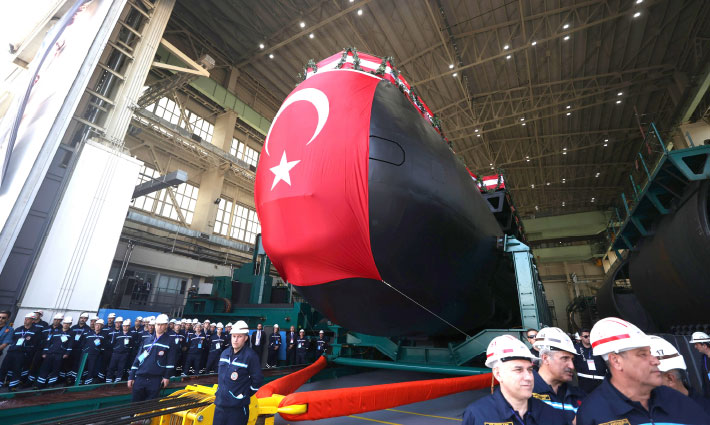
A New Milestone in the REİS Class Type 214TN Submarine Project : 2nd Submarine Moved to Floating Dock, First Steel Cut for 6th Submarine!
One of the interesting scenes in the short video shared by the Ministry of National Defense on the AKYA National Heavy Torpedo firing test in March 2022 was that the first submarine of the REİS Class, TCG PiriReis (S-330), was seen during maintenance at the floating dock. Work on the PiriReis Submarine, which was taken from the construction hall to the floating dock in December 2019 and launched on March 22, 2021, had not yet been completed as of March 21, 2022. However, for PiriReis to be delivered in 2022, the Sea Acceptance Tests (SAT) had to be started. The construction, outfitting, FAT, HAT, and SAT activities of each REİS Class Submarine take a total of 62 months. Following the completion of the outfitting activities of the PiriReis Submarine, it was planned to undergo Factory Acceptance (FAT), Harbor Acceptance (HAT), and Sea Acceptance (SAT) Tests, respectively. It was previously announced that HAT activities would take 9 months and SAT activities would take 11 months. The delay was announced on the official website of the Turkish Naval Forces Command, and it was stated that the first submarine would be delivered in 2023, not in 2022 as previously planned. "The construction of the first ship, PiriReis Submarine, started on September 28, 2015. Construction activities for the submarines continue, and they are planned to enter service after 2023, respectively. REİS Class Submarines will be the first submarines of the Turkish Naval Forces with an air-independent propulsion (AIP) system."
Meanwhile, in the Press Information Note published by the Presidency of Defense Industries on May 23, it was stated that the PiriReis Submarine is expected to be commissioned in 2022. "Within the scope of the project, the first submarine PiriReis, which is under construction at Gölcük Naval Shipyard, is planned to be commissioned this year. It is planned that our HızırReis submarine, which has been towed to the floating dock today, will be commissioned in 2023 and SelmanReis in 2027. From this year on, one submarine will be commissioned every year, and until 2027, 6 New Type Submarines will be delivered to our Navy. Submarine Delivery Dates: PiriReis 2022, HızırReis 2023, MuratReis 2024, AydınReis 2025, SeydiAliReis 2026 and SelmanReis 2027."
Speaking at the ceremony, President ERDOĞAN stated that the New Type Submarines are impressive in terms of their technical features and said: "With a surface displacement of 1,856 tons and a submerged displacement of 2,042 tons, our submarines can dive deeper than 300 meters. Our submarines can stay submerged for 3 days and operate at sea for 12 weeks without resupply (mission endurance). Equipped with effective weapons against the underwater, surface, and land targets, our submarines are capable of firing various types of torpedoes, missiles, and laying mines. We will integrate our national torpedo AKYA and our national anti-ship missile ATMACA into our submarines with air-independent propulsion capability. Under our New Type Submarine Project, we aim to deliver the first submarine, PiriReis, to the Turkish Naval Forces Command this year. Our HızırReis submarine will be commissioned in 2023 and SelmanReis in 2027. Starting from this year, we will add 6 new submarines to our Navy until 2027 by commissioning one submarine every year."
President ERDOĞAN also touched upon the National Submarine (MİLDEN) Project in his speech, noting that the preparations for MİLDEN, which will consist of a national design and predominantly national systems, are continuing at full speed, and said, "I hope we will start the construction of MİLDEN in 2025 at Gölcük Shipyard." President ERDOĞAN emphasized that they will use the experience from the construction of the 6 REIS Class submarines in the National Submarine Production process and said, "We are planning to deliver our national submarine to our Naval Forces in 5-6 years."
MİLDEN Design Project Office was established on April 19, 2019, and the new office was opened on March 22, 2021. The protocol regarding the preparation of the design of MİLDEN was signed between the General Directorate of Naval Shipyards and ASFAT on December 22, 2021.
One of the main combat units of the Turkish Navy, the Submarine Group Command currently operates a total of 12 submarines: four AY Class, four PREVEZE Class, and four GÜR Class. The Turkish Naval Submarine Fleet, always ready with its 12 submarine vessels, is a significant deterrent force in our region and around the world...
A Brief Overview of REIS Class Submarines
The TCG PiriReis (S-330) Submarine, which is the first of the Type 214TN REİS Class Submarines, the construction activities of which were carried out at Gölcük Naval Shipyard under the New Type Submarine Project (NTSP) worth €2,060 billion and which was transported to the floating dock on December 22, 2019, was launched on March 22, 2021. The TCG PiriReis Submarine, which is expected to be a significant power multiplier in the Blue Homeland in the Eastern Mediterranean and the Aegean Sea, was planned to be commissioned in 2022 with full operational capability. It would be followed by TCG HızırReis (S-331, 2023), TCG MuratReis (S-332, 2024), TCG AydınReis (S-333, 2025), TGC SeydialiReis (S-334, 2026) and TCG SelmanReis (S-335, 2027) respectively.
Speaking at the ITU SAVTEK 2021 Conference on March 24, 2021, Head of the Naval Platforms at the Presidency of Defense Industries Alper KÖSE stated that they are working to deliver TCG PiriReis Submarine by the end of 2021. I pointed out that this would not be possible then; because the HAT and SAT processes would have to be shortened and accelerated for PiriReis, which was launched on March 22, 2021.
While the construction activities of TCG PiriReis (S-330), the first submarine of the project, started on September 28, 2015, the construction activities of the second submarine TCG HızırReis (S-331, expected to be delivered in 2023), started in 2016. The third submarine TCG MuratReis (S-332, expected to be delivered in 2024) was laid down on February 25, 2018; the fourth submarine TCG AydınReis (S-333, expected to be delivered in 2025) was laid down on November 4, 2018; and the fifth submarine TGC SeydialiReis (S-334, expected to be delivered in 2026) was laid down on December 22, 2019. The construction activities of the last submarine of the project, TCG SelmanReis (S-335), will start on May 23, 2022. Havelsan delivered the Submarine Information Distribution System, which will be used on the TCG SelmanReis, to Gölcük Naval Shipyard Command for installation at the beginning of March 2021.
The Submarine Production Plant at the Gölcük Naval Shipyard, where the construction of REİS Class Submarines is carried out, consists of two large hangars, Block-A and Block-B. Block-A, which can hold three boats at one time, is used for construction and outfitting activities, while the B-Block is used for welding work on the sheets that form the submarine hull and the assembly of the blocks.
Initially, the submarines were named CERBE Class and were planned to be 66.3m long with a surface displacement of 1,845 tons. However, significant design modifications were made to meet Turkish Naval Forces Command (TNFC) requirements because of some technical problems with the design, and Turkish engineers found five major design flaws and developed solutions for them. The resulting submarine, which is longer and heavier than CERBE, was renamed REİS Class in 2014. At that time, according to the technical documents of the Turkish Naval Forces, REİS Class Submarines were 67.6m in length, 13.1m high (excluding periscope masts), 6.3m wide, with a 6.0m draft, submerged displacement of 2,042 tons, and surface displacement of 1,855 tons. However, the technical specifications of the REİS Class Submarines were revised, and the total length was increased again following the modifications. Additionally, the number of Cylindrical Metal Hydride Tanks (MHT) that are used to store Liquid Hydrogen, an essential element of the Air Independent Propulsion (AIP) System, have also been increased.
In this new version, which we call REİS-II, the overall length of the submarine was increased to 68.35m (0.75m longer than the first version of the REİS-Class and 2.05m longer than the CERBE Class), while the height (13.1m/16.5m with the periscopes), width (6.3m), draft (6.8m), and the surface displacement (about 1,855 tons) did not change. The submerged displacement of the submarine was not shared.
Two BZM120 Proton-Exchange Membrane (PEM, also called Polymer Electrolyte Membrane) Fuel Cell modules (each generates 120kW power) lie at the heart of the Air Independent Propulsion (AIP) System of the Type 214 Class Submarines (the first batch of the U212A submarines and the first batch of the Type 214 boats ordered by the Republic of Korea Navy have 9 (one backup, eight active) BZM34 PEM modules that generate a total of 306kW (400hp) power). The service life of the BZ120 PEM Fuel Cell modules (each weighing 900kg, with a capacity of 500 liters, and constitutes 320 cells) is estimated to be between 2,000-4,000 hours. This means that after running for 2,000-4,000 hours, the BZM120 PEM Fuel Cell modules will need to be replaced. The BZM120 PEM module enables the submarine to navigate at a cruising speed of 2 to 6kt (3.7 to 11.1km) and stay underwater without surfacing for about three weeks, depending on the speed. The Type 214 submarine can reach 12 knots on the surface and 22 knots while submerged. Thanks to the AIP System, the submarine can stay underwater for 18 days (approximately 1,250nm/2,315km, 14 days with AIP System, and four days using batteries) at 4 knots without snorkeling to charge batteries or travel 12,000nm (22,224km) at 4 knots with maximum fuel and snorkeling.
The submarine uses its diesel engines while cruising at high speeds and the AIP System for low-speed silent cruising. The main components of the AIP System consist of the PEM Fuel Cell module, cylindrical metal hydride tubes, liquid oxygen tank, and control unit. The submarine can operate for an extended time without surfacing by using the electrical energy generated in the fuel cell module because of the chemical reaction between the liquid oxygen and the hydrogen stored in metal hydride tanks. Since the fuel cells use pure hydrogen to generate power the module can continuously produce electricity as long as hydrogen is supplied to the system.
The energy required for the Proton Exchange Membrane (PEM) Fuel Cells used in the AIP System is provided by pure hydrogen (H2), which is toxic and carried in cylindrical double-walled metal hydride tubes. Using 7 rows of Cylindrical Metal Hydride Tanks instead of 6 rows in the Type 214TN submarine (Each carries a horizontally placed 15.3-ton capacity Liquid Oxygen [LOX] tank in its pressure hull) will considerably increase the amount of hydrogen carried in the Metal Hydride Tanks, which provide the necessary energy for the fuel cells used in the AIP System and will also increase the maximum amount of time that a submarine can stay underwater (Submerged Endurance). The Type 209PN and Type 214 Class submarines have 6 rows of metal hydride tanks (each row includes 6 cylinders, 3 on the right and 3 on the left) located outside the pressure hull at the bottom of the submarine hull while the Type 209 AIP submarines have 5 rows. However, the scale model of the Type 214TN New Type Submarine Project, which was revealed by TKMS for the first time at the 8th Naval Systems Seminar held in October 2017, has 7 rows of metal hydride tanks outside the pressure hull. This means that REİS Class Submarines will have 6x7=42 metal hydride tanks.
For the filling of liquid oxygen and hydrogen cylinders in the AIP System after a long mission, a special (fixed or mobile) fueling facility should be built at the Gölcük Naval Base, where Type 214TN REİS Class submarines will be deployed. It is stated that there are special caps for filling the LOX tank and metal hydride cylinders where hydrogen is stored and that all hydrogen tanks can be filled at the same time by connecting to the filling system with manifolds.
Carrying pure hydrogen in cylindrical double-walled metal hydride tanks is expensive, difficult to maintain, and rather heavy (2 tons of hydrogen used in the AIP system are carried in 100-ton metal hydride tanks). In addition, this method limits both the cruising speed (maximum 6knots) and the submerged endurance to a certain extent while the submarine is in AIP mode. In order to overcome such problems, different Reformer Systems have been developed that enable obtaining and using the hydrogen required for Fuel Cell modules from the diesel fuel of the submarine (Diesel Fuel Converter); or from liquid methanol (methyl alcohol) or bioethanol (ethyl alcohol) to be carried in an insulated tank with safety precautions instead of transporting it in metal hydride tanks. For example, S-80A Plus Submarines being built for the Spanish Navy (81m in length and 3,300 tons in submerged displacement) will be equipped with Ethanol (Bioethanol) Fuel Cell modules and Ethanol Reformer starting from 2026 (300kW+ capacity in total). The Type 216 Submarine (89m long, 8.1m wide, and 4,350 tons submerged displacement) proposed by TKMS for the Royal Australian Navy (RAN) would use four PEM Fuel Cells (total power capacity of approximately 500kW) with Direct Methanol Fuel Cell (DMFC) technology and Lithium-Ion (Li-Ion) battery sets consisting of two sets of Methanol Reformers. On the other hand, it is claimed that Type 212CD Submarines can also be equipped with Reformer. In the meantime, the new AIP system based on the 2nd Generation Fuel Cell (FC-2G) technology introduced by DCNS in recent years also uses a Diesel Fuel Reformer, which enables the hydrogen required for the Fuel Cell modules to be obtained from the diesel fuel of the submarine.
The Press Information Note shared by the SSB on May 23, 2022, includes that "R&D activities for the development and use of existing systems in REİS Class Submarines have also started, and the development of domestic and national fuel cells, main electric motors, batteries and various types of sonar systems has started by the Presidency of Defense Industries."
Within the scope of the Submarine Propulsion System Components Development Project initiated by the SSB for the establishment of a national infrastructure for the need for PEM Fuel Cell and Reformer (Methyl Alcohol will be used and only for MILDEN) technologies for Type 214TN REİS Class and MİLDEN Submarines, tender proposals were requested from ASPİLSAN, ROKETSAN, and VESTEL DEFENSE companies and TÜBİTAK MAM, and the first proposals were submitted to the SSB in recent years.
While there are still two PEM Fuel Cell modules with a capacity of 120kW each (240 kilowatts in total) in the REİS Class Submarines, under the Submarine Propulsion System Components Development Project, a total of 300kW net and approximately 360-370kW gross, power generation was targeted for MİLDEN. It was planned to reach this goal with 6 indigenous design and production Fuel Cell modules, each of which has a capacity of 60-65kW. According to the information I received, in the first phase of the project, a 65kW Fuel Cell would be developed and produced with national resources and delivered to the SSB for tests. Following the tests, the serial production of 6 Fuel Cell modules (65kW each) would begin if the products were successful. Domestic design and production Fuel Cell modules will also be used in REİS Class Submarines. In the future, the foreign-origin PEM Fuel Cell modules are planned to be replaced with indigenous Fuel Cell Modules. In this context, the REIS Class is expected to use 4 locally designed and produced PEM Fuel Cell modules for the 240kW power requirement