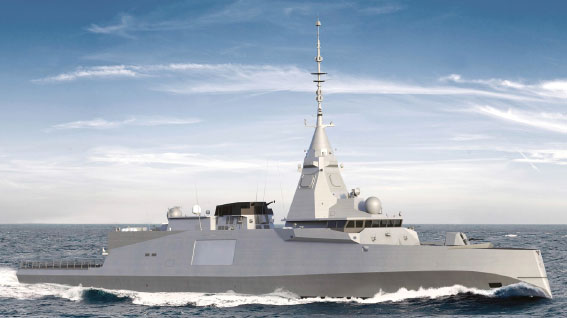
Admiral Ronarc’h Class Frigates

For missions of lesser value such as policing in French Overseas Territories, protecting exclusive economic zones, conducting maritime presence operations or performing other joint interoperability NATO/EU missions French Naval Forces need simpler, cheaper units.
Currently the high-end units in the French Navy are the FREMM Class Frigates with its anti-air and anti-submarine warfare versions. 6 units are in service and the last two are expected to enter service in 2022. The five La Fayatte Class Frigates make the low-end part of French Naval Forces. When these very futuristic looking warships were commissioned in the early 1990’s they were the first true stealth warships designed. However, the La Fayette Class Frigates were chronically under armed especially in air defense. Although there is space reserved forward of the bridge for Sylver A43 octuple VLS launchers, this option was never exercised.
The Admiral Ronarc’h Class Frigates under construction are intended to replace the La Fayette Class Frigates on a one-for-one basis, after 2023.
The Admiral Ronarc’h Class was initially referred as medium frigates, FTI (Frégate de Taille Intermédiaire). This was later changed to Escort and Intervention Frigates, FDI (Frégate de Defense etd’Intervention).
The program for the FDI was confirmed in May 2015. The ships unique design was unveiled in 2016. The inverted bow to improve seakeeping, the integrated mast with Thales SeaFire AESA Multifunctional Radar give the ship distinctive look just like the La Fayatte Class had when it entered into the service.
The construction of the first ship Admiral Ronarc’h started on 24 October 2019. The ship is scheduled for delivery in 2023.
According to Naval Group, the FDI is a high sea vessel with a 4,500 tons class displacement. Multipurpose and resilient, it is capable of operating, alone or within a naval force, through all of types of warfare: anti surface, anti-air, anti-submarine and allows for special forces projection.
The frigate is 122.25 meters long and 18 meters wide. The main machinery is 4 MTU 16V 8000 M91L diesel engines in CODAD configuration with 2 shafts. The maximum speed is 27 knots. The range is 5,000 nautical miles at 13 knots economical speed. The ship will be able to autonomously operate up to 45 days with an accommodation of 125 crew and 28 passengers.
The main offensive weapons of the FDI class are 8 Exocet MM40 B3C anti-surface missiles. The MM40 B3 missile is the latest generation shipborne variant Exocet family. The missile all-weather capable missile has a 200km class operational range at very low altitude against all classes of warship. The active RF seeker enables the missile to have a high hit probability even against moving targets.
For defense against airborne threats the frigate can carry a total of 16 Aster 15 or Aster 30 missiles. Aster 15 is the short range of the two missiles with a range of more than 30 km whereas Aster 30 has a range more than 120 km. Aster missiles provide the ships with an all-round anti-missile and anti-air capability to ensure self-defense and consort protection. In addition, Aster 30 also provides long-range interception capability for area defense.
The Aster missiles are guided by the Thales Sea Fire radar system. The Sea Fire is a fully digital AESA multifunction radar, equipped with four fixed antenna panels, supporting the ships’ simultaneous defense against threats ranging from conventional to asymmetric or hyper-velocity and highly-maneuvering, according to Thales its manufacturer. The Sea Fire brings moderate size frigates the power and performance of destroyers dedicated to extended air defense with advanced surveillance and fire control capabilities. The radar provides simultaneous long range 3D surveillance, horizon search, surface surveillance and fire control for the Aster missile family. The Sea Fire provides early warning of potential attacks. It’s 300km air coverage can detect and track more than 800 objects simultaneously without saturation up to a 90° elevation and it provides surface coverage up to the horizon.
The integral mast radar on board the FDI type frigates, in addition to the Sea Fire radar, supports the BlueGate IFF integrator. This system too has 4 fixed antenna panels compliant with Mode 5 and Mode S. The ship also has an integrated electronic warfare system composed of a radar detector (Sentinel and a communications detector (Altesse-H). For communications the Surfsat-L naval SATCOM terminal is installed which can achieve very high data rate, transmit several carries simultaneously and overcome severe jamming.
Other electronic systems on board the FDI Class that protect against underwater threats, are the Captas-4 compact variable depth sonar, and the Kingklip Mk2 hull mounted high performance sonar with torpedo and underwater obstacles detection capabilities.
Furthermore, the FDI Class are armed with MU90 antisubmarine torpedoes, and one 76mm main gun. The frigates are able to embark simultaneously a NH-90 Caiman helicopter and an unmanned aerial vehicle (UAV). The ships can also accommodate a Special Forces detachment with their two boats.
According to the Naval Group, the FDI will be the first French frigate, natively protected against cyber threats, with a Data Center accommodating a great part of the ship applications. The FDI introduces the concept of a dedicated system for asymmetric threat warfare, distinct from the operation room. Located behind the bridge, it will lead asymmetrical warfare against air and surface threats such as mini-UAVs or boats.
As a general-purpose frigate capable of combating surface, air and sub surface threats and asymmetrical threats, when commissioned into service the FDI Class Frigates will take over a number of missions from the older frigates in service, thus rejuvenating the French Navy.
However, the Naval Group believes that there is an international demand for a frigate of this tonnage; and Greece quickly became the first export customer.
A Letter of Intent (LoI) was signed on the 10th of October 2019 by the Greek Minister of Defense, Nicolaos PANAGIOTOPOULOS and the French Minister for Armed Forces, Florence PARLY. This was in line with the strategic cooperation between the two countries and regarded a step to sell FDI known as “Belharra” for international markets, to the Hellenic Navy. The Chief of the Hellenic Navy Nikolaos TSOUNIS was among the high-ranking guests during the first steel cutting ceremony on 24 September 2019.
After negotiations on 28 September 2021 almost two years after the construction of the first FDI Class Frigate had started, Greece announced that it would buy three Belharra Class Frigates. The Memorandum of Understanding (MoU) for the purchase of these frigates was signed less than two weeks after France lost the Barracuda Submarine contract in Australia. The Greek media stated the deal to be worth €5 Billion and has an option for a fourth ship.
For the French President MACRON this deal was first a face-saving event after the loss of a €56 billion submarine contract with Australia. Second it was the fruit of his long-term efforts to be a player in the Eastern Mediterranean region, and lastly to prove his idea that Europeans should take care of themselves. For the Greek Prime Minister MITSOTAKIS the deal represented a bold step in the defense of his country and finding a strong second ally from Europe against Turkey.
The first Greek frigate is expected to be delivered in 2024 one year after the delivery of the first French frigate. The short delivery time indicates that the main construction work will be performed in France and Greek industrial participation will remain very low or negatable at best





