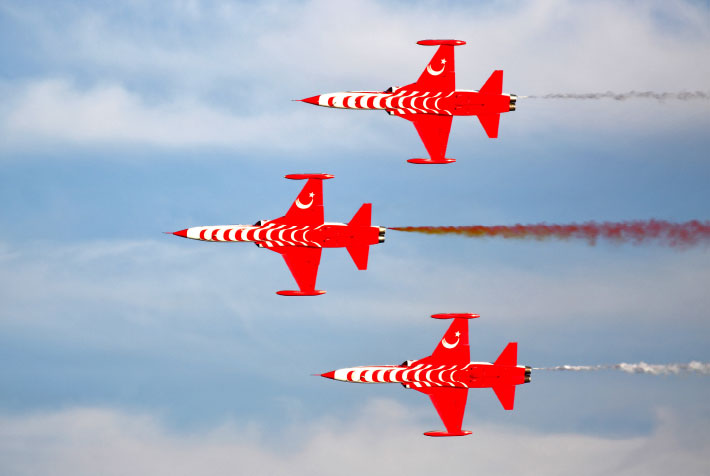
Aerobatic Teams in the Turkish Air Force and Turkish Stars
It is widely recognized that the first aerobatic activities in the Turkish Air Force began with Pilot Lieutenant Mr. Fazıl's “Spin 182” maneuver on March 5, 1914. Flying a Depedussin-type aircraft named “Ottoman,” Mr. Fazıl initiated a spin and successfully recovered from it at an altitude of 400 meters, marking the first aerial aerobatic demonstration in Turkish aviation history.
Since the 1930s, single-aircraft air shows have evolved into multi-aircraft formations and teams. While most solo performances were conducted by civilians, aerobatic teams were primarily composed of military aircraft and pilots. Notably, formations of synchronized aircraft began to appear in official parades. The first official aerobatics activities within Turkish Air Force, which claimed a significant position in world aviation history in a very short period of time, was commenced in 1926 within the Air Force School. These group, formed under the chairmanship of Pilot Lieutenant Enver AKOĞLU, and containing many successful pilots such as Pilot Lieutenant Tekin ARIBURUN), the first team performed aerobatic maneuvers such as inverted dives, split-s, and tailskids.
National Acroteam of TuRAF
With the inclusion of jet aircraft in its inventory, the Turkish Air Force established air acroteam squadrons, paralleling those in Western countries at the time. The first acroteam of the Turkish Air Force was formed at the 9th Air Base (Balıkesir) in 1952 and began its activities. This team, with the call “Milli" (National) which carried out activities from 1952 until 1962 with F-84G (Thunderjet).
On October 16, 1950, First Lieutenant Lütfi GÜNDOĞDU was sent to the United States for jet instructor training and is considered the founder of the National Acroteam. During his training at Williams Air Training Base in Arizona, Türkiye's first jet pilot discovered that the base had a four-aircraft acroteam. He flew twice with the demonstration team in the United States, gaining firsthand experience in the basic principles of acroteam squadrons. Upon returning to Türkiye, Gündoğdu shared his knowledge and proposed the establishment of an aerobatic team. His proposal led to the formation of the team, with Gündoğdu as the leader. The flight formation included Şeref UĞUR flying to the right as number 2, Ali Tekin to the left as number 3, and Osman Celalettin COŞKUN behind the leader as number 4, creating a four-aircraft aerobatic formation. The National Aerobatic Team participated in air shows in Ghedi, Italy, in 1954, Liège, Belgium, and the Netherlands in 1958, and Naples, Italy, in 1959. The team gained significant attention from the Turkish public and achieved notable success but was disbanded in 1962.
Flying Swans Acroteam
The second aerobatic team of the jet era was established in 1955 at the 4th Air Base Command in Eskişehir. Named "Swan," this team flew F-86E aircraft painted in red and white with a swan motif on their noses. The team operated from 1955 to 1964. When the Flying Swans Aerobatic Team was first formed, its four-flight formation included Air Pilot Captain Cezmi Arı, First Lieutenant Cahit ERKUL, Pilot Master Sergeant Hami ÜNLÜ, and Pilot Master Sergeant Sabahattin MISTIKOĞLU. On May 30, 1959, the Flying Swans performed flight demonstrations in Istanbul to mark the 10th anniversary of NATO, attracting thousands of spectators.
The Flying Swans, renowned for their four-aircraft formation shows in their early years, expanded to nine-aircraft displays in 1964. This marked the Flying Swans as the Turkish Air Force's first nine-aircraft formation aerobatic team. However, the team's activities were discontinued when the 141st Squadron transitioned to F-104G aircraft in 1964.
Scorpion Acroteam
In 1957, the third aerobatic team of the Turkish Air Force, named "Scorpion," was established at the 181st Squadron Command within the 8th Air Base Command in Diyarbakır. This team operated F-84G aircraft and was active from 1957 to 1959.
Bats Aerobatic Team
The fourth aerobatic team of the Turkish Air Force, known as "Bats," was established at the 5th Main Jet Base Command in Merzifon. Flying F-86E aircraft, the Bats operated for two years, from 1964 to 1965.
The Bats began their aerobatic performances with five aircraft, later expanding to formations of nine and ultimately twelve. This team holds a unique place in the history of the Turkish Air Force's aerobatic teams, being the only one to perform with twelve aircraft, the largest formation in Turkish Air Force history.
On October 31, 1965, the Bats Aerobatic Team performed a major air show over Istanbul with nine aircraft. The demonstration proceeded as planned over the Bosphorus, sparking great enthusiasm. Following this success, the Bats conducted additional air shows with twelve aircraft over Ankara as part of the 55th anniversary celebrations of the Air Force Command, after which they concluded their activities.
Eagle (Coşkun) Acroteam
The 161st Squadron, with the call sign “Eagle,” transitioned to F-5A aircraft in 1965, becoming the Turkish Air Force's first squadron equipped with the F-5. Shortly after the transition, the squadron command began efforts to establish an acroteam. Consequently, the Eagle Acroteam was established in 1966 at the 6th Main Jet Base Command in Bandırma. Operating F-5A aircraft, this aerobatic team, also known as “Eagle,” performed from 1969 until May 21, 1971.
Until 1971, the aerobatic team used the name and symbol of the eagle, which was originally the emblem of the squadron where it was first established. On May 21, 1971, Air Pilot First Lieutenant Coşkun TURAN tragically martrydom in an accident incident in-flight. In his memory, the acroteam name has been the renamed with “Coşkun.” The Coşkun Acroteam subsequently participated in various domestic and international air shows, with their final performance taking place in Italy on June 26, 1971. During this event, the team represented Türkiye with great success at the NATO air shows held in Aviano.
Between 1972 and 1992, the Turkish Air Force did not maintain a dedicated acroteam, instead integrating aerobatics into combat readiness training. During this period, there were no air shows exclusively focused on aerobatics; rather, limited aerobatic displays were incorporated into various ceremonies. In the early 1990s, renewed interest arose in establishing an acroteam to bolster the promotion of the Turkish Army and Turkish Air Force. Efforts to form a new acroteam were initiated in 1992.
Turkish Stars
On November 7, 1992, an order was issued to establish an acroteam within the 132nd Squadron, consisting of four F-5/NF-5 aircraft. Efforts began to choose a name for the acroteam that would be easily pronounceable in both Turkish and English, resulting in the official name “Turkish Stars” being adopted on January 11, 1993. During this period, visits were made to the “Red Arrows” acroteam in the United Kingdom, the “Snowbirds” in Canada, and the “Frecce Tricolori” in Italy to enhance the knowledge and skills of the acroteam pilots.
The modifications and upgrades to the nine NF-5A and one NF-5B aircraft allocated to the Turkish Stars acroteam were completed by July 1994 and delivered to the squadron. Initially established within the 132nd Squadron, Turkish Stars later transitioned into an independent squadron and was renamed the 134th Acroteam Squadron Command, considering the specialized nature and intensity of its mission.
In 2003, efforts began to enhance the show's impact by expanding the team to include eight aircraft. Turkish Stars performed its inaugural eight-aircraft formation on March 30, 2004, marking the world's first aerobatic team to showcase such a display with supersonic aircraft. Today, Turkish Stars is renowned as one of the world's premier acroteams and proudly holds the title of Türkiye's “National Team in the Skies.”
Turkish Stars performed its 200th show in Rize on July 3, 2004 and reached its 300th show milestone at the Florennes International Airshow in Belgium on August 5, 2008. Since its inception, Turkish Stars have performed 490 shows across 121 provinces and districts in Türkiye, as well as 161 shows in 24 countries worldwide. They continue to showcase the prowess and capabilities of the Turkish Air Force to aviation enthusiasts both domestically and globally. Turkish Stars, known as Türkiye's “national team in the skies,” will soon incorporate the HÜRJET aircraft, produced by Turkish Aerospace (TUSAŞ), into their performances, marking a new chapter with our country's first indigenous jet aircraft.
On April 27, 2024, Turkish Stars, the demonstration team of the Turkish Air Force, engaged with aviation enthusiasts at an interview and autograph signing event held at the Istanbul Air Force Museum. During the event, the National Defense University Air Force Academy Band performed a concert for visitors. Following the concert, attendees had the opportunity to meet with the Turkish Stars team during the interview and autograph session.
After introducing themselves and their teams, the members of Turkish Stars shared their expertise and experiences in aerobatics, demonstrations, and related activities. Visitors, especially children, enthusiastically asked the pilots about various aviation topics. Pilot Majors Hasan Kocabaş, Kürşat KÖMÜR, Mehmet BALTA, Alim KOCAMAN, Gökhan ESEN, and Saim Yalçın, along with Pilot Captain Mehmet KILIÇ and First Lieutenant Fatih SAĞLAM, the press and public relations officer, responded to their questions.
Major KOCABAŞ stated, “We're here with future pilots, engaging with young people. Currently, we fly with F5s, but Turkish Stars will soon transition to flying with HÜRJETs. Our hope is that the young people we meet today will eventually take up this role with HÜRJETs. We look forward to passing on this mission to them and witnessing their future success with joy.”
After the interview, the Turkish Stars pilots signed autographs for their fans. A long queue formed in front of the stage as attendees eagerly awaited their turn. The signing session concluded with participants and pilots taking photographs together





