Air Defence Destroyers in Europe
Since World War II, the conflict between air power and warships has only intensified. The advent of shipborne anti-ship missiles has made air defence crucial for the survivability of ships. Navies that could afford it produced dedicated warships designed solely to detect airborne threats from long distances and fire air defence missiles at these targets. These dedicated air defence ships are now integral parts of any task force, providing a protective umbrella for the mission-critical ships within the task force.
With the proliferation of ballistic missiles, the task of ballistic missile defence has also been added to the responsibilities of air defence ships. In this new area of warfare, these dedicated air defence ships are increasingly valuable in protecting valuable units against airborne threats and critical infrastructure or population centres against ballistic missiles.
The mission of tracking hundreds of airborne vehicles, both civilian and military, identifying friend and foe, and continuously tracking them over long distances while guiding missiles against airborne threats is daunting. To successfully complete this task, a warship needs advanced radar with very high resolution and range. There must be sophisticated software to detect threats against backscatter and environmental constraints and track them without losing them. This software should also be able to receive and distribute data to other units to create comprehensive air situational awareness. The air defence ships need to have large magazines and different types of missiles to combat targets at both long and short ranges, and, if necessary, ballistic missiles at the edge of the atmosphere. Furthermore, these warships need sophisticated fire control radars to guide their air defence missiles to intercept their targets successfully.
We will take a brief look at the existing air defence destroyers in service with European navies and compare them with the Turkish Navy's TF-2000 project.
Turkish TF-2000 Class
The TF-2000 AAW Destroyer, with a length of 149 meters, width of 21.3 meters, a draft of 5.75 meters, and displacement of 8,300 tons, will be equipped with a Combined Diesel or Gas (CODOG) configuration main propulsion system consisting of 2 LM2500 Gas Turbines and 2 Diesel Engines. It will be capable of a maximum speed of 26 knots and operating in Sea State 5. The Preliminary Design of the TF-2000 AAW Destroyer has been completed. Due to design changes, model tests are planned to be conducted again in collaboration with İstanbul Technical University during the summer months of 2024.
Similar to the previous longer TF-2000 design, a split funnel was again chosen for the TF-2000 AAW Destroyer. A dual funnel (split funnel) with a large surface area is preferred to allow better air intake, improved cooling, and further thermal signature reduction. We learned that the two rectangular structures immediately in front of the funnels are ventilation intakes, not allocated areas for additional VLS as previously predicted.
The TF-2000 AAW Destroyer will feature 32-cell VLS at the bow and 64-cell VLS launchers amidships, tones 96 cells for MİDLAS VLS. The decision to use 96 cells has been finalized. The number of Quad-Pack capable cells in the MİDLAS VLS, which is expected to be Strike length, will be determined over time.
The ÇAFRAD (Multi-Function Phased Array Radar) AESA Radar System antenna arrays will be integrated into the ship both at the bow and stern in separate compartments. The choice of separate array/mast placement is preferred to enable unrestricted 360-degree scanning, target detection, and tracking without any visual obstruction. In the new ÇAFRAD System Configuration, two fixed S-Band Long-Range Radar (UMR) arrays are placed on the ship's superstructure at the bow (starboard and port sides), while the other two fixed arrays are mounted on the mast at the stern. In addition to its early warning capability, UMR will also provide guidance for HİSAR and SİPER missiles to the target. The phased array antennas of the X-Band Multi-Function Radar (ÇFR), which will focus solely on surface engagement, are located on the integrated main mast. The standard detection range for ÇAFRAD is expected to be 450 km+, with a target detection range of 750 km at full power.
The first TF-2000 AAW Destroyer will be constructed at İstanbul Naval Shipyard Command with a local content ratio of 85%.
British Daring Class
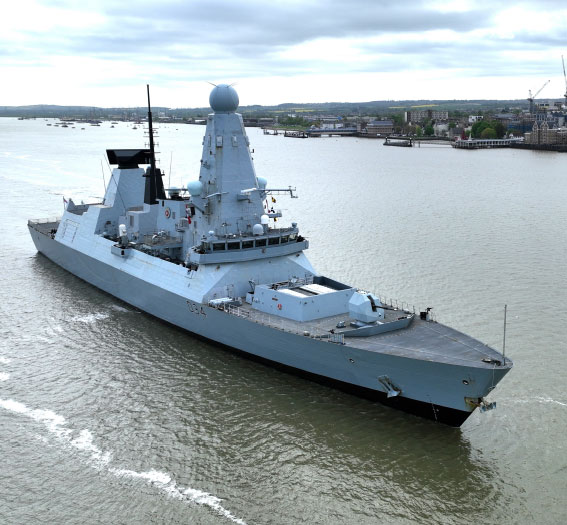
The Daring class consists of six Type 45 destroyers (HMS Daring, Dauntless, Diamond, Dragon, Defender, and Duncan) that were purpose-built for anti-aircraft and anti-missile warfare to replace Type 42 destroyers. These destroyers feature reduced radar cross-section superstructures, thanks to their deck equipment and life rafts being concealed behind panels. The Type 45 destroyers are fitted with a Fully Integrated Communications System (FICS45), which provides voice, intercom, data links, and conference calls—both internally and externally. This communications suite also includes a Meteorology and Oceanography (METOC) system for total awareness of the ship’s surroundings.
Sea Viper is the principal weapon system of the Daring class destroyers. Comprising long-range and missile-directing radars, a combat control centre, and vertical missile silos, Sea Viper can launch eight missiles in under ten seconds and guide up to 16 missiles simultaneously. Type 45 destroyers are easily identifiable by the SAMPSON radar system—a large, spherical surveillance device that can detect and track threats from over 250 miles away and guide friendly missiles. Unlike conventional radars, SAMPSON can perform several functions at once, has immense range and accuracy, and through its adaptive waveform control, is immune to enemy jamming.
French Forbin Class
The French Forbin class is a product of a three-nation project with Italy and the United Kingdom. The joint project office was established in 1993, and after the UK's withdrawal from the project, Italy and France continued to design the air defence warship together. Originally, France planned to have four ships of this class, but these plans were later shelved due to budget constraints.
Their air defence capabilities are focused on the PAAMS anti-air missile system developed by Italy, France, and the UK. This system comprises the European Multifunction Phased-Array Radar (EMPAR) and Aster 15 short-range and Aster 30 medium-range surface-to-air missiles. The modified S-1850M variant of SMART-L performs long-range search functions. The S1850M is advertised as being capable of fully automatic detection, track initiation, and tracking of up to 1,000 targets at a range of 400 kilometres (250 miles). It is also claimed to be highly capable of detecting stealth targets and able to detect and track outer-atmosphere objects at short range, enabling it to form part of a Theatre Ballistic Missile Defence system.
German Sachsen Class
The three Sachsen or F-124 class warships were ordered in June 1997 and commissioned from November 2004 following sea trials. Although classified as frigates by the German Navy, their displacement puts them in the destroyer size category.
Since Germany and the Netherlands collaborated loosely when developing air defence warships, the Sachsen class is conceptually very similar to the De Zeven Provinciën class.
The ships have four 8-cell modules of the Mk-41 VLS system. However, these 32 cells are supplemented by two 21-cell Mk-49 RAM launchers for close-in air defence.
The main sensor of this class is the Thales Netherlands Active Phased Array Radar (APAR) and SMART-L surveillance radar. The SMART-L can detect and track targets in excess of 300 nautical miles, handing over to APAR for later-stage tracking and fire control. The APAR-controlled Standard SM-2 and ESSM missiles provide an effective layered defence system suitable for littoral waters.
Italian Andrea Doria Class
These warships are essentially very similar to the French Forbin class, as the two nations developed the warships and their main air defence systems together. However, there are still some differences, such as the main anti-ship missiles, with the Italians using the indigenous Oto Melara Teseo Mk2/A.
The main anti-air missile systems on board these ships are essentially the same as their French counterparts, with the European Multifunction Phased-Array Radar (EMPAR) and Aster 15 short-range and Aster 30 medium-range surface-to-air missiles and the S-1850M long-range search radar. EMPAR is intended for autonomous and simultaneous medium- to long-range air and surface surveillance. The hemispheric mission envelope takes in all surface and airborne targets and can display over 300 targets. It has the ability to track 168 priorities within the mission envelope and to acquire up to 50 targets simultaneously for prosecution within a local area defence system. EMPAR eliminates the need for several discrete systems to individually perform search correlation, acquisition, and tracking.
These warships have six 8 cell DCN Sylver A50 modules. Their typical weapon load is 15 short ranged Aster 15 missiles and 32 medium ranged Aster 30 missiles.
Dutch De Zeven Provinciën Class
The four ships of this class were ordered in 1995, and the first vessel was delivered in 2002. These ships combine the air defence capabilities of the APAR and SMART-L with a broad range of general-purpose capabilities. The ships have space allocated for six eight-cell MK-41 VLS modules, but only five modules are carried on board.
The Royal Netherlands Navy contracted Thales in 2016 to modernise the combat system and APAR radar. It was announced in 2022 that only two ships would receive APAR Block II and ESSM. In parallel, the SMART-L air search radars are being replaced with the SMART-L MM/N version. This version combines anti-air warfare and ballistic missile (BM) defence in one mode by adaptable radar waveforms for the various tasks in a single rotation. It covers an instrumented range of a maximum of 2,000 km against space objects and ballistic missile targets.
According to Thales, in October 2015, HNLMS De Zeven Provinciën, equipped with a prototype of the new SMART-L MN/N, participated in the At Sea Demo organized by the Maritime Tactical Ballistic Defence Forum off the coast of Scotland. The radar successfully tracked an outer-atmosphere ballistic missile travelling at 7,000 km/h and provided real-time cueing information to a US destroyer that launched an SM-3 to destroy the threat. Simultaneously, SMART-L MN/N engaged and tracked two anti-ship cruise missiles that attacked two ships in the squadron.
Norwegian Fridtjof Nansen Class
The Royal Norwegian Navy decided to award the contract for the next generation of warships to Spanish shipyard Navantia, as it offered a smaller variant of the F-100 class warships with a smaller SPY-1 radar. The first ship was ordered in 2002 and delivered in 2006.
Displacing 5,200 tons, the Norwegian ships are lighter and smaller than their Spanish counterparts. The key factor in this difference is the new compact AN/SPY-1F version of the Aegis system and restricting the air-defence weaponry to short-range ESSM missiles.
The SPY-1F array has only 1,856 radar elements and is 2.4 meters in diameter. The smaller arrays require less energy and less cooling. SPY-1F works with 32 ESSM missiles on board, quad-packed in each eight Mk-41 cells. There are also two target illumination radars on board. The Aegis software was optimized for enhanced performance in the littoral and against pop-up missiles.
These are the smallest warships ever to incorporate the AN/SPY radar arrays and the Aegis system on board.
Spanish Álvaro de Bazán Class
Initially, Spain was in partnership with Germany and the Netherlands to develop an air defence warship. The Spanish Navy determined that the USA-made Aegis system was suitable for them and invested in the F-100 class. This class has the distinct pyramid-like superstructure shape forced by the Aegis SPY-1 fixed radar panels. The first ship was ordered in 1999 and entered service in 2002.
The Aegis is a broader integrated weapon system that is effective across anti-air, anti-submarine, and anti-surface missions. Command and control functions are built around interlinked weapons command and control and decision computer systems. Designed to combat saturation attacks, the AN/SPY-1D is an electronically scanned array radar. The four fixed phased array antennas have 4,350 radar elements and are 3.8 meters in diameter.
The Aegis system requires separate slaved fire control illuminators not found on European systems.
The Álvaro de Bazán class has six eight-cell Mk-41 VLS modules. These ships were upgraded to Baseline S-2 standard, enabling them to use Standard SM-2 Block IIIB and ESSM missiles





