Airbus Defence and Space at DIMDEX 2014
At DIMDEX 2014, it’s the first time that Airbus Defence and Space - a new division within the Airbus Group – is publicly present with all its four business lines at an exhibition in the Middle East region. The division has been formed by combining the business activities of Cassidian, Astrium and Airbus Military. At previous DIMDEX shows just Cassidian was present with its defence and security portfolio.
Airbus Defence and Space is Europe’s number one defence and space enterprise, the second largest space business worldwide and among the top ten global defence enterprises. It employs some 40,000 employees generating revenues of approximately €14 billion per year.
Within this new organisation Airbus Defence and Space is reinforcing its capabilities to service the customers better with a one-stop-shop offering an integrated portfolio based on one sales organisation under one strong brand, continue to build on a strong and reliable partnership with one known face to the customer and present the integrated and innovative product and services portfolio at competitive prices. The new Division started operating at executive level as of 1 January 2014.
Airbus Defence and Space is composed of four business lines: Military Aircraft; Space Systems; Communication, Intelligence & Security (CIS); and Electronics. It brings together a wide portfolio to continue to meet the complex needs of its customers across the world.
The business line Military Aircraft will showcase the Airbus C295 in Maritime Patrol version. The aircraft is the market leader in the medium-size maritime patrol aircraft / anti-submarine warfare (MPA/ASW) sector with an endurance of up to 11 hours, excellent low-level flying characteristics with up to 3g manoeuvrability and a cruise speed optimised for persistent surveillance and wide area coverage. It benefits from wide field-of-view bubble windows and safe low-speed flying characteristics. And it has special anti-corrosion treatment for the maritime environment, contributing to its low lifecycle costs. The C295 is normally equipped with the Fully Integrated Tactical System (FITS), a proprietary system of Airbus Defence and Space, providing up to four operators with an advanced interface with the sensors to ensure maximum operational effectiveness. The system processes the data from sensors including: radar, electro-optic/infrared, acoustics, MAD, automatic identification system, IFF, communications and electronic intelligence. Communications include satcoms, HF/VHF/UHF, and Link 11 and Link 16 datalinks. In the ASW, role it features sonobuoy and armament inventory management with launch pattern control. The C295 ASW has been in service, and armed with Mk46 torpedoes, since 2010.
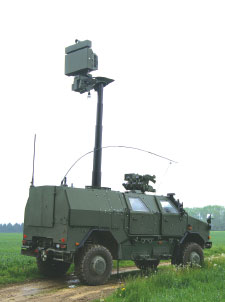
The tactical Unmanned Aerial System TR-170 KZO is a combat proven aerial artillery observer and surveillance drone. It has been designed to enhance the commander’s situational awareness and provide highly stabilized and precise target coordinates, fully integrated into the artillery C4I system. A jamming resistant datalink, independence from GPS and IR/radar stealth capabilities allow operations even in a challenging environment.
TR-170 KZO can be launched even in stormy weather due to it’s rocket-assisted takeoff. When landing, it measures wind conditions and performs a high-precision parachute landing, being operational again in less than an hour. Developed to be operated by land forces soldiers, the mission plan and flight path is calculated automatically based on reconnaissance tasks, reducing training costs. The system has full tactical mobility and can be operated directly from the field. The full system, aircraft and ground vehicles, is fully certified according to German certification regulations. TR-170 KZO has been operated from 2009 - 2012 by the German Army in Afghanistan. The UAS is avaible for export customized or as it is.
The business line Space Systems will showcase the submarine rescue system RESUS. It ensures rapid surfacing of submarines in an emergency situation: RESUS will empty the Main Ballast Tanks (MBT) of the submarine at all diving depths within a very short time, working independently form other on-board systems. RESUS consists of a number of gas generators and electronic components to activate the system as well as to control and test the system integrity. The gas generators (GG) are installed in the forward and aft MBTs. Remote starting devices are located at several positions along the boat. Thus RESUS can be put into operation without any delays. The gas generators produce a hot gas that is cooled and guided to the top of the MBT. This provides enormous buoyancy, stabilising the submarine attitude immediately and raising the boat safely to the surface. The gas generators in the aft MBT stabilise the boat when surfaced. The gas generators are activated from the control and test unit by release of a pyro valve (liquid fuel generator) or electrical pulses (solid fuel generator). RESUS has been standard equipment on board all German submarines for over 20 years. RESUS has been installed on many submarines of classes 206A, 209, 212A and 214.
SCOTPatrol is a next generation naval terminal designed to extend satcom capabilities to smaller ships such as Mine Counter Measures and Offshore Patrol Vessels (OPVs) or larger ships with smaller data requirements. SCOTPatrol is manufactured from carbon fibre making it the lightest ever naval satcom terminal of its type. The reduced top-weight, together with a compact footprint above and below decks makes for easier integration on smaller vessels such as OPVs, a reduced magnetic footprint, exceptional strength to withstand shock, vibration and harsh operating environments, through-life performance benefits from easier logistics and materials handling. With the capability to transmit large volumes of data over Ku, Ka and X bands, SCOTPatrol can act as a beyond-line-of-sight (BLOS) relay for video, multispectral and radar imagery, from intelligence, surveillance and reconnaissance (ISR) assets such as helicopter UAVs. SCOTPatrol incorporates much of the performance and functionality found. Nearly 200 SCOT terminals (more than 300 antenna assemblies) operating in various frequency bands have been delivered to 11 navies, making it one of the most widely fitted naval milsatcom terminals in the world.
DeckFinder is a local navigation system, designed to enable automated operations of manned or unmanned aerial vehicles. The system enables the calculation of precise relative position – independent of Global Navigation Satellite Systems. DeckFinder’s core applications lay in the navigation of helicopters and helicopter UAVs i.e. fully automatic take-off and landing on fixed or moving ground like oil and gas platforms or ships and trucks. It assists manned helicopter landings under difficult conditions. There are numerous further fields of application and the system can adapt to a wide range of requirements and challenges.
Several communications satellites based on Eurostar E3000 are already in operation for the Middle East. This product covers a wide range of civil and military applications with a payload power of between 4 and 15 kW and has a capacity to operate more than 100 transponders for more than 15 years. It can be easily customised to meet specific customer requirements.
The business line Communication, Intelligence & Security (CIS) is providing the Nationwide Security System to Qatar. This integrated system provides Qatar with surveillance and command and control of land borders and its coastal region. High performance sensors and state-of-the-art IT tools to secure more than 900 km of Qatar‘s coastline, land borders and the Qatar Area Of Responsibility. The system is destined for the Qatari border guard, coast guard and Navy for the exclusive economic zone. It is intended to allow monitoring of the territory, secure communications and speedy decision making to counter potential intruders. It will also include several layers of command and control centres interconnected with each other and with all surveillance stations through a high performance secured and encrypted communication network to transmit and transfer live data and picture to the concerned command and control centres. The network is a civil security system which covers sensitive sites, including offshore platforms operated for Qatar Petroleum. The system is designed to allow action by the Qatar Armed Forces on any identified threats. For instance, the naval radars are required to detect and identify a fast boat approaching an oil platform and to give the authorities time to decide how to respond to the potential threat. Related products are shown at the NSS partner booth.
The business line Electronics will show a new generation of naval radars with unprecedented capabilities for the surveillance of sea areas and countering asymmetric threats: TRS-4D is the innovative step from conventional radar into a “new dimension” of operational capability. It enables ships from patrol vessels to frigate size to exert the different detection tasks of a ship-borne medium range surveillance and target acquisition radar, in blue waters and also in complex littorals with high target densities. It performs faster, more accurate and against a wider scope of targets than conventional radars. TRS-4D provides navies and coast guards with the benefits of solid-state based AESA technology, which up to now has been available to highly expensive systems only. A non-rotating variant with four fixed array panels is under production for the new F125 frigates of the German Navy.
Also on display is TRSS (= Tactical Radar for Surface Surveillance), a new naval X-Band radar optimized for the detection of extremely small objects and countering asymmetric threats. Based upon the latest AESA radar technology (AESA = Active Electronically Scanning Array), TRSS substantially increases the detection capabilities, and thus the protection level of navy ships and coast guard vessels. TRSS is able to detect and distinguish small objects precisely at close ranges, e.g. individual swimmers. These features give ship operators an optimal overview of the situation, e.g. against terrorist attacks, and enable ships to monitor movements on land.
SPEXER 2000 (TRGS) is a security radar for surveillance of border areas or sensitive industrial installations with unprecedented performance. The radar which has been sold as part of a huge border protection system in the Middle East forms the nucleus of a whole product family of security radars named SPEXER. It is the worldwide first security radar using the newest radar technology of Active Electronically Scanning Array (AESA). By electronic guidance of the radar beam this technology enables the sensor to fulfill several tasks at the same time while increasing the detection capability substantially. Therefore, one SPEXER 2000 can replace two or more conventional radars.
About Airbus Defence and Space
Airbus Defence and Space is a division of Airbus Group formed by combining the business activities of Cassidian, Astrium and Airbus Military. The new division is Europe’s number one defence and space enterprise, the second largest space business worldwide and among the top ten global defence enterprises. It employs some 40,000 employees generating revenues of approximately €14 billion per year.
Military Aircraft, headed by Domingo Ureña-Raso, designs, develops, delivers and supports military aircraft and is the leading fixed-wing military aircraft centre in Europe and one of the market leaders for combat, transport and tanker aircraft world-wide. Key products include the Eurofighter, A400M, A330 MRTT and C295/CN235 as well as the development of unmanned aerial systems.
Space Systems, headed by François Auque, covers the full range of civil and defence space systems with its unique expertise. Its satellite system solutions for telecommunications, earth observation, navigation and science include spacecraft, ground segments and payloads. As the European prime contractor for launchers, orbital systems and space exploration, its key systems include Ariane launchers, the French deterrent force and European space cargo vehicle, the ATV.
Communication, Intelligence & Security (CIS), headed by Evert Dudok, is the new “one-stop-shop” for satellite and terrestrial communication, intelligence and security services and solutions. The customer base encompasses both the government sector – notably defence and security forces – and commercial sector including transportation (maritime, airport, metro), energy (oil, gas and electricity), mining and agriculture. Key services and solutions include: military and commercial satellite communication services, professional mobile radio communication, emergency response centres (such as 9-1-1/112), border surveillance systems, command & control (C4I) systems, cyber security solutions and services and observation satellite based geo-information services.
Electronics, headed by Thomas Müller, provides high-performance equipment for system integrators serving both Airbus Defence and Space within the Airbus Group as well as external customers worldwide. Products are mainly for civil, defence and security markets covering ground, maritime, airborne and space applications. Key products include radars and IFF systems, electronic warfare devices, avionics, space platform electronics, space payload electronics as well as optronic sensors.