Airbus Defense and Space, TMB16 – Execution of Strategy Driven by Focus on Services
Mr. Dirk Hoke, CEO Airbus DS, addressed journalists who gathered from across globe at the annual Airbus Defence & Space (DS) Trade Media Briefing 2016 (TMB16) at the Airbus Defence & Space Head Quarters in Ottobrunn, Germany. Defence Turkey Magazine attended the two-day event on 20 - 21 June 2016 which included presentations on the company’s strategy, successes, technology solutions of the future. Presenters during the two day event also included; Mr. Jean Pierre Talamoni - Head of Sales & Marketing, Airbus DS, Mr. Miquel Angel Morell - Head of Engineering, Jana Rosenmann – Head of Unmanned Aerial Systems, Fernando Ciria - Head of Marketing, Tactical Airlifters & ISR, Stephan Miegel - Head of Military Aircraft Services, Mr. Alberto Gutierrez - Head of Eurofighter Program, Fernando Alonso - Head of Military Aircraft, Jeronimo Amador - Head of Marketing MRTT & Other Airbus Derivatives, Mark Henning - H145 Program Governmental business, Mr. Christian Fanchini - Senior Operational Marketing Manager and Mr. Ian Morris - VP Head of defense business Airbus Helicopters UK. The event concluded with a media tour the Helicopter facility at Donauwörth, 120km Northwest of Munich; journalists were provided with an opportunity to get an up-close look and access to the latest developments.
Dirk Hoke Looks Forward to Strategy and Technology Changes
Mr. Dirk Hoke, CEO Airbus DS, informed the TMB16 audience, “We have to become more agile, faster, increasing the speed of our business, learning to integrate start-up ideas. We are looking at how via technology we can grow our business again. We have to look at our traditional business, military aircraft, to increase the speed of our work and growth.” Sales are divided equally between military and civil markets. Support and services represent 47% of its income and exports, 70% of Airbus Helicopters sales. In addition, he noted the importance of developing skills specific to need, saying that competency mapping and identification of key areas of resource development should be the right methodology to be able to improve.
The second presentation was made by Mr. Jean Pierre Talamoni, Head of Sales & Marketing - Airbus DS on the company’s market outlook and emphasized the importance of Customers, Services and Innovation in his Market Outlook presentation. With a projected an annual growth of 2.4% until 2020, the total defense procurement budget is ≈400€ billion per year with a large part military aircraft in the defense procurement market is coming from the ASPAC (6%), Europe, without France, Germany, the UK, and Spain (2%), who make up their own market growth-share (1%), and the Middle East (3%) and Latin America. According to Airbus DS, 2/3 of these opportunities are in Asia and the Middle East, with global competition on the horizon. It is expected that in the next 10 years, military opportunities will include approximately 150 heavy transport aircraft, 85 tanker aircraft, 750 combat aircraft, and 350 mission aircraft. More competition will lead to the need to leverage new markets. Key rising stars are Russia, Japan, and Embraer. Aircraft platforms represent the biggest defense segment by far, accounting for a quarter of defense procurement budgets worldwide. The UAV segment represents a small portion of defense expenditure, however it a segment with the potential to see the highest growth in the years to come.
Major Trends in the Military Aircraft Industry were highlighted in Mr. Talamoni’s presentation: Increasing Competitor Intensity (traditional competitors, new entrants, local developments), customer Based Diversification (police, parapublic, commercial, smaller Air Forces), Unmanned Air systems (intelligence, surveillance, reconnaissance, strike, refueling), Second-Hand Markets (surplus and conversions of 2nd hand commercial platforms), Versatility and Affordability (increasing focus on value).
Journalists Get a Comprehensive Summary of the Latest in Technology and Innovation of Airbus
Mr. Miquel Angel Morell - Head of Engineering provided details regarding technology and innovation advancements, particularly in relation to A400M, C295, Connectivity, UAS and Eurofighter.
AAR (Air to Air Refueling) - The objective of the Air to Air Refueling Technologies is to simplify the Air to Air Refueling maneuvers trying to get the maximum feasible automation reaching important improvements in operational and safety aspects, adding value by saving risks (due to the fact that manual AAR operation is very complex), time savings (the number of AAR operation is increasing during the mission time) and to facilitate the operation for users. Mr. Morell provided an update on the project status, noting that the Operational Evaluation at Engineer Simulator has been successfully completed, Operational Evaluation in Flight without contact successfully completed. Contact Flight Test Campaign is scheduled to start at the end of 2016. AAR Refueling Kits include the AAR for C295 that equips their Medium & Light aircraft with Air-to-Air refueling capabilities for low speed receivers, as Turboprop A/C, helicopters and UAVs. The A400M Helicopter AAR - A400M Helicopter AAR R&D program launched to analyze extended hose length solution (from 80ft to 120ft) feasibility.
Tactical Ground Collision Avoidance System for A400M T-GCAS ® T-GCAS® has been developed to provide CFIT protection for all military flight phases: – Tactical Take-off and Tactical Landing (e.g. unpaved runways) without the use of a runway data base or terrain clearance floor – Low level flight down to 150 ft in VMC and down to 500 ft in IMC – CFIT protection during low level delivery down to 15 ft above ground level. Predictive Mode - Forward-Looking Terrain-Awareness, Evaluation of digital terrain model, aircraft foreseen trajectory and maneuver capability for current aircraft configuration. Alert indication in PFD, HUD and audio signal, 2 alert levels for improved crew situation awareness, and exact location of the predicted terrain or obstacle incursion indicated on the Navigation Display
C295 Cockpit Automated Procedures - The objective of the R&T Program is to enhance modern cockpit operation taking into account Human Factors aspects to improve Situational Awareness and reduce Pilot Workload Load keeping flight safety level and mission effectiveness. The new function aims to simplify the way how flight crew interacts in the cockpit during normal operation or after system failure occurrence to reach the objective of automated flight.
Unmanned Aerial Systems on the Rise...literally
Jana Rosenmann – Head of Unmanned Aerial Systems shared with the TMB16 audience details behind the significant opportunities in Unmanned Aerial Systems, noting that they are looking seriously at the potential drivers for the consolidation of this particular market “this is a great market opportunity but with strong uncertainty.” The market for commercial UAVs is estimated to grow to nearly $17 billion by 2020 and the military market of unmanned systems is growing with estimates that two-thirds will be in the US, half of it in black programs. The Future Combat Air System (FCAS) by Airbus D&S is another small and flexible force multiplier. It “mules“as a carrier for sensors and weapons to bring about co-operation of high value platforms with Force-Multipliers. Reallocating capabilities from complex / expensive platforms to simple UAVs and thus multiplying effects technologies in fields of autonomy, artificial Intelligence, swarming, low cost mass production, etc. makes it an enabler. A link to the commercial market is key to gaining a leadership position, a significant market opportunity but with strong uncertainty. In mid July 2016 Airbus Defence and Space signed a definition study contract with OCCAR for the European medium-altitude long-endurance (MALE) remotely piloted air system (RPAS). OCCAR is the contracting agency, representing the MoD’s of Spain, France, Italy and Germany. The project will define the common Operational Capabilities, Top Level Technical Requirements, Overall System Design, future MALE RPAS Development and Production Program, with the launch of the development and production program expected to occur at the end of 2018. The European MALE RPAS project was launched in May 2014 with the goal of providing an unmanned capability to the armed forces of France, Germany, and Italy. Ms. Rosenmann also discussed the Heron 1 Leasing Program for the German Air Force in Afghanistan, which began in 2009. Airbus DS provides UAS Operational Services on three Heron1 UAS with two ground stations in Afghanistan. Updates on the ZEPHYR High Altitude Pseudo-Satellite and the development that has started recently for the Development of Zephyr T (twin tail) were presented as well. In the pursuit of innovation, Airbus Group and Local Motors launched their first joint pilot project for the co-creation of the next generation of commercial drones, Airbus Group and Local Motors have officially kicked off the ‘Cargo drone challenge’, an open competition to identify and design a premium drone solution to transport quickly urgent medical supplies to people and places that are traditionally difficult to reach. The starting design of this competition would be Airbus Quadcruiser’s hybrid concept, combining the VTOL (Vertical Take-Off and Landing) and hovering capabilities of the well-known quad-copter design with the speed and cruise efficiency of a fixed-wing aircraft by using an additional pusher motor.
Getting to know “The reliable workhorse” C295, and the Light & Medium Aircraft Family
Light and Medium Highlights were presented by Mr. Fernando Ciria, Head of Marketing and Tactical Airlifters & ISR. Key Figures: 920 aircraft sold in 66 countries (world market leader for Light & Medium platform), 127 operators and more than +4,800,000 flight hours, 58% of the market and new contracts signed (e.g. Egypt, Kazakhstan, Saudi Arabia…), 13 Full In Service Support customers, Proven operational efficiency: Tactical, Maritime Patrol and ISR missions. It covers a wide variety of transport and Intelligence, Surveillance and Reconnaissance missions.
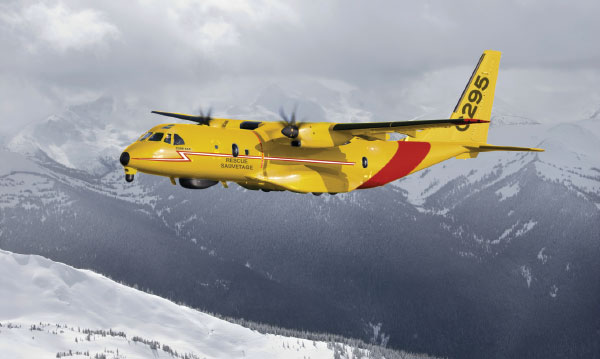
C295 referred to as “the reliable workhorse” is the most capable and versatile transport and surveillance aircraft for use facing current and future challenges: Increasing number of piracy attacks over oil tankers and offshore platforms, Need for environment protection against oil spillages, Monitoring and Surveillance of Exclusive Economic, Zone and Fisheries Protection on territorial waters, Maritime Search and Rescue, Medical Evacuation, High maneuverability and excellent low-level flying, qualities for maritime and sea ops, Maritime Surveillance and Pollution Control sensors on same aircraft, Proven Mission System with renewed tactical system FITS and advanced mission sensors for target detection and classification
AAR for CSAR Helicopter Operations providing tactical capability for Air Refueling of helicopters a Force multiplier for CSAR operations, MPA in Mediterranean Sea, C295 MPA has the capacity for dropping of large rescue packages, Largest endurance in its class, Detection and tracking of small targets, Increasing need for Maritime Patrol to control the dramatic number of human movements from North Africa, Air platforms as deployable on scene C2 for crisis management, Drug trafficking control from North
Africa to Europe, Search & Rescue needed to counteract higher rate of maritime distresses, Search & Rescue in the case of air accident Border surveillance: Security and terrorism response C295 Specific version for Ground surveillance with advanced surveillance, reconnaissance, imagery and target acquisition High resolution SAR / GMTI radar.
Plans to Work Jointly with Customers Worldwide to Deliver on the Airbus Group’s Mission
Mr. Stephan Miegel, Head of Military Aircraft Services presented the Airbus Group’s Service Strategy 2.0 that is focused on Services that drive 7 strategic paths toward commercial leadership, defense & space optimization and value creation: The strategy is to strengthen market position and profitability while remaining a leader in Commercial Aeronautics, Preserve leading position in European Defence & Space and Government markets, Exploit incremental innovation potential within their product programs, Focus on profitability, value creation, and market position, actively manage portfolio, Adapt to a more global world, Focusing on services on and around their platforms – Mr. Miegel emphasized “Services are a key enabler to execute on Strategy 2.0 along the 7 strategic paths”, in addition to Strengthening their value chain position. Focus, Leadership, Innovation, Differentiation, Profitability and Globalization were key terms used by Mr. Miegel as he elaborated on how the company’s outstanding teams, working jointly, with customers worldwide will work together to deliver on their mission with success.
The latest Developments on Eurofighter was Presented in Detail
Mr. Alberto Gutierrez, Head of Eurofighter Program provided an overview of the Eurofighter Program to TMB16 attendees, sharing that the aircraft has been ordered by 8 nations, 47 delivered to 5 customers in the last 12 months. It is combat proven and trusted security backbone of 6 Nations (GE, IT, SP, UK, AUT, KSA), however the Eurofighter Typhoon today is facing serious competition in Europe with the F-35. 599 a/c have been ordered – Europe’s largest military collaborative program, 21 Eurofighter Typhoon units spread across a wide range of operational locations, 478 a/c delivered, 21 operating units and over 340,000 flying hours achieved. Mr. Gutierrez discussed the Secured Capability Growth Path and Achievements of the program, the common capability route for all customers, and the approach to widening the collaboration and sharing principles to new customers, with continuous upgrades and add-ons along the life cycle. In 2014 Active Electronically Scanned Array Radar (AESA) contract was signed, in 2015 contract for P3E was signed, including Brimstone 2 integration, and in 2016 Successful Storm Shadow and Meteor missile trials were completed. There is a new 5-years Performance Based Material Availability Service Contract for Material Services and Repairs from 1st of August 2016 for Eurofighter operated by the Spanish and German Air Forces. The New 10-years Weapon System Availability Services in UK establishing the Future State Operating Model (FSOM) covering material services and further tasks such as training, fleet management, A/C repairs. There is a 5-years extension for Logistic and Engineering Support Services Contract from 1st of January 2017 for the 4 Core Nations. There is a new 8-years In-Service Support Contract signed with Austria, providing logistics, material and engineering support services. Contract extension to support Typhoon’s Radar and Defensive Aids Sub System (RDSS), which forms the backbone of Typhoon’s advanced situational awareness and target identification capability. Recently Kuwait Signed Contract for the Delivery of 28 Eurofighter Typhoons on April 5th, 2016. Mr. Gutierrez highlighted the promising outlook ahead for the Future Combat Air System (FCAS) having had a successful history thus far. A European / Multinational FCAS is the heart of the FCAS System of Systems approach, a Next Generation Weapon System (NGWS) will be tailored to customer needs and budgets, it is scalable and adaptable to future needs and technologies, it gives operational sovereignty to customers, secures existing defense industrial base and promotes innovation and growth over a wider spectrum of technologies and enables partnership.
The A400M is perfectly suited for today’s crises and able to land everywhere, with military operations with France, Germany, Turkey and the UK. The aircraft is currently in operational use with French Forces in Burkina Faso, Chad, Mali, Mauritania, Niger in Operation Barkhane; the RAF in Operation Shader, supporting Typhoon and Eurofighter Typhoon over Iraq and Syria; in Operation Chammal, supporting French MIRAGE 2000s over Iraq and Syria; supporting German Typhoons and Turkish fighters since 2015; and more. Mr. Fernando Alonso - Head of Military Aircraft Airbus DS, shared that the company expects to capture a 75% Tanker market share in the coming decade (not including future programs to complete US fleet renewal.) There is optimism that within the next 30 years, the company will see foreign sales of at least 200 A400Ms; and the US is considered to be the largest prospective client nation.
Journalists were given a Tour of the Facility of Airbus Helicopters at Donauwörth
On the second day of the TMB16 event journalists were given a tour of the facility at Donauwörth, Germany. Included in the presentations at this location included Mr. Jeronimo Amador, Head of Marketing MRTT & Other Airbus Derivatives shared highlights from his division: He gave an overview stating that 27 Aircraft in operation in 4 countries (5 RAAF, 6 RSAF, 3 UAE, 13 FSTA), Over 55.000 Flight Hours since Entry into Service in 2011. There are 3 new MRTT programs (French AF, Korean AF & Gov. of Singapore), 2 Full In Service Support customers (FSTA & RSAF), Up to 96% fleet availability (the highest record for a military platform) and Proven efficiency in Air to Air refueling operations. MRTT Operations provided 24/7 support directly on Customer Base to ensure Mission Success. Mr. Amador detailed that during the last months, their customers have been operating their A330-MRTT fleet flying well over the originally expected flight hours, proving a very high reliability in their missions. He also noted that these reliability figures are close to the ones provided by the civil A330 and, therefore, could be considered as a record for a military platform. Also, MRTT aircraft are qualified to refuel several type aircrafts (i.e. fighters, tankers, transport), using both boom and pod systems. In addition, Mr. Amador touched on Air-to-Air Refueling - Automatic Refueling (A3R), In-Flight Training (AR), Hose Length Indication Lights, In Flight Training: Real Tanker + Augmented Reality, Hose & Drogue Visual Aids, Hose Length Indication Lights, Smart Tanker - WB SATCOM, Increased connectivity, and additional ISR capabilities. In addition, another development is the JRE (Joint Range Extension) Link16 for Tankers. The application of Link 16 JRE Functionality in the tanker
Airborne Laser Terminal – Flight Demonstration is scheduled to take place by end of July 2016, over a Spanish restricted airspace area, performing up to 8 independent air-to-sat laser links between the Airbus DS Optronics terminal onboard de A310, and the EDRS-A satellite in its geospatial orbit.
Strategic Tankers are positioned to be a solid market in the coming years and Airbus Defence & Space has made the decision to invest in a new A330 MRTT Full Flight Simulator on top of the already existing ARO (Air Refueling Operator Simulator). The FFS will be fully operational by the first quarter 2018. The simulator will be manufactured by INDRA and will be located in the already existing state of the art training facilities in Seville: International Training Center. The new FFS will significantly enhance the in house training capabilities for MRTT.
HForce and an up-close look at the H145 - Airbus’s alternative Laser Guided Rocket, the “Cirit”
Mr. Christian Fanchini, Senior Operational Marketing Manager provided detailed insight into the HForce Generic Weapon System (GWC). It is geared at enabling operators to quickly and easily transform their civilian platforms into armed military ones by means of a single common mission computer. He shared details of the timeline: The program launched in April 2014, Entry into service of central unit test bench: May 2015, 1st Flight: December 2015, 22nd February 2016: Unveiling to the international press in Marignan, 1st firing campaign successfully completed at a test range in Belgium from 25 May to 3 June, involving a company-owned H225M helicopter to demonstrate the system with ballistic weapons, including 12.7 mm machine guns, 20 mm cannons, and 70 mm rockets. The company announced June 13 that it has completed initial testing of its modular HForce Generic Weapon System (GWC). The first fully qualified H225M should be ready in 2017, to be followed in 2018 by the H125M and in 2019 by the H145M.
The media tour at the Helicopter facility at Donauwörth, included a H145M Royal Thai Navy In-flight presentation as well as a H145M static display briefing. Mr. Mark Henning, H145 Program Governmental business, provided journalists with an up-close look at the H145 and the H145M with candid discussions about features and capabilities. He gave a quick background of the aircraft sharing that “the EC145 comes from the old BK117 that was the original type in the 80’s and we built and delivered about 300 BK117, then we changed the fuselage and some other systems in the aircraft to make it a fully digital cockpit; at that point in time, it was called DC145c2 which was civil certified in the year 2001 (Mr. Henning specifically noted that it is ‘Charlie-2’ not to be confused with the T2.) We have delivered about 750 aircraft of that type to international customers, the far biggest customer of the DC145c2 is the US Army with the Lakota; we have delivered about 330 aircraft as of now and we hope to deliver about 500 of these to the US Army. They selected this aircraft as their trainer aircraft, and they are a very important customer for us.” He added “because the engine was so strong with the H subtype, we had to replace the tailbone from the old BK117 version with a new carbon fiber tailbone.” Enhancements incorporated in the H145 include Airbus Helicopters’ innovative Helionix avionics suite and 4-axis autopilot; increased performance through the Arriel 2E engines; an anti-torque system with the latest version of the company’s signature Fenestron shrouded tail rotor; and a new tail gearbox as well as an upgraded main gearbox. During the tour Mr. Henning pointed out to the journalists, the differences between the H145 and the H145M, wittingly reminding onlookers that “M is for ‘more’ - it has a higher a take-off mass” as he drew attention to the outside of the H145M observing the reinforcements on the outside of the aircraft. Amongst the conversations during the tour, a journalist inquired as to why the H145 is not considered an attack helicopter. Mr. Henning replied “It’s a light attack helicopter, it is a multi-role aircraft, for smaller forces, with smaller fleets with multi-role missions, for use in light transport, utility, casualty evacuation, medical evacuation, the helicopter can also be used for armed reconnaissance and light attack. The aircraft can be reconfigured very quickly based on the mission.” He discussed how the H145 is prepared with a baseline for laser guided rockets and elaborated “We are integrating the FZ275 laser guided rocket, which uses a standard rocket launder from FZ and the laser designator from the MX15d, and recently with Roketsan we have a memorandum of understanding (MoU) and we are looking at an alternative laser guided rocket the CIRIT.” (Airbus and Roketsan signed a memorandum of understanding (MoU) on 13 July covering the integration of weapons systems on the Airbus C295W surveillance and transport aircraft. The agreement covers the integration of the Cirit 70 mm air-to-surface semi-active laser-guided missile, UMTAS long-range laser-guided anti-tank missile, and the Teber laser-guided bomb.) Mr. Henning continued on the discussion of customer options for the H145 “Our customers can select their equipment, of course we can recommend our baseline equipment but if a customer says for example that they want a different electro-optical system, we can modify with, for example, an Aselsan system. We will fulfill the customer wishes.”
Aftermath the site tour, Mr. Morris provided an overview of the selection of the H135/H145 family as the UK military training helicopters for the UK’s Military Flying Training System (UKMFTS). The contract is valued at £500 million over 17 years and Airbus Helicopters will supply a fleet of H135 and H145 capable of delivering the 28,000 hours per year necessary to meet the training requirement. Airbus Helicopters will deliver aircraft and an integrated support solution over the course of 18 months, ready to start training in April 2018, involving the manufacture of aircraft in addition to developing the support infrastructure and training initial crews and maintenance personnel. The Airbus Helicopters facilities in Donauwörth is the second largest Airbus Helicopter facility and it is the largest employer in the region with more than 7000 employees who have achieved the successful delivery of more than 11,930 helicopters to 3010 operators in 149 countries. The training academy located next to the production line, offers training for pilots and mechanics. It encompasses a H135 full-flight simulator. The facility has two assembly lines, one military and one civilian, development center, training academy and training workshop, civil maintenance center, customer center, competence center composite as well as a shop building doors for Airbus commercial jetliners. Engineering teams focus on the development of composites not only for Airbus Helicopter but also for all branches of Airbus. The H135, H145, EC665 Tiger, NH90 FAM and NH90 Sea Lion are built in Donauwörth. The proposed modifications were revealed during the TMB16 media tour for the NH90 of the Donauwörth production facility. Modifications include a dipping sonor; sonobuoys; heavy-stores carriage; AS2u Marte Mk 2 missile; MU90 torpedo; additional internal and external fuel tanks; a stores management system; as well as a second mission console. , builds on capabilities already incorporated that will enable it to replace the DM’s Westland Mk 41 Sea King maritime helicopter, with new anti-submarine warfare (ASW) and anti-surface vessel warfare (ASuW) modifications needed for a Sea Lynx replacement.





