Airbus Unveils LOUT Stealth Testbed
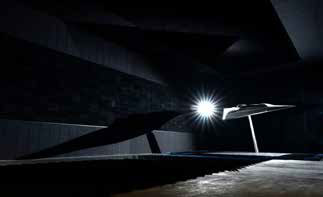
On November 5, during TMB 2019 Airbus unveiled for the first time a 4-ton classified Low Observable UAV Testbed (LOUT) that it has been developing in secret for almost 12 years at the Manching facility with a Shunk Works approach for the German Government. The Editor of Chief of Defence Turkey Magazine also attended the launch ceremony held at the ADS Manching facility where the LOUT model was revealed in a hangar with an anechoic chamber. On this non-flying 12m x 12m diamond-shaped subsonic UAV, Airbus has been working on very low observable (VLO) technologies in terms of designs, coatings and antennae that might be fed into the Future Combat Air System (FCAS) Project. LOUT design is focused on broadband radar, IR and acoustic signature reduction. It is claimed that the LOUT’s stealth profile makes it completely undetectable from air defence threats and radar-based detection. “It will make a valid contribution to the FCAS,” said Mario HERTZOG, FCAS Senior Project Manager.
According to HERTZOG the initial concept work on LOUT began in 2007 through Airbus internal funding, and the development continued in Skunk Works-like secrecy. LOUT was contracted by the German MoD in 2010 as a VLO ground testbed to demonstrate wideband signature reduction technologies and refine configuration and material choices for a potential configuration of a VLO-platform. Noting that ADS has been involved in VLO technologies for several years, HERTZOG said, “Bringing all our experience into one program was a logical conclusion. “Stealth is and will remain an enabler for survivability,” he added. During the development process, several configurations were elaborated. The company started with 2D platform evaluations, followed by 3D layouts, and then 3D configurations. The testing of the three most promising configurations was launched in 2014, and following the tunnel tests of scale-models, Airbus decided on a diamond platform shape in 2015.
LOUT covers all aspects, from simulation and development to production and measurement. The program aims to demonstrate a holistic approach to low observability. It is designed to offer visual, acoustic, radar (VHF to Ka-Band), and infrared signature reduction against ground-based threats, as well as the use of electronic countermeasures and electromagnetic emission control. The aircraft features an internal weapons bay located in between the engines with all-aspect stealth design features. The model has low-RCS diverterless air inlets mounted on top of the aircraft and a thrust-vectoring flat exhaust nozzle that is protected against ground-based sensors. LOUT also features a cockpit to test the properties of several transparency technologies that do not affect the aircraft's low observability. The canopy represents the installation of electro-optical sensors and does not indicate any manned capability for the aircraft. To further contribute to the low-observability, the aircraft features minimized gaps between surfaces as well as surface-wave attenuation that decouples mutually spaced scattering effects.
The model, which does not incorporate any traditional flight control surfaces, bears a striking resemblance to the twin-engine Airbus SAGITTA UAV that flew for the first time on July 5, 2017. Airbus launched the SAGITTA demonstrator in 2010 to jointly develop advanced technologies for unmanned flight. The project started as a feasibility study for the flying-wing configuration and developed in conjunction with institutes from the technical universities of Munich and Chemnitz, the University of the Federal Armed Forces (Universität der Bundeswehr), the Ingolstadt University of Applied Sciences and the German Aerospace Centre (DLR). Airbus stated that the research vehicle was constructed to a scale of 1:4 with a 3m wingspan, which corresponds to the 12m wingspan LOUT design.
The LOUT Program does not aim to produce a flying testbed; it intends to provide the means for developing and understanding low observable technologies. It focuses on testing radar-absorbent materials, LO structure, radar frequency, and infrared signature reduction, as well as analyzing the acoustic characteristics of such a design. Airbus affirmed that it completed contracted work on LOUT, and the first phase of testing has been completed but stated that additional phases could follow. It is expected that the technological gains from the LOUT Program will be available for EuroFighter Typhoon Long Term Evolution (LTE) activities and the proposed Future Combat Air System (FCAS/SCAF) being developed by France, Germany, and Spain.