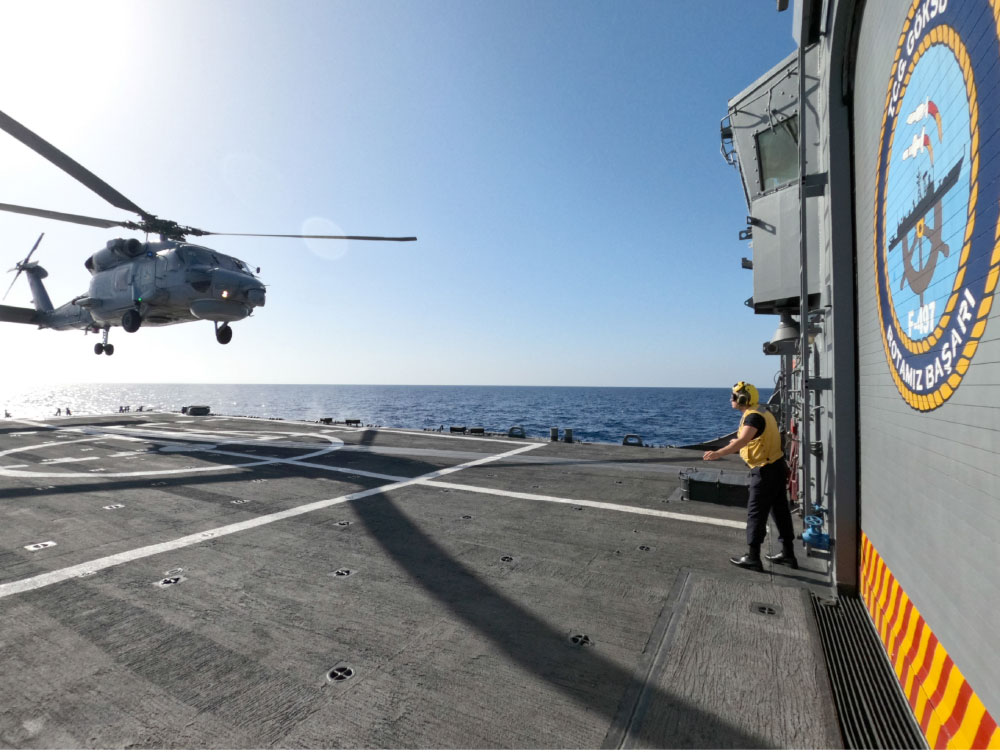
`Aircraft Secure and Traverse System `HAYAT` will Initially be Used on Offshore Patrol Vessels!`
Defence Turkey: Could you briefly inform us about the activities performed by HeliPLAT?
Fuat AKPINAR: On January 1, 2016, I retired from the Naval Forces Naval Command. I was the Navy's first platform inspector and I also served as the trainer inspector. The Defense Industry Agency (SSB) and Shipyards’ management called me when I retired and encouraged me to start a business to support them. They said they were supporting me as well. The requirement to carry out the Helicopter Platform Certification process of the ships with entirely national capabilities occurred during the process that started with the manufacturing of MILGEMs, our national warships. Starting with MILGEMs, our company is responsible for managing all aspects of the certification of the helicopter platforms for the LST Class Ships (Sancaktar and Bayraktar), Submarine Rescue (Alemdar), and Towing Ships (Akın-Işın), Fleet Replenishment Ship (DİMDEG), TUSK Corvette built for Turkmenistan, QTS Class Ships (Al Doha and Al Shamal) built for Qatar, and OPVs built for Nigeria.
In addition, we worked on the non-slip coating and lighting for the helipad in the TCG Anadolu LHD Ship Project. We also modernized the Helicopter Platform-Hangar lighting system on the Coast Guard Search and Rescue Ships built by RMK Shipyard.
The activities we carry out include engineering calculations according to the model, type, and weight of the helicopter that will land on the ship. In this regard, we calculate the landing area, and then we produce engineering drawings. We also install the fire system, the communication system, the JP-5 fuel system, the starting and feeding system of the helicopter, and the visual landing aid system. We follow their assembly on-site, and then we conduct tests.
Defence Turkey: So, you don't provide those products. You carry out the required preliminary planning and design for them. After that, you integrate them. It's a kind of engineering support.
Fuat AKPINAR: We don't provide any products. We specify the features which the product must have (the technical specifications), and we provide certification engineering support. In addition, we also conduct tests as they are assembled on-site. We have test equipment approved by TÜRKAK. We also have engineers on our team, including marine engineers and materials and metallurgical engineers. Together with this staff, we manage the certification process of all our ships. We also train the user on how to use the equipment/systems. Finally, we deliver the project by having the helicopter land on these platforms, which are prepared for helicopters and whose certifications are approved.
Speaking of products, I should also mention that the Defense Industry Agency has given us another responsibility for indigenization, which is applicable to every product we use, touch, or handle, and which is supplied from abroad. In coordination with the Defense Industry Agency's Department of Indigenization, the companies with production capabilities are identified. If Türkiye has an urgent need, the Defense Industry Agency directly owns it. If it is a second-priority product, the Defense Industry Agency directs us to the General Directorate of Shipyards. The General Directorate of Shipyards and the shipyards' experts examine this factory/company. They examine the product to be produced. We make a Strategic Cooperation Agreement upon the approval process. Thus, foreign dependency is minimized in this way. A domestic product arrives with a domestic stock number. Once this domestic product is put into service and its quality has been confirmed, it begins to be employed aboard our ships. While we are carrying out this activity, for example, DEARSAN is building ships for Turkmenistan and Nigeria. ADİK built and delivered ships to Qatar. Therefore, the products we produce are also exported. This is how we contribute to the country. As a result, we are bringing the money that has been sent abroad back home.
Apart from this, we are also interested in products with advanced technology and novel design. For instance, if they include features like artificial intelligence, then more beautiful things happen. This is how we developed the Automated Foreign Object Detection System (A-FOD) and launched it with ArgosAI. 22 units were initially sold to London Heathrow Airport. Then it won the first prize for technology design in Türkiye. They were installed at Istanbul Airport, and the tests were completed. It detects foreign objects with artificial intelligence and alerts the tower.
Defence Turkey: Does it use a laser for detection?
Fuat AKPINAR: It uses infrared camera systems. It has artificial intelligence and its own library. It says this is a frog, this is oakum, this is a laptop, or if it's a dead bird, it says this is a pigeon or crow. It informs the personnel there. As you know, the Concorde jet crashed because of a small metal piece hitting the tank, and the company went bankrupt. Therefore, this is a critical issue at airports, and the annual damage it causes is very high. If you ask what is forgotten the most, the laptop is forgotten. They are accidentally left there by technicians and staff. Necessary work is being done on the runway because operations should not stop on the runway. Additionally, for instance, 800 kits were supplied from the US annually for the special production of non-slip coating/painting of helipads on ships. We had this produced domestically with the company DURATEK after 4 years of effort, so it is no longer imported from the US.
Defence Turkey: Is the material used for each runway the same?
Fuat AKPINAR: No, it's different. It depends on the model and type of helicopter. It's more sophisticated in the military. In civilian helicopters, it is a little lower. Because in the military, there is constant movement, there is fuel supply, and the number of landings and take-offs is higher. Therefore, in the process, we started with anti-slip coating and had the Visual Landing Aid System made by AKIM METAL. Last week, a Strategic Cooperation Agreement was signed. The outdated technology helicopter lighting system currently used by our navy will be modernized, and at the same time, our ships will no longer be foreign-dependent.
Defence Turkey: So, what stage are we at with the Aircraft Ship Integrated Secure and Traverse (ASIST) System, a helicopter landing and take-off support system, in this indigenization process? What is the latest status of the assignment, company selection, employee training, and product indigenization?
Fuat AKPINAR: One of our indigenization efforts is the ASIST System. The ASIST System can land the helicopter at sea state 4-5 conditions, that is, when the sea and swell waves are higher. It follows the helicopter with a camera system and laser pointers, enabling it to land on the computer-controlled Rapid Securing Device (RSD), which captures and secures the helicopter. Such a system is required in adverse weather conditions. We initiated the project with ADVENS-SONITUS companies. Naturally, our businesses are unable to market specific products sustainably. ASIST is one of those products. We made a version of the MANTIS System from the same Canadian Company. This product, called HATS (Aircraft Towing System), is solely used for towing purposes. It is remotely controlled by a waist-mounted console connected to the device via cable. Think of it as a helicopter transfer system. It features two front-mounted clamp arms to secure and tow the helicopter into the hangar. HATS is first unveiled here at the SAHA EXPO Exhibition. The certification process will start after the exhibition. Similar to ASIST, the indigenously designed and produced Aircraft Secure and Traverse System "HAYAT" will initially be used on Offshore Patrol Vessels. The HAYAT Project has already been signed and approved. It is proceeding according to schedule. In addition, while making a product, we also develop another backup solution. Let's say there is a malfunction in ASIST/HAYAT, and we must take the helicopter inside the hangar. The helicopter is 10 tons (SH-70 SeaHawk). This is where HATS steps in. It secures the helicopter from the front wheel and remotely transfers it to the hangar using the waist-mounted controller without anyone touching the aircraft. The pilots don't want anyone to interfere because it has sensors, antennas, and weapon systems. Therefore, they can easily take it inside. Who else will require this product (HATS)? For example, TUSAŞ, RedStar, Kaan Air, and Special Operations will need it. These are the advantages of indigenization.
Defence Turkey: Was this project initiated in parallel with the indigenous ASIST HAYAT Project?
Fuat AKPINAR:Yes. ASIST is also in progress.
Defence Turkey: ASIST also has a computer-controlled Rapid Securing Device (RSD). The RSD, which can automatically move fore and aft along the flight deck track, maintains its position directly beneath a probe on the underside of the helicopter, and upon touchdown, the probe is secured by the RSD, and the helicopter is ready to be aligned and traversed into the hangar.
Fuat AKPINAR: I was the one who prepared ASIST's first launch experience guideline. It was claimed that it could not be achieved in Türkiye. However, we have already completed the tracks. The FATs of other components are ongoing.
Defence Turkey: Will there be a difference between the indigenous version and the foreign version? Given that the ASIST product has a history of around 30 years, but we are in the 2020s now?
Fuat AKPINAR:Ours will be more sophisticated. We have 38 ships right now, each having a helipad. So, when we develop a product for the Navy, we should also be able to provide support services to them. The components we make must also be compatible with the Planned Maintenance System in terms of the sustainability of the existing systems. We must be able to maintain them because it is not possible to replace all of them at once. It is also highly challenging both from an economical and practical standpoint. Therefore, we need to harmonize the outdated systems with the new ones that have been installed on our new ships. In other words, while designing and producing a new Helicopter Secure and Traverse System, we should also be able to maintain the old system.
Defence Turkey: Is there any agreement on that? As far as I know, the ASIST System is available on four MEKOs and eight GABYA Class Frigates.
Fuat AKPINAR: Eight GABYA Class, four MEKO Class Frigates, and four MILGEM ADA Class Corvettes have already been equipped with the ASIST system. They also have a Visual Landing Aid System. The Strategic Cooperation Agreement for the modernization of the Visual Landing Aid System was signed last week at Gölcük Naval Shipyard Command under the auspices of the General Directorate of Shipyards. The helipad lighting systems on the GABYA and MEKO Class Frigates will be upgraded. The old halogen light bulbs on the helipad (i.e., car headlights) will be replaced with LED PCBs compatible with Night Vision Goggles (NVG).
Defence Turkey: Is the Visual Landing Assist System you just mentioned an easily replicable system, or will it be replaced/installed during the overhaul?
Fuat AKPINAR: It is normally done during the maintenance period that is carried out every 5 years. However, as HeliPLAT we can prepare a ship every 12 days. However, it is slightly more challenging on older ships since cable laying takes a little longer. Therefore, after the company gains the necessary hands-on experience, let's say it completes the task in 20 days; this period will then decrease to 15 days and 10 days after a while.
Defence Turkey: For example, in the ongoing I Class Project or the BARBAROS Mid-Life Upgrade Project, can this replacement be made while the ships are there?
Fuat AKPINAR: Since the contracts and product/company selections in the I-Class Project were made in the past, they cannot be changed now. However, I hope that the indigenously produced Visual Landing Aid System will be used in our future national projects.
Defence Turkey: Can you please tell us about the Visual Landing Aid System over the mock-up/model here?
Fuat AKPINAR: We use it during our training programs. We provide training to aviation students in aviation workshops or at our office for free. The Visual Landing Aid System is a complete system with features such as the Stabilized Glide Slope Indicator (SGSI) and Horizon Reference System (HRS).
Defence Turkey: Do all three of these lights flash simultaneously?
Fuat AKPINAR: The SGSI has three colored light beams, and all three lights flash simultaneously. It provides red, green, and amber lights and the pilot can see these lights with his night vision goggles. When the green color comes in the horizon line, the pilot looks at the HRS on the final approach, and the horizon bar shows the pilot the ship's roll and pitch motion. After the HRS is completely flat green, the pilot looks over the shoulder with the eye-line lights and lands the helicopter there. During descent, if the ship has the ASIST system, it also follows the helicopter (Editor's Note: ASIST's precise Helicopter Position Sensing Equipment (HPSE) system continuously tracks and monitors the exact position of the helicopter relative to the designated landing area and displays it to the pilot through a series of visual landing cues. Guidance data is simultaneously relayed to a computer-controlled Rapid Securing Device (RSD), which automatically moves fore and aft along the flight deck track to maintain its position directly beneath a probe on the underside of the helicopter. Immediately upon touchdown, the probe is secured by the RSD, and the aircraft is ready to be aligned and traversed into the hangar).
Defence Turkey: Could you briefly tell us about the other indigenization activities that HeliPLAT has performed?
Fuat AKPINAR: One thing that makes us happy is the indigenization corner in our company building. For emergency lighting, the products purchased from abroad were made as IP56, but by working with AKIM METAL - FERMADA Group, we successfully produced IP68 emergency lighting systems. The helmets, ultraviolet glasses, and flashlights used by the Emergency Response Teams are also made locally. We also locally produced mechanical fasteners (i.e., eyebolts), which are used to secure helicopters to the fight deck, together with ABS PV Company and ended the foreign dependency for this equipment. As I have mentioned, we made the non-slip coating with DURATEK Company. We have chocks used to prevent the accidental movement of helicopters. We also produced floating rope and sinking rope with the company KAYA ROPES. Because you need to have a floating rope at the stern to prevent it from getting tangled in the propeller, but you must use a sinking rope at the ship's bow. We collaborate with successful companies in our country. We are proud of them. We will further expand our product family and perform even more amazing feats.
Defence Turkey: Mr. AKPINAR, thank you for your time, and we wish you success in your future endeavors.





