Alenia Aermacchi Focuses on Turkish Market
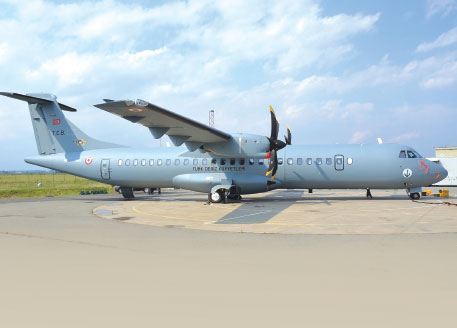
The Turkish aeronautics sector offers strong prospects for Alenia Aermacchi, which is currently promoting its industrial and technological capabilities in integrated training systems, special versions aircraft (for maritime patrole and anti-submarine warfare roles) and tactical transport aircraft. The supply of the ATR 72 ASWs (Anti-Submarine Warfare) to the Turkish Navy represents an important industrial co-operation in the aeronautics sector.
On **July 2012** Alenia Aermacchi has signed an agreement with Undersecretariat for Defence Industries (SSM) to deliver two ATR 72-600 TMUA (Turkish Maritime Utility Aircraft, already delivered to the Turkish Navy in July and August 2013) and six ATR 72-600 TMPA (Turkish Maritime Patrol Aircraft) to the Turkish Navy. The contract calls for strong industrial collaboration between Alenia Aermacchi and Turkish Aerospace Industry (TAI) for the duration of the project.
Designed, developed and manufactured by Alenia Aermacchi for anti-submarine warfare (based on the civil ATR 72), the ATR 72 ASW is a highly-efficient medium-range aircraft, with competitive purchase and operating costs, and is also able to conduct maritime patrol missions.
Thanks to the agreement, the Turkish Navy will obtain the last generation ATR72-600 equipped with a glass cockpit as well as more powerful engines that guarantee best performance and supportability for the next 30 years.
The C-27J tactical transport aircraft produced by Alenia Aermacchi is an optimum solution for Air Force with demanding military mission requirements and larger strategic airlift, now offered also in the MC-27J multi-mission version armed with direct and indirect weapons for special forces use. Its interoperability and common use by other NATO partners would provide the Turkish Air Force with a strong transport capability to participate in multinational activities such as peacekeeping, humanitarian relief and disaster response. The C-27J is interoperable with the A400M with making use of the same cargo pallets. The C-27J is fully autonomous and can be operated in many out-of-theatre scenarios .
In the field of Integrated Training Systems Alenia Aermacchi has developed an advanced system to accompany student pilots from flight school entry up to lead-in fighter training, guaranteeing a highly effective training course, while allowing air forces to achieve significant cost reductions.
Alenia Aermacchi has developed an advanced system to accompany student pilots from flight school entry up to lead-in fighter training, guaranteeing a highly effective training course, while allowing air forces to achieve significant cost reductions.
Today, Alenia Aermacchi is the only company in the world to offer complete and integrated training systems. Thanks to its range of trainer aircraft, Alenia Aermacchi can cover the pilot’s complete training syllabus, from the screening and primary phase on the lightweight propeller-driven SF-260TP, to the basic phase on the low-cost, yet proficient, single-engine turbofan-powered M-345, up to the advanced and LIFT (Lead-In Fighter Training) phase on the twin-engine M-346, which is unanimously known as its category leader. All this is further supported by a complete Ground Based Training System (GBTS) which includes specific simulators and computer based didactic devices for each aircraft.
Alenia Aermacchi offers to its customers a complete ITS, Integrated Training System, supplying all the elements required to build up a comprehensive flight academy, from the TNA (Training Needs Analysis) to the ground infrastructure design (classrooms, simulators, storage rooms, flight line devices, service hangars, etc.), through the supply of an advanced Training Management Information System (TMIS), essentially an IT system working as the school “Director”.
Screening and primary training: SF-260, an evergreen classic. For the screening and the so-called Phase 1 primary training, Alenia Aermacchi offers the SF-260 of which more than 900 have been delivered so far, today proposed in two versions with a 260hp fully aerobatic Lycoming AEIO-540 piston engine, and a 350shp Rolls-Royce Model 250 turboprop. The latter variant, designated the SF-260TP, offers high performance using jet fuel, particularly in hot-and-high condition.
However latest training and industrial requirements, together with further reduced defence budget are pushing Alenia Aermacchi to look to new solution capable to satisfy both screening and primary training.
Between the years 1990-1993 Alenia Aermacchi (at that time SIAE Marchetti), provided to Turkish Aiforce 40 SF-260, that were locally built in Turkish Aerospace Industry (TAI) using the components produced by SIAI Marchetti.
Currently the fllet is still in service for training the pilots of the Turkish Air Force.
Thanks to its superior aerodynamics, side-by-side layout (rather than tandem) of the cabin seats, allowing a better interaction between the student and instructor and the automatic fuel management system, the SF-260TP is specifically fitted for student pilots to make their first flights in total safety. Its high manoeuvrability, performance level, and advanced avionics allow the aircraft to extend the training Phase 1, which is typically limited to basic flying activities, navigation and to the instrumental flight and landing.
The latest version of the SF-260TP features a “glass cockpit” with two 15 x 20cm LCD displays integrated with a Control Display Unit (CDU) to manage the various operating modes, and VOR/ILS, ADF, DME, GPS, ADI and HSI systems. Furthermore an infrared camera installed under the right wing provides an Enhanced Vision System for safer night navigation or in case of bad weather conditions. All these characteristics make the SF-260TP also perfectly suitable to cover the first part of the basic training (Phase 2) that normally includes instrument and formation flights.
Basic training: M-345, the revolution.
For the Phase 2 training segment, in the past Alenia Aermacchi has proposed the successful MB-339, currently in service with several air forces around the world. However, this excellent aircraft is now planned to give way to the brand new M-345 HET (High Efficiency Trainer) which is being developed and scheduled to enter service starting from 2017.
The M-345 originates from the SIAI Marchetti S.211A, of which it maintains the basic advanced aerodynamic design, which includes a supercritical wing airfoil, whereas some structural components, the engine of 1550kg thrust class, avionics and systems are completely new.
With the M-345 HET Alenia Aermacchi decidedly takes a new direction, proposing a solution which guarantees a cost-effective ratio lower than the modern “heavy” turboprop trainers from the USA, Brazil and Switzerland. Compared to these aircraft, the M-345 features decidedly higher performance, specifically with regard to the transfer speed to the training range and the altitude, leading to a drastic reduction of “idle times” in each training session, because within the representative flight hour the student pilot can perform a higher number of tasks included in the Training Needs Analysis thus completing the syllabus in a 25% shorter time period (from the standard 120 hours down to 90).
Obviously, a turbofan burns more fuel than a turboprop, in this specific case averaging 30% more, but the M-345 performance, together with its advanced avionics including a Digital Moving Map, Store Management System and outstanding Embedded Tactical Training System (ETTS) allow to extend the basic training phase up to the introduction of air combat tactics, thus anticipating the next advanced training phase which the student pilot can reach with higher skills, thus reducing the flight hours needed on an advanced trainer.
Speed is important for training so the M-345 significantly reduces the transfer time to the training areas because, thanks to its ability to maintain a cruise speed of 300KTS at altitudes higher than 20,000ft, it can use the commercial airways without interfering with the civilian traffic, unlike turboprops which cannot fly with airliners because they cannot exceed 240KTS at those altitudes.
In a typical air-to-air training engagement, the M-345 compared to a heavyweight turboprop, has a maximum speed at altitude of 425KTS, against the 334 of the fastest turboprop trainer and around 300 of the average turboprop trainers.
Speed is even more important for the air-to-ground engagement training, where the whole procedure of target approach, weapon release and escape must comply with a precise schedule. In low altitude tactical navigation, conventional turboprop trainers, featuring a traditional aerodynamic configuration, typically maintain a cruise speed of 240KTS, whereas the fastest among them, featuring a more advanced aerodynamics and increased engine power, can reach a value of 300. In the same conditions, the M-345 can navigate at 360KTS: a noteworthy difference for this training mission in this phase.
A faster aircraft means getting the student pilot familiarized with very short reaction times and thus, more similar to those to be sustained in the advanced training phase, as they fly at a performance level more similar to those required in real missions.
With the M-345, flying the same number of flight hours the student pilot can complete Phase 2 with a significantly higher skill level, also including the management of sensors and weapons and the air-to-air and air-to-ground engagement procedures. In concrete terms, the air force can reduce the basic phase flight hours, for instance, from 120 to 90 or maintaining the 120 hours including the introduction to tactics, thus reducing Phase 3 on the advanced trainer from 70 to 50 hours (more than 28% less), and achieving great economic savings.
Advanced training and LIFT phases: M-346, the market leader.
Alenia Aermacchi’s system guarantees the best cost-effectiveness ratio also for the advanced training (Phase 3) and Lead-In Fighter Training (LIFT), which are indeed the most expensive yet also the most important phases of the whole training course.
For instance, it is enough to think that the same air forces which use the advanced high-speed turboprop trainer for both basic and advanced trainings for a total amount of 220 flight hours, must then perform a roughly 150 flight hour operating conversion period on the fighter twin-seat variant with each flight hour costing estimately 20-30 times more than with a basic aircraft.
The LIFT phase is even more important for those air forces which operate fighters with only single-seat variants, such as the F-22 and the F-35, because the idea to have a pilot flying the first time on a fifth generation fighter directly coming from turboprops, is unrealistic and unsafe.
With the M-346 and its Ground Based Training System, Alenia Aermacchi solves this issue without disregarding cost containment.
The M-346 characteristics and its Integrated Training System have been defined as allowing recreating the virtual scenarios for each training session.
The M-346 stands out for its manoeuvrability at a high angle-of-attack, over 35° (it is able to sustain load factors up to +8/-3 g), and also for its ability to reach transonic flight speeds (in levelled flight it sustains 590 KTS and rates of climb of 22,000ft per minute, allowing the student pilots to try their skills in tactics with reaction times similar to those of fighters. For instance, from take-off brake release up to the achievement of 40,000ft altitude, the M-346 takes 3 minutes, against the average 2 required by a modern fighter.
Older advanced trainers with traditional design yet still in production and on the market take more than 12 minutes. Furthermore, the M-346 offers such performance despite lacking an afterburner because it would significantly increment the flight hour average cost and the aircraft maintenance cost. The high fuel consumption of an afterburner engine would also reduce the aircraft endurance at the expense of training session duration.
For example in a given mission the M-346 has an average burn of 55kg of fuel per minute to get maximum performance, whereas its supersonic competitor - which, in order to reach the same manoeuvre performance as the M-346 must use the afterburner - burns more than three times.
Furthermore, the M-346 offers very high safety levels, thanks to its twin-engine solution (based on the turbofan Honeywell F-124-GA-200) equipped with FADEC (Full Authority Digital Electronic Control) and to the quadruple redundant fly-by-wire flight controls. The latter, further to guaranteeing the care-free handling, can be reprogrammed to impose limits for maximum angle-of-attack, load factors, rolling rate and stall prevention threshold, starting with a “less performing” aircraft and afterwards increasing its capacities as student pilots’ progress within their training.
The GBTS component developed by Alenia Aermacchi for the M-346 Integrated Training System is the most complete and advanced in the world. Further to the e-learning system, the procedural simulator and a 180° display simulator called the Part Task Trainer (a type of advanced version of the Phase 3 OFT), Phase 4 also provides for a Full Mission Simulator (FMS) whose 360° cupola visual guarantees an “extreme” realism.
The simulator cockpit is just like the real one and reacts exactly the same as the original, meanwhile the virtual map resolution, which reaches 50cm, makes the simulated experience unbelievably effective. Furthermore, the simulator also allows for the use of the NVG (Night Vision Goggles) and the HMD (Helmet Mounted Display).
With two simulators, two student pilots can test their ability in collaborative missions in pairs, both with their own virtual aircraft, or in air engagement. Alternatively, one of the two simulators can be equipped, by means of a proper “roll-in/roll-off” system, with the Weapon Systems Officer rear cockpit, in order to simulate a mission with pilot and system operating in pairs on the same aircraft.
The simulators can replicate any tactic situation, because the system can generate and manage an infinite number of “synthetic” units to populate the scenario.
In the Advanced and LIFT training phases, the simulator is crucial to prepare and test the missions before flight.
The M-346 GBTS system cannot be considered a mere tool to reduce costs replacing the flight hours. In fact, thanks to the integration of the ground simulator with the aircraft ETTS throughout the datalink, the concept of Live Virtual Constructive (LVC) simulation can be implemented by networking via datalink the aircraft (Live), the simulator (Virtual) and the ETTS (Constructive) within a distributed operating environment.
The last upgrade of the ETTS allows the student pilots to visualize the virtual aircraft entering their visual field through the Helmet Mounted Display.
The on-ground instructor supervises all training phases through the Real Time Monitoring Station (RTMS) connected to both simulators and flying aircraft (via datalink). Thanks to this feature, the instructor can intervene modifying the scenario in real-time, for instance adding or deleting a threat.
Among the Integrated Training System ground infrastructures the Mission Planning Debriefing Station (MPDS) is also noteworthy, where the instructor and the student pilot plan their missions and perform their debriefing.
The MPDS allows the student pilots to become accustomed to approaching the training missions, be they real or virtual flights, with the same modalities of a real mission, planning all details on ground.
In the same way, at the end of the mission, the debriefing is performed downloading all data collected during the flight. All this information is then transferred to the Training Management Information System, the above mentioned virtual school “Director” which records all tasks performed by the student pilots.