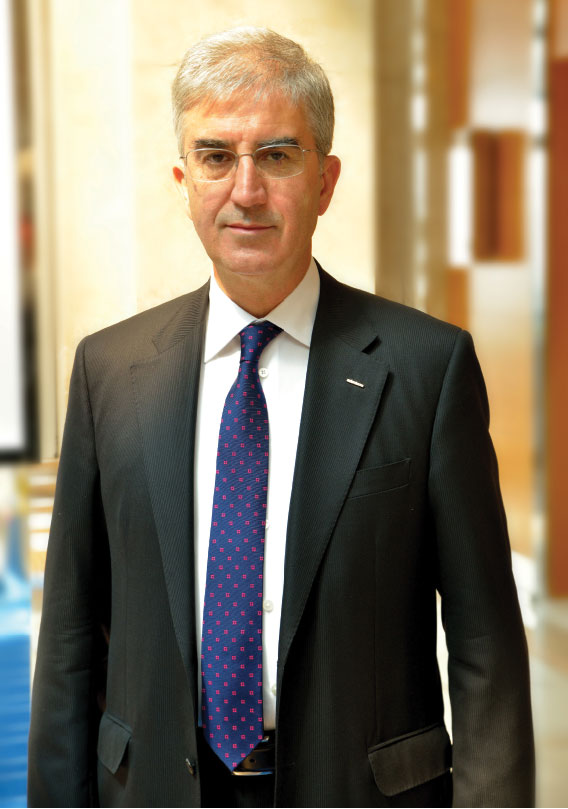
All Systems Go – Roketsan is Positioned as a Rising Global Company with the Velocity to Direct the Missile Technologies of the Future
Defence Turkey: Dear Mr.Selçuk Yaşar, first of all we would like to thank you for the interview. Can you provide us with a recap of Roketsan’s 2015 performance?
Roketsan’s foreign activities, in recent years, have been significantly impacted by the rapidly evolving relations affecting the world financially. We’ve adopted the principle of avoiding dependence upon a single resource and a single product. As a consequence of conducting our activities based upon this principle, and I can say that these problems have only had a minimal effect on us.
Defence Turkey: Taking into consideration your Company’s sales figures for the last five years, how do you assess your growth trend in domestic and foreign sales for the upcoming period? In association with this, what are your expectations for 2016 and the following years?
The boom in the exchange market and the extreme decrease in oil prices will clearly have a negative effect on our foreign sales in the short term. Affordable products with high technology and high precision have been in demand by our sector in recent years. In order to fulfill such expectations, we have been developing our high technology and high precision systems, for 7-8 years now. At this time, 2016 and onwards, we are aiming to cater to the Turkish Armed Forces’ requirements and to deliver our products to our clients in foreign markets as a result of our intensive marketing activities.
Defence Turkey: Roketsan products have reached a maturity level that is able to compete head to head with the products of worldwide rival companies. Moreover, the export figures have been increasing each year. Your export performance for 2014 reached $ 170 million with an increase of %176, compared to the prior year’s figures. Is it possible to sustain this type of export growth trend? What type of short and medium term strategies have you established to facilitate the continuation of this increased rate?
Compared with the rate of previous year, our export sales for 2014 increased by 176 %. With this export performance, amongst 61,000 companies in Turkey, our company climbed up to rank 76th in overall exports of Turkey and became the 3rd company in the defense industry sector in general. Focusing on maintaining this outstanding success, we are updating our export goal while increasing our share in the defense market by conducting effective marketing activities worldwide for our products.
Roketsan has already proven the quality it provides in products, design and services in the Middle East. In order to sustain our achievements in exports we will continue our activities in many areas around the world, spanning from America to the Far East and from South Africa to Northern Europe.
Roketsan has gained prominent acquisitions in the last twenty-seven years. With the establishment of a long-term steady technological infrastructure, in order to reduce risks, we will continue our contact extensively with our clients in various geographies. Additionally, we accomplished various strategic studies within this twenty-seven-year period for an organizational structure that is in a simultaneous parallel with the organizational structures of the governmental institutions of the sector.
In my opinion, we owe these achievements to our highly qualified and devoted staff that are deeply attached to national values.
Defence Turkey: In order to attain sustainable growth and a sustainable industry, our defense industry companies at sector events highlight the importance of achieving a balance between domestic and foreign sales. How do you approach this issue, what is your point of view?
To cultivate sustainable growth performance, strategic allocation of technology development and general capital investments in various areas, products and projects is of vital importance. Business enterprises should avoid depending on a single resource or a single product in order to maintain their activities. Roketsan aims to increase its technological and commercial acquisitions in numerous national and international projects and thus conducts its business accordingly.
Defence Turkey: With the Middle East market that Turkey is very active in, and also considering its focus on markets in African countries, South Africa, Turkic Republics and the South America, what are your thoughts about Roketsan’s current status and its future position with the NATO market?
In the 21st century, the Middle East and the Far East are regarded as regions with increasing global importance. Taking their rich natural resources and geopolitical advantages into consideration, all of the countries of these regions are expected to be effective increasingly in terms of political and military developments in the international arena. They will play more active roles within the international system from the second half of the 21st century onwards.
In recent years, defense expenses of countries across the world are experiencing a deceleration trend. However, due to the ongoing conflicts and tensions in the Middle East, the countries of the region and those intending to escalate their dominance in the region are increasing their defense expenditures. On the other hand, the threat perceptions of Russia, Syria, Iraq, Iran, North Korea and China, emerging from their relations with the neighboring countries, have been a catalyst for the increase in defense expenditures in those regions as well. Furthermore, there is still an important market opportunity, although relatively smaller, in Africa, Turkic Republics and South American countries, and Roketsan is quite focused on these areas.
In the realm of NATO countries, the joint utilization of military resources and the strategy of building a common foreign policy, fulfilling the requirements through reduced defense system procurement is on the agenda. Within this scope, Roketsan continues efforts toward participating in activities for concept development, building cooperation with NATO Allied Command Transformation prior to the procurement process, creating awareness and information related to the priorities of NATO and Turkey as well as areas of interest. Efforts to affect NATO’s capacity building continue.
In my opinion, Roketsan’s participation in platforms of strategic levels such as the NATO Industry Forum, and its involvement in coordinated activities through NATO’s Concept Development and Experimentation, would accelerate technological development, resulting in the acquisition of solutions related to the requirements of NATO allied countries (contributing to capacity development as well), increasing competitiveness and providing benefits. Without a doubt, as a result of such efforts, we expect Roketsan to reach a far better position within the market of NATO countries in the near future.
Defence Turkey: Mr. Yaşar, as Roketsan you assumed a notable role in the development process of the Low and Medium Altitude Air Defense Missile systems “Hisar-A” and “Hisar-O” programs. How are the testing and development processes related to these programs proceeding? Could you please summarize the current situation?
We designed the “Hisar-A” and “Hisar-O” missile systems in two different versions for Low and Medium Altitude in accordance with the requirements of the Turkish Armed Forces. These missile systems stand out amongst their rivals with their performance and technology.
Test firings of Hisar-A’s Controlled Test Missile-1 (KTF-1) with autopilot control and Ballistic Test Missile-2 (BTF-2) with a dual pulse solid propellant rocket motor, which itself is a first in Turkey, were successfully accomplished in Aksaray by Roketsan with the participation of the Turkish Land Forces Command, the Undersecretariat for Defense Industries (SSM) and Aselsan in June of 2015.
During the tests, which have now been completed; “Hisar-A” missiles successfully separated from the launcher with the ignition of the first pulse rocket motor, then igniting the second pulse motor in flight to perform programmed maneuvers under the control of on-board autopilot.
With the successful flight of the first dual pulse motor missile in Turkey, Roketsan proudly took its place amongst the limited number of companies with similar technological capabilities in the world. As a result of these firing tests, another milestone has been reached with the development of the first Indigenous Air and Defense Missile Systems of Turkey.
In the near future we plan to launch the serial production of the “Hisar” missiles, that we have been developing since 2011, in cooperation with the pioneering technology companies of Turkey and the world, under the guidance of Roketsan’s technology and experience.
Defence Turkey: Do you think that gaining such capacity would pave the way for Turkey’s skipping of a threshold, especially regarding the acquisition of High Altitude Air Defense missile systems?
Differing from other missile systems, the aim of the Air Defense Systems is high-speed with high maneuverability. Due to this characteristic, air defense missiles have to bear different and superior technologies. In order to fulfill the air and defense requirements of the future, “Hisar” missiles, under development, have Imaging Infrared Seeker (IRR), thrust vector control, Mid-course Guidance Via RF data link, and for the first time in worldwide air defense missiles, the dual pulse solid propellant.
Moreover, these missile systems have the potential of smooth integration to various types of platforms due to their alignment with the existing and future NATO/military standards. These systems, differing from each other with their ranges, dimensions and weights are being developed as an integrated product family due to their completely similar sub-systems.
In addition to our pride in attaining the prestige of Indigenous Air Defense Missiles for our country, considering the technological acquisitions, it offers design based on family integrity and ease of integration and logistics. “Hisar” missiles are a very significant accumulation for Turkey in reference to the acquisition of High Altitude Air and Defense Missile Systems.
Defence Turkey: After the cancellation of the T-LORAMIDS program, Turkish Defense Industry Companies were selected to be developed for High Altitude Air Defense System by the decision of the Turkish Defense Industry Executive Committee. Defense authorities agree that the system to be developed should fulfill the operational requirements of the next 20-30 years. On the other hand, threats are increasing and rapidly developing as well. Regarding this issue, rather than proceeding with a prototype system that would be launched in the next ten-years, in order to recover the time lost and use resources more efficiently, do you think that launching the more developed “Hisar-U” version of the ongoing “Hisar-O” at the first stage would be a more applicable model for creating an indigenous technological knowledge?
First of all, I would like to express my appreciation regarding this decision on the development of the High Altitude Air Defense System by the Turkish Defense Industry. Roketsan will successfully fulfill the tasks to be assumed as a result of that crucial decision and we possess the sufficient infrastructure and experience to develop these systems.
Surely, the technology is developing at an unprecedented pace worldwide. As a globally pioneering company, Roketsan has no intention of lagging behind in such developments. As Roketsan, beyond following the technological developments, we are proceeding towards the future as a company that leads technology. Within the scope of the Hisar program, we determined to exceed the technological requirements. Indigenous products were created through this challenge and we attained an important success.
At this very point, I believe it would be better to separate the Ballistic Air Defense – the most important requirement of the High Altitude Air Defense Missile Systems. Regardless of the contributions and advantages that the more improved version of “Hisar-O” system, the “Hisar-U” system would bring, in respect to building a national technological accumulation and rapidly fulfilling the air defense requirements, it should be kept in mind that indigenous technologies are still essential for developing a ballistic missile defense umbrella.
Defence Turkey: Mr. Yaşar, how are the integration activities going for Cirit and “UMTAS” missiles under development for the “Atak” helicopter? Could you please inform us on the process?
Upon the requirements identified during the development period, UMTAS missiles are qualified with two different guidance technologies and two warhead alternatives. In addition to the IIR seeker and insensitive tandem warhead in the development contract, through Roketsan’s own resources, laser seeker and anti-personnel warhead were included in the system configuration. Thus, enabling the armament of the similar platform both with IIR/laser seeker guidance and depending on the requirement with tandem or anti-personnel warhead. As a result, we offer our users the flexibility required by the operation environment. Both systems’ integration to the Atak helicopter is still ongoing.
Defence Turkey: The 2.75’’ Laser Guided “Cirit” missile not only features the rotary wing platforms but also has a flexible infrastructure allowing installation to both land and fixed land platforms in addition to the fixed-wing platforms. You’ve recently signed various cooperation agreements with several countries such as Germany and Poland as well as with major defense companies in order to make use of potential opportunities regarding the integration of these systems to existing platforms. What are your immediate expectations regarding these cooperation agreements and the foreign sales of our indigenous systems, namely the “Cirit” and “UMTAS”?
The integration of “Cirit” laser guided system to rotary-wing platforms in particular are currently going on, as well as the fixed-wing (manned/ unmanned) systems and land platforms. The integration of Cirit missile was completed in 6 different platforms composed of three rotary-wing platforms and 3 fixed-wing platforms. Considering land platforms, this system could be integrated to tracked and tactical wheeled vehicles as well. Within the scope of this concept, our product PMC (Pedestal Mounted Cirit) vehicle was displayed at IDEF 15’ and attracted considerable interest. Moreover, we have applications for fixed or towed platforms.
This product range and flexibility support our efforts to penetrate into foreign markets. We aim to sign new export agreements both for our anti-tank missile systems and for the laser guided “Cirit” missile systems in the near future.
Defence Turkey: Mr. Yaşar, in respect to the “SOM-J” Program, Roketsan signed an agreement with Lockheed Martin Company at the DSEI 2015 Fair. Which type of a model and cooperation are planned regarding the modification integration of “SOM-J” missiles to F-35 JSFs within the scope of this program? What are your remarks on the phases to be established and the identified program schedule?
The system design activities of the SOM-J missile are being conducted successfully in line with the program schedule. Cooperation continues between Lockheed Martin Missiles and Fire Control Unit and Roketsan toward revealing a world-class cutting-edge system.
We are planning to launch the SOM-J Design Review Meeting in coming period. The sub-system design and tests will be initiated thereafter.
The flight tests are scheduled to be launched with the Turkish Air Forces’ F-16 Block-40 aircrafts in the second quarter of 2017. The development program is expected to be completed in 2018.
As part of the F-35 Integration activities, our studies with LM Aero Company are continuing. We accomplished Phase-I (Feasibility Study) and Phase-IIA (Risk reduction). For the integration activities to be conducted in 2016 and onwards, our negotiations on a two-stage contract model continue.
Defence Turkey: Roketsan signed a MoU on the integration of “SOM” cruise missile to Eurofighter Typhoon aircrafts with the Airbus Defense and Space Company in 2014. Is there any progress regarding this issue? Meanwhile, with the “SOM” missiles brought into use at F-4 2020 and F-16 Block-40 aircrafts in the Turkish Armed Forces inventory, are there any demands coming from allied countries with F-4 and F-16 fleets? Which countries and which regions do you have contact with regarding this issue?
On SOM missile’s integration to Eurofighter Typhoon aircrafts, the content of the activities were discussed and agreed upon in the meetings conducted with the Airbus Defense and Space Company. The documents to be shared to this end were identified and the attempts for the permits for sharing these determined documents reached a final stage. We presume that the permits would be granted in 1-2 months and that the activities with the Airbus Defense and Space will be initiated soon.
Allied countries have demanded the SOM missile. Roketsan has received demands from countries having fleets in classes different than F-16 as well. Permits are required for sharing information with such countries and we are exerting efforts to this end. We believe that these activities would gain momentum as soon as the required permits are granted.
Defence Turkey: Could you briefly apprise us on the activities conducted in relation to the New Generation Laser Guidance Kit “TEBER”?
TEBER system is a new generation INS and GPS aided Laser Guided Kit and it is being developed through Roketsan’s own resources. MK-81 and MK-82 general-purpose bombs are transformed into smart ammunition and they are qualified with high precision hitting capability. TEBER is developed with the support of the Ministry of National Defense and the Air Forces Command. It is a laser guided (LAB) kit supported with Inertial Guidance System (INS) and Global Positioning System (GPS) and is capable of performing its tasks successfully under all weather conditions. The ammunition to which TEBER is integrated to has merely INS, INS+GPS, INS+ Laser and INS+ GPS+ Laser configurations. TEBER consists of a semi-active laser seeker (SAL), a (body) strake kit that is located front section. The tail section has aerodynamic control surfaces, inertial guidance system combined with GPS/GNSS receiver, guidance computer, control actuation system and thermal battery. It’s a cost-efficient laser guidance kit. TEBER is capable of destroying both fixed and moving targets.
Within the framework of the studies conducted with the Air Forces Command, the certification firings of the TEBER system in F-16 jets are scheduled to be launched in early 2016. In parallel, without making additional investments and using our existing infrastructure, we aim to operate the serial production line in the middle of 2016.
Roketsan unveiled the TEBER Laser Guidance Kit at IDEF 15’. Roketsan showcases TEBER Laser Guided Kit at international fairs. I would like to state that the Turkish Armed Forces and Gulf countries showed great interest in our product.
Defence Turkey: Which capabilities were and will be acquired with the Firing Test and Evaluation Center (ATDM) launched last year in Konya?
The Ministry of National Defense Firing, Test and Evaluation Center (ATDM) was inaugurated by the Prime Minister Prof. Ahmet Davutoğlu in Konya Karapınar on March 24, 2015.
ATDM is a test center established in accordance with international standards, and is capable of fulfilling the requirements of both local and international defense industrial entities. The center provides extremely important capacities to our country on critical issues such as, protection of data confidentiality for national projects, duration reduction of R&D processes and improving range safety.
The Modernized Firing Range is equipped with test equipment capable of data measurement, recording and tracking including Multi Sensor Platform, which was designed for the first time in the world with Roketsan’s technical coordination, mobile optical systems and mobile Long-Range Tracking Radar Systems, that are capable of instantaneous data transfer, are installed at the center as well.
There are a limited number of high technology Firing, Test and Evaluation Centers in the world. All types of infantry/tank/ artillery ammunition, rocket and missile flight-testing within the range limits can be performed at the Center. The range, direction, position, accuracy, speed, acceleration features of the aforementioned ammunition can be tested precisely at ATDM. Moreover, during the flight tests, command control application, data collection, processing, analysis and archiving of all data at a single site with simultaneous execution of multiple firing tests, video transfer from the target region, and live monitoring of the firing activity from the observation area can all be done in the Modernized Karapınar Firing Range.
We are proud to accomplish the turnkey delivery of the high technology Firing, Test and Evaluation Center, established within NATO standards, with the help of the knowledge and experience gained through the ballistic test activities that we have been conducting for many years.
Defence Turkey: Roketsan is considered to be amongst the important innovation generating institutions in Turkey. You are continuing to act as a pioneer in our country with R&D investments and the technological products that you put forth. Could you please share a bit about the power and strategy behind this design and engineering know-how? In addition, what are Roketsan’s budgeted investments for the coming period?
Developing new technologies, building our products over these acquired technologies and actualizing designs and products that could compete in world markets constitute Roketsan’s top strategic aims. To this end, each year, in order to develop the targeted technologies, we allocate a certain portion of our annual turnover to R&D programs and we add new technology areas to our portfolio with the activities that we conduct financed with our equity capital. We adopted the principle of adapting the impetus and experience we gained from R&D based projects with the requirements. In accordance with this principle, we have constantly been developing our product range and thus we have reached a level allowing us to compete with our worldwide rivals today. Our R&D investments and programs will be continuing at full steam. Our budgeted R&D investment for the next three years will be approximately $ 6,620,000.
Defence Turkey: Could you please inform us about the final status of other domestic and foreign programs conducted under the auspices of Roketsan’s departments?
We are extensively executing our programs that will help us to reach both our domestic and international goals. By primarily fulfilling the requirements and modern rocket and missile weapon systems identified by the Turkish Armed Forces, we are shaping the future of the combat field. Within this scope, in order to immediately fulfill the new requirements and to enable rapid modification and improvements, we are continuing to add new departments and capabilities to our company.
Defence Turkey: In the 2020s, within the scope of the military requirements and doctrines of the Turkish and worldwide Armies, which type of vision did Roketsan identify? Where will Roketsan position itself?
With globalization, high-speed technological changes and new markets emerging in international arena, the competitive environment is becoming more complex than ever and this underlines the importance and the indispensability of strategic management. I believe that strategic management could be achieved through active and successful participation of all layers of the company in addition to a visionary and consistent administrative approach.
In this journey that we started as part of an international Project, as Roketsan, we strive to become the leading company of the country in the future in naval systems, space systems, rocket and missile systems. In accordance with our vision for the future, we aim to create Roketsan as a company that directs missile technologies with its indigenous and high-technology products, remaining in the world’s top 50 defense companies with its position in the world market and its sales figures.