An Analysis of the Russian Black Sea Fleet

The Russian Federation is the largest country on earth. Its coastline is more than 2.5 times as long as its land borders.
However, as the fate of geography, this large nation needs four and a half fleets to protect its maritime borders: the Northern Fleet, Baltic Fleet, Black Sea Fleet, Pacific Fleet and the Caspian Flotilla.
While the Northern and Pacific Fleets are the largest fleets equipped with the most powerful ships, both fleets have nuclear-powered attack submarines and more importantly, these fleets operate the ballistic missile submarines forming one of the three legs of the Russian nuclear deterrence.
Between the fall of the Warsaw Pact and the dissolution of the SSCB and the annexation of Crimea by the Russian Federation in 2014, the Black Sea Fleet was in a decline. As it was not a part of the Russian nuclear deterrence, the Black Sea Fleet did not receive any attention or funding until the end of the 2000s while the strategic nuclear units of the other fleets received much-needed attention.
In the same period, the Black Sea Fleet was reduced sharply in size. One reason for this decline was the decommissioning of the old Soviet-era warships as they had reached their useful lives and they had become too expensive to maintain. The other reason was the partition of the Fleet between Russia and Ukraine when the latter gained independence in 1991.
According to the agreement signed between the two countries in 1997, Russia and Ukraine shared the vessels in the Black Sea Fleet with a 50/50 division. Russia had an option to buy the ships back from Ukraine in the future. Since the maintenance, supply and other support facilities Russians have constructed in and around Sevastopol over centuries has no match elsewhere along the Russian Black Sea coast, Russia leased port and land in and near Sevastopol from Ukraine in a 20-year lease for US$97.75 million a year. The payments were written off against Ukraine’s energy debt to Russia.
Without a clear mission and lacking funding, the Black Sea Fleet was comatose. In 1997 Rear Admiral Valery Alexsin, Head Navigator of the Russian Navy stated that in 2000 Russian sea power in the Black Sea would be half of that of Turkey.
Nevertheless, even if it was a shadow of its former self, the Russian Black Sea Fleet was more than a match for the small and infantile Georgian naval forces. In 2008 the warships of the Black Sea Fleet successfully eliminated any Georgian naval resistance and were able to perform amphibious landings on Georgian soil and conduct embargoes on Georgian ports.
After the 2008 war between Russia and Georgia, the Russian Ministry of Defense initiated a rearmament program with approximately US$ 165 billion allocated to the naval forces. In the early 2010s the Black Sea Fleet started to commission new combat units again.
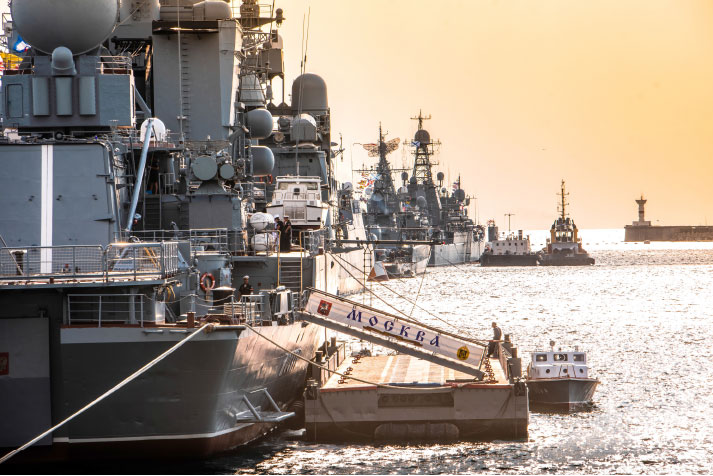
The annexation of Crimea in 2014 by the Russian Federation was a turning point for the Russian Black Sea Fleet. Sevastopol was again fully under Russian control. This city has always had a special relationship with the Black Sea Navy since its creation by the Russian Empire. Over time large shipbuilding, maintenance and related industrial bases were established along with the large naval base. The large fiord that cuts the city in half offers a deep harbor and protection against the elements. The region's mild climate and its all-around year accessibility by the sea make Sevastopol and the surrounding supporting bases and facilities around Crimea indispensable for the Russian Black Sea Fleet.
Once the Russian Federation gained control over Crimea and Sevastopol, it was more eager to invest in the Black Sea Fleet as it was not bound by the Black Sea Accords signed between Ukraine and the Russian Federation. Ukraine was mending with the types and the numbers of new warships Russia can deploy in the Sevastopol Naval Base. Freed from these constraints it was time for Russia to take action to stop the bleeding.
The State Armament Program 2011-2020 can be seen as the rebirth of the Black Sea Fleet. The Russian Ministry of Defense ordered six Admiral Grigorovich (project 11365M) class frigates in 2010 and 2011. Later six Improved Kilo (Project 636.6) class conventional submarines were also ordered. These submarines are based on the Soviet Kilo (Project 878) class submarines. By remodifying an existing design, the Russian Ministry of Defense selected a path with the least possible technical problems and set back and with the quickest way to enhance the submarine capabilities of the Black Sea Navy. Among the procurement projects started in this period, the one that gave the most wide-ranging solution was the acquisition of Buyan-M (Project 21631) class light corvettes with Kalibr missiles.
The State Armament Program 2011-2020 was very ambitious in its goals however the Russian Military-industrial complex failed to deliver good results. It is this period when Russia started to look to the west for new and innovative solutions for its ship design and construction problems. The procurement of two Mistral-class landing ships from France is a good example of this.
Moreover, the Russian annexation of Crimea in 2014 dealt two big blows to the revitalization of the Russian Black Sea Fleet. The first one was the sanctions imposed on Russia by the European countries. These sanctions terminated the procurement of good and reliable engines for the ongoing shipbuilding projects such as Buyan-M corvettes and Grachonok class anti saboteur boats. Both projects were relying on German companies for the diesel engines. Russia was forced to replace German-made engines with Chinese ones after the fifth Buyan-M corvette. It is reported that the Chinese engines are not up to the quality of the German ones.
The second blow was the right refusal of Ukraine to supply marine gas turbines to Russia anymore. In Soviet times the industrial infrastructure was planned on convenience rather than with intra Soviet borders in mind. Thus, when Ukraine gained its independence Zorya-Mashproyekt, the main gas turbine provider for the Soviet and later Russian warships went under Ukrainian management. This is simply to the fact that this factory was located near Mykolayiv, Ukraine where a big shipyard was located that constructed large warships in Soviet times.
Ukraine naturally severed its industrial connections with Russia after it invaded Crimea and refused to supply gas turbines for the last 3 hulls of the Admiral Grigorovich class frigates. This sanction effectively interrupted the Grigorovich frigate construction program right in the middle of it. The remaining unfinished hulls were later sold to India when Ukraine agreed to supply the gas turbines for these vessels, directly in India.
Despite these bumps on the road, the Black Sea Fleet, between 2014 and March 2018, received approximately 50 new units including service, support, surface combatants and submarines. However, most of these are small combatants with a limited operative radius and limited defense against multiple threats. One notable area where the Russian Ministry of Defense failed to modernize the Black Sea Fleet is amphibious warships. The Black Sea Fleet still has two Alligator (Project 1171) classes and four Ropucha (Project 775) landing ships. These ships and their sisters from other Fleets have been extensively used since Russia started active military operations in Syria. Named as the Syrian Express the regular deployments of these landing ships between Sevastopol and Tartus were vital to support the presence of Russian military forces in the region.
The current State Armament Program 2018-2027 of the Russian Federation has more realistic goals in terms of naval procurement than the previous program. The new State Armament Program allocates less funding to the navy as Russia will focus on its two large Fleets namely the Northern and Pacific Fleets and invest in long-range blue water capabilities. The Black Sea Fleet will remain as a critical asset with new green water units capable of firing long-range anti-ship and cruise missiles such as, such as the Kalibr-NK land-attack cruise missile and the P-800 Oniks anti-ship cruise missile.
The State Armament Program 2018-2027 did not allocate any new larger warships such as destroyers or amphibious assault ships for the Black Sea Fleet.
Like in the past conflicts of the Russian Federation since 2000, the Black Sea Fleet is taking an active role in the maritime domain in the 2022 Russia-Ukraine War. In the first month, the maritime front remained in a secondary role in the campaign.
The weak Ukrainian naval forces were no match for the existing units of the Black Sea Fleet. The closure of the Turkish Straits by Turkey due to the relevant Articles in the Montreux Convention did not have a profound effect on the power balance.
Prior to the start of the fighting, Russia was able to deploy three Ropucha class landing ships from the Northern Fleet and two Ropucha and one Ivan Green class landing ships from the Baltic Fleet. Reinforced with these additional units the Black Sea Fleet was able to tie up a considerable amount of Ukrainian ground forces in the Odesa area simply by fleet-in-being.
The main mission of the Black Sea Fleet will be to create a security zone where the Russian naval platforms capable of firing Kalibr cruise missiles can patrol in safety, as most of these platforms are small corvette sized warships unable to survive in a high tempo multi-threat environment outside the bubble created over the Black, Azov or the Caspian Sea. By basing long-ranged air defense systems here such as S-400 and long-range anti-ship missiles, the Russian Black Sea Fleet created a substantial anti-access and area denial zone over the Black Sea.
This A2/AD zone is also acting as a buffer to keep enemies away from the Russian homeland by protecting coastal areas and preventing enemy forces from accessing Russian territory.
Although its force composition and the range of its units is adequate to perform its mission in the Black Sea and in the Eastern Mediterranean region, the Tartus Naval Base in Syria can provide some maintenance and repair and it may have suitable infrastructure to keep many ships operational for extended periods. Russia has created a small bubble here with the S-400 air defense system and Bastion anti-ship missiles. Outside of this protective umbrella, the Black Sea Fleet is not capable of conducting long-range out of area maritime operations for a long period of time. It lacks modern and numerous support and supply ships that are needed to keep the vessels away from home for a long time, and it will find itself unable to conduct peer to peer operations