ANKA-III UCAV Will be Ready for Duty in 2024!
Within the scope of the ANKA-III Program, which was carried out by TUSAŞ using the company's own resources and approximately 200 engineers, the first flight with a scale model was carried out in June 2022, and the name ANKA-III was announced to the public for the first time in December 2022 by Vice President Fuat OKTAY. ANKA-III TİUS/MİUS was publicly unveiled for the first time during the "Century of the Future" Program held on May 1, 2023, at TUSAŞ's facilities in Ankara, Kahramankazan. As part of the "Century of the Future" Program, we had the opportunity to conduct interviews with Ömer YILDIZ, Deputy General Manager responsible for Unmanned Aerial Vehicles at TUSAŞ, and Nevzat POLAT, Systems Engineering Manager at the UAV Office, regarding the ANKA-III TİSU/MİUS and SUPER ŞİMŞEK Programs. We will include the information we obtained from both interviews in this article.
According to the information we acquired, high-speed taxi tests with ANKA-III will commence as of May 2, 2023. The images of the first taxi test were shared with the public on April 25, 2023, and thanks to the readiness achieved within a week by May 1, as well as the availability of autopilot software, the first flight is expected to be made in second week of May. Following the maiden flight, the maneuvering envelope will be expanded in subsequent flights according to a specific timeline, and weapon integration tests will be conducted within 2023. According to the information we obtained, the Turkish Air Force (TurAF) conveyed a series of requests to TUSAŞ after examining ANKA-III, and the changes to address these requests will be implemented on ANKA-III through subsequent discussions.
Meanwhile, TUSAŞ is nearing the completion of the production of the second ANKA-III prototype, for which part production and final assembly activities began in the past months. TUSAŞ will conduct the flight test program with these two ANKA-III prototypes, which are designed to serve as backups for each other and are identical to each other. This way, even if a technical issue arises in one of the aircraft, the flight test program can continue without interruption. Furthermore, while ground tests (during the weapon integration phase) are performed with one prototype, live-fire flight tests can be conducted with the other. This will accelerate the flight test program and ensure that ANKA-III is ready for delivery in 2024.
ANKA-III TİSU/MİUS, which is an indicator of the production quality and engineering capability gained by TUSAŞ through its 5th Generation aircraft programs such as the F-35 JSF and KAAN MMU/TF-X, is built on the avionics architecture of ANKA and AKSUNGUR MALE UAVs. Moreover, the existing ground systems used in the ANKA and AKSUNGUR Programs were used as a baseline in ANKA-III, and additional new software systems have been integrated into it. Consequently, ANKA-III TİSU/MİUS can be controlled with the same ground stations as ANKA and AKSUNGUR, paving the way for the complementary use of these three systems.
With ANKA-III, the Turkish Aerospace Sector has designed the first-ever flying wing aircraft since 1948 and has brought it to the flight-testing phase. Having an extremely flat structure with no vertical tail or control surfaces, ANKA-III potentially has a low radar cross-section (RCS). The potential low radar cross-section due to the body design is supported by the complete composite construction, as well as the use of Radar Absorbent Materials (RAM) and RAM-coated special paint, ensuring ANKA-III's low Radar Cross-Section (RCS) values. Furthermore, the turbofan engine exhaust, which is currently exposed, will be enclosed within the fuselage in the future, and the hot air gases emitted from the exhaust will be combined with cold air from the air intake to suppress the infrared signature. This way, in addition to reducing the RCS, ANKA-III's infrared (IR) signature will also be reduced, making detection difficult with Infrared Search and Track systems and thermal cameras.
Although aircraft with low RCS values have low visibility on radar, flying wing designs with 'stealth' characteristics lack traditional stabilizing surfaces and associated control surfaces, resulting in natural disadvantages such as instability and difficult controllability. However, with today's technology, a digital fly-by-wire flight control system, which is a computer-assisted system (the movement of control surfaces is handled through actuators with the help of a lever called a side-stick, there is no physical connection between the control surfaces and the side-stick lever), minimizes most of the aerodynamic disadvantages inherent in flying wing designs, allowing efficient and effective production of long-range bomber aircraft.
The algorithms used within the ANKA-III Program have been developed and tested on a 200kg scaled model demonstrator, which also has a flying wing design and made its first flight in June 2022. The scaled model took off and landed autonomously with the assistance of autopilot, without any human intervention, and autopilot tests and relevant software were carried out and developed using this scaled demonstrator. The autopilot tests conducted with the scaled model have established a level of confidence in the flight control system used in ANKA-III. Following the completion of tests with the scaled model, the production of the first ANKA-III prototype began in the second half of 2022 based on the lessons learned. TUSAŞ (Turkish Aerospace) also has conducted a series of wind tunnel tests for ANKA-III and has continued with flying wing (delta wing geometry) configuration based on the results.
ANKA-III Technical Specifications and Payload Capacity
ANKA-III TİSU/MİUS, both in terms of appearance and concept, bears a resemblance to nEUROn UCAV, which Türkiye was interested in in the early 2000s. In fact, ANKA-III shares similar dimensions and weight with the nEUROn UCAV. Open sources provide information about the nEUROn, stating a total length of 9.5 meters, a wingspan of 12.5 meters, an empty weight of 4.9 tons, and a take-off weight of 7 tons.
According to the information we have obtained, ANKA-III's maximum take-off weight (MTOW) is 6.5 tons, payload capacity is 1,200kg, service ceiling is 40,000ft, maximum operational altitude is 44,000ft, endurance is 10 hours (at 30,000ft altitude), cruising speed is 250 knots (0.42 Mach at 30,000ft altitude), and maximum speed is 425 knots (0.7 Mach at 30,000ft altitude).
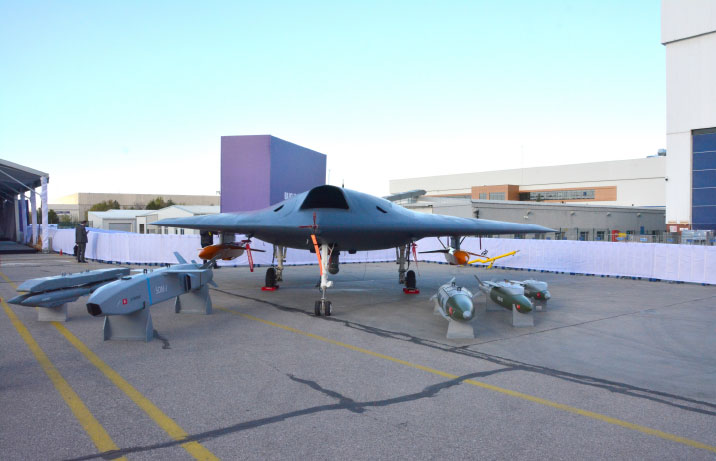
The single-engine ANKA-III TİSU/MİUS can carry weapons and a payload of up to 1,200kg on its seven different weapon stations. Each wing has two external weapon stations; the inner stations can carry 650kg, while the outer stations can carry 100kg. The internal weapon bays (IWB) also have a capacity of 650kg each. The central external station has a carrying capacity of 1,000kg. The IWBs and inner underwing stations can carry Mk-82 and Mk-83 series general-purpose or guided munitions. ANKA-III can carry SOM-J and Mk-84 smart or general-purpose munitions (up to 1,000kg) on the central external weapon station. The internal weapon bays can hold a total of 8 TOLUN Guided Munitions (similar to Small Diameter Bomb/SDB). KUZGUN Guided Munitions can also be carried on the internal weapon bays. Additionally, TUSAŞ's newly developed SÜPER ŞİMŞEK High-Speed Target Drone, expected to undergo its first flight test on May 15, can be carried on the underwing stations. The ANKA-III prototype exhibited at the "Century of the Future" event held on May 1, 2023, featured SÜPER ŞİMŞEK mock-ups on the underwing weapon stations.
ANKA-III Engine Information
The single-engine ANKA-III TİSU/MİUS prototypes, which have a maximum take-off weight of 6.5 tons, are powered by the AI-322 series low bypass turbofan engine produced by Ukrainian company Ivchenko Progress. The AI-322 Turbofan Engine has a length of 1,960mm, a width of 640mm (fan diameter 624mm), weighs 440kg, and features an axial compressor design. It consists of a two-stage fan at the front (rotating at low-pressure speed), followed by eight high-pressure compressor stages. Behind the combustion chamber, there is one high-pressure (HP) and one low-pressure (LP) turbine. The combustion chamber is located between the compressor and the turbine. The HP turbine drives the compressor, while the LP turbine drives the fan. The AI-322 Turbofan Engine produces a thrust of 2,500kgf (5,511lbf/24.5kN), whereas the AI-322-30 Turbofan Engine, weighing 534kg, has a thrust capacity of 3,000kgf (6,614lbf/29.4kN)
During the production phase, the ANKA-III TİSU/MİUS will be powered by the TF-6000 Turbofan Engine, which is currently under development by TEI using the company's own resources. TEI aims to start the assembly of the first TF-6000 prototype in April. With a dry thrust of 6,000lb (2,721kgf/27kN), TF-6000 will be the largest domestically developed turbofan engine in Türkiye. The goal is to perform the first operational test before the end of 2023.
According to the information we have obtained, TEI has designed the TF-6000 Turbofan Engine to be easily interchangeable with the AI-322 engine, using its own resources prior to the start of the ANKA-III program. This design allows for easy replacement of the TF-6000 engine with the AI-322 engine on both ANKA-III and KIZILELMA without significant technical difficulties in terms of mounting points, length, diameter, and other aspects.
The TF-6000, which is a military turbofan engine with a low bypass ratio and an axial compressor design similar to the AI-322, features a single shaft at the front and a two-stage axial fan (rotating at low-pressure speed). Behind the fan, there are six compressor stages. After the compressor stages, the combustion chamber begins. Immediately behind the combustion chamber, there are two turbine stages: a high-pressure (HP) turbine at the front and a low-pressure (LP) turbine at the rear. Compared to the AI-322, the TF-6000 has fewer compressor stages, making it lighter and providing higher thrust. It also incorporates more advanced technology. For example, both the fan and compressor stages in the TF-6000 are manufactured using "blisk" technology. This means that instead of manufacturing the blades separately and stacking them onto a disk, the disk and blades are produced as a single piece. Additionally, the turbine blades are manufactured using single-crystal casting technology to withstand high exhaust gas temperatures and operate at extremely high temperatures. TEI has utilized second-generation technology in the production of single-crystal blades, while ongoing research is being conducted on the production of third-generation single-crystal turbine blades.
ANKA-III Brief Information
The ANKA-III UCAV, which was developed as a Loyal Wingman that can perform joint missions with the KAAN MMU/TF-X, is made entirely of composite materials.
Although the first ANKA-III TİSU/MİUS prototype has reserved space for internal weapon bays, they are not currently active.
The ANKA-III UCAV can carry a payload of 1,200kg.
ANKA-III is expected to be ready for delivery between 6 months to 1 year after the first flight test.
No weapon integration has been performed on the ANKA-III yet. Payload integration studies will commence on the ANKA-III prototype after the first flight.
The ANKA-III is capable of deploying all munitions that can be used by the ANKA and AKSUNGUR. Additionally, new munition and payload integrations will be carried out along with a targeting system for the ANKA-III UCAV.
The local content rate for the ANKA-III is very close to 100%, excluding the engine. The flight control computer, links, software, and all critical systems are domestically designed and produced.
The current ANKA-III prototype does not have RAM paint or coating. However, ANKA-III will include them when delivered to the Turkish Air Force (TurAF). TUSAŞ continues studies in this regard.
In the future, the ANKA-III will be equipped with the ASELSAN-produced AESA Radar, TOYGUN Electro-Optical Targeting System (TOYGUN EOTS), and Infrared Search and Track System (KARAT IRST). When stealth capability is not required, FLIR systems like CATS can be mounted on the ANKA-III. Since there is currently no new generation EOTS/IRST type targeting system in serial production that can be mounted on an Unmanned Aircraft such as ANKA-III, CATS can be considered as an intermediate solution for laser target designation.
The EOTS/IRST can be mounted to the right or left of the landing gear.
For the air-to-air role, the ASELSAN AESA Radar will be located in the nose of the ANKA-III, and space has been reserved for this purpose.
ANKA-III will also be integrated with air-to-air missiles to be used against opportunity targets (not for air-to-air dogfights).
The ANKA-III will primarily serve as a deep strike aircraft, making optimal use of the advantages of a flying wing design. Subsequently, configurations for air-to-air missions and Electronic Warfare/Electronic Support tasks will emerge. Sufficient volume/space has been allocated inside the fuselage for equipment dedicated to these missions.
The communication system on the ANKA-III is similar to that of the ANKA and AKSUNGUR. It includes a dual redundant Line-of-Sight (LoS) communication system and both wideband and narrowband satellite communication (SATCOM) systems. The narrowband SATCOM system enables voice and short message format data exchange, while the wideband SATCOM systems can be used for image and video sharing.
The first prototype of the ANKA-III is capable of retracting the landing gear (bays, doors, actuators, etc., are ready and installed), but the first flight will be conducted with the landing gear deployed due to safety regulations.
Anticipating significant demand for the ANKA-III after the first flight, TUSAŞ has prioritized equipping the ANKA-III with weapons and mission systems, considering the user's desire to see the ANKA-III on the field as soon as possible. In this regard, the most urgent requirement has been identified as the targeting pod.
In the future, it is expected that a larger-scale version of the ANKA-III will be developed, capable of carrying more weapons and payloads. Additionally, there is a possibility of a twin-engine version or a single-engine version with a more powerful TF engine being considered.
SÜPER ŞİMŞEK Brief Information
Developed to be used in conjunction with UCAVs, SÜPER ŞİMŞEK can be employed independently or can be deployed through AKSUNGUR or ANKA-III when necessary.
According to the contract signed with TUSAŞ, the development of SÜPER ŞİMŞEK was planned to be completed within a 6-month timeframe. The 6-month deadline expired on April 30, 2023. The first flight of ŞİMŞEK is expected to take place on May 15, with a delay of 15 days.
SÜPER ŞİMŞEK will commence its missions after its first flight. There are currently 11 different missions defined for SÜPER ŞİMŞEK. One of these missions is to serve as a Loyal Wingman and operate in a swarm formation. Work on software and algorithms for swarm mission capability is ongoing, and the demonstration of swarm mission capability is expected before the end of 2023.
The initial agreement for SÜPER ŞİMŞEK was signed with ROKETSAN. Within this scope, SÜPER ŞİMŞEK will initially serve as a target aircraft in the SİPER Air Defense System developed by ROKETSAN and TÜBİTAK SAGE. Then decoy and munition versions will follow.
SÜPER ŞİMŞEK can only be carried on the external underwing hardpoints of ANKA-III and can be controlled by the pilot at the ANKA-III Ground Control Station.
The company IDEALAB is developing a new engine for SÜPER ŞİMŞEK, which is currently powered by a TJ engine produced by PBS Velka Bites. Additionally, TUSAŞ is also looking for alternative engines.
SÜPER ŞİMŞEK can be armed with various types of payloads/warheads up to 35kg.
SÜPER ŞİMŞEK, which can also be used as a decoy target, will perform a parachute-assisted belly landing after completing its mission. It is also aimed to be recovered in the air with an aircraft such as the C-130.
SÜPER ŞİMŞEK can be employed for electronic warfare purposes to suppress enemy ground systems.
It can be used in joint operations with manned/unmanned systems such as ANKA-III, KAAN National Combat Aircraft, HÜRJET, and F-16