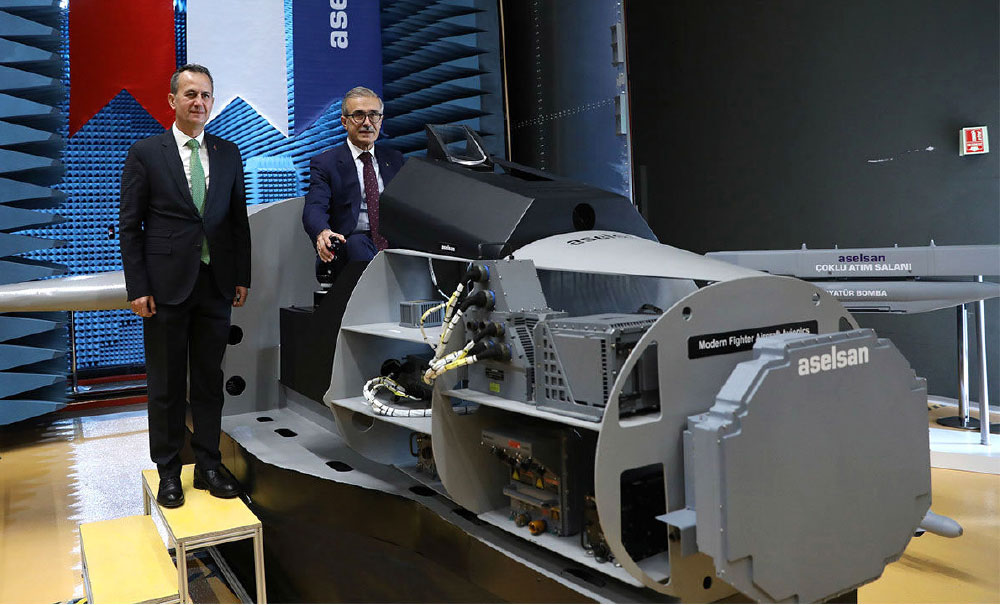
ASELSAN Introduced the "MURAD" F-16 AESA Nose Radar

Speaking to members of the press following the event, SSB President İsmail DEMİR stated that they visited ASELSAN to see the results of the ÖZGÜR Project and to share the future roadmap with the project partners." We are talking about a long-term project led by TUSAŞ and ASELSAN, with our players in defense and aerospace participating with all their capabilities."
Noting that November 10th is the anniversary of the death of the Great Leader ATATÜRK, DEMİR continued his speech as follows: "As he pointed out, 'the Future is in the skies,' we say that dominating the skies is vital for our independence and future. In that context, the first step of our F-16 Modernization Project, our liberation project, is the ÖZGÜR Project and its outputs. Our MURAD AESA is a very modern radar. It is a radar development project identical to the most advanced radars currently in the world. We will be talking about an aircraft with fully digitized components in the cockpit and several national products into which Turkish systems can be integrated, and our national weapons can be used."
Emphasizing that the studies carried out at this stage constitute the cornerstones of the National Combat Aircraft (MMU/TF-X) project, DEMİR said, "We did not start the TF-X journey from scratch. All these projects and all these studies were the necessary steps to the TF-X, and I hope we will be taking one more step with all the skills we have gained here for the TF-X Project." Emphasizing that there are various models of F-16s in the TurAF's inventory (Blok-30TM, Blok 40M, Blok 50M, and Blok 50+), DEMİR underlined that the ÖZGÜR project is already being implemented, starting with the first models (Blok-30TM). "One by one, our upgraded F-16s will continue to serve our Air Force with much more advanced capabilities."
President DEMİR continued his speech: “This is a journey we all take together. In this journey, the Turkish Air Force, Turkish defense industry companies, ASELSAN, TUSAŞ, TÜBİTAK SAGE, other TÜBİTAK institutes, ROKETSAN, HAVELSAN, and all our defense industry companies that contributed to this system showed outstanding performance. But what we have seen and achieved now is a sign that we can do much better in the future. I want to thank all the partners who contributed to this success. What we see here raises our hopes for success even more and shows that Türkiye will do much better in both manned and unmanned systems in the aviation industry. In fact, we will use our AESA radar in unmanned systems, AKINCI UCAV, in a very short time. Later, we will see our AESA radars and related electronic systems in our F-16s and the TF-X. This represents a significant capability increase. I hope we will have systems that will increase Türkiye's air power, air-to-ground, and air-to-air capabilities even more. I want to thank all our partners who contributed; we still have a long way to go. But what we have done so far shows us that these distances will be covered much faster and more successfully."
What is an AESA Radar?
An Active Electronically Scanned Array (AESA) is a type of phased array radar in which each antenna element is connected to a small solid-state transmit/receive module (T/R) that performs the functions of a transmitter and receiver independently. Unlike conventional radars with mechanical steering, the AESA radar's computer-controlled array antenna can electronically steer multiple beams of radio waves to point in different directions without moving the antenna. AESA radars can also perform more than one task (such as air-to-air or air-to-ground) at the same time. Whereas, in a mechanically steered radars, the pilot needs to activate separate modes for air-to-air, air-to-ground, or air-to-surface missions. In this way, air-to-air and air-to-ground missions can be performed simultaneously while precisely tracking multiple targets. Furthermore, the coverage of the target search function can be set independently of the tracking function. AESA radars also offer high-precision multi-target tracking, precise detection and tracking of low-speed targets, advanced Electronic Protection/EP (higher resistance to jamming as multiple beams can be emitted at the same time), and high reliability, as well as increased range compared to mechanically steered conventional nose radars.
An Overview of the MURAD AESA Nose Radar Development Project
The MURAD AESA Nose Radar was first introduced with a one-to-one scale mock-up during the IDEF 21 Fair. The F-16 AESA Nose Radar, which was stated to be ready in 1-1.5 years at that time, consists of Transmit/Receive and Signal Processing Unit (GASİB), Converter Unit, and Antenna sub-systems. The F-16 version of the AESA Nose Radar, which was previously intended to be installed on the AKINCI UCAV by the end of 2021, will first be integrated into the F-16C/D Block 30TM Aircraft under the ÖZGÜR Project. AESA radar integration studies on the AKINCI UCAV had started in the past months. Previously, it was aimed to install a mechanically steered radar on the AKINCI UCAV around 2019-2020 and the AESA Radar in 2022. According to the ASELSAN 2018 Almanac document, the F-16 AESA Nose Radar Development Project Phase-I Protocol was signed between the SSB and ASELSAN on December 4, 2018. The Defense Industry Agency announced the signing of the Phase-1 Protocol on March 24, 2019, on its official social media account. ASELSAN is also developing the AESA Nose Radar for the National Combat Aircraft (MMU/TF-X). However, the AESA Radar developed for the MMU/TF-X will have a different and highly advanced architecture called the National Combat Aircraft Integrated RF System (BÜRFİS).
The short video of the event shared by the SSB also includes sections from the project briefing attended by SSB President İsmail DEMİR, including the project timeline. According to a slide shown during the briefing, the project started in early 2019 and will continue until the end of 2027. The project timeline indicates important milestones for the end of 2022, the beginning of 2023, the middle of 2023, the end of 2023, the first half of 2024, and the second half of 2024. Subsequently, critical steps will be completed in the last quarter of 2025 and the first quarter of 2027. Based on this information, we can make the following predictions; it may be planned to complete the AKINCI UCAV integration at the end or beginning of 2022, conduct flight tests with the AKINCI UCAV in 2023, complete the test process on the AKINCI UCAV in 2024 before integrating the MURAD AESA Nose Radar on the prototype F-16 Block 30TM Aircraft, and demonstrate the radar's performance on the aircraft with flight tests to be carried out by the last quarter of 2025. Upon successful test results, it can be expected that the signing of the MURAD AESA Nose Radar Serial Production Contract could occur at the end of 2025 for other F-16C/D Block 30TM Aircraft in the inventory and that the delivery the Serial Production MURAD AESA Radars could occur in 2026-2027 and then the integration of the radars into the aircraft under the ÖZGÜR Avionics Modernization Project. Of course, these are just personal estimations as we do not have clear information about the project timeline at the moment.
Another point in the video was the one-to-one scale mock-up of another AESA Radar with a larger antenna array in the hall where the System Integration Laboratory (SIL) prepared for the MURAD AESA Nose Radar was located. Since I do not expect a model of the BURFIS AESA Nose Radar to be introduced at the moment, I believe this model may have been considered for the KIZILELMA National Combat Unmanned Aircraft System.
The F-16 AESA Nose Radar Development Project Phase-I Protocol, signed between the SSB and ASELSAN on December 4, 2018, covered the development of the AESA Radar, prototype production, factory tests and verification, and the preliminary studies necessary for its integration into the F-16 Block 30 Aircraft. In the second phase of the project, it is aimed to integrate the prototype radar into the F-16 Aircraft, to demonstrate its performance on the aircraft, and to start serial production if the results are successful.
GaN-based T/R modules are used in the ASELSAN AESA Nose Radar antenna array. According to the information I received at the IDEF 21 Fair, the GaN chips used in the radar were produced abroad since chips of this size could not be produced at the ASELSAN BILKENT Micro Nano (AB-MikroNano) Factory. ASELSAN design chips are produced in factories in East Asia; however, they are planned to be produced locally in Türkiye in the near future. It is stated that the ASELSAN F-16 AESA Nose Radar, which will have more than 1,000 T/R modules, will have matching performance to that of the APG-83 SABR. According to open sources, the GaAs-based AN/APG-83 SABR AESA Radar has a maximum range of 296.3km (370.4km in another source). The SABR radar can detect a warplane from 120km, lock it from 84km, and track more than 20 targets at the same time (it can detect a target with a 1m2 RCS at a distance of 47nm, the APG-68(V)9 radar can detect a target with same RCS from 38nm). Although there is no information about the number of T/R modules on SABR in open sources, there are 1,020 on its predecessor AN/APG-80 (F-16E/F). The unit cost of the SABR Radar is approximately US$2.5 million as of February 2020. Under the US$244 million contract, when the first batch of 72 radars was ordered in June 2017, the unit cost was around US$3.38 million.
Both the antenna element and the Signal Processing Unit (it is the system's brain and also controls the status of the radar) of the ASELSAN MURAD F-16 AESA Nose Radar are liquid-cooled. Since the power amplifiers in radars generally work most efficiently between +40°C / +60°C, the liquid cooling system (which generally uses a water + glycol mixture or pure monoethylene + glycol) actually aims to keep the transistors at a certain temperature level. There is also an air-cooling system on the F-16. The cooling capacity of the F-16 is around 5.5kW in open sources. The closed-circuit liquid cooling system in the radar is used to remove the waste heat from both the antenna array and other radar units. According to the ASELSAN personnel I met during the IDEF 21 Fair, the F-16 AESA Nose Radar can compete with the AN/APG-83 SABR used in F-16V Block 70 Aircraft, and it will go far beyond the AN/APG-68(V)9 Radar used in the F-16s in the TurAF inventory in terms of performance. While the MURAD Radar prototype was being produced, the nose of the F-16 was examined, and the radar was designed accordingly. The AESA Nose Radar can be fitted to the existing radar mount on the F-16 as is, without the need for any additional modifications. In this context, ASELSAN is preparing an interface document for the TurAF. In parallel with the production activities, certification studies for software and hardware have also started. Therefore, when the F-16 AESA Nose radar is completed, it will already be certified. Pointing out that the aim is maximum performance with minimum changes on the platform, ASELSAN personnel noted out that the power requirement of the radar will be met by the aircraft. The F-16 AESA Nose Radar mock-up exhibited at the fair is mounted on the exact same chassis, which has the dimensions of the real F-16 AN/APG-68(V)9 radar mount. While the upper shelf of the chassis is reserved for the placement of auxiliary equipment, AESA electronic equipment is located on the lower shelf. The ASELSAN F-16 AESA Nose Radar will be integrated with the mission computer and avionics equipment of the F-16 Block 30 Aircraft, which has been upgraded under the ÖZGÜR Project. In this context, ASELSAN has prepared an Interface Document. It was also stated that the ASELSAN F-16 AESA Nasal Radar will be an ITAR-Free and COTS (commercial off-the-shelf) product





