ASELSAN`s 2023 Radar Studies and Future Projection

ASELSAN REHİS (Radar, Electronic Warfare, and Intelligence Systems Group) carries out its studies at ASELSAN's Gölbaşı campus in Ankara. Established on 350 acres, REHİS has 75,000 square meters of indoor space and has around 1,800 employees here (about 60% are engineers). The Radar, Electronic Warfare, and Intelligence Systems Group conduct intense R&D and all kinds of engineering activities, from the chip level to integrated circuit designs and LRUs, including platform integration and qualification. REHİS also carries out system, subsystem, and platform-level integration and qualification activities, as well as design, production, and testing for microwave modules, boards, antennas, radomes, and embedded software.
There are several large towers at ASELSAN's Gölbaşı campus to measure and evaluate antenna arrays and electronic warfare systems in phase space and far-field conditions. There are also four antenna test chambers inside the building with an infrastructure of up to 110 GHz to conduct tests in near-field and compact-field. ASELSAN uses its test center in Ankara Gölbek mostly to find the correct placement of antennas on platforms at communication frequencies (ranging from 20 MHz to 6 GHz) and to collect calibration data. ASELSAN also has EMI/EMC accredited laboratories in the center.
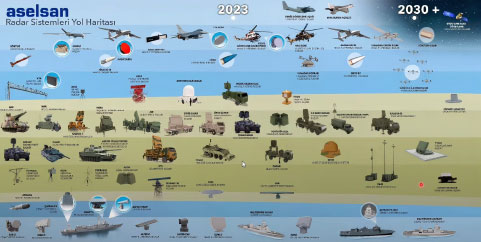
Currently, 35 different radars have been developed and produced by ASELSAN, and more than 1,500 radars, most of them small-sized, are in active service. In addition, the company has 29 radars under development. ASELSAN also conducts technology studies for 12 radar projects it aims to develop in the 2030s. Looking at the targets for 2022-23, it is seen that ASELSAN has completed its S-band radar studies. These are Long Range Weapon Detection Radar (STR) and Early Warning Radar Systems (EIRS). The EIRS system will soon replace the TRS-22XX radars produced in Türkiye under the French Thales license. In this context, the first EIRS radar replaced a TRS-XX22 radar stationed in Adana following the completion of the factory acceptance tests. It is stated that around 18 Portable EIRS (T-EIRS) and Fixed EIRS (S-EIRS) radar systems will be produced by 2030.
In addition to land-based radars, ASELSAN also develops nose radars for fighter jets, including F16, AKINCI UCAV, HÜRJET, and KIZILELMA. However, AESA radar studies for the National Combat Aircraft KAAN are a little behind compared to other projects. To accelerate the project, ASELSAN increased its technology readiness level, and it expected the first products to appear with the project starting towards the end of 2023.
Development of the Low Altitude Radar (AIR) and Early Warning Radar, which are part of the SIPER Long Range Air Defense System, were completed, and the systems were delivered. In this context, radars are actively used in SIPER Air Defense System tests. Acceptance tests of AKKOR Active Protection System's radar are continuing. AKKOR APS has vital importance for the survivability of the ALTAY main Battle Tank.
ASELSAN's Future Projection
ASELSAN's future plans, on the other hand, focus on more network-centric multi-static radars instead of single and mono-static systems. In addition to passive radar and networked radar studies with ballistic missile tracking capacity, satellite-based radars also come to the fore. ASELSAN closely follows these concepts and plans accordingly. In this context, SAR/GMTI (Synthetic-Aperture Radar/Ground Moving Target Indicator) satellites are especially important in detecting adversary threats early. The GÖKTÜRK-3 project was initiated for a satellite with SAR capability, but there has been no further development regarding the project for a long time.
ASELSAN Deputy General Manager Mustafa AKKUL emphasized the importance of Multi-Function Radar architectures and AESA radars by stating that using a separate radar for each function raises different problems. "Today, using different radars for each function is not desirable, even on ships. Low observability (LO) has become an essential requirement, even for naval platforms. Therefore, you need to reduce the antenna apertures because it is easier to achieve low observability by reducing the number of antenna apertures. It is no longer sustainable to use more than one independent radar for different tasks, such as volume search, early warning, air defense, and missile guidance on ships. Surface search is an especially important function against sea-skimming missiles. You also need to provide mid-course guidance for guided missiles until the terminal phase. You won't have the chance to use separate radar equipment for such tasks five or ten years from now. It will be inevitable in the future to perform all these missions with 3 or 4 fixed AESA arrays on ships. When we look at warplanes, the multi-function radar is required to perform air-to-air missions, any type of volume search and provide the necessary fire control loops to guide the missiles. Therefore, it needs to provide a data link between the aircraft and the munitions. It also needs to track the movements on the ground in air-to-ground mode and even has terrain following mode for the aircraft's survival. All these tasks are performed in the limited volume and angle of the aircraft's nose. These are even more limited with the mechanically steered antennas compared to AESA radars."
After explaining the importance of AESA radars, Mustafa AKKUL stated that ASELSAN's radar development studies in the last 10 years are on AESA radars and explained the working principles of AESA radars, "The working principle of radars is related to energy and time. In this context, how much time and energy is spent is an important parameter. Because you have to perform several functions and you have to track multiple targets at the same time. You need to optimize the energy and time allocation problem very well here. Time cannot be used very effectively with mechanical scanning antennas. This can be achieved with AESA and PESA radars. AESA radars can provide significantly faster target tracking and detection from very long ranges. Unlike PESA radars, AESA radars do not have a central source. Instead, each antenna element is fed from a separate power amplifier. Each antenna has its own control component behind it. Therefore, AESA radars have as many transmit/receive (T/R) modules as the number of antennas. If one of the modules is damaged in PESA radars, the radar becomes ineffective. However, this is not the case with AESA radars. Multiple modules also make AESA radars more resistant to jamming. For example, there are 4000 T/R modules in the Long-Range ERIS Radar developed by ASELSAN. Even if 20% of these modules are damaged, the radar can continue to operate with only a 10% degradation in range."
The power amplifier and control components are very critical subsystems for radars. In this context, ASELSAN's partner Mikroelektronik Ltd. Company (MKR-IC, 85% owned by ASELSAN) carries out studies. The company has a team of 25 people who conduct design studies only on silicon technologies (MMIC). These teams design chips that can be produced by foundries (semiconductor fabrication plants) in East Asia, with all IP rights belonging to Türkiye. These teams, which have been working for about 10 years, have so far completed the design and production of all chips in the S, X, Ku, and C-bands, where Türkiye may face an embargo. Mustafa AKKUL pointed out that acquiring chips from abroad is nonproblematic during the prototype design and development process of AESA radars, but there could be procurement problems when the serial production phase starts. "Now there is a problem, when you try to make a phased array AESA radar, you can buy 10 chips, but when it goes into serial production, and you ask for 1,000, they say no. Because it is too much of a troublesome technology, they don’t want anyone else to have it. Even if you're a NATO member, they don't want to."
ASELSAN’s AESA Radar Studies and Network-Based Radar Concept
ASELSAN's first studies on AESA technology started with the KALKAN PESA radar, which was developed towards the end of the 90s, and continued with SERHAT, ASELSAN's counter-battery radar. Today, ASELSAN is working on the ÇAFRAD (TF-2000 Destroyer), EIRS (Early Warning Radar), AIR (Low-Altitude Search Radar), STR (Counter-Battery Radar, ÇFAKR (Multi-Functional Fire Control Radar of SİPER Air Defense System), and the CENK-S AESA radar (İstif-Class Frigates). These radars have digital beam-forming capability. The first S-Band domestic transistors produced by AB Mikronano, which was established in partnership with ASELSAN and Bilkent University in 2015 to produce RF critical technologies, started to be used in the EIRS Early Warning Radar. According to the images shared at the presentation, ASELSAN continues to work on domestic GaN (Gallium Nitride) chips in the MURAD AESA radar developed for the F-16 fighter aircraft and AKINCI UCAV. In this context, the first domestic modules are expected to be used in 2024. Both S-Band and X-Band power amplifiers and metal-ceramic packages can be manufactured by AB Mikronano. These components are also used in the CENK-S radar and AURA radars.
However, Mustafa AKKUL stressed that, unfortunately, Türkiye has a gap when it comes to the RF Silicon on Insulator (SOI) technology. "The chips in our AESA radars are based on either RF Silicon-on-Insulator (SOI) technology or silicon-germanium technology. Unfortunately, Türkiye doesn't have access to a foundry that can manufacture these technologies. Currently, we can only work with Silterra company in Malaysia, but they only have CMOS capability. We can manufacture core chips in X-Band and S-Band, but when we say RF SOI, the required technologies are unfortunately unavailable in this foundry. We have a gap here."
Data processing (such as jet engine modulation/JEM) and automatic target identification technologies are also being studied by ASELSAN. In this regard, the GÖRÜ (SENSE) Project was carried out to obtain SAR images using the SARPER radar on the ANKA UAV. TÜBİTAK and MİLSOFT developed special algorithms for SAR images taken with SARPER and got successful results. As a result of the program, marine targets can be directly identified without additional post-processing. With its 35 years of experience, ASELSAN also strongly continues its antenna design activities. In this context, ASELSAN studied all kinds of antennas (EW and Radar applications), including FSS (Frequency-Selective Surfaces), Patch arrays, Vivaldi antennas, and slotted waveguide arrays, which are essential for low observability. One of the most important factors in radar systems is to operate without being seen by Electronic Warfare (EW) systems with the proper waveform selections. At this point, signal processing is a very critical issue. ASELSAN is working with Bilkent, METU, and TOBB universities in this regard.
Network-based radar operations are an important element among ASELSAN's 2030s targets. ASELSAN aims for a different concept than the one currently implemented in RADNET, in which all radars transfer the data to a single center. In the new concept, radars need to work together. In other words, the advantages of target and radar geometry should be utilized by making plot fusion instead of trace fusion (collecting the plot information provided by each radar from multi-capacity networks in a single center and creating a shared/common high-resolution air picture). This capability also provides resistance against jamming. Because even if a radar in the networked system is jammed, other radars can continue to detect/track targets. Network-based structures also aim to increase detection against stealth aircraft by using the echoes of radars at different angles. In order to use these geometry advantages, it is necessary to connect these radars with a wide band network, and significant technologies are required to synchronize frequency, waveforms, and time