Aselsan`s New Electro-Optical Solutions for National UAV Platforms

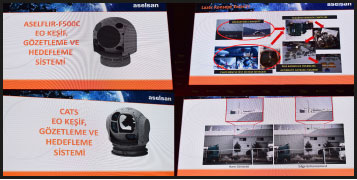
The 3rd Efficiency & Technology Fair was recently held between June 9-12 this year and Aselsan Engineer Cihan PİRİMOĞLU made a presentation titled "Aselsan Electro-Optical Solutions for our National UCAVs", sharing important information about Aselsan's CATS and ASELFLIR-F500C electro-optical (E/O) systems that were developed for fixed and rotary wing platforms, and the ASELFLIR-600 system, which is still in the design process.
The Common Aperture Targeting System (CATS), the first product developed by Aselsan for national UAV/UCAV platforms, takes its name from its system architecture. Developed with Aselsan's own resources, CATS was designed to increase the targeting, reconnaissance & surveillance capabilities of medium altitude unmanned aerial vehicles in all weather conditions, day and night. The Common Aperture of CATS has a Cassegrain structure that is optimized to receive all wavelengths (thermal, daylight, SWIR) with the same optical lens, unlike equivalent systems. In this way, high electro-optical performance is achieved in a small volume with a single optical window for all imaging channels. Additionally, thanks to the Common Aperture, different sensors that do not normally fit inside a certain gimbal volume can be integrated into a single system, unlike Distributed Aperture E/O systems.
CATS has 6-axis image stabilization, including 4-axis mechanical stabilization for the gimbal and 2-axis precise optical stabilization for the mirror mechanism. CATS feature multi-target tracking capability. Aselsan stated that they achieved less than 5 microradians (µrad) sensitivity with UAV/UCAV platforms. CATS is ground stabilized (can lock to a point on the ground), can lock and set orientation to GPS coordinates, or calculate the coordinates of a tracked target. The CATS use system-specific image processing algorithms, many of which are patented. With Visual Object Tracking (VOT), CATS can calculate the position, direction, and speed of the target with high accuracy. It can also mark the target with its Laser Designator and direct laser-guided munitions with high precision.
Following the embargoes on electro-optical systems used in UAV and UCAV systems in 2020, Aselsan made some changes to optimize the CATS system. First, the thermal sensor of the CATS system has been improved so that the range and image quality performance obtained in good weather can also be achieved in adverse weather conditions as well. Aselsan switched to a dual-gain sensor, which can capture a higher level of signals by changing the gain parameters in adverse weather conditions and in cases where the temperature drops in winter. The second change is that certain environmental conditions can reduce the signal detection capacity. This increases the load on the electronic components and, in turn, raises the internal temperature, especially in gimballed E/O systems with limited volume, creating a "noise" that decreases the sensor output. Aselsan managed to reduce the internal temperature to +15°C under certain conditions and solve the noise problem by changing and adjusting the electronic components. The third change is weight optimization for use in UAV/UCAV platforms. Initially, CATS was 62 kilograms, and then its weight was reduced to 56 kilograms after further optimization studies carried out in 2020 and 2021. Aselsan continues its efforts to reduce the weight of CATS from 56 kilograms to 55 kilograms.
Furthermore, Aselsan aims to increase the performance of CATS considerably by changing its algorithms (both daylight and thermal), along with the newly developed electronic equipment. Aselsan has succeeded in seeing the designator laser, which can only be viewed at night in certain conditions, in both day and night with various filters integrated into CATS (filters all wavelengths except the laser) and verified these improvements in operational environments. Currently, only specific frequencies can be viewed with the low-light camera. However, Aselsan continues its studies to view all PRF (Pulse Repetition Frequency) codes that are necessary to guide all the laser-guided munition types used by fighter jets with UAV/UCAVs. Significant gains have been achieved in laboratory and systemlevel studies" yerine "Aselsan achieved significant results in laboratory and systemlevel studies.
In his presentation, Cihan PİRİMOĞLU emphasized that because of Aselsan's nationalization studies on sensors, which are the most critical components of Electro-Optical systems, and their cooperation with East Asia and Chinese companies following the embargoes, Aselsan accessed High-Definition (HD) detector technology and subsequently started the development of the ASELFLIR-F500C system last year. PİRİMOĞLU said, "As Aselsan, we carry out dozens of different projects from VGA (Video Graphics Array) formats to HD formats with MCT (Mercury Cadmium Telluride) and superlattice technologies in cooled systems and metal and silicon-based packages in uncooled systems. Some of these are Aselsan's own projects, and some are carried out for critical projects such as the Altay MBT, Turkish Fighter (TF-X), CATS, AF-500C, with the support of the Presidency of Defense Industries (SSB). We continue our efforts to begin the serial production phase of HD detectors very soon. These sensors are highly critical components that can severely hamper both design and production processes in case of embargoes. Right now, we have multiple sensor alternatives for our systems, such as CATS, ASELFLIR-300T, and ASELFLIR-F500C, both from within Aselsan and from the East Asia and Chinese companies."
While some of the uncooled detectors (YAMGÖZ Close Range Surveillance System and ADIS Driver's Vision System) used in the Altay Main Battle Tank (MBT) and the M60TM Fırat Modernization Projects are Aselsan products, some of them are supplied by other sensor companies. Aselsan continues its studies to produce all these detectors. Aselsan also continues its efforts to nationalize the infrared (IR) detectors used in the CATS, ASELFLIR-300T, ASELFLIR-F500C, and the commander's and gunner's sights of the Altay tank. Optical designs of all E/O systems belong to Aselsan, and the company also carries out reflective and refractive optical design activities for short (SWIR), medium (MWIR), long (LWIR), visible, and ultraviolet (UV) wavelengths. Aselsan also designs spherical, aspherical, and holographic lenses, single, multifocal, and afocal lenses, and carries out computer-aided performance analysis and tests of optical systems. Within the scope of optomechanical technologies, Aselsan designs structural elements, focus mechanisms, motors and gears, and position control sensors, as well as optical components such as lenses, mirrors, and prisms.
Providing laser solutions for nearly 20 years, Aselsan designs and manufactures APLD (Ambient Pressure Laser Desorption) sensor chips and laser modules used in cavity and gimbal systems independently of export permits, ITAR (International Traffic in Arms Regulations), and BAFA (Federal Office of Economics and Export Control) procedures. Aselsan also works on laser imaging, DIRCM (Directional Infrared Countermeasures), and laser defense systems. Various image processing algorithms used in electro-optical systems have been patented or indigenously developed by Aselsan in line with user needs. (Such as Dehaze, Edge Enhancement, Color Correction, Auto-White Balance and Image Sharpening for daylight camera and Non-Uniformity Correction [NUC], Bad Pixel Replacement [BPR] and Enhancement [IOP] for thermal cameras). Moreover, Aselsan uses machine learning to eliminate the image defects that affect the performance of the E/O systems. Thanks to the very complex Scene-Based NUC algorithm used in CATS, ASELFLIR-F500C, and ASELPOD systems, system-related or image-affecting defects can be isolated automatically after a certain learning period.
Aselsan CATS (Common Aperture Targeting System)
CATS consists of a 640x512 MWIR (Medium-Wave Infrared) Focal Plane Array camera with 15 μm (micron) pixel pitch operating at a 3-5 μm infrared wavelength, 1920x1080 HD daylight camera, 640x480 EMCCD (Electron Multiplying Charge-Coupled Device) low-light near-infrared (LL-NIR) camera, laser designator (LD), laser rangefinder (LRF), laser illuminator, and laser pointer. CATS has a 220 mm diameter Common Aperture, which is the 'primary' optical lens of the thermal, daylight, and low-light cameras. The 640x512 MWIR detector has a 15 μm pixel pitch and 60x optical magnification capability, which is considerably higher than its counterparts. While many equivalent products have a narrow field of view (FOV) of 1°, CATS has a much narrower FOV, such as 0.5°. In addition to 0.5°, 0.9°, 3.2°, narrow FOVs, CATS also has 30° wide FOV to provide wide-area surveillance. Aselsan plans to add two more FOVs between 3.2° and 30° in the near future. After the embargo in 2020, a much more efficient dual-gain detector started to be used without changing the sensor resolution of the existing detector. This detector is an Indium Antimonide (InSb) based detector instead of MCT (Mercury Cadmium Telluride) and provides far greater advantages over other sensors in parameters such as counter-efficiency and NFTD. The Daylight TV Camera has 1920x1080p HD resolution, and all the camera modules integrated into the CMOS (Complementary Metal Oxide Semiconductor) detector were designed by Aselsan. The sensors of the daylight and thermal cameras are procured from foreign sources, while all the optical and optomechanical elements, electronic cards, controller cards, and image processing cards belong to Aselsan. The Low-Light NIR camera has 640x480 resolution and 60x optical magnification capability. All cameras feature 2x and 4x continuous digital magnification.
The laser designator is one of the most critical components of CATS, and it is entirely designed by Aselsan, including the optical cavity. It uses a Diode-Pumped Nd:YAG laser designator module operating at a wavelength of 1064 nm. It has a range of 25 km (± 5 meters) with a high output power (100 millijoules/mJ and above). The Laser Designator is compatible with all NATO STANAG 3733 PRF codes and national code; hence it can be used with all NATO standard laser-guided munitions. The LD has a Repetition Frequency of up to 20 Hz (Band 1 and Band 2). Since May 2020, the "beam divergence value" of the Laser Designator was improved by Aselsan, and the effective range at which laser-guided munitions could be designated was further increased. The beam divergence value, which was 0.5 milliradians (mrad) in the initial production models, has decreased to 0.3 mrad in the current serial production models (0.3 mrad causes a beam diameter of 3 meters at about 10 km. 0.5 mrad is 5 meters at 10 km). The Laser Rangefinder (LRF) has a range of 30 km and has been verified in the field. It has an accuracy of ± 5 meters and has pulsed or continuous measurement capability. The Laser Pointer operates at 808 nm wavelength and is compatible with the low-light camera on CATS and the night vision goggles of friendly forces. The Pointer has a range of 20 km and an output power of 150 milliwatts (mW); its divergence value is about 1 mrad (10 meters at 10 km). The Laser Illuminator module can illuminate targets up to a range of 2 km at low and medium altitudes. It also operates at 808 nm wavelength and is compatible with the low-light camera on CATS and the night vision goggles of friendly forces. The operating temperature of CATS is between -54°C and +50°C, and the storage temperature is between -55°C and +70°C. According to Cihan PİRİMOĞLU, the first serially produced CATS units have been delivered both in Turkey and abroad this year, and the system is actively used by the Turkish Armed Forces (TAF) and friendly nations. Although the CATS deliveries continue, the system is still being improved, so the verification work for its final configuration is still ongoing and it is expected to be completed soon.
ASELFLIR-F500C E/O System
Aselsan started to work on the ASELFLIR-F500C E/O system, an advanced version of CATS, in 2020. With the new project, Aselsan aims to upgrade the thermal sensor, image processing pipeline, and hardware, reduce the overall weight, and optimize the general E/O system performance. Aselsan started developing the ASELFLIR-F500C system this year with its experience from CATS and its access to HD sensors. Developed with Aselsan's own resources, the system will be used in UAV/UCAVs such as TB-2 and ANKA-S and fixed-wing aircraft and attack helicopters. The most important advanced feature of the ASELFLIR-F500C system compared to CATS is the HD thermal sensors. With optimized lens/detector parameters (F#/MFT), Aselsan aims for a better DRI (Detection, Recognition, Identification) range in imaging channels, improved image quality, and optimization of E/O system performance. To better support the increased effective ranges of domestic munitions and neutralize air defense systems that pose a threat to UAV/UCAV systems from longer distances, Aselsan has updated and changed the laser modules. A new laser module with higher output power and lower beam divergence will be integrated into the ASELFLIR-F500C system. Unlike CATS, the ASELFLIR-F500C system is aimed to be used on all platforms thanks to the improved gimbal design (tactical and MALE class UAV/UCAVs, attack helicopters, and fixed-wing aircraft). In summary, Aselsan aimed to provide a single gimbal solution for various aircraft types used by the TAF and allied nations. Since the ASELFLIR-F500C system is still in the design phase, it will first be used in unmanned aerial vehicles. After the preliminary design activities are completed, it is planned to be used on HÜRKUŞ, ATAK-I Phase 3, and ATAK-II.
ASELFLIR-F500C system consists of a 1280x1024 HD MWIR (Medium-Wave Infrared) Focal Plane Array camera with 15 μm pixel pitch operating at 3-5 μm infrared wavelength, 1920x1080p HD daylight camera, 1280x1024 HD SWIR (Short-Wave Infrared) camera with 10 μm pixel pitch operating at 0.9-1.7 μm infrared wavelength, Laser Designator (LD), Laser Rangefinder (LRF), and Laser Pointer. Like CATS, ASELFLIR-F500C will feature a Common Aperture for the MWIR, daylight, and SWIR cameras. While the equivalent products can only view the laser spot with their low-light cameras under certain environmental conditions, with the SWIR integration, ASELFLIR-F500C is intended to see the laser spot on all imaging channels (daylight, MWIR, SWIR). ASELFLIR-F500C is planned to weigh around 50 kg, 6-7 kg lighter than the 56 kg CATS system. The operating temperature of the system is between -40°C and +50°C, and the storage temperature is between -55°C and +70°C. Like CATS, it also uses a 1064 nm Diode-Pumped Nd:YAG laser designator with a range of 25 km (± 5 meters). The LD has selectable PRF (NATO STANAG 3733 PRF codes and national code) capability and Repetition Frequency of up to 20 Hz (Band 1 and Band 2). The Laser Pointer operates at 808 nm wavelength and is compatible with the night vision goggles (NVG) of friendly forces. Aselsan aims to increase the pointer output from 150 milliwatts to 500 milliwatts and reduce the divergence value below 1.2 mrad. The preliminary and detailed design phases of the ASELFLIR-F500C system will be completed in 2021, and the serial production phase is expected to start in 2022.
In addition, Aselsan has started the 'New Generation Gimbal Development Project' with its own resources with the experience from the CATS project. The project was initiated to bring linear motor technology, which will provide structural advantages to Aselsan gimbal systems. It focuses on optimizing weight, increasing stabilization capabilities, and transitioning to different system architecture. Within the scope of the project, which is planned to be implemented into the systems in approximately 2 years, Aselsan aims to reduce weight, increase the mechanical stabilization performance in 4 axes, reduce connection parts, change the mechanical architecture that affects the control range, reduce the brush friction, and increase the effective internal volume. To further improve the 5 µrad sensitivity of CATS and increase the stabilization performance on platforms that are exposed to heavy vibration, such as attack helicopters, Aselsan plans to switch to linear motors on the inner axes and geared motors on the outer axes. By switching to gear motor structure in the ASELFLIR-F500C system, Aselsan aims to increase the wind load resistance of gimballed systems used in fixed-wing platforms at high speeds such as 300-350 knots. Ultimately, Aselsan intends to use linear motors on the inner axes of all gimballed systems and gear or direct-drive motors on the outer axes depending on the platform on which the E/O system will be mounted.
ASELFLIR-600 E/O System
The latest product introduced at the "Aselsan Electro-Optical Solutions" presentation was the ASELFLIR-600 system, a new generation reconnaissance, surveillance, and targeting system designed for high-altitude long-endurance (HALE) national UAV/UCAV systems such as Akıncı and Aksungur. The preliminary design of the system will start this year, and it is planned to be launched as an official development project with Aselsan's own resources after the completion of initial analysis. In this context, Aselsan works together with the SSB and UAV platform manufacturers to determine system specifications. CATS and ASELFLIR-F500C have a gimbal diameter of 15 inches, while the ASELFLIR-600 is planned to have a diameter of 22 inches. ASELFLIR-600 system will consist of critical modules such as 1280x1024 HD MWIR camera with 15 μm pixel pitch operating at 3-5 μm infrared wavelength, 1920x1080p or higher resolution daylight camera, SWIR camera, Laser Rangefinder, Laser Designator, and Laser Pointer. ASELFLIR-600 aims to achieve high stabilization by using linear motors instead of the existing gearless direct-drive motors on the inner axes. In this way, Aselsan plans to achieve superior range and image performance by integrating optical designs with very high magnification capability into the system. Aselsan also intends to increase the laser output and decrease the beam divergence by increasing the internal space allocated to the laser modules thanks to the enlarged and optimized gimbal structure. Lastly, after acquiring critical sensor technologies in-house and starting serial production, Aselsan has recently begun to develop a new product between the 15-inch and mini gimballed systems for short-range/tactical UAV platforms