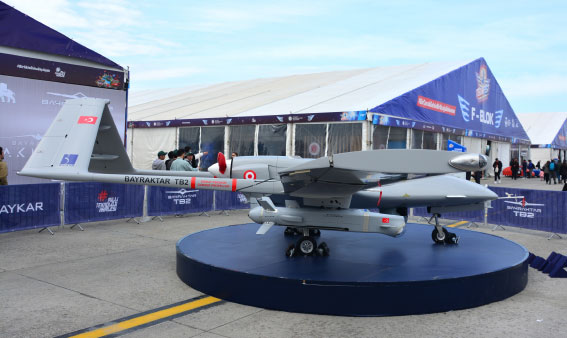
BAYRAKTAR KEMANKEŞ Mini Cruise Missile Extends the Lethality of BAYRAKTAR TB2

The KEMANKEŞ Mini Cruise Missile was announced for the first time by BAYKAR Chairman of the Board of Directors and Chief Technology Officer Selçuk BAYRAKTAR during the delivery ceremony of the TCG Anadolu Multi-Purpose Amphibious Assault Ship to the Turkish Naval Forces Command held at SEDEF Shipyard on April 10, 2023, and it was officially introduced during TEKNOFEST 2023, the Aviation, Space, and Technology Festival held at İstanbul Atatürk Airport between April 27 and May 1, 2023. During TEKNOFEST on April 28, the BAYKAR representative I spoke of mentioned that flight tests had begun with the KEMANKEŞ and were ongoing.
In the short video shared by BAYKAR Technology, the IL170 Engine (170N/17.3kgf) started while the KEMANKEŞ was still on the external pylon. This method is preferred due to certain limits on the operating speed of the engine because munitions are launched from UAVs at lower speeds compared to fighter aircraft. After the engine starts, the munition is released once the system software gives approval. The same concept will also be used in the firing test of the KUZGUN-TJ Modular Munition from the UAV. KUZGUN-TJ is the Turbojet Engine variant of the KUZGUN Guided Modular Munition Family, nationally developed by TÜBİTAK SAGE. Accordingly, the engine will be started and brought to idle before the KUZGUN-TJ is released from the UAV. This method eliminates concerns about whether the engine successfully starts after the launch and prevents the munition from going to the wrong target.
Another point that draws attention in the firing test is that KEMANKEŞ was mounted on the TB-2's underwing station facing upwards. However, smart munitions like TOLUN Miniature Bomb, KGK Guidance Kit, or KUZGUN-TJ, which have folding wings like KEMANKEŞ, are launched from the aircraft in an upside-down position. During TEKNOFEST, the representative of BAYKAR TECHNOLOGY explained this situation as follows: "KEMANKEŞ is fired in an upwards position from the UAV. This is because most munitions have light and fragile wings with symmetric profiles, not designed for long-range flight. After the munition is released, it can quickly turn and adopt its flight profile in the air. However, our wings have a design that resembles a real aircraft wing more closely. Firing the munition in an upside-down position could negatively affect its recovery."
According to the product brochure, the KEMANKEŞ Mini Cruise Missile has a total length of 1.73m, a height of 40cm, and a wingspan of 1.25m, and weighs 30kg. It is stated that the KEMANKEŞ, equipped with the IL170 TJ Engine, can reach a cruising speed of Mach 0.3 (360km/h) and a maximum speed of Mach 0.7 (720km/h) while diving toward the target. It is capable of carrying a 6kg warhead/payload. The KEMANKEŞ has an operational altitude of 18,000ft (5,486m) and is equipped with an Artificial Intelligence-Assisted Electro-Optical (EO) Guidance System (2-axis stabilized HD Day TV camera with 36x optical zoom) and a laser device within the window on its nose section (for measuring distances up to 2.8km and locking on target). During my conversation at TEKNOFEST, the company representative mentioned that the thermal camera from OPSİN Company, currently used on the Bayraktar VTOL UAV, will also be integrated into the KEMANKEŞ in the future. The KEMANKEŞ is stated to have an endurance of 1 hour and an operational range of 200+ km. The maximum range is expected to reach 250km. The KEMANKEŞ can be used on BAYKAR products such as BAYRAKTAR TB2, BAYRAKTAR TB3, and AKINCI UAVs.
Parts of BAYRAKTAR KEMANKES Mini Cruise Missile
The BAYRAKTAR KEMANKEŞ Mini Cruise Missile features a stabilized EO camera system housed within an extended glass window on its nose section. When asked about the reason behind the design, a representative from BAYKAR TECHNOLOGY explained, "The gimbal's movement mechanism experiences strong aerodynamic forces, and this negatively affects the performance of the gimbal, especially at high speeds. When flying at high speed of 100 m/s, which is equivalent to 0.3 Mach (358 km/h), the gimbal becomes ineffective, meaning it cannot rotate. We needed to protect the EO camera and ensure its functionality, so we enclosed it within a glass housing. Design requirements pushed us toward this solution."
The warhead is located just behind the stabilized EO camera (Artificial Intelligence-Assisted Optical Guidance System). On the right of the gimbal, there is a pitot tube used for measuring airspeed. However, the KEMANKEŞ utilizes different sensors for airspeed measurement. For example, the airspeed is also calculated using GPS with different mathematical algorithms. The pitot tube and GPS measurements are later combined and displayed to the operator as the most proper speed. The GPS antenna is located just in front of the hardpoint connector attachment. The fuel tank is located inside the middle of the fuselage, and the folding wings are positioned at the underside of the body (can be opened and closed together with servo motors). The data link antenna is located on the top, aligned with the side engine air intakes, and also serves as the video link antenna. There are four movable fins/control surfaces at the rear. The IDEALAB IL170 Turbojet Engine is installed at the very back. According to IDEALAB, the IL170 engine can operate even at an altitude of 20,000ft (6,096m).
According to the information I have gathered, BAYKAR TECHNOLOGY has met with multiple companies to select the engine of KEMANKEŞ. TEI (TUSAŞ Engine Industries) was also among these companies. In fact, BAYKAR TECHNOLOGY has also participated in the development activities of the required engine. The IL170 has become the standard engine for the current model of KEMANKEŞ. However, BAYKAR TECHNOLOGY is currently working on different versions of KEMANKEŞ. For instance, they are exploring concepts such as a larger version with a heavier warhead or a ground-launched version of KEMANKEŞ. In this context, if a decision is made to produce a larger and heavier version, the IL170 engine may not be sufficient. In such cases, BAYKAR TECHNOLOGY evaluates other alternatives, such as using the TJ Engine proposed by TEI (modified version of TEI-TJ60 [250N/56lbf]) or other domestically proposed engines. Although still in the conceptual stage, BAYKAR TECHNOLOGY is also working on a new smart missile with different design features than KEMANKEŞ, which can be launched from naval platforms like Fast Attack Crafts.
Communication and Control
The KEMANKEŞ Mini Cruise Missile is operated on the Man-in-the-Loop principle and relies on LoS (Line-of-Sight) communication through BAYRAKTAR TB2, TB3, or AKINCI UAVs (Man-in-the-Loop refers to having an operator in the loop from the moment the munition is fired until the moment of impact, maintaining control throughout the process). Utilizing LoS communication, it transmits all telemetry data and camera footage to the Ground Control Station (GCS) through the platform, enabling real-time data tracking. The BAYRAKTAR TB2, TB3, and AKINCI UAVs employ active NETA C-Band Data Link antennas. These systems have extended the LoS range of the platforms to 300km and beyond. However, since KEMANKES is a small platform, it can only establish communication with the data link/LoS system up to 100km (due to weight and volume limitations).
As mentioned above, the BAYRAKTAR KEMANKEŞ Mini Cruise Missile relies on LoS (Line-of-Sight) communication with the carrier platform up to a range of 100km during flight. In this case, for example, since the BAYRAKTAR TB2 UAV has an LoS communication range of 300km, the TB2 UAV can carry and deploy the KEMANKEŞ missile to a target up to 300km away. The onboard LoS communication system (data link) of the KEMANKEŞ is effective up to a maximum range of 100km. Therefore, in theory, the KEMANKEŞ could be used up to a range of 400km by utilizing the TB2 UAV as a relay for communication. Furthermore, if the BAYRAKTAR TB2 UAV has SatCom capability, the operational range of the KEMANKEŞ could be extended even further.
Due to its small size and low Radar Cross Section (RCS), the KEMANKEŞ Mini Cruise Missile can avoid detection by enemy air defense systems from long distances. It can remain airborne for one hour and autonomously navigate at high speeds toward its target using the artificial intelligence-supported autopilot system and the TJ engine. This capability allows the KEMANKEŞ to effectively engage even the most heavily defended targets (fixed or mobile) deep within enemy territory. According to BAYKAR TECHNOLOGY, the KEMANKEŞ Mini Cruise Missile is equipped with Anti-Jamming technology, which allows it to remain unaffected by electronic countermeasures. With the support of the Artificial Intelligence-Assisted Optical Guidance System, the missile can recognize/identify its target and effectively engage it with high precision, even in challenging weather conditions. The KEMANKEŞ is designed to be cost-effective, making it a more affordable option compared to most medium and long-range air defense missiles that can be used to shoot it down.
Each BAYRAKTAR TB2 UAV can carry 2 KEMANKEŞ Mini Cruise Missiles. When a strike package consists of 3 TB2 UAVs, a total of 6 KEMANKEŞ missiles can be simultaneously deployed against enemy targets. Currently, the KEMANKEŞ does not possess swarm attack capability. However, BAYKAR TECHNOLOGY's swarm intelligence team is conducting R&D work in this area. It is expected that, in the future, when ongoing research is completed, the swarm attack capability will be added to the KEMANKEŞ with its artificial intelligence-supported autopilot system.
Concept of Operations (CONOPS) from Firing to Moment of Impact
The KEMANKEŞ Mini Cruise Missile can be effectively used against stationary and moving targets with the EO system on the carrier UAV. It can also engage targets beyond the line of sight with known GPS coordinates. In this case, it is necessary to pre-load the target coordinates into the missile before launch.
In accordance with this scenario, after being launched at an altitude of 18,000ft (5,486m) or 12,000ft (3,657m), the KEMANKEŞ Mini Cruise Missile autonomously flies towards the pre-determined GPS coordinates using its artificial intelligence-supported autopilot system. As the KEMANKEŞ approaches the target area, it descends to 5,000ft (1,524m). Since the KEMANKEŞ locks onto the target using its own stabilized EO camera system rather than relying on data from the TB2 UAV, it needs to descend to 5,000ft to get a clear image of the possible targets with the Artificial Intelligence Assisted Optical Guidance System. Featuring automatic target tracking capability, the Artificial Intelligence-Assisted Optical Guidance System detects and displays the targets and moving objects in the area on the operator's screen. Once the operator commands to lock onto one of the displayed targets, the KEMANKEŞ starts continuously tracking the locked target and rapidly dives toward the target upon receiving the attack command from the operator. Thanks to its Man-in-the-Loop feature, it attacks the target with much higher accuracy than GPS alone. BAYKAR TECHNOLOGY plans to equip the KEMANKEŞ with the ability to recognize the target area and accurately position itself even in the event of communication loss, using artificial intelligence and a preloaded map. While diving toward the target at high speed (Mach 0.7), the KEMANKEŞ Mini Cruise Missile detonates its warhead shortly before impact. KEMANKEŞ uses a laser rangefinder in the gimbal to measure the distance to the target before the impact





