BMC Power Opens Its Facilities at the 1st Main Maintenance Factory Directorate to Defense Media!
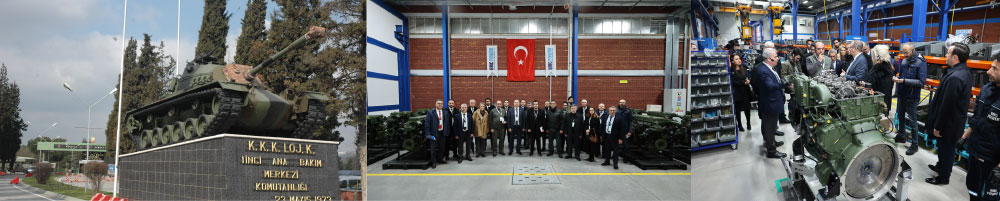
During the BMC POWER Press & Media Meeting event, BMC Board Member and CEO Murat YALÇINTAŞ and BMC POWER General Manager Mustafa KAVAL met with the sector press at the Radisson Blue Hotel and provided information and answered questions about ongoing projects. Then, we were taken to the 1st Main Maintenance Factory Management (ABFM) at the General Ali Fuat CEBESOY Barracks, located right next to the Radisson Blue Hotel, with a bus allocated to us. We visited Türkiye's largest and one of the few modern Powerpack Test Centers in Europe, which has a Prototype/Serial Production Workshop among the investments made by BMC Power and an infrastructure capable of testing 4 engines and 4 transmissions and powerpacks at the same time. We were informed about the ongoing test activities under the 400hp TUNA TTZA and 600hp AZRA Diesel Engine, 1,000hp UTKU, and 1,500hp BATU Powerpack Programs and capabilities of the center. During the BMC Power Facility Tour, General Manager Mustafa KAVAL, Deputy General Manager Ertuğrul AKKAYA, Production Director İhsan ERSOY, and PT Integration & Testing Director Serdar AKÇA accompanied us.
The BMC Power Press & Media Meeting ended in a friendly meeting atmosphere after lunch at the Radisson Blue Hotel. After listening to the press members' impressions and recommendations about the event, BMC CEO YALÇINTAŞ and BMC Power General Manager KAVAL provided answers to a questions.
The TTZA Engine, produced by BMC Power, was first launched at the shipment ceremony held on February 2,
2023, with the participation of officials from the Defense Industry Agency (SSB) and the Turkish Land Forces Command (TLFC). The engine was named 'TUNA' and will be used in the BMC VURAN Armored Vehicles, first for the Land Forces Command and then for the Gendarmerie General Command (JGnK, engine delivery is expected to be completed by the end of May or the beginning of June). In this context, BMC Power will deliver a total of 90 TUNA engines to BMC Otomotiv's production facilities in Pınarbaşı, İzmir. The first batch, which is currently in serial production, consists of 20 TUNA engines. It was announced that their shipment from BMC Power facilities at the 1st Main Maintenance Factory Directorate (ABFM) in Arifiye, Sakarya, to İzmir would be completed on February 6. The delivery of all engines is planned to be completed by the end of May 2023. Engineering work totaling 300,000 hours was carried out over approximately 52 months for the TUNA engine development project that began in November 2018. The TUNA engine was tested for over 6,500 hours at the Test Center and 143,000 km on vehicles and passed the NATO Endurance Tests. Vehicle tests were conducted on roads with different climates and geographical conditions in Erzurum and Antalya. Acceptance tests were then carried out with the participation of the SSB and the Turkish Land Forces representatives. The TUNA diesel engine will also be installed on the KIRPI-II MRAP vehicles towards the end of 2023. The TUNA diesel engine on the VURAN TTZA is coupled with the Allison Transmission 3200SP Automatic Transmission.
With the Presidential Decree, the operation and production rights of the 1st Main Maintenance Factory Directorate, which was transferred to ASFAT free of charge on May 14, 2019, with the ownership remaining with the Ministry of National Defense, was transferred to the BMC Defence Company for 25 years with a protocol signed between ASFAT and BMC Defence. As of August 2019, the transfer process was completed. BMC Defence has committed to invest US$50 Million in the 1st Main Maintenance Factory Directorate, where the company has been operating under the control and supervision of the MSB since August 21, 2019.
Notes from the Facility Tour
A - Prototype/Serial Production Workshop
BMC Power Production Director İhsan ERSOY shared the following information about the Prototype/Serial Production Workshop, our first stop as part of the Facility Tour:
In the approximately 2,700-square meter workshop, production, quality control, and intra-depot movements are managed with locally developed software called ASM and Minerva.
İhsan ERSOY and 35 personnel work in the workshop, where the prototype, pre-series, and serial production of BMC Power's TUNA and AZRA Diesel Engines and BATU Powerpacks are finalized.
With the investment of BMC Power, the final assembly and production of 4 different engines and powerpacks can be carried out simultaneously at the stations in the workshop, which was established in an existing building.
The facility has the capacity to produce a total of 1,000 engines in three shifts (200 V8-V12 (UTKU/BATU) and 800 TUNA and AZRA). With the commissioning of the new production facility to be built in Ankara, this capacity will at least double.
The smart equipment used in the workshop accelerates the production process and increases the quality. Thanks to smart systems, it is possible to detect and control the torque with which the bolt is tightened, at what angle it is tightened, whether it is tightened or not, who tightens it, and whether there are any missing bolts or untightened bolts in the assembled engine.
Thanks to smart systems, the operator cannot go to the next step without doing what he must do in the relevant process and entering it into the system. For example, if there are 8 bolts on the equipment and 7 of them are tightened, the eighth one cannot proceed to the next step until it is tightened.
There are two separate TUNA Engine Assembly Stations at the facility. In case of need, the number of stations can be increased to four. Each TUNA Engine takes approximately 14 hours to assemble.
Many localization projects have been completed for the TUNA Engine. All the main parts of the TUNA Engine, which has a local content rate of over 75%, are produced and processed in Türkiye. In this context, the engine block and flywheel are cast and processed domestically. Since there is no room in the workshop, some work is done outside. For example, machining equipment is located outside. When the new production facility in Ankara is completed, this equipment will be moved to this new facility.
There are also necessary test environments, a positive pressure room (Class 5 type, it is used during the assembly of the fuel system), and measurement systems (the parts are brought together with 100micron precision during the engine assembly) in the workshop, which can accommodate four different engine types.
In the newly established Measurement Laboratory, all parts are precisely measured before going to the assembly line. For example, the measurement of the V12 engine block, which is manufactured with a precision of 5 microns, is carried out with an accuracy of 1.8 microns.
When the production facility in Ankara is commissioned, the Prototype/Serials Production Workshop in Arifiye will be used for maintenance/integration service.
Both the separate engine and the first prototype of the complete powerpack configuration of UTKU (complete with engine, transmission, cooling package, and auxiliary units) were exhibited side by side at the workshop. While the BATU powerpack is in U-drive configuration and located at the rear of the vehicle, the UTKU powerpack to be used in FIRTINA is in T-drive configuration and located at the front.
The powerpack is installed into the vehicle's engine compartment according to the mechanical analysis. It is first checked whether the powerpack will fit into the engine compartment digitally, and if something goes unnoticed, it is detected when installed on the vehicle. UTKU and BATU are installed on FIRTINA and ALTAY with millimetric tolerances.
High-strength Compacted Graphite Irons (CGI) are used for casting the V-type engine blocks.
AZRA Gen-I series engines are produced in limited numbers. The total weight of the tank transporters (TTAR) is 130 tons. The AZRA Gen-II Engine includes vehicle-specific modifications, including software and turbocharger with different packaging. The testing process of the AZRA Gen-II Engine is expected to be completed soon.
B - BMC Power Test Center
At our second stop, the BMC Power Test Center/Powerpack Test Center, the VURAN Armored Vehicle equipped with a TUNA Engine and TUĞRA 8x8 Tank Transporter equipped with an AZRA Engine greeted us in working condition. In response to our question about whether the engine compartment of the VURAN was changed for the domestic engine, BMC officials stated that they didn't change the design, especially due to the V-shaped hull (V-hull) of the vehicle.
During our facility tour, BMC PT Integration & Testing Director Serdar AKÇA shared the following information with us:
The Powerpack Test Center is a 3-story facility with an area of 500 square meters. The test chambers are on the first floor with two main halls. Four Powerpack and Transmission Test Chambers and the Inclination Test Rig produced by ALTINAY DEFENCE are located in one of the halls and four separate Engine Test Chambers are located in the other hall. The Conditioning Units and Chemical Plants are on the second floor, while the Chiller, Cooling Tower, Transformers, and Mechanical Pump Room are on the third floor.
There is a 15-megawatt (MW) transformer at the Powerpack Test Center, which is stated to have more facility infrastructure than a large factory. While the cooling tower of the center is 8 MW, the chiller capacity is 3.6 MW.
The Inclination Test Rig is used for inclination tests of AZRA, TUNA, UTKU, and BATU, engine, transmission, and powerpacks. With this Mechanism, which can tilt 45 degrees sideways and 45 degrees forward, working conditions of 60% vertical inclination and 30% side slope can be simulated. In this context, oil pump performance, oil inner tube design, crankcase ventilation performance, and turbocharger lubrication can be tested in this Mechanism. If there is any problem, necessary design changes are made. During our visit, we had the opportunity to watch the AZRA Engine being tested on the Inclination Test Rig.
There are two Powerpack Test Chambers at the right and left of the Inclination Test Rig. UTKU and BATU Powerpacks will be tested in the Powerpack Test Chambers, where up to 1,800 hp powerpacks can be tested. There is a 1,000-kilowatt electric motor for braking, two flywheel sets that can simulate the inertia of 40-45 tons and 70 tons vehicles, and a gearbox set that can allow different static loads.
The center, which has more transformers and cooling systems than a factory, is connected to the city's electrical grid for power. However, apart from the dynamometer and the 1,000kW electric motor used for braking in the Powerpack Test Chamber, there is also a 1,600kW electric motor in the engine test hall, and two 900kW, three 1,000kW and three 1,200kW electric motors in the Powerpack Chambers. Thanks to the fuel tanks, each with a capacity of 25 tons, the center can operate uninterruptedly for two weeks with 75 tons of fuel. It was stated that the center's monthly electricity and fuel bills are also quite high.
The center has 2 R&D Rooms for transmission development tests. These rooms are very flexible. Both engines, transmissions, and powerpacks can be developed. These rooms also have high torque braking dynamometers, electric motors, and special motors. There are two active electric motor brake dynamometers in the R&D Test Rooms. The BATU engine prototype was running in the R&D Test Room on the right as part of the moment calibration test.
After necessary checks of the first UTKU Powerpack prototype are completed at the Prototype/Serial Production Workshop, it will be gradually taken to one of the Powerpack Test Chambers in the Powerpack Test Center within two months, and operational trials will begin.
The first prototype of the BATU powerpack (complete with engine, transmission, cooling package, and auxiliary units) is expected to be ready in April 2023.
The BATU engine will undergo the 400-hour NATO Test, which is accepted as the general standard. In addition, powerpack level tests will be carried out per the standards, ranging from 400 to 600 hours. These tests will be performed at the Test Center. In addition, 10,000km Qualification Tests will be conducted in Şereflikoçhisar on the ALTAY MBT. Before the Qualification Test, onboard Calibration Test, Vehicle Performance Studies, and Environmental Conditions Test will be conducted by BMC Power. In this context, apart from the Arifiye Test Track, the Altay MBT will go to Erzurum and Sarıkamış for Field Tests such as High-Altitude Tests, Offroad Tests, Speed Tests, and Cold Start Tests, and climb to Uludağ.
As part of the development tests carried out for the Engine, Transmission, and Powerpack, PreCalibration studies such as Pre-Durability Test and Calibration Functionality Test are carried out in the first stage. Afterward, the Functional Control and Development Test of the engine or transmission is carried out. Subsequently, Subsystem Level Durability and Mechanical Improvement Tests and, finally, System Level Durability Tests are performed. During our visit, Pre-Calibration tests were being carried out with the BATU Transmission prototype, which was operated for the first time on January 27, 2023, in the Powerpack Test Chamber. At this stage, while the transmission runs without load, the clutches are calibrated, and gear shift performance is monitored. We have been told that the BATU Transmission will be partially disassembled later, and its gears will be examined. It will then be reassembled and run at partial load.
Under the UTKU and BATU Powerpack Projects, BMC Power not only develops powerpacks but also establishes the necessary infrastructure and ecosystem for manufacturing and testing processes since there has not been an infrastructure and ecosystem in this regard in our country before. In this context, for example, BMC Power is developing a domestic Engine Control Unit and Transmission Control Unit together with its local partner.
The UTKU and BATU Powerpack contracts signed between BMC Power and the SSB consist of two main phases, the Development Phase, and the Acceptance (Qualification) Phase. BMC Power has successfully completed the NATO Test (400 hours) in the Development Phase for the UTKU Powerpack and has reached a certain stage in the Calibration Phase.
As of February 1, 2023, the engine reached the maturity level to drive the vehicle in the UTKU Powerpack Project. Operating tests at higher loads are planned for the FIRTINA Howitzers. The prototype engine currently runs at 675kW/900HP as part of the Calibration Phase.
As of February 1, 2023, up to 1,000 hours of Preliminary Durability Test and Calibration Functionality Tests have been conducted with the BATU diesel engine, but no official test, such as the 400-hour NATO Test, has yet to be carried out. NATO standard test activities will begin soon.
The other two test chambers in the engine test hall are the Mechanical Development Chamber and the Durability Test Chamber. Both UTKU and BATU diesel engines can be run in these two chambers. They are mainly used for durability and functional development tests. During our visit, the second BATU prototype engine was tested in the left chamber, while the UTKU engine was tested in the right chamber.
A protocol was signed between TR TEST and BMC Power at the SAHA EXPO Fair so that the BMC Power Test Center/Powerpack Test Center, which has great importance for the Turkish Industry, can be used jointly by other defense industry organizations. With the protocol, it is planned to open the Powerpack Test Center to other domestic companies operating in this field and to other companies through the company TR TEST





