Chinese Naval Modernization

The impressive modernization program of the Chinese People's Liberation Army Navy (PLAN) has been closely watched by other nations. The scale of the program and its results are astonishing.
This modernization program also creates some sleepless nights for the politicians and senior naval leadership of the countries along the Indian and Pacific Ocean.
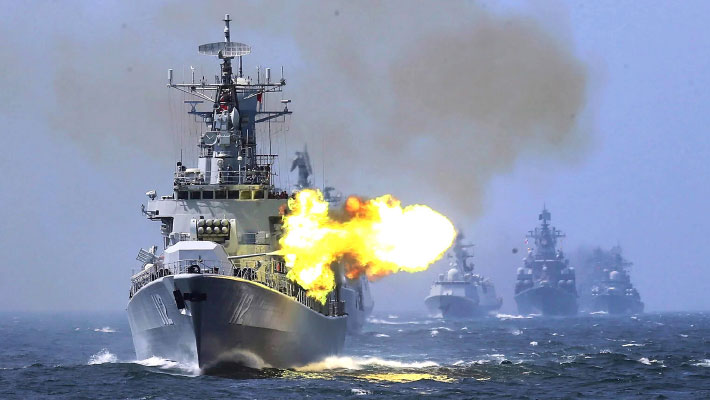
The PLAN is the largest navy in the world with a battle force of approximately 355 platforms, including major surface combatants, submarines, aircraft carriers, ocean-going amphibious ships, mine warfare ships, and fleet auxiliaries. This figure does not include 85 patrol combatants and craft that carry anti-ship cruise missiles (ASCMs). The PLAN’s overall battle force is expected to grow to 420 ships by 2025 and 460 ships by 2030, as reported by the US DOD to the US Senate.
According to a report prepared by the US Congress Research Center, China’s naval modernization effort forms part of a broader Chinese military modernization effort that includes several additional areas of emphasis, and it has been underway for more than 25 years, since the early to mid-1990s, and has transformed China’s navy into a much more modern and capable force.
The modernization program not only just covers the construction of warships. According the aforementioned report China’s naval modernization effort encompasses a wide array of platform and weapon acquisition programs, including anti-ship ballistic missiles (ASBMs), anti-ship cruise missiles (ASCMs), submarines, surface ships, aircraft, unmanned vehicles (UVs), and supporting C4ISR (command and control, communications, computers, intelligence, surveillance, and reconnaissance) systems. China’s naval modernization effort also includes improvements in maintenance and logistics, doctrine, personnel quality, education and training, and exercises.
There are a few events in the 1990’s that started the development program for the PLAN. One of these events was the 1st Gulf War. Chinese leadership was concerned with the USA’s military dominance during Operation Desert Storm. The then General Secretary of the Chinese Communist Party Jiang Zemin adopted a guidance of local wars under high-tech conditions in 1993. However, another event had a more direct and profound effect upon the PLAN modernization program. When Taiwan held the first presidential election in March 1996, Lee Teng-hui, an openly pro independent candidate was elected as President. China launched a series of military exercises and ballistic missile demonstrations in the Taiwan Strait close to the island’s main ports, blocking the island for a brief period. In March 1996 the US Navy intervened and dispatched two carrier groups based on the USS Nimitz and USS Independence, to the general vicinity of Taiwan.
Being unable to prevent the US Navy from intervening was a wake-up call for Beijing. From this point on, PLAN and other Chinese armed forces started to focus on deterring or denying future American interventions on behalf of Taiwan.
At the core of the China’s military modernization effort, including its naval modernization effort, is the desire to develop capabilities for addressing the situation with Taiwan militarily, if need be; for achieving a greater degree of control or domination over China’s near-seas region, particularly the South China Sea; for enforcing China’s view that it has the right to regulate foreign military activities in its 200-mile maritime exclusive economic zone (EEZ); for defending China’s commercial sea lines of communication (SLOCs), particularly those linking China to the Persian Gulf; for displacing US influence in the Western Pacific; and for asserting China’s status as the leading regional power and a major world power.
Consistent with these goals, observers believe China wants its navy to be capable of acting as part of a Chinese anti-access/area-denial (A2/AD) force—a force that can deter US intervention in a conflict in China’s near-seas region over Taiwan or some other issue, or failing that, delay the arrival or reduce the effectiveness of intervening US forces. Additional missions for China’s navy include conducting maritime security (including antipiracy) operations, evacuating Chinese nationals from foreign countries when necessary, and conducting humanitarian assistance / disaster response (HA/DR) operations.
As a result of the evaluation of PLAN hardware, the PLAN started to conduct operations further away from its usual operation areas near the Chinese Mainland. The PLAN dispatched a small flotilla to the Gulf of Aden in 2008 to protect merchant ships from Somali pirates. This deployment has been sustained uninterrupted until 2020. Furthermore, with the growing ability to operate further away from home, Chinese ships assisted the evacuation of Chinese nationals from Libya in 2011. In 2015, three PLAN ships from a Gulf of Aden naval escort task force evacuated 629 Chinese citizens from Yemen to Djibouti and Oman.
In 2012, 2015 and in 2017 a task group consisting of one destroyer, one frigate and one replenishment ship arrived in Türkiye. In 2012 and 2015 the destroyer and the frigate passed through the Bosporus and entered the Black Sea.
The PLAN Type 920 hospital ship Daishan Dao carried out dozens of humanitarian missions, treating over 180,000 patients around the world Since its commission in 2008. This is an important soft power and hearts and minds operation helping not only to the image of People’s Republic of China but also many sick and injured people around the world.
While the PLAN can perform operations in faraway seas its main focus remains closer to home. The main goal for the PLAN is to keep the potential enemies such as the US Navy and its allies as far away as possible from the mainland. To this end China is investing heavily in anti-access and anti-denial weapons.
One of these A2/AD weapons is the Anti-Ship Ballistic Missiles (ASBMs). Ballistic missiles are usually used for non-stationary targets such as airfields, cities, command centers or other ballistic missile silos. However, China has developed two types of land-based ballistic missiles with a capability of hitting ships at sea. Both missiles are fired from mobile TELs making them very difficult to hit in a pre-emptive strike. The DF-21 has a range of 1,500 kilometers and the newer DF-26 has a range of 4,000 kilometers. These missiles were tested against moving sea targets in August 2020 and engaged their targets successfully. These ASBMs are considered game changing weapons as they are hard to defend against. Combined with broad-area maritime surveillance and targeting systems, these ASBMS would permit China to attack their enemies’ important ships such as aircraft carriers, accurately before they can launch an attack against the Chinese mainland.
The more conventional type of the A2/AD weapons China is developing are the classic anti-ship cruise missiles. The PLAN’s frigates and corvettes, as well as modernized older combatants, carry variants of the YJ - 8 3/YJ-83J ASCM with a range of 180 km, while newer surface combatants such the destroyers are fitted with the YJ-62 with a 400 km range. The newer large combatants will be fitted with a variant of China’s newest ASCM, the YJ-18A. These missiles have a 537 km range.
China has notable political problems in the South China Sea and the East China Sea:
A dispute over the Paracel Islands in the SCS, which are claimed by China and Vietnam, and occupied by China;
A dispute over the Spratly Islands in the SCS, which are claimed entirely by China, Taiwan, and Vietnam, and in part by the Philippines, Malaysia, and Brunei, and which are occupied in part by all these countries except Brunei;
A dispute over Scarborough Shoal in the SCS, which is claimed by China, Taiwan, and the Philippines, and controlled since 2012 by China; and
A dispute over the Senkaku Islands in the ECS, which are claimed by China, Taiwan, and Japan, and administered by Japan
Furthermore, China adamantly opposes an independent Taiwan, and senior political and military leaders expressed their desire to create a “One China” many times.
Japan, South Korea are key US allies in the region and the US has showed many times that it will intervene on behalf of Taiwan against China. And the US considers China as its biggest rival in the Indo-Pacific region. This rivalry too fuels China’s desire to have a large naval force.
As stated by a report to the US Congress, China’s military modernization effort, including its naval modernization effort, is assessed as being aimed at developing capabilities for addressing the situation with Taiwan militarily, if need be; for achieving a greater degree of control or domination over China’s near-seas region, particularly the South China Sea; for enforcing China’s view that it has the right to regulate foreign military activities in its 200-mile maritime exclusive economic zone (EEZ); for defending China’s commercial sea lines of communication (SLOCs), particularly those linking China to the Persian Gulf; for displacing US influence in the Western Pacific; and for asserting China’s status as the leading regional power and a major world power.
The planned ultimate size and composition of China’s navy is not publicly known. China believes in order to achieve their political agenda regarding Taiwan and the border disputes, a strong armed force is necessary, and the navy is an integral part of it. A strong and large PLAN is a useful tool for China not only to keep the enemy away from the mainland but also to assert its interest in the region as they want to follow President Theodore Roosevelt's foreign policy: "Speak softly and carry a big stick; you will go far"