Countering Loitering Drones Over the Battlefield

Since the beginning of the 1990s, we started to see operational use of Unmanned Combat Air Vehicles (UCAVs) in different sizes and sophistication. The name UCAV contains a long list of Unmanned Air Vehicles (UAVs) that are designed and used as a weapon system with munition payloads for a wide range of missions, primarily for ground attack purposes. Due to their sophistication and popularity in recent wars, this article will focus on Loitering Drones (LD) (also called Loitering Munitions), which is a specific category of UCAVs. In the final section of the article, we will also look at how to counter this threat from Türkiye’s defense perspective. Loitering Drones can be defined as UCAVs with an integrated warhead in the frame that can fly autonomously or under control by an operator, then hit their target with their body mass. If necessary, LDs can loiter over the target area to wait for their intended target to appear.
We witnessed the proliferation of LDs in the 2010s as E/O or radar sensor or navigation technologies improved, and drones got smaller and more affordable. For example, high-resolution IR or daylight camera technologies meant that loitering drones could see and detect any target on the battlefield from long distances and could also send the live video feed back to the launcher platforms or a single soldier’s handheld control unit. With remote sensing capability operators can decide which target is important and target priority. Moreover, automatic image recognition and guidance technologies improved the accuracy of loitering drones. Over the years, miniaturization of these guidance and detection sensors has led to handheld loitering drones that could be carried and launched by soldiers at platoon levels.
Currently, UCAVs are built in all sizes and shapes around the world. The U.S. Department of Defense classifies UAVs into several groups based on their take-off weight, size, and operating altitudes (ft). The table below shows the classification benchmarks. The classification of LDs in terms of their size and weight follows the same table.
There is no doubt that Israel has been the front runner in the development of LDs during the late 1980s and the early 1990s. The Israel Defense Forces (IDF) realized the potential of drones in the anti-radar or anti-SAM (Surface to Air Missiles) role following its experience during the Lebanon War in 1982. The IDF drones were used for reconnaissance and decoying missions to locate and spoof Syrian Surface to Air Missile (SAM) batteries in Lebanon’s Beqaa Valley.
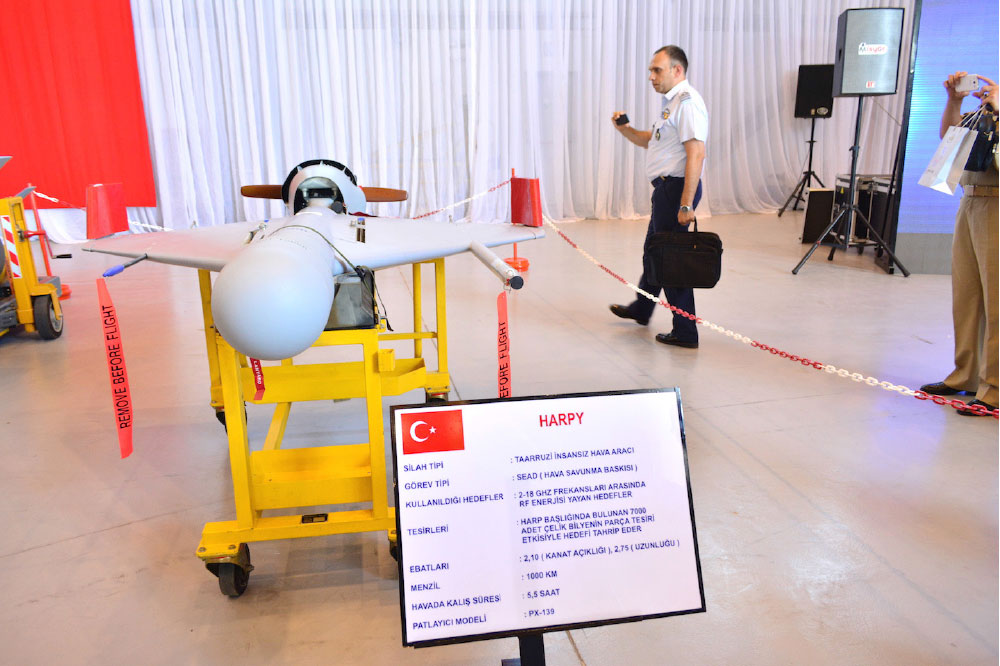
One of the first Israeli LDs used in the IDF operations is called Harpy. It is basically a radar hunter drone with a passive RF (radio frequency) signal detection sensor in its nose and antennas in its wings. The Harpy weighs about 135kg with a 32kg warhead and is pushed by a small piston engine in the back. Depending on the mission requirements and availability of targets, Harpy would be preprogrammed before its launch. In loitering mode, it would fly to a designated target area and enter a search pattern for preprogrammed radar frequency at an altitude. If a specific radar is activated, then the Harpy would dive onto the radar transmitter antenna and destroy the radar assembly using its blast fragmentation warhead. In target of opportunity mode, Harpy flies to a designated area and attacks any hostile radars regardless of their operational frequency. According to open sources, the Harpy has a range of 600km and can loiter over the battlefield for up to six hours, depending on the location from which it has been launched. Türkiye, China, and India also bought the Harpy in the early 2000s.
An improved version of Harpy, called Harop, was developed in the early 2000s and became operational within the IDF. The main difference between Harpy and Harop is that the latter got a day/night electro-optical camera system under the nose of the drone, and the capability of a live video feed via data link system was added to Harop. In addition to the IDF, several other countries have purchased the system. One notable example of the Harop’s operational videos came from Azerbaijan’s military operation over Karabagh in the summer of 2020. Several video footages showed Harop targeted and destroyed the Russian-made TOR-M2 ADS and 30N6E Flap Lid engagement radar of the S-300 ADS belonging to the Armenian Armed Forces.
Most recently, the Turkish company LENTATEK revealed a loitering drone called Kargi for the first time at EFES-Multinational Combined Joint Live-Fire Exercise, in June 2022. The existence of the Kargı project was known, but there has been limited information about its progress. The official specifications of the Kargı haven’t been released to the public yet, but it appears that it would replace the Turkish Air Force’s Harpy drones in the near future and mainly be used for SEAD/DEAD missions to destroy hostile radars and air defense systems. Another Turkish firm TUSAŞ is offering its Şimsek target drone for possible air-to-ground attack missions. The small turbojet-powered Şimşek was initially designed as a target drone for air defense systems, but TUSAŞ has devised a plan to modify Şimşek to be used as a loitering munition with options of launching from a catapult on the ground or from TUSAŞ-built ANKA-S UAV at medium altitudes to extend its range. According to TUSAS, if it is fired from ANKA-S at medium altitudes, Şimsek can fly as much as 200km to its intended target, and if necessary, it can loiter over the target area before hitting its target.
Russia’s Kalashnikov Group has been developing a kamikaze drone called KUB-E and it also received an export permit from Russian authorities for possible export contracts from abroad. The picture below depicts a KUB-E swarm attack against a warship. The swarm attack capability of loitering drones should not be ignored on the land or sea.
Iran is another strong producer of LDs in several types and scales. Even though Iran has been under sanctions and has had difficulty getting subsystems from western countries, surprisingly enough, Iran has managed to produce highly advanced long-range drones and missiles, which are increasingly used in Yemen and Syria and, most recently, in Ukraine. Iran’s first attack drone, called Raad-85, was introduced to the public in September 2013. The Raad-85’s use as a loitering drone was consistent with Iran’s military doctrine, which relies on using asymmetric capabilities to deter adversaries with vastly superior conventional military power. It is speculated that Raad-85 has a short range of around 100km, but it has been claimed that it can hit stationary or moving targets. One of the most notable Iranian loitering drones, named Shahed-136, is very similar to Israel’s Harpy and Türkiye's Kargı loitering drones. It has delta wings and a piston engine that allows it to fly autonomously to the target area and engage its intended target with a high angle of attack. It is claimed that it has a range of 2,500km with a weight of 200kg. A most recent addition to Iran’s arsenal of drones is called Arash. According to open sources, this drone has a traditional wing and body frame that gives it a longer range, up to as much as 1,000km.
On the smaller scale of loitering drones (see table for classification of the drones by the U.S. DoD), Switchblade is one of the well-known operational “miniature” loitering drones fielded by the United States Army. The U.S. Army used the Switchblade-300 in Afghanistan against important high-value targets, which can be classified as soft targets like terrorists or insurgents traveling in a vehicle or mortar teams, light vehicles, etc. The Switchblade is tube-launched and remotely controlled by a single soldier with a handheld control unit. It weighs only 2.5kg and is pushed by a battery-powered electric engine which gives it a range of about 10km with 15 minutes of loitering time if the target was not immediately available after its launch. The newer and larger version of Switchblade, which is called Switchblade-600, saw a major upgrade compared to its first version. The Switchblade-600 has a launch weight of 25kg, a larger body frame, and longer wings that provide about 40km range and up to 40 minutes of loitering time if needed. An anti-armor warhead was added in addition to the already available anti-personnel warhead option. Both versions of Switchblade loitering drones fly autonomously to a selected target area; their E/O or IIR sensors provide a real-time overview of the target area to the ground control unit via a data link. Then, the operator locks the drone to a selected target using a live streaming two-way video link. The non-line of sight capability is extremely important in order to hit the intended target from a long distance.
Poland’s Warmate is another example of a small-scale loitering drone on the market. It has several versions, including armed and reconnaissance versions. The working principle is similar to the U.S. made Switchblade system. Warmate has a maximum take-off weight of 5.7kg and can be launched from a tube, catapult, or multiple launchers from a truck or pickup. It can operate at a range of up to 30km with a max speed of 150km/h. It can fly up to 60 minutes in loitering mode over a target area. Warmate has been exported to at least 5 countries, including Ukraine, India, and the UAE.
Turkish Company STM currently offers two loitering drones, Kargu and Alpagu, respectively. Kargu is a man-portable quadrotor drone with autonomous flying and hovering capability over the target area. It has a range of 10km and weighs about 7kg (1.3kg warhead); only one person can carry and operate it easily. Alpagu is a fixed-wing drone that is very similar to the Switchblade-300 in terms of size and operational concept. Alpagu is designed for both reconnaissance and striking targets, with high accuracy even if they are outside the operator’s line of sight. It can be carried by a single soldier and operated autonomously (lock-on before launch) or with remote control (man-in-the-loop).
As in the case of larger-size LDs, Israeli firms offer small-scale LDs that are also popular in the export market. Undoubtedly, the Orbiter-1K has been the most selling Israeli-made small LD system. Orbiter-1K is derived from its older cousin Orbiter-2, which is used solely for reconnaissance missions. Orbiter-1K can be launched from a catapult or a bed of a truck, and it can stay loitering up to 2-3 hours with a maximum 100km line of sight range from the ground control station. Overall take-off weight is 13kg, including a 3kg warhead. It has advanced electro-optics with a high-resolution thermal camera for day or night missions. The Azerbaijani Armed Forces employed the Orbiter 1K during the 2020 Nagorno-Karabakh conflict with great success to destroy Armenian armor vehicles and artillery pieces.
As we witnessed in recent wartime applications, the LDs provide a highly precise and cost-effective alternative to anti-tank missiles and artillery/mortar units as an indirect fire option. Moreover, LDs are cheaper than dedicated missiles or smart bombs dropped from high-flying drones/aircraft and have faster reaction times as they are able to be launched by a soldier on the ground immediately. Using IIR seekers or daylight cameras and autonomous flight controls, they are far more accurate than traditional artillery/mortar rounds.
Regardless, LDs are likely to be fielded by more and more militaries in the future because of their versatility and effectiveness. Given that most LDs are made of composite materials with low radar, visual, and thermal signatures; loitering drones would be very hard to detect, track and kill. Success on a future battlefield may very well be determined by which side can use their LDs to the greatest effect and how effectively the air defense systems can be used against them.
Possible Solutions for Türkiye's Unique Needs to Counter Loitering Drone Attacks
There is no doubt that Türkiye could be under the threat of LDs from several countries in the region. As it was discussed above, Iran possesses a significant amount of long-range loitering drones and turbojet-powered cruise missiles and doesn’t hesitate to proliferate this technology to the neighboring countries in the region, as was seen in the Ukraine-Russia war. Iran sold a large number of Shahed-136 loitering drones to Russia in recent weeks in an attempt to contain Ukraine’s recent push on the battlefield. Similarly, there is no doubt that Iran would sell or help Syria to operate these loitering drones in the case of a conflict with Türkiye.
Türkiye's historical rival Greece has been on a weapon buying spree to improve its warfighting capability and expand its inventory of guided munitions in recent years. Considering Israel's close military relations with Greece, the Greek Air Force could purchase Israeli-made Delilah (cruise missiles with the loitering capability), Orbiter-1K, Harpy, and Harop loitering drones for SEAD/DEAD missions against Türkiye. Greece already has the long-range cruise missile SCALP-EG in its inventory. Moreover, it should be expected that there is a strong possibility of Greece purchasing Switchblade-300/600 drones from the U.S. as well.
Turkey also faces asymmetric threats from terror groups. In recent years there have been a number of drone attacks on military installations in Eastern Türkiye, mainly from PKK-affiliated groups. They mostly used heavily modified remote-controlled hobby drones, including modified quadcopters and fixed-wing model aircraft (1-1.5meter wingspan, foam body) from commercial kits such as Talon-X, which cost about $150 from online hobby stores. Usually, a hand grenade is dropped from these modified model aircraft that can fly several km and follow GPS-controlled waypoints if modified with already available kits on the hobby market.
What Path Should Türkiye Follow to Counter These Loitering Drones or Cruise Missile Threats?
An article titled “Point Air Defense Needs of Türkiye” was published in the 110th issue of Defence Turkey Magazine which discussed loitering drones and missile threats with possible military scenarios. The article analyzed Türkiye's military threat perspective, which was caused by neighboring countries and listed possible realistic scenarios. These scenarios are still valid from a military point of view if a conflict arises. If we reiterate what steps Türkiye can take to counter these threats, the following capabilities are critical for establishing a robust air defense against a wide range of guided munitions and drones in all categories.
Directed Energy Weapons: These weapons damage or destroy their intended targets with highly focused energy, including laser or high-power microwave beams. These weapons can be highly effective on small-size drones, especially swarm attacks. These weapons are now small and light enough to be mounted on armored vehicles and ships. One of the HPM solutions, called Leonidas, is proposed by Eripus, located in the U.S. In a test demonstration, the system was able to destroy 66 out of 66 small drones (Groups 1 and 2 are classified). Turkish Company Meteksan Defence NAZAR system is a good example of a laser beam weapon system that can disable hostile missile seekers from a considerable distance.
Anti-Aircraft Gun (AAA) Systems: Once considered old technology, anti-aircraft gun systems are gaining popularity again due to their low cost and operational effectiveness against low-flying drones, missiles, helicopters, and aircraft. With advances in radar tracking, electro-optical detection and smart munitions, these gun systems can counter low-flying targets with fast reaction times. For example, German Gepard and Türkiye's Korkut SPAAG both use 35mm smart ammunitions to counter air threats. The U.S.’s Centurion Phalanx solution is an alternative solution to counter these threats. It is intended for C-RAM (Counter Rocket and Artillery-Mortar) rounds but can also be effective against low-flying cruise missiles and drones.
Low-Medium Altitude Air Defense Missile Systems: Some of the well-known low altitude (below 5km altitude) air defense systems such as TOR, Pantsir, or French Crotale-NG all use SACLOS (Semi-Automatic Command Line of Sight) or ACLOS (Automatic Command Line of Sight) guidance techniques which control the missile towards its intended target via radio commands. This technique is not ideal for saturation attacks, especially under swarm attack scenarios. An effective solution to counter low-flying multiple loitering drones and missiles require fire and forget missile solutions. A simple and effective example of a low altitude capability is using Stinger, Mistral, or Sungur missiles on a pedestal system that is controlled by radar or electro-optical fire control systems. On the higher end of the low to medium air defense missile systems, more capable solutions such as NASAMS-II, Spyder, MICA-VL, CAMM, and HISAR air defense systems are becoming popular in the west. All these mentioned systems use the midcourse guidance technique in the mid-flight of the missile, and in the terminal phase, the missile’s active radar or passive IIR seeker locks on the target. These systems can ripple fire their missiles to multiple targets simultaneously.
Conclusion
Based on the threats it faces in the region, establishing a modern and robust air and missile defense command and control system is extremely important for Türkiye. The technologies and systems mentioned above should be part of this modern command control system without further delay. On the bright side, Türkiye's investments in these wide range of air defense systems using an indigenous development approach are slowly coming to fruition. KORKUT SPAAG and modernized towed 35mm guns, Sungur portable missile, HISAR-A+, and O+ air defense systems, and related radar and command and control architecture (HERRIKS, BKKHM, HAKIM) have entered the inventory of the Turkish Armed Forces already. The long range SIPER project is currently in the testing stages, but the first batteries could be ready within a few years. Of course, a comprehensive review of Türkiye's air and missile defense should be studied every five years, and necessary steps (improvements, updates) should be incorporated into the production of these systems accordingly.
Several suggestions could be made to improve the effectiveness of the air defense missile systems of the TurAF (Turkish Air Force) and other branches of the Turkish Armed Forces:
The ZIPKIN PMS (Pedestal Mounted Stinger) should be modernized or replaced with a 5th generation, nationally developed Sungur missile system. The Sungur missile uses newer technologies than the Stinger, such as an IIR seeker, a new missile rocket motor, and an improved guidance control system (Sungur is tail controlled whereas the Stinger missile uses nose canards for guidance). It will offer better maneuvering, a longer range, and better target discrimination compared to the Stinger.
Configuring a mobile 35mm gun system mounted on a truck, as shown in the picture below. Mobility is key in many air defense scenarios to quickly fill air defense gaps.
Designing low-cost mobile air defense systems with integrated radar/EO systems and multiple Sungur/Sungur-ER missiles or Bozdoğan launchers on an 8x8 truck.
HISAR-O+ and KORKUT-FCS radars should be upgraded with AESA radars to improve their performance, and have better target discrimination, longer range, robust ECCM, etc.
The HISAR-O+ system should include a mix of IIR/RF seeker missiles and possibly new missiles in the future to increase its performance in the horizontal and vertical axes.
Each air defense system should include a GPS spoofing/jamming system to reduce the success of missiles and drones by denying GPS in the protected area.
Especially small-size loitering/kamikaze drones (HAROP/HARPY or smaller size Switchblade, or Orbiter-1K) could penetrate or go undetected by radars. Passive Infrared Target Search and Tracking (IRST) systems could be developed and used by point air defense systems. For example, Aselsan's PIRI IRST could be modified for land usage. If there is jamming directed towards point air defense systems, a land based IRST system can be used for early warning and target tracking purposes.
The EIRS Early Warning Radar and SIPER long-range air defense system (ADS) is currently in the development stages, but when they become operational, SIPER can be deployed in the Aegean, Marmara, Eastern Mediterranean, and Syrian borders to defend the air space around Türkiye's borders. The SIPER ADS will establish a strong A2/AD (Anti-Access/Area Denial) over important locations during a crisis or wartime. Deployment of long-ranged SIPER ADS along with medium (HISAR-O+) and low altitude systems (Korkut-SPAAG and Sungur Batteries) would provide a robust, layered air defense system from a very low altitude up to long-ranged, high altitudes.