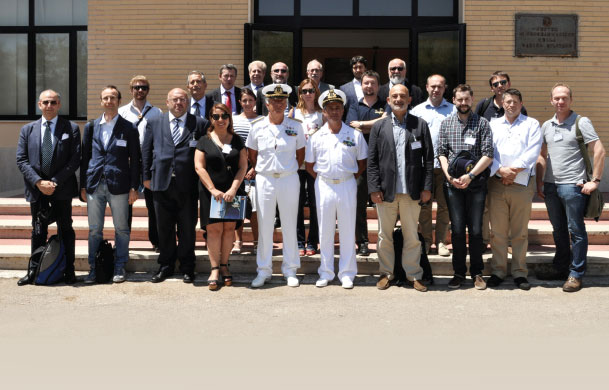
Defence Turkey Visited Maricenprog, Italian Programming Center in Taranto
Maricenprog, Italian Navy Programming Center
Maricenprog located in Taranto is responsible for developing and managing the operating software used by Command and Control Systems on board all Italian vessels, as well as developing and integrating tactical data link systems, developing of new generation C2 Systems, life cycle support and configuration management of C2 systems in service , conducting system test and technical/operational training. The center has successful cooperation with Italian Defence Industry with a total staff 80 military and civilians.
The origins of Maricenprog date back to June 1968 with foundation of Maricensadoc (Italian Navy SADOC Center) which was then transferred to Taranto in 1970 and renamed Maricenprog.
In addition to the its main mission to implement the Operating Software for Command and Control Systems installed on naval vessels (aircraft carrier Cavour, Orrizonte, Fremm, Garibaldi etc), Maricenprog also distributes to their entire development cycle. Definition of requirements and operating specifications for onboard systems, the preparation of preliminary system architecture studies, monitoring and control of operating software, ensuring interoperability with platforms that operate tactical data links and the engineers assigned to system operation , maintenance and software production are realised in this center.
Maricenprog also acts as a center of excellence for the Italian Navy in tactical data links and has the systems and equipments needed to perform development, integration, testing and interoperability verification activities.
In the center , between 1972- 2014, total 49 ships (33 ships of them still in service) were equipped and 5 ships will be equipped in the coming period.
ITS CAVOUR Shore Integration & Acceptance Center
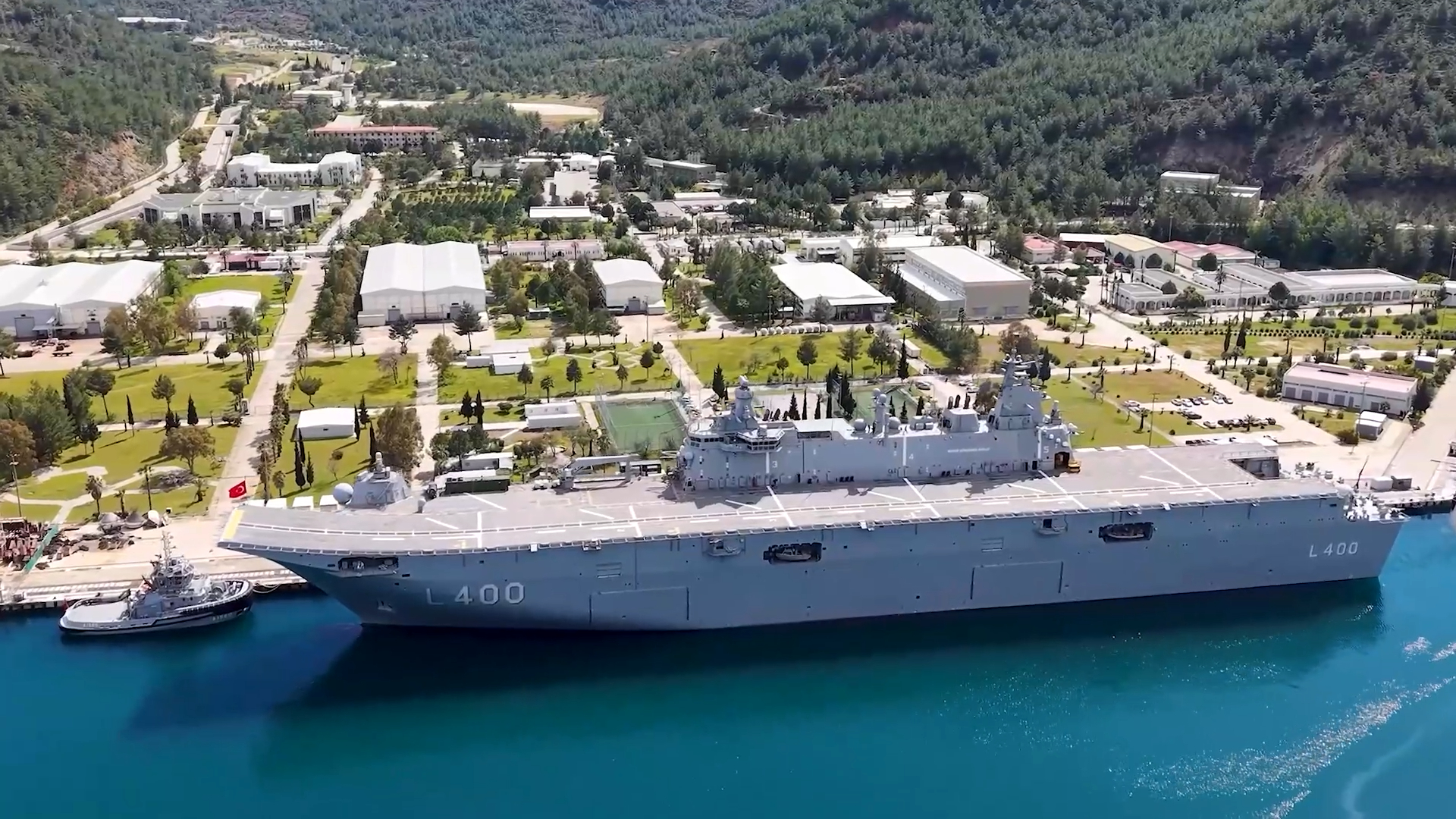
Cavour is an Italian aircraft carrier and the newest flagship of the Italian Navy She is the largest unit in the Marina Militare (Italian Navy) and was launched in 2004. The ship is designed to combine fixed wing V/STOL and helicopter air operations, command and control operations and the transport of military or civil personnel and heavy vehicles.
This center mission is to provide a shore facility for CMS SW maintenance, developing & operator’s training in a ITS Cavour Combat System fully compliant replica. The laboratory are composed by subsystems of the Naval Combat System (Subsystems emulators & simulators, real subsystems and devices).
Along with Italian vessels, Multi Data link Process Subsystems (developed by Selex) are tested in this center for Finish Navy.
Horizon Class Shore Integration & Acceptance Center
The Horizon-class are a class of highly sophisticated air-defence destroyers in service with the French Navy and Italian Navy. The programme started off as the Common New Generation Frigate (CNGF), a multi-national collaboration to produce a new generation of air-defence destroyers. In Italy the class is known as the Orizzonte-class, which translates to Horizon in French and English.
France, Italy and the UK issued a joint requirement in 1992 after the failure of the NATO Frigate Replacement for the 90s (NFR-90) project. The resulting CNGF programme consisted of the Horizon frigate and its Principal Anti Air Missile System (PAAMS). The Principal Anti Air Missile System (PAAMS) is a joint programme developed by France, Italy and the United Kingdom for an integrated anti-aircraft warfare system. PAAMS is designed to track, target and destroy a variety of high performance air threats, including saturation attacks of very low altitude (sea skimming), supersonic cruise missiles, fighter aircraft and UAVs. PAAMS, with its Sylver Vertical Launching System, can launch 8 missiles in under 10 seconds while simultaneously guiding up-to 16 missiles to designated targets at any one time
Afterward Uk withdrawal, France and Italy continued their collaboration under the Horizon project, ordering two ships each which deploy the PAAMS missile system. The Italian Navy ordered two units, Andrea_Doria (D553) and Caio Duilio (D554), to replace the Audace-class destroyers. Andrea Doria was accepted on 22 December 2007 .
Within this programme, this center provides CMS SW maintenance, developing & operator’s training of Horizon Class Combat System, Anti-ship missiles TESEO and DAVIDE integration to the vessels The Teseo is an Italian-built, anti-ship and coastal attack missile first built by the Italian company Oto Melara jointly with Matra and now made by MBDA.
C - Dep: Coalition Distributed Engineering Plant
In 2007, with support from the company SELEX-SI, the C-DEP (Distributed Engineering Plant Coalition) structure has been created. This capability provide the possibility to federate ASTT
(MARICENTADD), MARICENPROG SIACs and ITN Assets (Ships, aircrafts, helicopters, submarines) with similar geographically distributed NATO/Coalition Centers.
This plant of Maricenprog is a technological platform to test interoperability of systems and operational procedures, involving geographically distributed Centers and wide area networks by using dedicated protocols. This structure, created by the federation of various MARICENPROG SIACs, it’s managed by a Control Room, composed by hardware and software components such as Scenario generator and Animator (DIS o HLA), Recording e analysis Tools, Network monitoring, VoIP and VTC capability, Simulation of tactical communication using DIS protocol. The C-DEP structure has the capabilities focused on Operative Scenario sharing, Voice Over IP, Link 11 and Link 16 data exchange over IP protocols, Force Engagement Order Exchange and Remote support session’s activations.
Moreover, in the center Italian Navy Distributed Training structure allows single operator and functional teams training using a combination of live, virtual and constructive simulation. To realize distributed Training methodology is necessary for a network infrastructure to inject a scenario from a master scenario generator to remote sites, allowing training activities even to harbour moored units.
Many activities and exercises have been conducted since 2007 in C-DEP facility. IT Navy conducted more than 20 NATO/Coalition Training or Technical events as follows:
Coalition Warrior Interoperability Exercise (CWIX)
Active Layer Theatre Ballistic Missile Defence Ensemble Test (ALTBMD ET)
Maritime Theatre Missile Defence (MTMD)
NATO Ballistic Missile Defence (NATO BMD)
Medium Extended Air Defence System (MEADS) Interoperability Demonstration (in progress)
The activities such as European Air and Missile Exercise Alliance (EAMDEX), Maritime Theatre Missile Defence (MTMD), Fleet Synthetic Training (FST) with US Navy and RAMSTEIN ALLIANCE (NATO BMD) will be planned by the end of 2014.
The role of Maricenprog in NATO Ballistic Missile Defence Programme
NATO Ballistic Missile Defence (BMD) was established in September 2005 as the Active Layered Theatre Ballistic Missile Defence (ALTBMD) Programme, for the protection of deployed forces. This followed the completion of a two-year feasibility study in which eight NATO nations and various NATO projects cooperatively participated. As a result of the NATO Lisbon and Chicago Summits in November 2010 and May 2012 respectively, the programme was expanded to include the protection of NATO European populations and territory. An interim theatre ballistic missile defence capability was fielded in 2010 followed by an interim territorial defence capability in May 2012.
The focus of the Programme is the upgrade, test and integration of NATO’s command and control (C2) systems and underlying communication network to enable effective information exchanges between various NATO and national missile defence systems. This integrated system-of-systems architecture will create a larger range of detection, communication and missile defence capabilities for NATO forces, whether deployed within or beyond NATO’s area of responsibility, and NATO populations and territories.
Italian Navy’s DORIA Class with a CMS including a Tactical Data Link fully Ballistic Missile defence
Capable. NATO program is structured in Ensemble Tests (ET) sessions performed in net-centric environment. Each ET aims to verify a different capability. The goal of the ET 1, played in autumn 2011, was to establish the NATO BMD architecture, using software models, developed by the Nations.
MARICENPROG developed Italian software model called CMS Orrizante -Use Case 5.
For the Ensemble tests 2, Maricenprog realized the first BMD prototypical software version of Doria Class CMS, running in a hardware controlled environment, connected to the others NATO BMD assets. In winter 2014 NATO will run the Ensemble tests 3 dedicated to Non Real Time activities. MARICENPROG developed and employed a Mission Planner, based on NATO NIRIS software, within CMS Orizzonte UC-7. ET3 is going to be finalized within autumn 2014.
MBDA Ballistic Missile Defence Activities
MBDA’s Aster achieved the first ever successful interception by a European missile of a target simulating a ballistic missile threat and to offer a European contribution to NATO ballistic missile defence programme. Aster is primarily operated by France, Italy, and the United Kingdom and is an integrated component of the PAAMS air-defence missile system, known in the Royal Navy as Sea Viper. As the principal weapon of the PAAMS system, Aster equips the Type 45 destroyers and the Horizon class frigates. Aster also equips the French and Italian FREMM multipurpose frigates, though they will not be operating as part of a PAAMS air-defence suite. The Aster missile series, comprising the Aster 15 and Aster 30 are a family of vertically launched surface-to-air missiles .
Although The Aster 30 is anti-balistic missile capable, with its 3 different variants, Aster 30 Block 1, Aster 30 Block 1NT and Aster 30 Block 2, MBDA has enhanced its Balistic Missile Defence capabilities.
Aster 30 Block 1 has ground-based wide area defence capable against 600 km-range ballistic missiles. System has already successfully tested 3 times with real engagement of Short Range Balistic Missile targets. It is is used in the Eurosam SAMP/T system operated by the French Air Force and the Italian Army .
Aster 30 Block 1NT (New Technology) will be able to intercept ballistic missiles with a range up to 1000 km. It has a lower layer capability providing enhanced capability and force protection against theatre Ballistic Missiles with regard to Aster 30 Block 1 and improved seeker to increase system capability. It is compatible with existing Sylver A50 launcher.
Aster Block 2 with Hit-To-Kill capability and exo-atmospheric capability, is currently being developed. It maximizes the protection of sensitive zones and deployed troops against the whole spectrum of ballistic and air breathing threats and uses a complementary high altitude interceptor operating in the upper layer to cope with evolved ballistic threats (SRBM and MRBM). It will feature significantly enhanced ballistic missile Defence and has a wide area defence capable against 3000 km-range ballistic missiles. Moreover it is designed as an evolution of ASTER Capability and provides a potential contribution to the upper layer of NATO BMD. The first Aster Block 2 is expected to deliver after 2020.
The UK and France have agreed to strengthen defence co-operation in Anglo-French Brize-Norton summit held on January 2014. According to the final declaration, 2 nations have decided to launch a bilateral dialogue on Ballistic Missile Defence (BMD). This would include analysis of the potential to develop a longer range BMD role for the MBDA Aster missile. This work has synergies with the “One Complex Weapons” initiative which aims to coordinate the development and acquisition approach that eliminates duplication in the industrial base.
On the other hand, France Parliament has voted 250 M€ for the development of Aster B1NT in this year’s budget.