Distinguished Experts and Researchers Discussed & Analyzed the Impact of EDTs on War Fighting & How they Shape the Trajectory of the Ongoing Russia-Ukrainian War
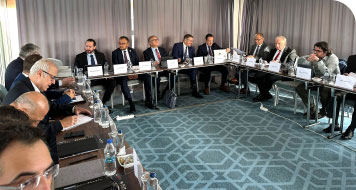
Supported by the NATO Science for Peace and Security (SPS) Program, the event was held in person at the Radisson Blu Bosphorus Hotel located in Ortaköy, Istanbul. The event brought together a group of some 35 distinguished experts and researchers from politics, industry, media (including Defence Turkey Magazine), civil society, academia and think tanks.
Within the scope of the workshop the main discussion themes included a range of different EDT-related topics such as the future of war, drone warfare, unmanned systems, dual-use technologies, NATO’s DIANA Project and the military application of artificial intelligence (AI). Besides pre-organized panels, the insightful presentations delivered by the eminent speakers lined up in the two-day work shop program also laid the ground work for a rich and informed discussion with the contributions distinguished participants. Since the event was subject to Chatham House rules, in this article I will only share opening remarks delivered by Ambassador (R) Tacan İLDEM, Chairman of EDAM and Vasyl BODNAR, Ambassador of Ukraine to Türkiye.
The two-day advanced research workshop (ARW) began with the opening session at 9:30 a.m. on October 27, 2023 and ended with Concluding Remarks (Panel VI) of Ambassador (R) Tacan İLDEM, Chairman of EDAM at noon on September 28, 2023. The main part of the workshop was conducted in six panels that followed the opening session. In the five panels, the sixth one was for Concluding Remarks, during the two days, the following topics were discussed: “Digitalization of the Battlefield & the Future Operating Environment (FOE)”, “Emerging Disruptive Technologies (EDTs) in Ukraine”, “Red Team Tracker: EDT Trends in Russia and China”, “Türkiye’s Way: Turkish Unmanned Systems Portfolio and AI Strategy”, and “Lessons Learned for NATO & the Way Forward”. During the workshop Opening Remarks were delivered by Ambassador (R) Tacan İLDEM, Chairman of EDAM and Vasyl BODNAR, Ambassador of Ukraine to Türkiye and James APPATHURAI, Deputy Asistant Secretary General for Emerging Security Challenges, NATO (VTC).
Ambassador (R) Tacan İLDEM, Chairman, EDAM welcomed all present and thanked participants for accepting their invitation to take part in the deliberations of this workshop on this important topic. In his remarks, he underscored that in the past decades we have seen the introduction of a number of destructive technologies into warfare, including some whose effects are so expensive that they can be considered by their own domains such as Cyber and Cognitive Warfare. He continued his speech as follows, “Maintaining the technological edge is the foundation up on which NATO’s ability to deter and defend against potential threats ultimately rest. Without a strategic search in this area, allowing potential adversaries to gain competitive advantage would impede NATO’s ability to win on the battlefield and change the fundamentals of deterrence. It would also offer state and non-state actors, including terrorist groups, the potential to threaten our societies from within. In a complex security environment more and more governed by the dynamics of a systemic strategic competition, where EDTs can be both force and threat multiplier, it is essential to put innovation at the heart of the work of NATO.”
Ambassador (R) İLDEM stressed that the objective of NATO innovation should be to encourage government, industry and academia to engage in explorations of certain technologies that go far beyond those currently envisaged. “NATO is doing some of this already, its allied command transformation, innovation and its engagement with the academic institutions and private ventures in pushing the boundaries of what is possible. The Innovation Fund and the Defense Innovation Accelerator for the North Atlantic, DIANA, are notable examples in that respect. The acquisition of and access to EDTs in fields such as Big Data, Artificial Intelligence (AI), autonomous capabilities, space, hypersonic and new missile technologies, quantum technologies and biotechnologies and human augmentation is fundamental to future security of NATO and Allies. These should be reflected in the capabilities NATO asks its allies to deliver. To be ahead of the efforts underway by authoritarian states to achieve dominance in key EDTs must be a strategic priority for the Alliance”, he said.
Regarding the program of the workshop Ambassador (R) İLDEM shared following information, “Our program for this workshop will give us the possibility to dive into different aspects of this important question. In our panel on digitalization of the battlefield and the future operating environment, among others, we will be analyzing the impact of EDTs on war fighting. In the session on the EDTs in Ukraine we will focus on how EDT use in the Ukrainian Armed Forces defensive combat operations shape the trajectory of the ongoing Russia-Ukrainian War. In the panel on EDT trends in Russia and China, we will have a red team tracker to have a better understanding regarding how countries like Russia, China, Iran and North Korea in so far as development of EDTs and cooperation among them are concerned while also discussing the role of EDTs in the US-China Great Power competition. In our session on Türkiye’s Way: Turkish Unmanned Systems Portfolio and AI Strategy, we will try to evaluate current Turkish Drone Warfare in light of the current trends in the global defense technological industrial base and see the added value of Türkiye in the Alliance’s technological edge. And finally in a separate session we will try to draw lessons for NATO and come up with a way forward.”
Then Vasyl BODNAR, Ambassador of Ukraine to Türkiye took the floor and gave an overview of what is going on now in the Russian-Ukraine War and how they look at this situation. At the beginning of his address Ambassador BODNAR congratulated Türkiye for its 100th anniversary which is very essential not only for the Turkish Nation, but also for Ukraine because the fight which was organized by ATATÜRK at that time also inspires Ukraine today to defend against superior forces and even to beat them like ATATÜRK did 100 years ago. Today, Ukrainians are demonstrating the true heroism in defending the sovereign territorial integrity of their country against Russian invasion, which constitutes a blatant violation of fundamental principles that underline global and European security.
Ambassador BODNAR continued his speech as follows, “Unfortunately war is going on and war is terrible, but we are defending, keeping the lines. The reason why it is going on, first of all is the bravery of the Ukrainian people, and the international solidarity and support it has received, also new technologies which actually are changing the battlefield and creating new views, new opportunities. This war is not only technically new but it also creates a different perception so it’s an online war, which we are watching practically in real time, a war which unfortunately is opening most probably a gateway to instability globally, because of what we see in the Middle East in Gaza and we don't know where the next fire will appear. It is also a story from which we need to take lessons. And from one point of view for Ukraine it is the entire nation’s fight because it’s engaged practically all Ukrainians and it creates a different perception of the world in more black and white tones.”
In his address Ambassador BODNAR listed the reasons why Ukraine is more or less successful defending itself and trying to even beat Russians back and reoccupy territories they captured as follows:
“First of all it is as already mentioned about the great Ukrainian people. But I mean not only people who take up weapons and go to the Army, but practically all Ukrainians, because it is very mobile, a highly digitalized and self-organized society which actually helps states not the state help them. So, that is the ground which creates this resistant movement and creates opportunity to defeat a superior enemy.
Secondly, it is effective e-Governance. So, let's look in details. When ZELENSKY became the new President and appointed a new government the key priority was digitalization. We have a separate ministry (the Ministry of Digital Transformation was established in 2019). We have very skillful specialists who started to digitalize everything possible. So, before the war, this work on ‘State in a Smartphone’ became real. So, the people, when they see any Russian movement, could easily send a message to the application via their smartphone and everybody, including militaries, saw them online or could get the information. It means digitalization of the battlefield physically, but the whole society is working on that and you know different private and government apps, social media and networks, they are working as one system.
Thirdly, Ukraine has a very strong IT Sector. Before the war, the export of IT Sector services was second in comparison with other services we provide to the world. Our IT Sector is very independent and has global connections to all key players in this market. So, when the time came to go to Google, Amazon or SpaceX they responded very quickly. It even is the story which is not visible, it has allowed us to preserve the ruling of the militaries, the governing of structures despite, physically, the government was dispersed in different places for security reasons, and many other things. It also helps us to preserve the state budget, coming money, and organize communication from different levels as well as start crafting money for people. If you have banking, you can easily engage everyone from Australia or South Africa to send money to support Ukrainian Armed Forces.
The fourth dimension of this story is Ukraine has a relatively modernized and digitalized Armed Forces.
Regarding the role of satellites in the war, Ambassador BODNAR stressed that the Starlink Satellites are actually part of the war especially in communication but pointed out that they are also serving as an early warning system. “Today every Ukrainian has an alarm system about air strike and even a plane in Russia just taking off, everybody in Ukraine knows they need to go to a shelter. So, this early warning system is really working as a new system and actually helps to save thousands of lives,” he stated.
Regarding the new technologies in Ukrainian Armed Forces service, Ambassador BODNAR gave BAYRAKTAR TB2 UCAV as an example and added, “A lot of things changed our perception of war. We have put attention to UAVs even before the war. The first contract on BAYRAKTAR TB2 was signed in 2018 then we trained the people who operate them. At the beginning of the war who stopped the armored columns of Russians? It was BAYRAKTAR TB2 who just hit the targets and helped aviation and artillery to stop it. Let’s not overestimate new technologies because still tanks, artillery and machine guns are the key players on the ground, but nevertheless it changed the landscape and digitalized warfare.”
After the opening remarks by Ambassador (R) Tacan İLDEM, Chairman of EDAM and Vasyl BODNAR, Ambassador of Ukraine to Türkiye, the floor was opened to the high-level participants of Panel 1, titled “Digitalization of the Battlefield & the Future Operating Environment (FOE)”
Codes of Ukraine’s Algorithmic Warfare: Palantir Technologies, Delta System, Kropyva Software and Starlink
Algorithmic Warfare is warfare conducted through artificially intelligent means. Artificially Intelligent means are those that are not only intelligent (collecting and applying insight) but also artificial (acting on intelligence in a way that humans cannot). After attending the two-day advanced research workshop focusing on Emerging Disruptive Technologies (EDTs) in defense and lessons learned from Russia-Ukraine War, I have realized that with Palantir Technologies, Delta System, Kropyva Software and Starlink the Ukrainian Armed Forces have managed to establish efficient Algorithmic Warfare capability, which allows it to establish balance and even gain superiority against the stronger Russian Army. Thanks to support of Artificial Intelligence (AI) Technologies and Algorithmic Warfare capability the Ukrainian Armed Forces have so far performed remarkably well against the much larger and initially better-equipped Russian Armed Forces. Therefore, in my opinion, the most fundamental EDTs in terms of the Russia-Ukraine War are AI Technologies, which pioneer the digitalization of the battlefield and increase the effectiveness of network-centric warfare capability and establishing a ground for the Algorithmic Warfare, and the Starlink Satellite Communication System, which allows uninterrupted and secure communication. Therefore, it can be said that there is also a battle between Ukraine and Russia inside computer codes in parallel with the battle on the ground on the territory of Ukraine.
The digital reforms implemented by the Ukrainian Government led by President Volodimir ZELENSKY, who has an idea of having ‘a State in the Smartphone’ have not only transformed the country’s economy, governance and public services but also the military. Ranked sixth in Europe for open data, and having ranked fourth place worldwide for the number of qualified IT specialists, Ukraine, has managed to significantly strengthen the potential of the Ukrainian Armed Forces in many areas from intelligence to military logistics through integration of digital technologies and systems based on artificial intelligence thanks to its partnerships established with leading local and international software companies and cloud solutions providers under the coordination of the Ministry of Digital Transformation.
The American IT company, Palantir Technologies Inc. is one of the leading international software companies and cloud solutions provider that provides IT assistance to the Ukrainian Armed Forces. The partnership between Palantir Technologies and the Ministry of Digital Transformation of Ukraine helps enable the company’s technologies to support the defense of Ukraine. Palantir Technologies provided protection for the digital component of the Ukrainian Armed Forces and helps with the transfer of information to a cloud environment with support for critical servers in the future. This protects them from Russian cyberattacks and missile strikes on data centers on the territory of Ukraine. Palantir Technologies has considerable experience in the field of artificial intelligence system development for processing large data sets and solving specialized problems. With the assistance of Palantir Technologies, Ukrainians are fusing their courageous fighting spirit with the most advanced intelligence and battle-management software ever seen in combat.
One of the largest defense projects in the last decade in the Ukrainian Armed Forces was the development and implementation of a situational awareness system called Delta System that can provide the military with various data about the enemy and help coordinate forces on the battlefield in real time. Created in 2021 by the A2724 military unit and further developed by the Ukrainian Ministry of Defense, the Delta System is a cloud-based battlefield mapping system containing actual data in real time, so the military can plan their actions accordingly. Since it is a cloud system a soldier can access it from a laptop, smartphone, tablet or other device with a browser. Delta System became broadly operational in August 2022 and has been utilized by the Ukrainian Armed Forces against Russian forces for a wide range of battlefield management tasks, including the planning of operations and combat missions, coordination between units, and secure exchange of information about the location of enemy forces. Helping the military track the movements of Russian forces, Delta System collects, processes and displays information on hostile troop movements, coordinates defense forces and provides real-time situational awareness. In addition, the system provides a comprehensive picture of the current battle space displayed and summarizes it on a user-friendly digital map by collecting data from sensors and open and secret sources. On February 4, 2023, the Ukrainian Government approved full deployment of Delta System to the Ukrainian Armed Forces and permitted hosting of Delta Systems’ cloud-components outside of Ukraine to protect it against Russian cyberattacks and missile strikes.
The ability to aggregate data from commercial vendors is one of the revolutionary features of Delta System. Using a Palantir Technologes’ tool called MetaConstellation, Ukrainian Armed Forces can see what commercial data is currently available about a given battle space. The available data includes a wide array, from traditional optical pictures to synthetic aperture radar that can see through clouds, to thermal images that can detect artillery or missile fire. The MetaConstellation platform allows the user to task earth observation satellites in low-earth orbit (LEO) to answer a specific query. If a military decision maker wants to know what is happening in a certain location and time in the Ukraine or Russian territory then he clicks on a button and MetaConstelation schedules the right combination of satellites to survey the designated area. Remarkably, the software can deploy algorithms at the source so that only those images where the algorithms find valuable information are downloaded, thus time is saved. During the Battle of Kherson, Palantir’s MetaConstellation assessesed roughly 40 commercial satellites passing over the area in a 24-hour period. According to open sources Palantir normally uses fewer than a dozen commercial satellite vendors, but it can expand that range to draw imagery from a total of 306 commercial satellites that can focus to 3.3 meters. Soldiers in battle can use handheld tablets to request more coverage if they need it.
Ukrainian Armed Forces have been utilizing software packages that are often developed and deployed by volunteers. The most well-known of these applications is Kropyva Software, an intelligence mapping and artillery software populated by information from UAVs, Drones and other sources. Provided by Army SOS (a non-profit organization) Kropyva Software allows Ukrainian units to plot both enemy and friendly positions. Running on Android, Kropyva Software allows commanders to enter target coordinates into a tablet, and then the direction of firing and the distance to the target are calculated automatically. Forward-deployed tactical units have downloaded the software and continuously updated it on handheld tablets and computers. Kropyva Software allows units of the Land Forces of the Ukrainian Armed Forces (artillery, armored vehicles, infantry or reconnaissance units, etc.) to plot both enemy and friendly positions. It uses short-wave and digital radio stations compatible with the North Atlantic Treaty Organization’s security communications standards. Kropyva Software has increased the effectiveness of Ukrainian Land Forces’ artillery units by an order of magnitude, acting as a force multiplier. Thanks to Delta System, Palantir Technologes’ MetaConstellation tool and Kropyva Software, Ukrainian Armed Forces can track Russian forces in real time using satellite and drone imagery, as well as visual recognition algorithms, and target with unprecedented speed and precision. With the utilization of Starlink, the commercially owned satellite internet constellation set up by SpaceX, Ukraine has ensured that Delta System, Palantir Technologes’ MetaConstellation tool and Kropyva Software remains up and running.
At the beginning phase of the Russian invasion Ukraine, Russian cyber units mainly launched a systematic attack on Ukrainian satellite connection terminals to disrupt their communications. Kyiv responded by switching them to Starlink, another tactical innovation that has allowed Ukraine to overcome Russian jamming. In order to enable the proper functioning of digital services (including the ones utilized by the Ukrainian Armed Forces) and critical infrastructure facilities such as hospitals, schools, and energy infrastructures amidst war, the Ukrainian Government was granted around 20,000 Starlink terminals, most of which are funded by Western support. The Starlink terminals are crucial for the ability to enhance and sustain Ukrainian network-centric warfare (NCW) capability through Delta System. Providing high-speed, low-latency broadband internet using advanced satellites in low earth orbit, Starlink has enabled Ukrainian Armed Forces to carry out intelligence collection and fire support operations against Russian positions even under severe jamming thanks to its capability to provide encrypted satellite communications. Overall, Starlink has helped blunt Russia’s attempts to jam signals, block the internet, and undermine Ukrainian command-and-control capabilities. Both drones, UAVs and AUVs use Starlink to stay connected when Ukraine lacks internet and power because of Russian artillery targeting its critical infrastructure