Emre ÖZTÜRK: “We Are a Company that Believes in Cooperation More than Competition”
Defence Turkey: Your company’s journey started in 2003 with the simulation company Anova Engineering and with the inclusion of companies founded in time with new partnerships, Anova Group transformed into a group of companies that provides services to all sectors, in particular to the defense industry, with its R&D activities, that reduce foreign dependency thanks to indigenous products and indigenizes sub-systems. Could you evaluate Anova Group’s 18-year adventure and the point it has reached as of today? What were the critical milestones on your way to success?
Emre ÖZTÜRK: As three engineers, we started our journey in 2003 at our office on the basement floor of a building and now we are proceeding with around 250 qualified staff at the group of companies you have mentioned. We used to work on a specific field such as the simulation of thermo-fluids in our company’s first years and presently we design sub-systems with their mechanics, electronics, software and equipment, produce and qualify them. We managed to become a critical player in the defense industry’s ecosystem, but we still have a lot to accomplish and there are many areas we need to improve ourselves. Today I consider Anova as a successful company and I believe the most significant factor in this success is our effort to maintain our turnover rate at a low level as a result of the value we attach to our employees. Our dedicated human resources with high levels of sense of belonging and experience are our greatest richness and thanks to them we are capable of executing the indigenization of the critical sub-systems and components that are difficult to procure.
Defence Turkey: Today, Anova Group is the source of indigenous solutions for the critical sub-systems in the defense sector. What are your comments on the defense and aerospace industry’s role in Anova Group’s development?
Emre ÖZTÜRK: The headquarters of the first company we established was Istanbul and in 2003 our defense industry was way behind its current position where it could fulfil Turkish Armed Forces (TAF) needs through direct procurement or licensed production models with a low domestic participation rate. Strategic decisions and the will for going towards local, national and indigenous products created quite remarkable opportunities for a few engineering companies in the sector and we made use of these opportunities properly. Being at the right place at the right time, we unrelentingly proceeded on our path with patience by perceiving the challenges of the sector as opportunities to improve our capabilities and by basing our business on R&D. In parallel with the growth of our sector, Anova achieved continuous growth in terms of its number of staff, capabilities as well as infrastructure.
Defence Turkey: Anova Group consists of five individual companies. What would you like to say about Anova Group’s current staff profile, its 2020 performance shadowed by the COVID-19 pandemic, its turnover as well as expectations and targets for 2021?
Emre ÖZTÜRK: The number of our group’s staff is nearly 250 and we project to reach 290 employees by the end of the year. Despite the pandemic, we employed nearly 40 employees in 2020. On average, one of every 80 candidates we interviewed started working at our company. We are quite meticulous in selecting our colleagues. The employee turnover rate is around 6% in our group. As of today, the average experience of our employees is 9.3 years. In 2020, our group’s turnover exceeded TRY 140 million and our forecast for 2021 is TRY 195 million. This growth rate has been proceeding in this trend in recent years. We were identified as one of Turkey’s most rapidly growing 50 Technology Companies by Deloitte for four consecutive years (Deloitte Technology Fast 50). Yet, our turnover per employee is behind the level we desire. The most critical factor of this is our intense R&D activities and the increase in the number of our products that went into serial production in recent years. As the number of products going into serial production increases in years, the per capita turnover will rise exponentially.
Defence Turkey: You focused on manufacturing indigenous product development activities regarding the defense and aerospace Industry with the company Anova R&D Technologies that was founded in 2008. In which fields does the Anova Group have indigenous design and production capabilities?
Emre ÖZTÜRK: Our design team is quite competent; therefore, many sub-systems and components are within our area of interest. However, we identified three main strategic areas and wish to intensify our activities in these areas, namely the weapon systems, environmental control systems and fuel systems. In each of such areas, we have indigenous products that have been qualified at component and sub-system levels and verified in the field. The number and diversity of these products are increasing day-by-day and we can generate solutions regarding almost all of the components of such systems that we can export to friendly and allied nations. These products are manufactured without foreign dependency, license or ITAR restrictions. We carry out the mechanical manufacturing and assembly activities of the sub-systems and components that we design within our body, yet surely, we benefit from our certified suppliers at other stages of production such as painting, coating, electronic typesetting and wiring.
Defence Turkey: Presently, Anova plays quite a critical role in the indigenization of the critical sub-systems required by the main contractor companies of the Turkish defense and aerospace industry. Within this scope, the Flex Chute regarded as Anova’s first product which you completed in 2011 for fulfilling Aselsan’s demands, the fuel pomp you developed for the utilization of ATMACA Surface-to-Surface Guided Missile and the Environmental Control Unit (ECU) which you developed for Aselsan’s AselPOD Electro-Optical Reconnaissance, Surveillance and Targeting System and continue the deliveries as a single-source are among the indigenized products that come to mind. At which point did the defense sector product indigenization process you launched with the Flex Chute arrive? What role did the transition to smart and electromechanical products from mechanical products play in this success?
Emre ÖZTÜRK: The flex chute is our first product. The product group we started with 12.7 mm turned into an essential part of the remote-controlled weapon systems of all calibers for both NATO and Russian missiles. In addition to our domestic industry, we conduct export activities to many countries. The flex chute is an entirely mechanical product. However, there are only two manufacturers of this product in the world and both of them are of U.S. origin and the procurement of this product from both companies requires export licenses. We have been the third company in the world to produce this product. As far as I know, we are the first and only company to design a feed chute compatible with the Russian missiles. The products we developed later evolved into smart and electromechanical products in time, as you have also mentioned. The fuel transfer pump we developed for ATMACA was in fact a Technology Acquisition Obligation project of the Presidency of Defense Industries. We revealed a qualified product at the end of four years and this product paved the way for the fuel systems. Presently we are developing similar pumps for different ammunition, these are centrifugal and gerotor pumps. The environmental control unit we developed for AselPOD was our first product at the sub-system level. In a period of 25 months, designed from scratch, it was produced, and it passed the qualification stage including verification and flight tests. Currently, it is used at the JF-17 fighter jets, the verification is being conducted for F16 as well. ECU can run cooling, heating and ventilation according to external conditions. It can operate under the toughest environmental conditions. The greatest advantage it brought to our company was the establishment of an electronic design directorate thanks to this project. Today, our electronic design team comprising 30 people designs all our cards, generates indigenous solutions in power electronics and builds designs that pass the EMI/EMC on the first try. The added value of the smart products is higher. Naturally, expert teams in areas such as system engineering, project management, configuration management, safety/reliability, integrated logistical support that are required for building these types of sub-systems have been formed. In defense and aerospace, these are essential areas but increase the costs. Documentation is equally important. It is said that when an aircraft is built, its documentation will be as heavy as the aircraft. As Anova, with a team having organizational memory, capable of building documents with a good command of the sector’s standards, we are designing domestic, national and indigenous products.
Defence Turkey: Surviving in the sector by merely delivering engineering services is not easy for an SME. Therefore, the sector companies need to carry out production activities and diversify their productization activities with various areas. On which areas/platforms will the Anova Group focus in the upcoming period?
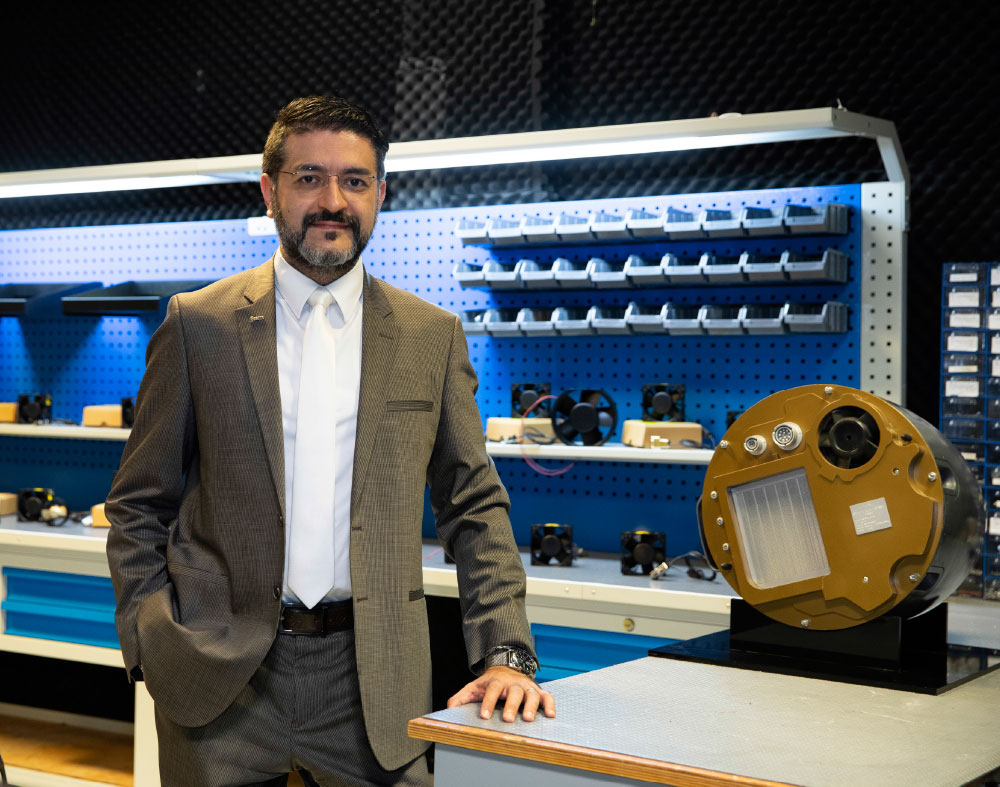
Emre ÖZTÜRK: That is quite correct, unfortunately operating a company of this size by merely running engineering activities is almost impossible. One cannot build a profitable organization through R&D. Once the products developed as a result of R&D activities go into serial production and you manage to sell them, you receive the returns of your efforts. Therefore, productization is at the top of our most critical priorities. Naturally, all R&D activities cannot result in commercialized products. We had certain successful products that could not be commercialized. Still, an R&D company has to take such risks. Our efforts and strategy to deepen in the three areas I mentioned before, in other words, in the weapon, environmental control and fuel systems are based on the indigenization of all these sub-systems’ components that we cannot procure commercially off the shelf (COTS). The military fans we recently indigenized can be mentioned as a good example. Also, we revealed our first product in mid-2020 as a result of our R&D activities that have been going on for three years on these products that have merely two manufacturers in the world. We conduct the aerodynamic and mechanical design, motor and driver designs compatible with the requirements and this enables us to execute the indigenization of all types of fans. Today we are working on 14 types of fans. We carry out the form-fit-function design of these fans that were imported in the past; their efficiency is higher than equivalent products. A part of our fans was qualified, and the deliveries started. Qualification of some fans is underway while another group of fans is going through the design stage. Then again, just from Aselsan and TUSAŞ, we received an order of around 1,300 for our fans within six months. We increased our production capacity to achieve timely delivery of such a large amount of production. We made a bench investment amounting to TRY 5 million in the last year. The fans have not been launched internationally yet; the cancellations of the fairs due to the pandemic prevented the international promotion of our fan group. We follow a similar path regarding the pumps, we are capable of the hydrodynamic, mechanical, motor and driver designs of a wide range of fuel, hydraulic and coolant pumps. Presently we fulfil the pump demands of our companies such as Aselsan, Roketsan, TÜBİTAK SAGE and TEI.
Defence Turkey: Research and Development (R&D) investments and activities are of vital essence for the Turkish Defense Industry to cultivate a resilient and reliable structure. The R&D activities that constitute one of the most critical conditions of the sector’s sustainability are also the most crucial assurance of becoming a global company for the sector companies. Could you enlighten our readers about Anova’s perspective of R&D, the share it allocates yearly to R&D from its turnover and its main ongoing R&D investments/activities?
Emre ÖZTÜRK: “R&D Today for Tomorrow” is our company’s motto. It is also on our logo. Since all our partners are R&D origins, we knew the importance of R&D in achieving a powerful and independent defense industry and worked with this vision before the “indigenous and national” concept became so popular. When one believes this much in R&D, continuous investments become inevitable. We invested significantly in power electronics in the last two years. Thanks to our software and hardware investments, our power electronics laboratory became self-sufficient. We built testing infrastructures for the fans, pumps, exchangers and the cooling turbo machines we refer to as air-cycle machines. We verify our designs first in the virtual environment with simulations and test them with the test systems. Each test system is customized for the product and enables us to carry out a wide range of performance tests. Other than that, we have been investing in gaining the capability of making designs in DO-178 and DO-254 standards for the Design Assurance Level - DAL level high software and complex hardware certifications for air platforms in particular. As I mentioned previously, our production investments continued during the pandemic. We manufacture our products with the CNC vertical machining centers, CNC Lathes and benches such as CMM capable of executing production in the precision and tolerance levels required by the defense industry. Our factory manufactures 98% of our products; we have never had a vision of becoming a contract manufacturer.
Defence Turkey: What is your evaluation of Anova’s current competitive power in internal and external markets?
Emre ÖZTÜRK: We are a company that believes in cooperation more than competition. We do not regard any of our companies as competitors, particularly in the internal market; we rather consider the opportunities to unite our competencies. One may observe this in the partnership structure of our existing companies as well. When we consider the potential components/sub-systems in Turkey to be indigenized and the number of sector’s companies, no one will be jobless even if the number is doubled. Therefore, instead of competition, cooperation and chasing cooperation opportunities are more critical for us. In external markets, our feed chutes are proceeding on their path to become a brand. We have distributors in the United Kingdom and South Africa. Regarding the fans, you will receive important news soon.
Defence Turkey: Explicit and implicit embargoes imposed on Turkey in the recent period by the EU and NATO member countries cause disruptions in the delivery processes of certain defense projects. Recently, the sanctions within the scope of the CAATSA (Countering America’s Adversaries Through Sanctions Act) announced by the U.S. Government (the Secretary for Foreign Affairs) have started to be officially imposed. What is the impact of these sanctions and embargoes on Anova Group? Has the delivery process of any of your projects been affected due to such embargos and sanctions?
Emre ÖZTÜRK: Though they seem to have negative impacts in the short run, in fact, the sanctions pave the way to the development of the indigenous defense industry in the medium run. Therefore, we do not consider the sanctions as a major issue. We have not faced any negative cases as we strive to use our designs or products that are not subject to license restrictions or off-the-shelf products with dual use in the sub-systems we developed. However, we are also affected by the global supply shortage particularly regarding electronic components such as connectors and relays though a part of these products is industrial products. We experienced a problem in the cooling systems of the AESA radars developed by Aselsan as we could not procure those products. Moreover, we faced cases where the duration of delivery processes identified as 18 weeks extended to 32 weeks in the procured products, but we are not the only company facing such issues and our customers tolerate such delays.
Defence Turkey: What would you like to say about Anova’s vision for the next ten years? After ten years, where will it be?
Emre ÖZTÜRK: It is not possible to compare the present Anova and the Anova that existed ten years ago. Therefore, ten years later, Anova will be quite different than today. I presume that we will see an Anova with over 500 employees and an extensive international reputation that is the strategic partner of the main contractors in the domestic market while collaborating with many Tier-1 defense and aerospace giants. To that end, we have identified targets such as generating and leading the technology instead of following technological developments. Though none of our products has such demand at the moment, we have a team working on artificial intelligence. We have been conducting projects entirely with our resources as we cannot stand aside regarding disruptive technologies of the future as we are intrinsically involved with R&D. Additionally, we have been taking remarkable steps towards institutionalization. As partners, we gradually started to withdraw from the Executive Board and handed over the tasks to the professionals. On the other hand, we are passing on an ERP system that extensively covers all the processes of the company. In parallel, we launched the installation of the PLM system.
Defence Turkey: Could you briefly introduce the TASECS Joint Venture Company that you founded in 2019 with TUSAŞ, GÖKSER, Gür Metal and FRITERM for the indigenous production of environmental control systems used on air platforms? Which type of assignments can TASECS assume in the ongoing GÖKBEY, HÜRJET and TF-X/MMU Projects?
Emre ÖZTÜRK: TASECS is a consortium established under the guidance of SAHA Istanbul and with the partnership of TUSAŞ. The purpose of this company’s establishment is the indigenous design of environmental control systems of air platforms. Our present priority is the National Fighter Jet (MMU). The environmental control system of the MMU consists of the combination of three quite complex sub-systems. A very high capacity is required but the volume and weight are quite limited. There are no design or production infrastructures in Turkey regarding certain components. The existence of components such as the valves and heat exchangers that need to operate at high temperatures and pressure, and the compressors and air-cycle machines operating at high speeds in the project as well as the tight project schedule is both exciting and intimidating. At the roll-out to be held on March 18, 2023, the environmental control system is expected to cool the cockpit and certain avionics. The remaining components of the system will be performing in 2025. Building proper designs, verifying and validating the products with high DAL levels, especially in the components I mentioned in such a tight schedule when our Technology Readiness Level remains at Level 2 or 3 is a major engineering challenge. When we succeed, we will enjoy the pride of bringing our country a sub-system in a platform regarded as a matter of survival and will obtain the capacity to generate solutions for all other platforms.
Defence Turkey: What would you like to say about Anova Group’s participation in the IDEF ‘21 Fair and its agenda regarding the event?
Emre ÖZTÜRK: This year we will be mainly focusing on the products such as the feed chute, pumps, environmental control units and fans that we displayed during the previous IDEFs. We are excited about displaying the military fans of various sizes and different speeds that operate both in AC and DC for the first time at a fair. Presently, we project different fan demands in various characteristics from our potential customers who witnessed our qualified products in addition to the fans we already developed. Besides, our visitors will have the chance to see the plate-fin type and micro-channel heat exchangers particularly used in aerospace in this fair. Regarding the fuel systems, we own products at a certain level of maturity, yet we will not be demonstrating any of them due to special permit requirements.
Defence Turkey: Could you briefly summarize the emergence of NUMESYS that you established in partnership with Figes in April 2018, its foundation purpose and the innovations the company brought to the Turkish Defense and Aerospace Industry?
Emre ÖZTÜRK: NUMESYS is a success story, which is quite rare in the world. Two competing companies decided to join their forces and unite them under a single roof. This decision paved the way to a very powerful simulation company. The company is one of the few Elite-status channel partners of the ANSYS Company represented in Turkey by Figes for 30 years and by Anova for 15 years. In line with its historical development, Figes has specialized in structural analyses and electromagnetic, and Anova in computational fluid dynamics and thermal analyses areas. When we joined our forces, we transferred all our engineers specialized in this field to NUMESYS and started to deliver more integrated services to our customers, mostly from the defense industry. We have been receiving positive feedback, and in 2020 NUMESYS ranked 11th among ANSYS’ partners across the world.
Defence Turkey: The U.S. origin ANSYS Company is a world giant in engineering simulations and NUMESYS is ANSYS’ authorized distributor in Turkey. What would you like to say about NUMESYS’ present partnership and organizational structure, its staff and production infrastructure?
Emre ÖZTÜRK: The partnership structure of NUMESYS is as follows: Anova - 50%, Figes - 40% and Koray Gökalp - 10%. We do not consider any changes in this distribution. Our structure consists of an executive board of three persons who are also the shareholders and professional staff. Our Director-General and Deputy Directors were the former staff of Anova and Figes. Regarding product development processes, since NUMESYS is a company that conducts software sales and delivers technical support and training to all global companies ranging from the micro-SMEs to global companies in essential simulation technologies, the company has no production infrastructure. The number of our staff is around 70. The staff has been appointed to the offices in Istanbul, Izmir, Bursa and Konya in addition to our headquarters in Ankara.
Defence Turkey: NUMESYS was established by Figes and Anova to focus more on R&D activities, indigenous and innovative product development activities and sector projects. Could you elaborate on NUMESYS’ existing product range and customer portfolio? Presently, to which sectors are you delivering services and in which areas do you plan to create added value in the defense and aerospace sector?
Emre ÖZTÜRK: The sector that requires R&D the most is the defense and aerospace sector. This is the starting point of simulation technologies as well. In parallel, 59% of NUMESYS’ turnover is generated by the defense and aerospace industry. We have been collaborating with all foundation companies and main contractors. I can say that nearly all of them contain ANSYS as the flagship software. Surely, ANSYS’ capacity to solve the multi-physics problems over the same platform in areas such as structural, thermal, fluid dynamics in a coupled fashion plays a great role in this success. Additionally, the company offers solutions for the problems faced in almost all areas of engineering such as software development compatible with the DO178, optical design, and equipment analyses in safety-critical systems. Being able to utilize industry-standard software such as the ANSYS, being developed for 50 years while manufacturing our domestic, national and indigenous products bring major advantages as well. Today, in all platforms developed in the defense industry which we can think of, the simulations built with ANSYS have contributed to the product development process.
Defence Turkey: Can you inform us of your targets and expectations for the future? Where will NUMESYS be in 2028?
Emre ÖZTÜRK: For the 10th anniversary of our company, we envision a NUMESYS with offices across the world. Other than that, we have been developing additional modules for the ANSYS products regarding simulation software, but we wish to develop our indigenous software in specific areas as well. In other words, NUMESYS may become a company selling the software it develops in addition to ANSYS products in the future.
Defence Turkey: Would you like to add any point or convey any message to our readers as we conclude our interview?
Emre ÖZTÜRK: As Anova, we wish to become the first company that comes to mind when the indigenization of sub-systems is considered. To that end, we own a sufficient number of references, qualified products as well as the human resources and experiences required for the indigenization of other sub-systems. With the major aerospace projects, that we will launch in the upcoming days, we will be including experienced or newly graduated colleagues in our group. I hereby invite all candidates with high motivation and enthusiasm about the defense industry and who are confident about their cognitive competencies to apply to our job postings on career platforms. Similarly, we have vacant positions in TASECS and NUMESYS, we are looking forward to the application of candidates experienced in advanced engineering analyses in a global working culture and those who wish to become experts