ESG: the Partner of Choice for Complex, Frequently Security-Relevant, Electronic and IT Systems and Sophisticated Services and Solutions
50 years of experience, comprehensive and in-depth knowledge and technology transfer across all industries make
ESG Elektroniksystem- und Logistik-GmbH (ESG) one of Germany’s leading companies for the development, integration and operation of complex, frequently security-relevant, electronic and IT systems for the military, public authorities and companies. Independent process and technology consultancy is one of ESG’s key areas of expertise. Among ESG´s customers are companies in the automobile, aerospace and defence industries and from the areas of industrial goods and commercial vehicles. As a special systems company for mission avionics, simulation and training, as well as special operations systems, ESG offers customised solutions. ESG is also a certified aviation company for the aviation equipment of the Bundeswehr and an aviation engineering company in line with EASA Parts 21J/G and Part 145.
ESG: Reliable partner of security forces for protection against micro - drones Commercially available unmanned aircrafts, also referred to as drones, are enjoying ever greater popularity. Due to their continuously reducing purchase price, they are accessible to a growing circle of users. Furthermore, they have more modern technology that enables virtually anyone to control them. At present, an end to this trend is not in sight.
This new technology opens a variety of beneficial options for application that up to the present could only be implemented using expensive manned aircrafts. However, for thoughtless or intentional criminal use, drones could present a great risk. The possible misuse can be very varied and can extend from illicit recording of videos and photography, through the carrying and deploying of forbidden objects, up to attacks on property or persons using explosives. Due to their compact construction and high agility, it is impossible for perimeter protection systems at present to detect these unmanned aircrafts, and therefore they are unable to deploy countermeasures. In order to effectively counteract these risks, a complete systems approach is required. The drones and, as necessary, also the controller, must be detected and verified as an actual risk. This information must be made available to the security forces. Subsequently, depending on the scenario, countermeasures can be initiated. Because an individual type of sensor cannot fulfil these requirements, ESG has developed a modular all-round system that can be scaled as required.
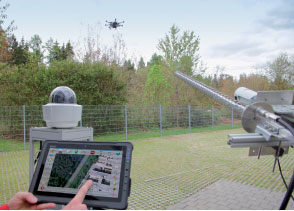
At the G7 summit at Elmau, Germany, in 2015, ESG successfully operationally deployed the overall system for detection, identification and defence of drones, together with leading technology partners. For this, using the ESG information distribution system, TARANIS, different sensors and effectors were networked and the operator was provided with a clear and constant up-to-date picture of the position - in the operations centre, on Smartphones or as input into existing position systems of the security forces. In addition to the large number of types of sensors already integrated, it is also possible to integrate the customer’s own sensors. Through this approach, the up-to-date picture can be extended by customer specific information for the individual user. This is made possible by the very flexible and adaptable design of the interface. In addition to the sensors, the system enables integration of different effectors and organizational countermeasures.
Using the existing system as such, the complete operating sequence of detection, verification, information and intervention can be carried out within an optimized working environment.
In addition to the successful protection of the G7 summit in 2015 at Elmau, Germany, ESG could already excite other national and international customers for the drone defence system. Cooperation was hereby formed in the military research and development sector, in the sector of national and public security, as well as for large industrial partners, as for example, leading automobile manufacturers and airport operators.
TARANIS: ESG´s capable position display and command system
TARANIS Mobile is a flexible position display and command system to network operational forces and organizations with security tasks, e.g. police, rescue services, fire service and civil protection services. Stationary operation, in control centres and operational headquarters, as well as highly-mobile in vehicles or application on foot is possible.
Once deployed, all operational forces have access to a common and continually up-to-date picture using TARANIS Mobile. And that within a secure, private sector. The data transmission is selectively carried out coded via the public mobile radio network, on Smartphones or other communication means, e.g. digital radio.
Position display
Using TARANIS Mobile, all participants – up to and including the commander of the operation – have an overview of the positions of all the forces involved in the mission on detailed maps. All events and activities of an operation of each participant can be brought together in the digital position map using simple symbols or tactical signs. These symbols are practically simultaneously presented on the display of every other participant, where it is processed, relocated or deleted, or can be displayed for further detailed information. The position map is also used to indicate objects detected in real time, e.g. infiltrating drones, to refer operation forces and for tracking. Detailed status information can also be visualized on all sensors and effectors.
Intuitive & easy to use
Thanks to its intuitive user interface, with large buttons and clear display elements, TARANIS Mobile is particularly suited for use in stressful situations where time is of critical importance. All functions can be operated by touch (even with gloves) or for example, as an alternative, the system can also be operated using a mouse and keyboard. The intuitive operating concept also enables less technically experienced users to independently operate and safely control the TARANIS Mobile after a short instruction period.
ESG´s standardised logistics solutions reduce costs
Many armed forces are modernising their logistics and increasingly using electronic documentation as the basis for upkeep. Standardised processes and powerful software solutions are the key to reducing costs, especially for multinational defence projects.
It all started with the Tornado combat aircraft. As West Germany, Italy and Great Britain were laying the groundwork for the joint development of this combat aircraft at the end of the 1960s, they hoped their cooperation would result not
only in technological, industrial, and military advantages, but mostly in reduced costs. This did not just refer to the cost of developing the fighter-bomber. The nations involved recognised early on that there was enormous potential for savings in the area of technical support, such as the supply of spare parts, during the service life of the aircraft. This made the Tornado the first earnest attempt to utilise the economic advantages of standardised logistics supply. A common path was found to unify the ‘descriptive documentation’ and ‘spare parts catalogue’ logistical service packages for all nations involved. This trend of developing weapon systems through multinational cooperation has continued. The logistics approach used at the time has since been developed further and expanded to include nonaerial weapon systems. This is why, under the auspices of the AeroSpace and Defence Industries Association of Europe (ASD), the defence industry and armed forces have worked closely together to develop the ASD S-Series in
Europe. This is increasingly becoming the basis in Europe for logistical planning when developing new weapon systems. Both specifications, ASD/AIA S1000D (Technical Publications) and ASD S2000M (Material Management) have been in use for decades for aircraft, ground vehicles, ships, and their accessories. Other specifications have been and are being developed, such as:
ASD S3000L (Logistics Support Analysis)
ASD S4000P (Preventive Maintenance)
ASD S5000F (In Service Data Feedback)
ASD S6000T (Training)
ASD SX000i (Integrated Logistics Support)
NATO manual ACodP-1 on the codification of items of supply is also observed. With these, the ASD S-Series forms an extensive regulatory space for the entire area of logistical planning, also known as integrated logistics support. This allows for standardised processes and interfaces between armed forces, as purchaser, and the defence industry, as supplier. Many armed forces have recognised the need for standardisation and thus resort to these specifications when modernising their logistics processes. Even the Dutch armed forces have taken this path.
Sophisticated software tools: ESG´s QuILS, APART, N-CORE
With QuILS (S1000D, Technical Documentation), APART (S2000M, Spare Parts Management) and N-CORE (ACodP-
1, NATO Codification), they have consistently chosen ESG software products. These are equally suited both in the defence industry for data generation and in armed forces for data validation.
All spare parts for a weapon system are grouped together by the defence industry into what are referred to as initial provisioning lists. Armed forces require this information as early as the development stage to review and plan subsequent spare parts supply during the in-service phase. Any comments can be sent back to the defence industry and factored in. This spare parts data is then used as the basis for material management, e.g., in SAP. Whether generating, managing, validating or exchanging spare parts data, APART allows the S2000M specifications to be applied to their fullest extent. APART is also the market leader in the German defence industry.
All military spare parts used by NATO require a NATO stock number. This procedure is called codification and must be completed by each responsible NATO member state. This system currently comprises more than 32 million spare parts data records NATO-wide. In order to complete the many codification tasks, numerous NATO member states use the established ESG product N-CORE NG.
Technical publications are generated at the same time as spare parts data. These include user manuals, maintenance instructions, spare parts catalogues, failure charts, maintenance schedules, and wiring diagrams. This documentation is generated by the defence industry as standardised data modules and submitted to armed forces for review.
Comments by armed forces are also usually added and factored in by the defence industry. The final product is finished documentation that also contains information on spare parts. All of this is possible with the QuILS-Author software by ESG. This software makes it possible to manage any number of publications, while also allowing important parameters to be set on a project basis. This makes QuILS-Author a suitable S1000D platform both for armed forces and the defence industry. As such, QuILS-Author is the new S1000D platform for the German armed forces and continues to establish itself in the defence industry.
Lastly, with QuILS-Web Retrieval, finished publications can be viewed by maintenance personnel directly on mobile devices.
Consistently applying ASD specifications in conjunction with the ESG software range has been proven valuable in the Dutch armed forces and in other multinational defence projects. Comprehensive logistics processes based on international standards and software products from a single source form the basis for effective defence logistics management and reduced development costs.
Note:TARANIS® is a registered Community trademark of ESG Elektroniksystem- und Logistik-GmbH