``Firing Tests of the TÜBİTAK SAGE KUZGUN Guided Modular Munition Family Will Start in the Last Quarter of 2021!``
Defence Turkey: What has been changed in the KUZGUN Munition Family since its first introduction at IDEF '19 Fair?
TÜBİTAK SAGE: When the KUZGUN Project was first launched in 2019, UCAVs were at the forefront. Since TÜBİTAK SAGE has been developing munitions for F-16 and F-4E 2020 aircraft for many years, we aimed to develop a joint munition family that uses common design and parts allowing to be used in both UCAVs and combat aircraft according to the operational needs with modular and cost-effective propulsion, navigation/guidance, and warhead options (can be launched from land, surface platforms, and air). KUZGUN munitions have common avionics, and most of them have common mechanical bodies. Some parts are specific to different munitions, but generally, they have common mechanical components. We collaborated with the Turkish Air Force (TurAF) and worked with UCAV personnel to determine the requirements for the KUZGUN Guided Modular Munition Family, which has variants designed especially against systems that require extended engagement ranges such as air defence systems. Although we are an institution mainly working on the projects of the Ministry of National Defence and SSB, we quickly implemented the Project with our own resources and our existing know-how since we had to act quickly to meet this need. Most of the technologies we use for the KUZGUN family are those we have previously verified. Also, there are several variants of our seeker.
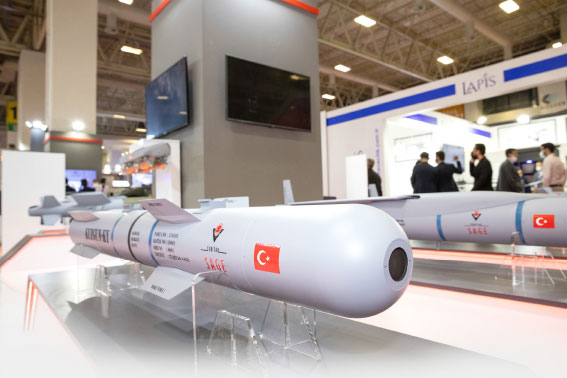
Defence Turkey: The model shown here looks to be equipped with a Laser Seeker.
TÜBİTAK SAGE: Yes, there is a Semi-Active Laser Seeker, and there are other navigation systems integrated into the seeker's body. The seeker can be changed depending on the operational needs. The first munition that we will test firing this year is the KUZGUN-SS, the Free-Fall variant. The entire navigation system, which includes the guidance (laser or IIR) and GPS/INS, is in the seeker section you see here. This seeker is common/standard in all three variants (turbojet, free-fall, and solid propellant). Therefore, thousands of these seekers can be produced and fitted to all variants.
Defence Turkey: TÜBİTAK SAGE had a Semi-Active Laser Seeker called CAMGÖZ. Did you use it?
TÜBİTAK SAGE: Yes, we can say that it is the Enhanced/Improved version of CAMGÖZ.
Defence Turkey: The CAMGÖZ Laser Seeker Family also has a Dual Mode variant with a 178mm seeker diameter named CG-178, which had both a Semi-Active Laser and an IIR capability. Will you use it in the KUZGUN Family too?
TÜBİTAK SAGE: Our main goal is to quickly verify the most cost-effective variants that will meet the requirements. As soon as the Dual Mode seeker is verified, it can be used in all the variants. We specifically chose the 180mm diameter. We are even working on a Millimeter Wave (MMW) Radar Seeker for the KUZGUN-KY (Solid Propellant) variant, which is highly critical for surface platforms and naval operations.
Defence Turkey: So, is KUZGUN-KY a complementary product to the ROKETSAN TEMREN missile? TEMREN is currently being integrated into an SH-70 SeaHawk Helicopter at ASELSAN facilities.
TÜBİTAK SAGE: Actually, these products fill a specific gap. We developed this solution after seeing such a gap in our OpsCon (Operations Concepts) studies with the Turkish Armed Forces. We accelerated the project to meet this need quickly. The main thing here is, we can use KUZGUN on all kinds of land platforms. We have our own navigation solution, ATLAS INS unit, and KAŞİF GPS receiver for accurate initialization, which is a big problem on land platforms. We are working on the integration of these systems to land, naval, and aerial platforms.
Defence Turkey: Can the KUZGUN-KY (Solid Propellant variant) be used in surface-to-land missions against coastal or inland targets?
TÜBİTAK SAGE: There is no dedicated munition in that area at the moment. The UK-designed Brimstone missile can be deployed from surface platforms, especially against coastal and nearshore targets. Currently, there is no other munition that can be equipped with an MMW seeker or dual-mode seeker.
Defence Turkey: Is it possible to use MMW Radar and IIR together in Dual Mode seekers?
TÜBİTAK SAGE: Even tri-mode is possible. In particular, there are multi-mode seekers which combine Laser Seeker + IIR and MMW Radar. We are currently working on a dual-mode seeker. On the other hand, we are also working on a single-mode seeker using only MMW radar. It can be combined based on user requirements. Our primary concern is to develop the KUZGUN munition family so that it can be used without considering the cost. Therefore, our goal is to select the relevant seeker according to the target type through the mission planning module and destroy that target with the highest success in the most cost-effective way. We also developed the software of the mission planning modules; that is, we also built a logistics software system.
Defence Turkey: You said KUZGUN-SS (Free-Fall variant) is the first product we will try. Which member of the Family will you test next?
TÜBİTAK SAGE: Currently, turbojet engine tests continue. When it is finished, we will start the tests of KUZGUN-TJ (turbojet variant).
Defence Turkey: Did you receive the engines?
TÜBİTAK SAGE: Yes, the procurement process is completed. Furthermore, I will not reveal its name, a local company is also developing a turbojet engine for our munitions. They have already started the localization of the engines.
Defence Turkey: Can you share some information about the engine power, like 600N, 800N, 900N?
TÜBİTAK SAGE: The actual requirement is around 600N (Newton). We do not have an engine at that thrust level right now. But as I said, we believe that the domestic equivalent engines currently being developed will reach those levels. TJ engine supplied from abroad has lower thrust capacity. We preferred such a solution to make procurement easier. However, for most of the mission types we plan, this engine can provide the desired performance for the turbojet variant.
Defence Turkey: KUZGUN-TJ somewhat resembles the SPEAR 3 missile. When the Dual Mode seeker becomes ready, will it also have an RF data link?
TÜBİTAK SAGE: All of them have an integrated RF data link. It has a jam-resistant GPS antenna on the front and an RF data link antenna on the back. You can even see the data link antenna at the bottom. The data link is two-way and encrypted. When equipped with an IIR seeker, KUZGUN munitions can also transfer images and gain man-in-the-loop capability.
Defence Turkey: Can you give information about the ranges of the KUZGUN Guided Modular Munitions Family?
TÜBİTAK SAGE: The range is, of course, very dependent on the platform and launch altitude. The longest-range heavy munition ever launched from a UCAV is the KGK-SİHA (KGK - Wing-Assisted Guidance Kit, SİHA - UCAV). It weighs about twice the KUZGUN. We reached 35km with that munition and declared the maximum range as 40km. We conducted the launch test at an altitude of 20,000ft with a speed of Mach 0.2. We aim for at least a 40km range with the KUZGUN-SS variant and 150km with the KUZGUN-TJ variant from an altitude of 20,000ft with a speed of Mach 0.2. The first tests we will carry out with KUZGUN munitions will be range tests. KUZGUN-TJ munition is expected to reach 250km when launched from fighter aircraft from an altitude of approximately 40,000ft with a speed of 0.9 Mach because it has a significant gliding capability. It can already glide up to 100km. If we add a 150km turbojet-powered flight to that, we believe we can reach 250km.
Defence Turkey: When the video of the KGK firing tests was shared, I realized that its wings opened about 8-9 seconds after being released from the plane. We thought the wings were opened late to prevent the munition from suddenly rising because of wind and damaging the aircraft. Launch altitude is also an important factor for the turbojet engine. You just stated that KGK was released from the UCAV at an altitude of 20.000ft with a speed of Mach 0.2. However, both AKINCI and AKSUNGUR can fly at altitudes above 30,000ft. Fighter planes may fly even higher. Is there a limit or restriction for engine start or launch/release altitude such as 20.000ft or 30.00ft for both the newly developed domestic engine and the turbojet engine purchased from abroad?
TÜBİTAK SAGE: For now, there is no problem up to 30,000ft, but we have some limits on engine starting speed when using it on UCAVs. Therefore, while designing and developing this munition, we envisaged that it could start its engine under the aircraft. This will free us from most of the limitations. We will start the engine at airplane speed, bring it to idle, then release the munition. However, on fighter jets, we will need to start the engine after releasing the munition. We are planning to increase the capabilities of the new engine for the fighter aircraft.
Defence Turkey: So you release the munition while the engine is running?
TÜBİTAK SAGE: Yes, Thus, we do not have to worry about whether the engine started or not after releasing the munition, and we prevent it from going to unintended targets. After the engine starts, the system software allows the munition to be released/launched.
Defence Turkey: In this case, will there be a certain speed limit for the aircraft?
TÜBİTAK SAGE: Fighter aircraft probably will not have such a limitation. Because when the munition is launched at the operating speed of the engine, we do not generally encounter problems. We have defined the requirements of the domestic engine in this way. The engine will start after being released from the fighter aircraft. However, since munitions are launched at lower speeds in UCAVs, the firing will be carried out while the engine is running.
Defence Turkey: The Turkish Naval Forces operate P235 and P270 Maritime Patrol Aircraft and SH-70 SeaHawk ASW/ASuW Helicopters. Is the KUZGUN Guided Modular Munitions Family suitable for use from this type of aircraft?
TÜBİTAK SAGE: Previously, we worked on the HÜRKUŞ aircraft of TUSAŞ. They have similar altitude and speed characteristics. With other aircraft, there is no restriction on using these munitions, especially at Mach 0.15 speed and 20,000ft altitudes. But on slower flying platforms, KUZGUN-KY is more effective because it can accelerate more quickly thanks to its solid-propellant motor.
Defence Turkey: What is the range of KUZGUN-KY?
TÜBİTAK SAGE: We did a range study for the land-based version. We aim to reach around 40km.
Defence Turkey: It is similar to Israel's Spike NLOS missile in terms of range?
TÜBİTAK SAGE: Yes, it looks like Spike, but it is actually closer to the Brimstone missile. Of course, our goal is, for example, when Brimstone first came out, its range was between 15km-20km, then they improved its engine. We have our own solid-propellant rocket motor development technology. We can develop both the propellant and the motor. Therefore, we set our requirements that way from the very beginning. Of course, the firing tests of KUZGUN-KY have not started yet. Eight missiles can be carried on Navy helicopters. The Turkish Navy operates Fast Attack Crafts between 25m and 65m in length. Equipping these vessels with KUZGUN munitions means a significant capability gain against coastal targets. For KUZGUN-KY, we highly recommend the concept that it can be used in fire-and-forget mode from the Armed Unmanned Surface Vehicles (USV). We carry out our studies around the idea that the armed USV approaches the coast target up to a certain distance, fires its missiles, and returns. You'll probably see KUZGUN-KY's firing tests in 2022. We plan to conduct our first firing tests with the KUZGUN-SS before the end of this year.
Defence Turkey: Are KUZGUN munitions tailfin controlled?
TÜBİTAK SAGE: Yes, actuators and mechatronic systems are in the tail section. It is controlled from the tail. We normally use pneumatic or spring mechanisms to move the wing assembly of our other products (such as KGK). However, in KUZGUN, we used electric motors to provide the top-attack/diving maneuver capability. The wings can be extended or folded/retracted to within the missile body when needed. Because there is no need for a top-down attack maneuver with the blast fragmentation warhead (for anti-personnel and light armored targets), but there will also be a penetrating warhead variant of KUZGUN developed by TÜBİTAK SAGE. Thanks to this capability, we will be able to study different options, such as retracting the wings and diving to the target at higher speeds.
Defence Turkey: You stated that KUZGUN-KY would use a solid propellant rocket motor. For example, when we look at the UMTAS Family, one of the criticized aspects of UMTAS is its speed. UMTAS has low speed due to its data link and man-in-the-loop capability. Will the KUZGUN-KY munition be able to reach Mach 1.2 like the HellFire II Missile?
TÜBİTAK SAGE: It can reach an average speed of Mach 1.5. In fact, it is not difficult for us to achieve these speeds; we believe it is sufficient. Normally, our GÖKTUĞ missiles can fly 2-3 times faster than this. Mach 1.5 is the limit for the data link and the GPS. A motor design that will not exceed that limit will be used. It is important that the engine burns slow enough to achieve the required range and does not exceed the Mach 1.5 limit for most of the flight.
Defence Turkey: Can the KUZGUN-TJ's motor reduce or increase its speed during the flight for loitering capability when needed.
TÜBİTAK SAGE: Of course, we will integrate the control unit together with the guidance and control software. We acquired the Electronic Control Units long ago and developed interfaces with our own PCBs. We developed solutions with our hardware-in-the-loop systems. We can control the motor through the system mainboard. We can bring the engine to idle, adjust its speed, slow it down and steer it according to guidance.
Defence Turkey: With these features, KUZGUN-TJ will have similar capabilities to SDB, SPEAR 3, and Delilah?
TÜBİTAK SAGE: Each of them has a different design concept. On the other hand, what we have here is a common munition family that can be used against any target type regardless of platform. Therefore, since the avionics will be verified with KUZGUN-SS, the integration and firing test processes of KUZGUN-TJ and KUZGUN-KY will be performed much faster. We still hear about SPEAR or SDB for the last 10-15 years. The common avionics of KUZGUN munitions will provide a huge advantage.
All members of the KUZGUN Modular Ammunition Family weigh less than 100kg. Especially the free-fall variant (KUZGUN-SS) has a significantly larger warhead, close to 60kg. And we used quite a new technology in the warhead. We will also disclose warhead performance tests soon. We used a tandem warhead. TÜBİTAK SAGE is already the only institution that designs Air-to-Ground fragmentation or tandem penetrating warheads. We've developed several warheads. We also designed various warheads for ASELSAN. Of course, the KUZGUN-TJ will not have such a heavy warhead as it has a turbojet engine. It will have a smaller warhead (half the size) than the KUZGUN-SS. KUZGUN-KY will have a similar warhead as well. We believe that the warhead size is sufficient for our intended target range, depending on the target type. The KUZGUN-TJ will also have another variant with an IIR seeker and a thermobaric warhead, especially for caves. We will soon begin the first flight tests with the IIR seeker for data collection and integration. We'll likely start integrating the MMW Radar Seeker in 2022.
Defence Turkey: Will you conduct flight tests on a manned or unmanned platform?
TÜBİTAK SAGE: Unmanned. We are talking with both of the UCAV manufacturers. At the first stage, it is easier to perform integration activities on UCAVs. We are used to fighter aircraft. The testing process with manned aircraft takes quite a long time, and there are very few planes available. Thankfully, unmanned system manufacturers provide much support. So, we have the opportunity to carry out the integration process with UCAVs quickly.
Defence Turkey: So, has BOZOK entered the inventory?
TÜBİTAK SAGE: All tests of BOZOK have been successfully completed. Studies on increasing the extra range were also carried out. It is ready to enter the inventory and can be used with the BAYRAKTAR TB2 UCAVs.
Defence Turkey: Thank you for sparing your time for our readers