First Batch of 5th Gen Portable Air Defense System SUNGUR Delivered to Land Forces Command

The post shared by President of the Defense Industries DEMİR also included a short video of the SUNGUR MANPADS firing at the Sinop Test Range. In the video, it was seen that the Banshee Jet 80 High Speed Target Aircraft, powered by two turbojet engines and equipped with a "hot nose" (IR enhancement device), was used as the target aircraft during the firing using a live warhead, and SUNGUR scored a direct hit on the target aircraft. As shown in the video, SUNGUR can be a genuinely frightening new generation MANPADS when the exit velocity from the canister, the burn time of the solid fuel rocket engine, the direct hit on the target, the IIR seeker capability and the impact of the warhead on the target are taken into consideration.
The Portable Air Defense Missile System (PADMS/PORSAV) Project was initiated with the contract signed between the Ministry of National Defense (MoND) and ROKETSAN on September 10, 2013, as part of the requirements of the Turkish Land Forces Command. According to the 2016 Activity Report of the MoND, the PHSFS/PORSAV Project, which was transferred to the Presidency of Defense Industries on November 28, 2016, covering the Design, Development and Production Phases, was planned to be completed in September 2022 with the first delivery in September 2020. Murat İKİNCİ, General Manager of ROKETSAN, announced in May 2021 that they started serial production of the Portable Air Defense Missile System SUNGUR and that they were preparing for the delivery to the Turkish Armed Forces soon.
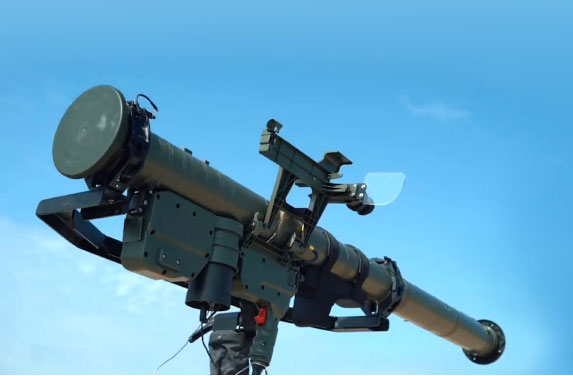
The SUNGUR Portable Air Defense Missile System, which is both shoulder-fired and platform-launched, is 80mm in diameter and 1.7m long (FIM-92 STINGER is 1.52m long) and can be used at an altitude up to 4km+ (sea level) with an 8km range. SUNGUR’s minimum range of interception, which is launched with the Lock-on-Before-Launch (LOBL) mode, is given as 500m against helicopter threats.
SUNGUR has an Imaging Infrared (IIR) Seeker that is cooled with special cooling gas (Argon gas is used) before launch and has a high explosive, partial piercing warhead placed in a titanium cylinder (it is possible that the continuous titanium rod warhead technique was used). The warhead is activated by a programmable percussion fuse (triggering the warhead on direct contact with the target). The IIR Seeker is mounted on a gimbal and has a ±40 Degree Visual Angle.
It was confirmed that SUNGUR, the 5th generation Portable Air Defense Missile System (MANPADS), is faster than the STINGER Missiles in the inventory (FIM-92A/B/C and FIM-92D/E RMP Block 1) in accordance with our assessment in light of the firing footage, even though information on its speed was not disclosed due to classified information. Based on the SUNGUR MANPADS firing video, I believe that SUNGUR can reach Mach 2.5+ speed while cruising.
The SUNGUR has a fin set moving in the direction of the firing in the front and a fin set moving perpendicular to the firing direction in the rear, and it can perform extremely agile and sharp maneuvers thanks to the main engine exhaust in the tail with the thrust vector control (TVC) feature, which can be directed along different axes.
According to the information I have obtained, the SUNGUR missile's body can sustain maneuvers of 50G throughout its flight to the target, and like the STINGER, has two independent engines: the launch motor and the sustainer engine, a dual-thrust main rocket engine powered by solid fuel. Thanks to the launch motor, the SUNGUR missile is launched from the launch tube to a distance of around 9 meters away from the target, without harming the shooter. Thereafter, the main rocket engine ignites, and the missile moves in the direction of the target.
The firing test videos demonstrate that when the SUNGUR launch engine is activated, the spin is stable at the time the missile leaves the launch tube and the launcher. Once the fins are opened (first the front fins, then the rear), and the dual-thrust main rocket engine (flight engine) is activated, the spin stops, and the missile begins to fly straight.
SUNGUR, which has a long range of 8km (previously announced as 6km+), uses a powerful cooling system to maintain the performance of the multi-band IIR Seeker at long ranges. As in the STINGER, Argon gas is used to cool the seeker. In the Portable Low Altitude Short Range Air Defense System configuration, the Battery Coolant Unit (BCU, also referred to as thermal battery) is placed in the launcher, not on the missile, while in the MANPADS configuration, the Coolant Unit is on the detachable gripstock as in the STINGER. SUNGUR is equipped with Identification Friend or Foe (IFF) equipment (mechanical connection) and can operate integrated with the Air Defense Early Warning and Command Control System (HERIKKS-VI). Deliveries under the HERIKKS-VI Project, the contract of which was signed between the MoND and ASELSAN on December 21, 2016, started in the last quarter of 2020. The HISAR-A+, HISAR-O+, KORKUT, KALKAN and SUNGUR Air Defense Systems in the inventory of the Land Forces Command are integrated into the HERIKKS-VI System, which also provides the ability to exchange information with other command and control systems within the TAF and NATO. In this way, the air defense effectiveness of the Land Forces Command is considerably improved.
Murat İKİNCİ, General Manager of ROKETSAN, who met with around 50 members of the press at the Swissotel on Monday, August 16, prior to the IDEF '21 Fair, said the following about the SUNGUR-based LEVENT CIWS System, which is currently under development: “As you know, the Close-In Weapon Systems (CIWS) on our ships are generally composed of RAM and SeaRam products. At IDEF, we will introduce for the first time our LEVENT System, which is based on our SUNGUR missile, our Portable Air Defense missile, and will provide close air defense support on ships. LEVENT will have two versions. In the first version, it will destroy targets using only the electro-optics and radars on the ship, while in the second version, it will be able to engage with its own independent electro-optics and radar systems. We will also make modifications on the existing SUNGUR missile. The range will be extended, and we will hopefully include technologies supported by RF Seekers and RF Receivers, to track the target more closely.”
Within the framework of the Pedestal Mounted Stinger (PMS) Project, which was initiated to meet the TAF's Low Altitude Air Defense System requirement, 70 ATILGAN (eight ready-to-fire Stinger missiles mounted on M-113A2 APCs) and 88 ZIPKIN (four ready-to-fire STINGER missiles mounted on Land Rover Defender 130 TWVs) PMS Systems, capable of firing STINGER missiles, were supplied under the contract signed with Aselsan on November 9, 2001. PMS Systems can be used with the Air Defense Early Warning and Command Control System (HERIKKS). I believe the National MANPADS SUNGUR will, in due course, be integrated into the PMS Systems and Attack Helicopters in the inventory of the TAF.