FS Languedoc (D-653) Frigate Visited Sarayburnu Port
Defence Türkiye Magazine was also among the guests at the reception held on the evening of June 7th. The opening speech of the reception was delivered by the Commanding Officer, Captain Laurent SAUNOIS, in the presence of numerous attendees, including Deputy Governor of İstanbul Özlem BOZKURT GEVREK, İstanbul Strait Commander Rear Admiral (LH) Semih OZANGÜÇ, French Consul General in İstanbul Olivier GAUVIN, high-ranking officers from the Turkish Naval Forces and NATO member countries (Attachés), as well as Consuls General and Diplomatic Representatives serving in İstanbul.
Recalling the longstanding acquaintance and over half a century of NATO alliance between the Turkish and French Navies, Captain SAUNOIS emphasized their joint efforts toward professional excellence. "Our ships in the Mediterranean regularly collaborate within the framework of NATO's Standing Forces, fostering a strong strategic dialogue. Tonight, we will celebrate the mutual trust that strengthens our relationship through this acquaintance."
Captain SAUNOIS emphasized that the common desire of Türkiye, France, and all NATO member countries represented by military attachés is to ensure peace and freedom of navigation in all seas worldwide. "Success at sea and in all aspects of warfare requires joint and systematic exercises and collaboration. What makes us strong is our ability to work together and share common methods. In an environment of international tension, as open seas become increasingly dangerous, we are strong thanks to our organization." Captain SAUNOIS continued his speech: "Today, I am proud and delighted to host you on board the Languedoc frigate, which is participating in NATO's Standing Maritime Group 2 for the second time in less than a year. Our enduring cooperation and flawless joint operations prove the strong bonds connecting NATO sailors. However, our collaboration extends beyond naval exercises. Gatherings like tonight's event are also part of our cooperation. Therefore, I conclude my words by inviting our esteemed guests to enjoy this evening and extend a warm welcome to all of you."
Taking the floor after Captain SAUNOIS, Olivier GAUVIN, the Consul General of France in İstanbul, thanked Captain SAUNOIS, also known as SAUONIS Pasha on the ship, for hosting them on this beautiful vessel. He greeted the military and civilian Turkish authorities for their hospitality in hosting French warships that frequently visit Turkish ports. "Seeing the Turkish and French flags waving together tonight fills us with pride," said Consul General GAUVIN, reminding everyone that the Languedoc frigate is the second French frigate to visit İstanbul this year, emphasizing the significance of these visits in the context of the longstanding NATO relationship between the Turkish and French Navies, the principal allies in the Mediterranean since 1952. He further added, "Preserving peace and stability in the region holds utmost importance for our countries."
Consul General Olivier GAUVIN continued his speech: "These days represent an important period for NATO, following the NATO Foreign Ministers' Meeting in Oslo and ahead of the upcoming Vilnius Summit in July. As highlighted by President Emmanuel MACRON on the evening when President Recep Tayyip ERDOĞAN was reelected, the re-establishment of peace in Europe and the future of the NATO alliance, as well as the issues to be faced jointly by Türkiye and France in the Mediterranean, are of great significance. I congratulate our esteemed crew once again for their service. Tomorrow, I will be pleased to host you, this time on land, at the French Palace, which symbolizes the longstanding relationship between Türkiye and France for almost five centuries. Before concluding my words, I must mention that the Languedoc frigate reminded me of another French naval officer who anchored in İstanbul. He was known for his connections between our countries and was also a writer, illustrator, and photographer. As you may have guessed, I am referring to Pierre LOTI, whose real name was Julian VIAUD. In the coming days, we will open walking trails called 'In the Footsteps of Pierre LOTI in İstanbul' in collaboration with the İstanbul French Cultural Center, commemorating the 100th anniversary of his passing. On this occasion, I would like to mention that the French School in İstanbul is named Pierre LOTI High School. I thank all the guests who have honored us with their presence and wish you a wonderful evening. Long live the friendship between Türkiye and France."
NETTUNO-4100 R-EA System
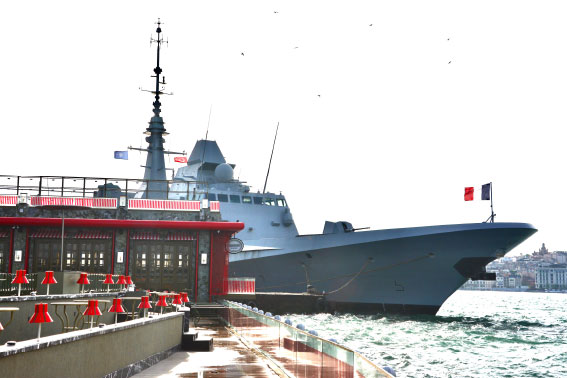
One of the features that caught my attention while I was visiting Sarayburnu Port in İstanbul on June 7th was the massive NETTUNO-4100 Radar Electronic Attack System antennas on the FS Languedoc (D-653) of the French Navy.
It is an advanced Radar Electronic Attack System with fully solid-state Transmit/Receive (TX/RX) modules, two separate active electronically scanned array (AESA) antennas (located at the port and starboard of the ship), wideband digital receivers, and DRFM capability. Due to its high technology and considerable cost, this equipment is not present on the FREMM frigates sold to Egypt and Morocco. In fact, due to budget-related issues at the time, FS Normandie (D-651) frigate operated for a while without the NETTUNO-4100 R-ET System due to its high cost.
The NETTUNO-4100 ECM System is intended to provide naval platforms with an Active Electronic Defence using selected ECM tactics, exploited through DRFM generated signals. These tactics can be equally effective against both terminal missile attacks and long-range designation radar systems The NETTUNO-4100 can exploit a wide range of ECM techniques against surface search and tracking radars in support of anti-surface engagements.
Covering the H to J Band frequencies the system has full (360°) azimuth coverage and can steer through 50° in elevation, and features electronic beam steering, including electronic stabilization to counter ship movements. Of particular importance is a single NETTUNO installation’s ability to jam multiple threats through time-sharing resource management. Its solid-state design ensures both high ERP and graceful degradation in case of minor failures. The design also removes the need for system warm-up times, and is inherently more reliable and maintainable than legacy systems, with Built-In Test Equipment (BITE) down to the module/card level. The solid-state architecture also makes for relatively simple shipboard integration and installation, as no microwave guides are required. The NETTUNO-4100 system is designed for ease of maintenance and support, and a host of products and services are readily available to minimize downtime. These include field test equipment, ground support equipment, automatic test equipment, library programming, and library loading/ unloading. NETTUNO Family systems are installed in a range of operational warships, including the Italian STOVL carrier Cavour and the multinational Horizon and FREMM frigates.
The antenna units of the NETTUNO-4100, referred to as Jamming Antenna Subsystem (JASS), are positioned on the port and starboard sides of the French FREMM frigates within highly imposing pedestals that are specially designed to reduce the ship's RCS signature. However, a more compact pedestal is preferred on Italian FREMM frigates such as ITS Carlo Margottini (F-592), which I had the opportunity to observe during NAVDEX 2019. Each JASS has a coverage of 180 degrees azimuth and 50 degrees elevation. In open sources, I have yet to find information on whether GaAs or GaN technology is used in the AESA antennas of NETTUNO-4100. However, considering the development period and the system's commissioning date, the likelihood of it being GaAs is higher.
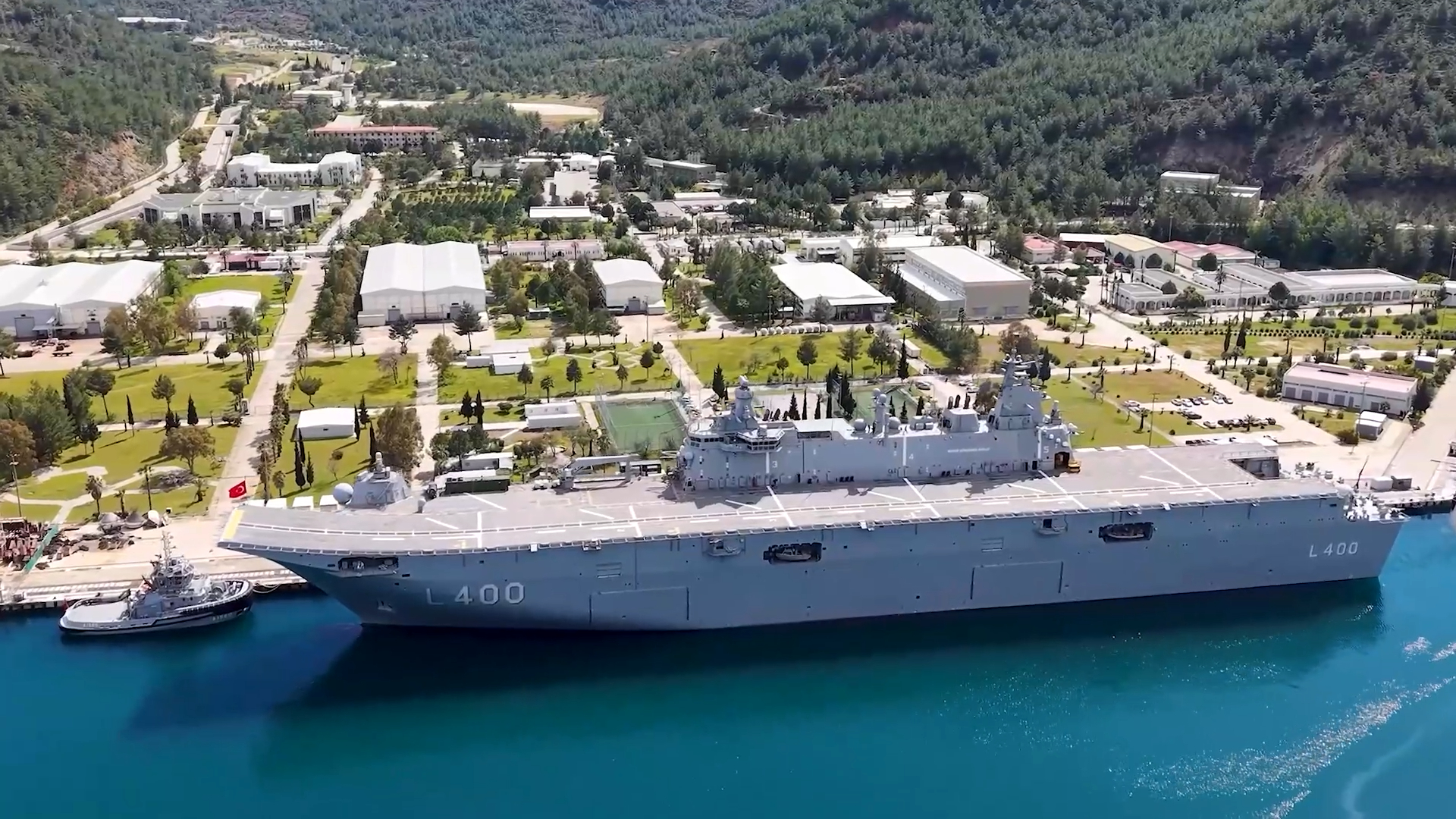
The ASELSAN’s AREAS-2N Radar Electronic Attack (R-EA) System in service with the Turkish Navy, shares some similarities with the NETTUNO-4100. The AREAS-2N R-EA System, first deployed on the TCG Anadolu (L-400) Multipurpose Amphibious Assault Ship (LHD), features different antennas on the starboard and port sides. According to the manufacturer, the solid-state AREAS-2N R-EA System, which incorporates AESA antenna design and DRFM capability similar to NETTUNO-4110, is a highly capable yet high-cost and high-energy-demanding Naval Electronic Warfare System.
Previously, at the IDEF Fair, I learned that the AREAS-2N is equipped with both narrowband and wideband digital receivers, Digital RF Memory (DRFM, for modern coherent threats), and solid-state power amplifiers. It was said to have four AESA antennas, each with a 90-degree coverage and over 1,000 T/R modules. Two of these antennas were planned to be positioned on the starboard side and the other two on the port side. The AREAS-2N was claimed to have the capability to deceive and jam threats using both deception and noise techniques, simultaneously handling a total of 32 threats (8 threats per antenna). However, the antenna structure on the TCG Anadolu LHD Ship is different from the design showcased at the IDEF Fair. Therefore, I cannot comment on whether these mentioned capabilities are present in the current system.
Thanks to its high-capacity DRFM capability, the AREAS-2N can utilize both coherent and non-coherent modern jamming techniques against multiple hostile radars. With these capabilities, it can effectively neutralize the search/track and illumination functions of hostile vessels. In the coherent jamming process, which involves radar-to-radar coordination, the digital DRFM captures the pulse of the threat radar, records it, and applies jamming/deception techniques to the recorded pulse before sending it back to the radar so it can be deceived and convinced that its own pulse is returning, thus being effectively jammed.
Indeed, AESA (Active Electronically Scanned Array) technology is essential for electronic attack capabilities on radar systems. The AESA Jammer is a crucial component, and the AESA antenna structure with electronic beam steering capability allows for simultaneous high Effective Radiated Power (ERP) attacks and jamming against RF threats coming from different directions and bands. The solid-state and AESA-based TX/RX modules are necessary for the antenna design to fulfill the requirements of jamming tasks with a high ERP value. The solid-state architecture not only allows higher Mean Time Between Failures (MTBF) performance than mechanical systems but also enables the production of the same ERP power in much lighter and more compact designs compared to older-generation Traveling Wave Tube (TWT)-based R-EA systems.
FS Languedoc (D-653) Frigate
The FREMM (European Multi-purpose Frigate; French: Frégate Européenne Multi-Mission) Frigates are extensively armed and are equipped with the most capable weapon systems and equipment, such as on the French ships the Héraclès multi-function radar with a simultaneous tracking capacity of 400 air and surface targets, the Naval Cruise Missile (NCM), the Aster and Exocet MM40 missiles or the MU90 torpedoes.
With a length of 142 meters and a width of 19,8 meters the Aquitaine Class Frigates of the French Navy have a displacement of about 6,000 tons, an draught of 4,88 meters, and a top speed of 27+ knots. Only 108 people make up the crew because of the high level of automation, with occasionally the addition of members of the naval air arm and special forces. The propulsion system gives the ability to the Aquitaine Class Frigates to sail for up to 45 days straight, or 7000 miles.
Well-armed and with good performance, FS Languedoc is an important component of the modern French Navy. Her construction started in November 2011, she was launched launched in July 2014, and on 16th March 2016, she was accepted by OCCAR on behalf of the Direction Générale de l’Armement (DGA) - the French defense procurement agency - and delivered to the French Navy. She was commissioned by the French Navy on July 4, 2017. Her primary function is anti-submarine warfare, although she is also capable of carrying out anti-air, anti-surface, and land attack missions. She is designed to conduct operations either alone or while commanding a task force the vessel can strike strategic targets on the ground.
The frigate is powered by an MTU Series 4000 (2,2 MW) engine and a CODLOG system, which enables it to reach a top speed of 27 knots and a max cruise speed of 15,6 knots. She has a range of 6,000 nautical miles (11,000 km) at 15 knots. The vessel has a crew of 108 persons (including the helicopter detachment) and accommodation capacity for 145 persons. The ship can use 3 propulsion modes:
Electrical Propulsion: 2 electrical engines positioned on the propeller shaft. Flexible and economical (for money and space), it allows the ship to move forward and backwards, up to 17 knots. Silent, it is well adapted for anti-submarine warfare. The engines are supplied by 4 diesel-fueled generating sets.
Mechanical Propulsion: Gas turbine to reach high speed (up to 30 knots with nice sea conditions), only forward. At full speed, it consumes 7.5 m3 of gasoil in an hour!
Rescue Propulsion: Retractable POD with adjustable blades, propelling the ship up to 6 knots in any direction.
FS Languedoc Frigate is equipped with various sensors and processing systems, including the Héraklès multi-purpose passive electronically scanned array (PESA) radar, the Thales STIR EO MK 2 fire control radar, the CAPTAS-4 towed-array sonar, and the UMS 4110 CL hull-mounted sonar.
Her armament includes a 76 mm Super Rapid gun, three 20 mm Narwhal remote weapon systems, a 16-cell SYLVER A43 VLS for Aster 15 air defense missiles, a 16-cell SYLVER A70 VLS for NCMs, eight Exocet MM40 Block 3 anti-ship missiles, and two B-515 twin launchers for MU90 lightweight torpedoes. The frigate is capable of carrying one NH90 Caiman multi-role helicopter equipped with anti-submarine warfare capability and has a single hangar for aviation facilities. Almost all the combat helicopters in the inventory of the French Navy can be supported by the ship’s helicopter deck