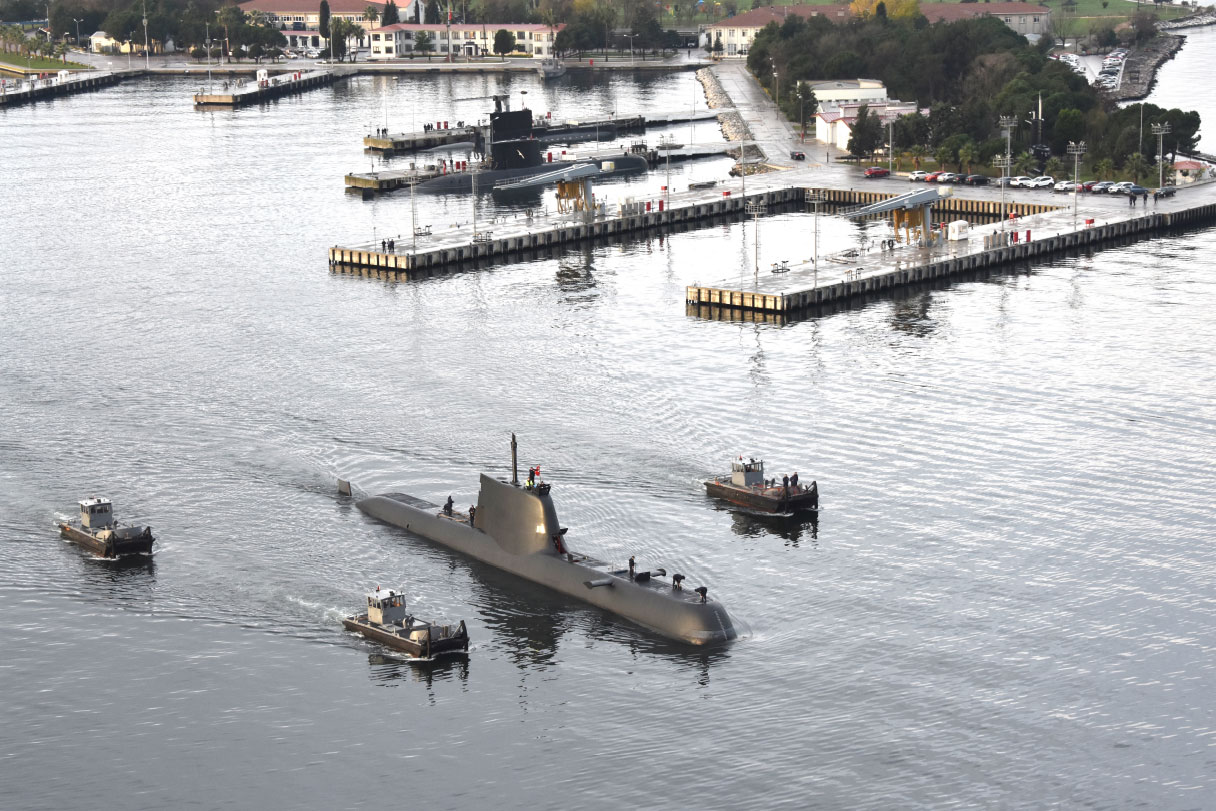
Guardians of Deep Blue: Submarine Fleet Command
During the Ottoman Empire era, Turkish Submarining began with the 'Abdülhamit,' a submarine assembled in the Taşkızak Shipyard from parts brought in pieces from England. It was launched into the Golden Horn on September 6, 1886. The Turkish Submarine Fleet Command was established as an independent unit when the submarines TCG I. İnönü and TCG II. İnönü were connected to the Tahtelbahir (Submarine) Ships Command by order of Acting Fleet Commander Commander (CDR) Şükür OKAN in 1929.
Looking at the history of Turkish Submarines, before the currently active AY Class (4x), PREVEZE Class (4x), and GÜR Class (4x) submarines, we see that a total of 39 submarines from 2 different countries, Sweden (built in the UK) and France (seized during World War I, formerly named Müstecip Onbaşı), were acquired until the Republic era. Additionally, after the Republic era, submarines were acquired from 5 different countries: the Netherlands, Italy, Germany, the United Kingdom, and the United States. These submarines served under the command of the Submarine Fleet Command until the end of their service lives. The AY Class (Type 209/1200) submarines, which are still in service and were designed and constructed through collaboration with Germany, began entering service in 1975. The first three submarines of the AY Class—TCG Atılay, TCG Saldıray, and TCG Batıray—were built in Germany, while the other three—TCG Yıldıray, TCG Doğanay, and TCG Dolunay—were constructed at the Gölcük Naval Shipyard Command.
All of the 1,400-ton PREVEZE Class (Type 209/1400) and GÜR Class (Type 209/1400 Mod) Submarines, representing the next stage of Turkish submarining, were constructed at the Gölcük Naval Shipyard Command, once again through collaboration with Germany. Their most significant features include not only modern electronic systems but also the capability to launch long-range guided missiles (UGM-84 Harpoon) from underwater.
The Submarine Fleet Command, constituting one of the striking forces of the Turkish Navy and regarded as the most strategic element due to its stealth capabilities, continually integrates the latest opportunities offered by the ever evolving and advancing technology into its arsenal. With its attained modern and superior combat power and the corresponding infrastructure, it steadily marches toward the future with confidence. In this context, the Submarine Fleet Command will enhance its strength by introducing the REİS Class Type 214TN Submarines, boasting several superior features compared to the submarines currently in inventory, particularly with the introduction of the Air-Independent Propulsion (AIP) technology, with the first two scheduled to enter service in 2024. Additionally, entirely indigenous design MİLDEN (National Submarine) Submarines will further bolster the Submarine Fleet's capabilities. The construction of the Test Block for these submarines is set to begin within the first quarter of 2024 at the Gölcük Naval Shipyard Command, while the hull construction will commence in 2025.
We visited the Submarine Fleet Command located within the Gölcük Naval Base in Gölcük, Kocaeli, to commemorate the 138th year of Turkish submarining. Our purpose was to introduce the current capabilities of the Turkish Naval Forces Command (TNFC) Submarine Fleet Command, one of the largest submarine forces in the region. During this visit, we conducted a special interview with Rear Admiral (LH) Timur YILMAZ, the Commander of the Submarine Fleet, to provide our readers with firsthand information about the submarines in the inventory and the next generation REİS Class, as well as the first indigenous design submarine, the MİLDEN Class, set to enter service in the future.
Defence Turkey: Dear Admiral, can we start our interview by getting information about Turkish Submarining, the brief history of the Submarine Fleet Command and our submarines that have served from the first submarine to the present day?
Rear Admiral (LH) Timur YILMAZ: The Turkish Submarine Fleet is one of the most established among the world's submarine fleets. The history of our Submarine Fleet dates back to 138 years, the Ottoman Empire. The beginning date of Turkish Submarine is accepted as 6 September 1886, which is the date of entry into service of the first Turkish Submarine Abdulhamid. Shortly after this, the second Turkish Submarine Abdülmecid entered service in 1888. In the contract made with the Nordenfelt company for the supply of these submarines, it was signed that the submarines would be built in Istanbul, although the construction cost and assembly time increased by 3 times. Following the completion of the pre-fabrication of the parts at the Vickers Armstrong Shipyard in England, the submarines were assembled at the Taşkızak Shipyard in Türkiye. Thus, an effort was made to bring submarine construction technology and experience to state institutions, and Taşkızak Shipyard became one of the first shipyards where a state-built submarines for itself.
These submarines are among the oldest submarines in the world. We cannot underestimate the role of these submarines in Turkish and world submarine history. For example, Abdülhamid is the first submarine to fire a self-propelled torpedo while submerged. As I mentioned before, these submarines could not be used effectively because they had very limited resources and as a result, they were taken out of service in 1910.
During the Republic period, until the Second World War, emphasis was placed on the supply of submarines, to provide maximum deterrence against the enemy. In this sense, the first attempt to purchase a submarine was made in 1924. Two submarines were purchased from the Netherlands in 1928 and their names were given as TCG 1st İnönü and TCG 2nd İnönü, inspired by the victories of that time. These two submarines remained in service until 1948.
However, in this process of trying to quickly develop a submarine force, it was not limited to the purchase of submarines that would be built abroad and delivered to the country. By the order of the great leader Mustafa Kemal ATATÜRK, 4 submarines were purchased from Germany, two of which were to be built in Taşkızak Shipyard. Of these submarines, Atılay and Yıldıray were built in Taşkızak and Gölcük Shipyards, and Saldıray and Batıray (not delivery due to the war) were built in Germany.
As I mentioned in both examples, while we have been trying to develop our submarine fleet from the beginning to the present, our priority has always been to build our own fleet in Türkiye with our local and national capabilities, rather than procuring platforms and systems from abroad.
The construction of the Atılay and Yıldıray Submarines in our country in the 1930s and 1940s was a milestone in providing Turkish shipyards with submarine construction capability. Thus, the knowledge, experience and qualifications of Turkish workers were increased. However, these experiences could not produce a nationally designed and built submarine. Our submarine needs were met with American-origin submarines procured after the Second World War. Overhaul repairs, which were initially carried out in America, began to be carried out at Gölcük Shipyard Command since 1964. With the construction/purchase of German-made AY Class (Type 209) submarines, which started in the early 1970s, the dependence on US-made submarines was reduced and the Gölcük Shipyard Command was given the ability to build submarines again. Since then, submarine construction has been continuing with the efforts of Turkish engineers and workers at the MoND Gölcük Shipyard Command. All our ships currently in service were built in Türkiye (except Batıray). We would like to proudly state that currently 6 Reis class submarines have been built with the design contribution of Turkish engineers, the labor of Turkish workers and the integration of Turkish defence industry products.
Today, the knowledge that our 138-year-old Turkish Submarine industry has provided us along with the construction experience we have gained with the submarines we have built in Türkiye since the 1970s, and the point our country has reached in the shipbuilding industry, constitute a great potential and sufficient opportunity to build our own submarine, namely MİLDEN.
Submarines continue to be the most strategic element today with their secrecy and the effects they create. Therefore, realizing our MİLDEN project will be a major breakthrough in our country's submarine supply processes. In this context, all our national power instruments of power are working to build our national submarine equipped with national weapons.
Today, we are moving towards the goal of building our submarine force with our own steel, our own sensors and systems, and our own workmanship. In this direction we are moving forward, with each successful experience of "Pirireis", the first of our REİS Class submarines, which is equipped with a higher proportion of domestic and national defence industry product systems compared to our previous generation submarines, the goal of building MİLDEN with local and national systems is getting closer.
Defence Turkey: Can we get information about the current deployment status of the Submarine Fleet Command?
RDML Timur YILMAZ: Submarine Fleet Command subsidiaries, which are under the establishment of the Turkish Fleet Command, are deployed in two regions: Gölcük/Kocaeli and Aksaz/Marmaris. We have the Submarine Fleet Command Headquarters, the Submarine Training Center Command and two commodores in the Gölcük region. A commodore is stationed in the Aksaz region. However, we have presence in all surrounding seas of our country, both with drills and rotational and routine missions.
Defence Turkey: Unlike surface warships that can move and evade maneuvers in two dimensions, the submarine, which operates in a three-dimensional environment and can perform evasive maneuvers, can operate independently without the need for any support, even in enemy-controlled waters, with its silent, secret and surprise weapon features, thus it is a strategically important naval platform. What can you tell us about the importance and effectiveness of the submarine weapon?
RDML Timur YILMAZ: Submarines can create a surprising effect on their opponents with their most important feature, stealth. Due to these features, submarines are one of the most important elements of modern navies today. Realizing this importance, the TNFC has kept submarines in its inventory since 1886.
Due to its geography, the Republic of Türkiye needs a navy with high deterrent power and ready for war at any time. Our submarines are indispensable among the most striking and strategic elements of this Navy.
With their stealth, submarines can attack and destroy surface elements at unexpected places and times without being detected. One torpedo fired from a submarine is enough to sink a frigate. To create this effect, other floating and flying elements must use much more effort and weapons.
Submarines are the elements that can enter the sea area under the control of the enemy and carry out any operations they want. Today, the submarine is the only element that can mine the entire coast of a country without being detected. You also have the chance to make an impact by approaching areas with your submarine where your country's weapon range is not sufficient. Your submarines will be your element that will collect intelligence and conduct reconnaissance and surveillance in these regions. Submarines are the most effective platform that can provide depth in the defence of countries. Therefore, you can start defending your country from far away with them. Even knowing that there is a hostile submarine in an operation area disrupts the operation and causes excessive efforts to find that submarine. Therefore, submarines are vital elements for the deterrence of our navy due to their features that can change the fate of the war.
By the way, I would like to point out something for those who want to be a submariner but see living in a submarine as dangerous. Imagine that you are in an operational environment during wartime, where electronic and satellite systems are highly developed within the scope of detection and identification, and where biological, chemical and nuclear weapons can be used. “In this environment, what do you think is the most reliable platform where people can be safe?” In our opinion, the answer to this question is of course the submarine.
Defence Turkey: Can you tell us about the types and brief technical information of the submarines currently under the Submarine Fleet Command?
RDML Timur YILMAZ: Currently, there are four types of submarines in the Submarine Fleet Command:
AY Class Submarines: Their length is 56 meters, and their diameter is approximately 6 meters. They are designed to operate underwater for approximately two months. They have homing torpedoes.
PREVEZE Class Submarines: PREVEZE Class Submarines, one of the modern conventional submarines of our age, are 62 meters long. In addition to modern homing torpedoes, they also can fire guided missiles.
GÜR Class Submarines: GÜR Class Submarines, which have the same hull structure as the PREVEZE Class Submarines, are updated versions of the PREVEZE Class Submarines with command control, sonar and fire control systems and high electronic warfare capabilities.
REİS Class Submarines: REİS Class Submarines, which differ from our other class submarines in terms of hull form and propulsion system, are 68 meters long. These submarines, which have an Air Independent Propulsion (AIP) System, can operate in maximum secrecy for up to 2 weeks without snorkeling. These submarines, which can fire Homing torpedoes and guided missiles like our other submarines, also can lay mines.
Our REİS classes are approximately two meters taller than their counterparts around the world. With the input of our Turkish engineers at the beginning of the project, the stability of the ship was improved. We see today how correct the improvement made today is, in the operations we perform, and we do not experience any problems.
Defence Turkey: The first hybrid-propelled Type 214TN REİS Class Submarine, TCG Pirireis, which constitutes one of the important milestones in the development process of Turkish Submarine with a history of 138 years, was planned to be delivered after SAT in November/December 2023. Could you briefly talk about what new capabilities do the REİS Class Submarines offer to the TNFC Submarine Fleet Command compared to their technical characteristics and the diesel/electric driven AY (Type 209/1200), PREVEZE (Type 209/1400) and GÜR Class (Type 209/1400 Mod) Submarines in the inventory?
RDML Timur YILMAZ: There are different versions of the 209 Class Submarines in our inventory. Although the technical capabilities of this class of submarines, which are used by many countries in the world, are largely the same, our PREVEZE and GÜR Class Submarines can launch Harpoon Guided Missiles. On the other hand, the Mid-Life Upgrade (MLU) that are being implemented on these PREVEZE Class Submarines and are in the projecting phase for the GÜR Class Submarines, and the equipping of these submarines with domestic and national ED, Optronic, Communication and Combat Management Systems continue. In this way, we expect the combat systems of our PREVEZE and GÜR class submarines to be equal to or even superior to the REİS Class Submarines.
Our REİS Class Submarines will expand the talent pool of our submarine fleet with distinctive capabilities such as mine shedding, covert transfer of special forces, towed -rray sonar, mine avoidance sonar, satellite communications and floating antenna; improve stealth ability with AIP, PERMASYN main engine and other noise reduction measures.
In the short term, the average age of our Submarine Fleet will decrease significantly with the new six Reis class submarines. Having a young fleet will give us a great advantage in terms of sustainment efficiency.
Our ultimate goal for all our submarines, including our Reis classes, is to use our national torpedoes and Guided Missile (G/M) in all of them. We are ensuring this change with our ongoing modernization efforts. Today, even our AY Classes can fire DM2A4 and AKYA HWTs. We will soon see that we are firing ATMACA and GEZGİN G/Ms from our submarines.
Defence Turkey: What are the latest developments in today's conventional submarines?
RDML Timur YILMAZ: Submarines with "diesel-electric" propulsion systems, where the electric motor that rotates the propeller is powered by batteries and these batteries are charged by diesel-generator sets, are described as "conventional submarines".
Air Independent Propulsion (AIP) System: Submarines equipped with the AIP System, while retaining the diesel-electric propulsion system components, also contain an additional electricity generator such as fuel cell, stirling engine and MESMA system that can provide the electrical power needs of the propulsion engine and auxiliary systems. Thanks to the AIP System, a conventional submarine has the opportunity to sail underwater at an average speed of 5-6 kts, depending on the type and power of the AIP System, for 2-3 weeks without going to the surface or snorkeling. Briefly, the AIP System provides a great advantage to a conventional submarine in terms of survivability and stealth. On the other hand, it seems that studies are continuing to develop submarine batteries based on Lithium-Ion cells, which provide higher cruising range by offering higher energy density compared to lead acid batteries.
Improved Wire Guided Homing Torpedoes: These types of torpedoes are wire-guided weapons that can be used against both surface and underwater targets, have an active and passive acoustic head, a wake detector and a multi-target guidance and control unit compatible with counter-countermeasure systems. Their maximum speed is 50 kts and above, and their maximum range is around 27-30 nautical miles. They are the weapons with the highest destructive power used against surface ships and submarines. A single modern torpedo fired from a submarine can sink a warship or submarine within a few minutes.
Torpedo Countermeasure Systems: In addition to sinking their targets by using torpedo weapons, it is also vital for submarines to evade incoming torpedoes. In addition to the evasive maneuvers used by submarines to avoid incoming torpedoes, it is also important to use systems that will deceive or confuse torpedoes. In recent years, there have been significant developments in torpedo jamming and deception systems, and modern torpedo jamming, and deception systems have been installed on submarines.
Submarine Launched Guided Missiles and Cruise Missiles: Today, guided missiles that can be fired from submarines have reached supersonic and even hypersonic speeds, shortening the warning time that is very valuable for air defence. Satellite navigation systems added to these guided missile systems have made it difficult to avoid the guided missile's search radar by taking advantage of the coastal cover. On the other hand, cruise missiles developed for land attack purposes also benefited from satellite navigation systems and made it possible to influence targets deep on the coast. Some of these systems have reached supersonic speeds or have become capable of executing their final attack phases at supersonic speeds.
Sonar Systems with Long Detection Range: Hull-mounted Flank Array Sonar (FAS), Expanded Flank Array Sonar (EFAS) and Towed Array Sonar (TAS), which can operate at very low frequencies, provide long reconnaissance range to submarines. Within the scope of the effectiveness of sonars, studies on fiber optic, digital sensors and acoustic sensors are yielding results and becoming widespread. Thus, the possibility of target detection and identification at very low frequencies is created. Of course, one of the most important factors affecting the efficiency of sonar is ship silence. With each submarine built, new practices are implemented to further reduce ship noise.
LPI Radar Technology: With the introduction of Low Probability of Intercept (LPI) radar technology on submarines, the accuracy of submarines in target detection has been increased with these very low output power radars, and the probability of being detected by counter electronic warfare systems has been reduced.
Modern Fire Control Systems: Another important area of development in submarines is Modern Fire Control Systems. Thanks to Modern Fire Control Systems that have a complex structure in which all sensors and weapon systems on the submarine are integrated, submarines have the capabilities to;
detect and analyze many targets at the same time,
attack multiple targets at the same time,
use different types of weapons (such as torpedoes and guided missiles) at the same time.
Communication Facilities: With systems such as satellite communication facilities and modular communication buoys, submarines can enter military and civilian communication networks while submerged, thus, they can communicate faster and more effectively and increase their superiority in operational areas as a part of network-centric operations.
Today, studies are being carried out and products are being produced in our country for each of the developments some of which are mentioned above.
Defence Turkey: What are the qualifications sought in a submarine personnel? Can you tell us about the difficult aspects of submarining?
RDML Timur YILMAZ: It is a “Quietly and Deeply” way of life. A good submariner must be passionate about his profession, knowledgeable and experienced, responsible, in solidarity with his crew and physically and mentally strong. Commitment to submarining and the submarine is also an indispensable element.
Since submariners perform tactical operations and operate and command a platform that can lead to strategic effects, they must have the highest sense of responsibility and be able to calmly make difficult decisions that need to be made under stress. This is the distinguishing feature of a submariner and what makes him a good submariner depends on it.
The biggest challenge of submarine is that the submarines carry out all their activities under real war conditions after leaving the port. All actual training in our submarines is based on this scenario. This intense process is necessary for absolute success and the execution of the task under all conditions.
In the world, the living space of submarine personnel is defined as the combat zone. Because with diving, the personnel have to constantly struggle with the enemy outside the submarine, that is, the pressure. The slightest imprudence and insensitivity to anything outside the routine can have very negative consequences. If we were to list the most difficult jobs in the world with artificial intelligence today, submarine work would be in the top two. Therefore, submariners are brave people who do one of the most difficult jobs in the world and who can afford to sleep side by side with their enemies, so to speak.
Because submarines are strategic weapons, their operations directly affect the fate of the war, and they operate alone, submarine personnel must use this vital weapon very well. In addition, considering the constant risks and dangers they are exposed to, including in peacetime, submariners must be knowledgeable, professional, cold-blooded, able to work tirelessly under all kinds of difficult conditions, able to make the right decisions in emergency situations, brave and patient.
Defence Turkey: What can you tell us about heavyweight torpedoes (HWTs), the main weapon of submarines? Which types are used in the Turkish Submarine Fleet? What are their capabilities?
RDML Timur YILMAZ: The torpedo, which is a weapon compatible with the nature of the submarine and integrated with it, is the main weapon that allows firing at the target without giving any indication and without revealing that the submarine was in the field until the moment of impact. The main weapon load of our submarines consists of heavyweight torpedoes with warheads that can destroy their targets with a single shot. When the high-explosive torpedo warhead explodes under the target with its magnetic gun, or "igniter" equipment, it creates a destructive effect in a single shot with the shock wave it creates.
Our submarines currently have “homing” torpedoes in their inventories. These torpedoes, which passively or actively search for the target with their own sonar after firing and can attack detected surface/submarine targets, have different versions in our inventory, which have a wake detector, advanced attack algorithms to eliminate decoys/confusers, and even the ability to report the targets it detects during its course to the firing ship and high target selectivity, that is, the ability to distinguish the correct target.
With these weapon systems, the stealth of the firing submarine can be maintained until the moment of hit and a destructive effect can be achieved on the targets.
Defence Turkey: What contributions did you, as the Submarine Fleet Command, make to the development process of the AKYA National Heavyweight Torpedo? Could you briefly touch upon the ongoing work to provide the new generation AKYA National HWT capability to the submarines in the fleet?
RDML Timur YILMAZ: From the beginning of the development process of the AKYA Heavyweight Torpedo, the Submarine Fleet Command has constantly guided with its knowledge and experiences
Our corporate experience has led us to respond to the question, “What should the features of a modern torpedo be like? How can maintenance be user-friendly?” We have always included these and similar answers in AKYA HWT development processes.
On the other hand, mutual views have been and are constantly being exchanged for the integration of the torpedo and the battle management system in our submarines with a user-friendly interface. The same sharing base will undoubtedly continue to update the AKYA Torpedo in terms of software and hardware in line with new technology and operational needs in the future.
In addition to sharing the knowledge, experience, and opinions I mentioned above, we provide our maximum contribution to equipping our submarines with local and national weapons by allocating submarines for integration tests and test firing of torpedoes.
Defence Turkey: In addition to the heavyweight torpedo (HWT), the UGM-84 Sub-Harpoon (Encapsulated Harpoon) Anti-Ship Guided Missile is also used as a weapon in our submarines. What capabilities does this weapon provide?
RDML Timur YILMAZ: Harpoon G/M, is an over-the-horizon weapon that can be launched by PREVEZE, GÜR and REİS Class Submarines. The guided missile in question offers the opportunity for engagement by our submarines at a distance of up to 75 nautical miles (130 km).
At the end of its firing, the Harpoon G/M executes its programmed navigation pattern and detects the enemy surface target with its own radar and carries out its attack. The Harpoon G/M provides a significant range advantage to our submarines and allows the submarine to engage beyond its own sensor range. These guided missiles, which have improved target selectivity and ability to deal with jammers in different versions, also enable submarines to be used in coordinated attacks in surface warfare.
Defence Turkey: The National Submarine (MİLDEN) Project was initiated to meet the Turkish Naval Forces’ need for a new generation attack submarine that will operate in the 2030s and beyond, with submarines designed and built nationally. Can we get your assessment of the Submarine Fleet Command's expectations from MİLDEN?
RDML Timur YILMAZ: Our expectations from the defence industry in the steps of our talent development plan for MİLDEN and our other platforms are ensuring all the systems, sensors and weapons to be national and local.
We evaluate that our Submarine Fleet, which currently operates with 12 submarines, can provide our national and local defence industry with very valuable experience in terms of competitive product development, and thus, the success achieved in unmanned aerial vehicles can be continued exponentially in the field of naval systems of our defence industry.
While capability development efforts continue with national and local opportunities, it is MİLDEN which will combine these capabilities its body. Because our current foreign submarines are products under the design authority, it is difficult to reflect all our 138 years of submarine experience on these platforms developed for commercial purposes. That’s why MİLDEN, which will cover all our submarine experience and meet all our national operational needs because we are the design authority, is very important.
In this context, we expect that our defence industry organizations, especially those operating on weapon and sensor systems, as well as the industrial organizations that will provide the platform and propulsion system components to be included in MİLDEN, will unite towards the same national goal, and foreign dependency in our platform and weapon systems will further decrease in the medium term.
Our submariner and engineer colleagues work together in our project office, and our fleet and our project office are in constant interaction. Therefore, the synergy and common sense created by our users and engineers are utilized in shaping the project. With the institutionality and experience of a 138-year-old fleet, our submariners can easily reveal the needs of what a submarine should be like, and our engineers are competent to reflect the solution to the needs in the design with the submarine construction experience gained since the 1970s.
Defence Turkey: Can you give information about the history of the Submarine Training Center Command, the currently implemented training concept, processes, and content of Submarine Specialization Courses and how submarine personnel are trained?
RDML Timur YILMAZ: Since the establishment of our submarine fleet, training personnel to command our platforms has had the same importance as platform procurement in the development of the submarine force.
In Turkish Submarining History, the training of submarine personnel started with the Core Submarine Course taken from Germany on February 5, 1915, during the Ottoman Empire era. The officers who attended this course worked as teachers in the Officer, Petty Officer and Private Submarine Courses opened in Aydınreis Gunboat for the first time in our country on April 1, 1917. The date in question was the establishment date of the Submarine Training Center.
Since this date, Turkish submariners have been trained domestically; training programs and curricula are constantly updated to include newly introduced platforms and systems and new operational tactics.
Other computerized simulation programs, especially Diving Simulators and Submarine Tactical Simulator (DATAS), are used to improve our personnel's familiarity with the systems they will operate, their ability to maneuver the submarine, their engagement and tactical picture compilation skills.
The Submarine Training Center Command has been training our submariners in our own right and efforts are made to supply training aids such as Submarine Diving Simulator and Submarine Tactical Simulator with indigenous and national resources.
The future of our submarine fleet depends on platforms equipped with modern technology and well-trained crew who will use them. It is an essential need to specially train the personnel who will work on a platform that is built to operate in a three-dimensional environment, has high deterrence due to its stealth, surprise features and weapons it can carry, and requires many different technological disciplines to work in harmony, with high reliability, in a restricted area.
In this context, the Officers who will serve in our submarines attend the Submarine Specialized Officer Course for 46 weeks at the Submarine Training Center Command, following their graduation from the Naval Academy, and the Officers who successfully complete the course are subsequently subjected to practical internship training in submarines for 16 weeks, and at the end of this training process, if they successfully complete the end-of-internship practical exam, which consists of two stages, they are entitled to wear a submarine badge.
Petty Officers, on the other hand, attend the Submarine Specialized Petty Officer Course for 28 weeks at the Submarine Training Center Command following their graduation from Naval Petty Officer Vocational Schools, and those petty officers who successfully complete the course are subsequently subjected to practical internship training on submarines for 16 weeks, and if they successfully complete their internship at the end of this training period, they are entitled to wear a submarine badge.
In addition, in-service training is provided within the scope of the professional development pattern of the personnel during their term of office. The aim of in-service training is to strengthen the staff's sense of professional and institutional devotion and improve the corporate culture, to increase the knowledge and productivity of the staff by ensuring their personal, social and professional development and/or to prepare them for higher-level positions.
Defence Turkey: What are your thoughts on the future of Turkish Submarining?
RDML Timur YILMAZ: It is obvious that situational awareness at sea will be very important in the future as it is today. That’s why we believe that submarines will continue to be one of the most important weapons in the field of naval operations in the future, as in the past.
Although modern reconnaissance and surveillance systems provide much better situational awareness on the surface, the world beneath the sea is still not transparent to despite the most advanced sonar systems because underwater sound physics varies based on many variables. Since even the most advanced sonar systems can perform at the scale allowed by underwater sound propagation, we evaluate that submarines will continue to be a secret and surprise weapon in the future.
Submarines are the only elements that can carry out operations while maintaining their survival in areas where the opposing side either prevents entry with long-range radar and guided missile systems, or provides direct sea control or air superiority.
Network-enabled capability that essentially connects combatants and decision-making authorities enables precise and accurate engagements by enabling real-time sharing of intelligence and target information. In today's operational environment, where delivering intelligence and target information from the battlefield to decision makers is of the highest importance, it is inevitable for submarines equipped with network-supported capabilities to join the warfare network. For this reason, submarines will be an indispensable element of the naval and joint operations of the future.
Our Submarine Fleet is developing its capabilities within a plan, primarily to increase its deterrent power in accordance with the requirements of the age in the geography, and to effectively carry out the tasks assigned to it today and tomorrow. And currently, the closest step of this plan is the entry into service of the REİS Class Submarines. They will be followed by MİLDEN Class Submarines.
On the other hand, the capability development plan of the submarine fleet is not limited to the entry into service of new class platforms. Within a comprehensive approach, it is being continued to;
upgrade the sensor, command control, weapon and communication systems of existing platforms with network-supported systems by taking advantage of local and national opportunities,
supply domestic and national heavyweight torpedo, mine, guided missile and cruise missile systems for all our active and new submarines planned to enter the inventory, integrate this ammunition into battle management systems and warfare network,
Develop land-based command control and communication systems in order to flexibly and dynamically manage the platforms that will provide the capabilities required by the operational environment, providing the highest level of interoperability with these capabilities.
Defence Turkey: Admiral, as we conclude our interview, is there anything important to add or a message you would like to convey to our readers?
RDML Timur YILMAZ: There have been many developments in recent history within the scope of our country's defence needs, and new ones are in the pipeline. These developments mean new experiences. Our 138-year-old Turkish Submarining has a great wealth of experience. This accumulation of experience and the excellent development in our defence industry reveal a great potential. It is our primary duty and goal to make the maximum contribution to our submarine industry by using this existing potential in the best and most effective way. In this context, with the excitement of being worthy of our nation, we continue our work with determination and commitment to do our duty in the best way possible.
Defence Turkey: Admiral, on behalf of our readers, we thank you for this comprehensive information and your time, wish you success in your work





