Havelsan’s Cyber Defense Technology Center - Hastening the Development of Products with Indigenous Technology
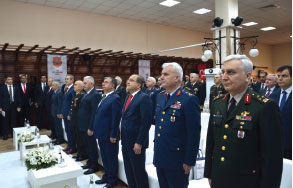
Havelsan’s Cyber Defense Technology Center (SİSATEM) was opened with an official ceremony on March 23, 2016. Havelsan, aiming to become a center of excellence of Turkey, has reached another milestone through this inauguration. The Minister of Transport, Maritime Affairs, Mr. Binali Yıldırım, Minister of National Defense Mr. İsmet Yılmaz, Undersecretary for Defense Industries Prof. İsmail Demir, Senior Executives of Havelsan and many military and defense representatives attended the opening ceremony of the Cyber Defense Technology Center (SİSATEM) located at the Central Premises of Havelsan.
In his opening remark at the ceremony, Havelsan’s Chairman of the Executive Board Mr. Yüksel Öztekin stated that the countries’ perception of threats towards their security changed transiently and continued, “Today, many countries are exposed to cyber threats capable of collapsing all the systems of a country in addition to the casualties caused by conventional weaponry. With the help of the intense cooperation of our foundation companies and institutions, today we are launching this center bearing vital importance for our country’s security. We will continue to make significant investments such as this center in the upcoming period for fulfilling the requirements of our country. We initiated the activities for the establishment of an Urban Warfare Training Center. We aim to introduce a well-equipped simulation center for the urban warfare training to the service of our armed forces. We are conducting our studies at full steam”.
Havelsan General Manager and CEO Mr. Ahmet Hamdi Atalay underlined that the scope of cyber security has expanded and became more complicated, adding that technology, human resources and applications were the three main components of cyber security. Atalay continued, “Nowadays, cyber security is of critical importance for countries. According to the analysis of the cyber security unit, considering the size of its destructive effects, strategic cyber warfare followed nuclear war. The entire world is reinforcing and reorganizing armed forces in accordance with the scope of cyber threats now. According to the data of 2005, the financial dimension of cyber threats exceeded $500 billion and Turkey unfortunately is one of the countries most affected by cyber-attacks. Our country takes part in the top ten in all statistics in this regard. We are ranked ninth in cyber-crimes and third in cyber-attacks in the world ranking. At this point, I would like to strike this issue. Systematic cyber-attacks to foreign countries are conducted by hackers and illegal organizations over slave computers in Turkey. And as these crimes are carried out via the devices with IP addresses in Turkey, a false perception that Turkey assumed an active role in cyber threats emerges. As a result, as you appear to be at the side of the attacking party, then naturally you are exposed to the counter attacks”.
Mr.Ahmet Hamdi Atalay: “97% of Cyber Security products are procured from foreign countries.”
Stating that the size of the cyber security market in Turkey reached $ 300 million, Atalay added that Turkey was importing products in order to cover its cyber security gap and underlined that the foreign companies presently dominated 97% of the Turkish market. Atalay continued, “When we analyze the breakdown of these products, we see that 55% of the products are imported from Israel and 35% is composed of products with American origin. Here, we need to stress this point. Turkey now has to reveal indigenous products. It is not possible to guarantee cyber security by importing products from foreign countries. The sectors we refer to as critical infrastructure such as energy, transportation, communication and finance, must adopt absolute indigenous solutions. As a company generating software based technological solutions, we aim to focus on more specific areas by raising this capability to prominence through this center. We possess an extensive perspective regarding cyber security from training facilities to national security. We plan to initiate an important project for the security of the pipelines of BOTAŞ with Aselsan within this context soon”.
Atalay underlined that Havelsan’s embedded cyber security functions were being used in many products under service and continued, “As Havelsan we are amending our concept. We are exerting utmost efforts to transform these products into separate products instead of embedded ones. With the products we will have as a result of these efforts, we are willing to cater to the requirements of all the institutions and associations”.
Atalay conveyed that the Cyber Security Center was actualized in accordance with the guidance and strategies of the Turkish Armed Forces Foundation and the Undersecretariat for Defense Industries, adding that numerous precedent products would be naturalized through a multi-functional R&D center. Atalay said, “We are conducting studies to build an indigenous attack detection system which is imported from foreign countries. Moreover, we are developing cloud technologies expected to boom in the upcoming period through national resources again at this center. We are establishing firewalls for web applications. Besides, we are also executing activities on the technology launched as the new generation firewall. Meanwhile, the secure communication issue has become crucial recently. A communication technology which allows correspondence requiring special security is among the projects we have been developing as well”.
Mentioning that the Cyber Security Center would also be functioning as a test and verification center Atalay continued: “Is there any harmful code or a backdoor within a procured product? Are there any security flaws? We will be able examine these aforementioned issues at this center. Additionally, we will be carrying out the expert training required by the institutions again in this center. We attach great importance to training. Statistically, currently there is a 1.5 million cyber security expert deficiency in the world. Turkey needs to employ at least 15 thousand cyber security experts under current conditions. Yet, it is quite difficult to achieve this with the existing systems and resources. Besides, training a cyber-security expert is not an easy task. Therefore, we need to efficiently utilize the existing staff. We will be training qualified experts for the institutions in this center while establishing a structure in which the institutions feel secure without employing any additional experts through the services we will offer. Our functions such as incident monitoring and intervention will serve the institutions at our operation center. I would like to draw attention to another ongoing study. Currently, we are searching for the experts and researchers all over the world and working on ways of including the competent names to our eco-system. We will be hosting 70 scientists that we identified, in Ankara soon, and we will be assessing the contributions we will be making together.”
Minister of National Defense Mr. İsmet Yılmaz: “The Cyber Security Instruments will be produced indigenously with the help of SISATEM”
Minister of National Defense wished SISATEM a bright future both for Havelsan and Turkey and said, ”We will be generating indigenous solutions, conducting training, offering protection services, developing national software and thus enabling the emergence of a cyber-awareness in Turkey. The traditional warfare conducted on land, at sea or in the air is being replaced by cyber wars and space wars. I especially brought this discussion to the agenda at the NATO meeting and emphasized that the cyber-attack should also be considered as a motive for war. Cyber wars are causing more damage to dozens of countries each day, more than the damages caused by nuclear war. Therefore, I believe that it is more dangerous and harmful than the nuclear war. The attacks are made through cheap and less risky instruments and thus the same damage caused by nuclear war could be created through cyber-attacks nowadays. Without doubt Turkey required such a facility. I hope that Turkey would not only use this center for its own security purposes but also for it to be open to the idea of helping each country in the Balkans, Middle East and Caucasia, those demanding its expertise in this area. The cyber technologies center of Turkey will assume an important mission for training the required human resources in this area and it will help the country to become a worldwide brand”.
Mr. Binali Yıldırım, Minister of Transport, Maritime Affairs and Communications announced that according to their estimations, approximately 2 million slave computers existed in the world presently and added, “We do not know yet how much of this figure exists in our country but we have to rapidly generate indigenous hardware and software in order to increase the cyber-security and respond to the attacks”. Yıldırım reminded the participants that they established the National Cyber Security Center (USOM) in 2013 and stated that the staff at the center monitored the worldwide traffic 7/24 and closely tracked each development that may create a cyber-threat instantly. Yıldırım expressed that starting from 2012 up until now, Turkey accomplished three cyber security operations at the national level and one in international level and added that as the USOM center they detected nearly 20 thousand threats and over 300 harmful software.
Following the speeches, Minister of National Defense Mr. İsmet Yılmaz and Minister of Transport, Maritime Affairs and Communications, Mr. Binali Yıldırım and the accompanying delegation closely examined the studies and activities conducted at the center.
SISATEM Cyber Security Center
Within the scope of the Cyber Security Technology Center, as an extension of the technology and know-how developed by Havelsan for many years, Technology and Product Development, Test – Analysis and Simulation, Manageable Security Services, Institutional Support Services and Training Services will be offered.
The objective of the center is to hasten the development of products with indigenous technology in order to abolish foreign dependency on technologies developed in cyber security and the license obligations. In addition, at the Cyber Defense Center, in the most dynamic unit of SISATEM, the teams will be on task 24/7, performing counter-measure functions to thwart cyber-attacks.
Cyber Defense Center is equipped with the capabilities that could register all the attacks towards a system, classify them and eventually react after an evaluation. This Cyber Defence Center is composed of the following functions: Cyber-attack early warning, cyber threat intelligence, cyber-attack detection, cyber-attack analysis and response to cyber incidents.
There is also a training center in which operations and training will be conducted with the test and analysis laboratories within the body of SISATEM. Institutional support service will be offered to the comprehensive institutions by SISATEM.