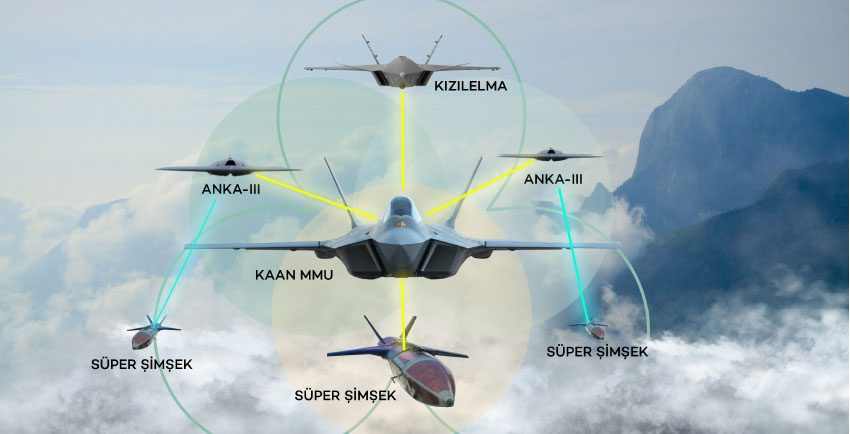
Hybrid Air Warfare and Integration of Artificial Intelligence into the Domain

Air warfare is evolving as technology is moving forward to offer more autonomous/robotic systems to replace humans. The United States Air Force (USAF) recognizes that future conflicts will likely take place across multiple domains (land, sea, air, space, and cyberspace) and therefore focuses on developing a more integrated and synchronized approach to its military operations. One of the key capabilities of the integrated multi-domain warfare approach is to focus on developing more networked and collaborative systems where different assets (manned and unmanned) can share information and work together seamlessly.
The USAF's main tactical warfighting capabilities are currently consisting of 4th gen (F-16C/D, F-15E/EX), 5th gen (F-35A, F-22), and, in the near future, 6th gen NDAG (Next Gen Air Dominance) fighter aircraft and other logistical support assets such as C-5, C-17, KC-46, KC135R, etc. Moreover, on the unmanned side of the systems, the USAF has a diverse fleet of unmanned aerial vehicles (UAVs) that provide a range of capabilities across different mission areas. The USAF's current UAV capabilities include MQ-9 Reaper and RQ-4 Global Hawk. The MQ-9 Reaper is a long-endurance UAV that can operate at high altitudes and is primarily used for intelligence, surveillance, and reconnaissance (ISR) missions. It is also equipped with weapons systems and can perform surgical strike missions. The RQ-4 Global Hawk is a high-altitude, long-endurance UAV that is primarily used for ISR missions. It is equipped with advanced sensors and can operate at altitudes of up to 60,000 feet. Not much is publicized, but still, the operational RQ-170 Sentinel is a "stealthy" UAV that is used for ISR missions. It is designed to evade detection and has advanced sensors for gathering intelligence.
The USAF has been interested in pairing next-generation UAVs with fighter aircraft since the launch of its Skyborg program, which is a concept that the air force intends to incorporate with its Next Generation Air Dominance (NGAD) fighter using UAVs as Collaborative Combat Aircraft (CCAs). The CCAs are planned to fill roles like carrying additional missiles, providing extra sensor coverage, or even taking a hit from an enemy in the place of a piloted aircraft. The USAF's future plans also involve incorporating these drones into a range of mission scenarios, working alongside manned aircraft to achieve air superiority, and enhancing the capabilities of the USAF in a networked environment.
The Birth of the Skyborg Program
The United States Air Force's Skyborg program is a program to develop a family of unmanned "combat" aerial vehicles (UCAVs) that can operate alongside manned fighter aircraft in a range of mission scenarios, working alongside manned aircraft to achieve air superiority and enhancing the capabilities of the USAF in a networked environment. The Skyborg program is part of the Air Force's larger strategy to accelerate the development and fielding of next-generation combat capabilities into the next century. The project is intended to develop a "loyal wingman" concept, where these UAVs can act as wingmen for manned aircraft, performing tasks such as reconnaissance, electronic warfare, and even strike missions.
The program was first launched in 2019 and has since received significant funding and support from the Department of Defense. The project is seen as critical to the Air Force's future success in a rapidly changing global security environment. As threats continue to evolve and become more complex, unmanned aircraft will play an increasingly important role in military operations, enabling the Air Force to operate more effectively and safely.
The main goal of the project is to create a low-cost, attritable system that can be used for a range of missions, including electronic warfare, intelligence, surveillance and reconnaissance (ISR), and strike operations. The Skyborg program includes developing autonomous systems that can operate in contested environments, increasing the number of air assets available to the USAF, and reducing the risk to manned aircraft in high-threat environments. These autonomous systems will also include a suite of sensors and weapons, including advanced sensors for situational awareness, electronic warfare capabilities, and precision-guided munitions. One of the key features of the Skyborg system is its autonomous capabilities. The system will be designed to operate autonomously, making real-time decisions based on the information it receives from sensors and other sources. The system will also have the ability to be remotely piloted by a human operator when necessary.
The Skyborg program is a collaborative effort between the USAF and a number of defense contractors, including Boeing, Kratos, and General Atomics. The program is also working closely with the Defense Advanced Research Projects Agency (DARPA) to develop advanced artificial intelligence (AI) and machine learning (ML) capabilities for the system.
The Defense Advanced Research Projects Agency (DARPA) is an agency of the United States Department of Defense responsible for the development of advanced technologies for the national security of the US and the United States Military. In addition to the many areas of research interest, the agency is also performing/supporting research activities in the field of AI (Artificial Intelligence) and ML (Machine Learning) to enhance the capabilities of military systems, including missiles and UAVs. This includes developing algorithms for autonomous decision-making and improving the ability of military systems to process and analyze large amounts of data.
DARPA is leading the development of the Skyborg program, working closely with the USAF and other partners in the project. The agency is responsible for developing the autonomous capabilities of the Skyborg UAVs, including artificial intelligence (AI) and machine learning (ML) algorithms that will enable the UAVs to operate autonomously in complex and dynamic environments. The agency is also working on developing a "brain" for the Skyborg UAVs, which will enable them to learn from their experiences (machine learning) and make decisions autonomously (Artificial Intelligence). This will involve developing advanced algorithms for data processing, decision-making, and situational awareness.
DARPA's LongShot Program
Even though not directly related to the Skyborg program, DARPA's LongShot program is an experimental project that aims to develop an "air-launched drone" (could be dropped from a bomber or fighter) capable of taking down enemy aircraft from a distance. The drone will be designed to operate autonomously and be able to make decisions in real time based on the information it receives from sensors and other sources. The LongShot program is unique in that it focuses on developing a drone with the capability to engage targets beyond visual range, which is a significant challenge for existing air-to-air weapons. This capability could potentially give the US military a significant advantage in air combat scenarios, especially in the Asia-Pacific region.
DARPA originally picked General Atomics, Lockheed Martin, and Northrop to provide preliminary designs for LongShot's first phase in February 2021. So far, only General Atomics has moved into the second phase of the project, according to the press release by DARPA. The LongShot program is still in its early stages, and there is no guarantee that it will be successful. However, DARPA has a reputation for pushing the boundaries of technology and developing innovative solutions to challenging problems. Therefore, the LongShot project has the potential to be a significant step forward in the field of autonomous systems in air combat. It should be expected that the DARPA's LongShot could potentially become part of the Skyborg program and develop into a joint Navy and Air Force project in the future.
The USAF's Skyborg program is currently in the testing phase, with several prototypes being developed by different defense contractors, as mentioned before. The Autonomous Core System (ACS), the "brain" of Skyborg, has successfully flown multiple aircraft made by different contractors so far. Multiple drones operated by the ACS have flown together, demonstrating coordination between the drones produced by different manufacturers, but most of these flights have not been publicly announced.
In one of the test flights released to the press, the Air Force successfully flew an F-22 and F-35B alongside XQ-58A Valkyrie "attritable" drone in a test flight on December 9, 2020, demonstrating connectivity between stealth platforms. It was the fifth flight of the Valkyrie flying in formation with the F-22 and F-35 to achieve initial test goals. The Valkyrie (made by Kratos), one of the drones in the Skyborg project, carried what is called a "gatewayONE" translator system, allowing a USAF F-22 and a Marine Corps F-35B to communicate with each other using their otherwise incompatible datalinks: the Intra-Flight Data Link (IFDL) on the F-22, and the Multifunctional Advanced Data Link (MADL) on the F-35. Less secure link-16 datalink modules are standard on both aircraft. These F-22 and F-35 specific secure datalinks let F-22s and F-35s communicate with other jets like themselves without being detected or overheard, but they were not interoperable datalinks. Therefore, F-22 and F-35 cannot communicate with each other using IFDL and MADL; both aircraft require link-16s to communicate.
The USAF promoted the test as an important step to establish a kind of military wifi system that connected both stealth aircraft in the air. The Valkyrie worked like a flying gateway or served as a translator between the two fifth-generation fighters. Later days, it was revealed that the KC-46 tanker served as a communications node by passing F-35B full-motion video to a ground controller.
In a most recent test campaign of the Skyborg, General Atomics Aeronautical Systems (GA-ASI) 's MQ-20 Avenger drone has conducted a flight test to further validate the firm's Collaborative Combat Aircraft system in January 2023. The drone was paired with an MQ-20 "digital twin" to assess the CCA's artificial intelligence and machine learning capability in live, virtual, and constructive multi-objective missions.
Another UCAV project that was at the spotlights in recent years is the Loyal Wingman, designated as MQ-28 Ghost Bat and is being developed by Boeing Australia. The Loyal Wingman is also part of the Skyborg program to create autonomous unmanned aerial vehicles that can operate alongside manned aircraft. The Loyal Wingman is intended to be a force multiplier, providing additional capabilities and support to manned aircraft and increasing their effectiveness.
The Loyal Wingman is a modular platform that can be customized for different missions with different payloads and sensors. It is designed to be able to operate autonomously or under the control of a manned aircraft, depending on the mission requirements.
Boeing has so far developed three prototypes of the Loyal Wingman aircraft, which have undergone extensive testing and evaluations. The first flight of a Loyal Wingman prototype took place in February 2021. The Australian government has also provided funding to support the development of the Loyal Wingman program.
Türkiye’s UAV Drive Continues: KIZILELMA and ANKA-3
The TB2 UAV, developed by Baykar, a Turkish drone manufacturer, has been used in several conflicts, including the Turkish Army's operations in Syrian, the Nagorno-Karabakh conflict, and the Libyan Civil War. It has been particularly effective in the Nagorno-Karabakh conflict between Armenia and Azerbaijan, where it played a vital role in providing situational awareness and targeting for Azerbaijani forces.
The TB2 UAV has demonstrated its effectiveness in providing real-time ISR capability and delivering precision-guided munitions (MAM-C, MAM-L), and its success has led to increased interest in UAV technology by militaries worldwide. Moreover, the TB2 UAV is relatively inexpensive compared to rival unmanned systems, making it an attractive option for countries with limited military budgets. It is also easy to operate and maintain, making it accessible to countries without extensive military infrastructure. After securing more than 300 TB2 orders from 30+ customers around the world, Baykar has turned its attention to the more advanced and larger UAVs.
The twin turboprop Akinci UAV is a high-altitude, long-endurance drone designed for use in intelligence, surveillance, and reconnaissance missions, as well as offensive operations. It has a wingspan of 20 meters, a maximum take-off weight of 5,500 kg, and a maximum altitude of 40,000 feet, making it one of the largest and most capable UAVs in the world.
One of the most significant features of the Akinci UAV is its ability to carry a wide range of weapons, including 100km+ ranged TRGL-230 and SOM missiles and precision-guided munitions such as MAM-L, MAM-T, Teber-81/82, HGK-82/83/84 and LGK-82/83/84. This gives it the capability to strike a variety of targets, including enemy aircraft, ground targets, and even naval vessels.
Additionally, the Akinci UAV is equipped with advanced sensors and communication systems, allowing it to operate in contested environments and provide real-time intelligence to ground forces. It also has a long endurance of up to 24 hours, allowing it to stay on station for extended periods.
Baykar's single jet-powered new UAV, called KIZILELMA (Red Apple in English), appeared as a surprise to many Western observers when KIZILELMA made its debut flight on December 14, 2022. Its overall design reflects stealth characteristics with canards and twin vertical tails for high maneuverability. The first prototype, KIZILELMA-A, is powered by the Ivchenko-Progress AI-25T turbofan engine (3000lb dry thrust) and will be mostly used for flight testing to validate with mission and command control systems. It's expected that the operational version, KIZILELMA-B, will be powered by Ivchenko-Progress AI-322F turbofan with a power of 5000lb dry thrust and 9200lb with afterburner. KIZILELMA-B version will reach high subsonic speeds at an operational altitude of 35,000 feet and carry many of the Turkish guided bombs and missiles in its internal weapons bay (when stealth is required) and its wings (when stealth is not required). According to Baykar's infographics, KIZILELMA will be integrated with an AESA radar from the leading defense electronics company Aselsan and air-air missiles produced by TUBITAK (Turkish Institute for Scientific Research and Development) for air combat missions. The first delivery of the high-performance KIZILELMA-B UAV is expected towards the end of 2024 to the Turkish Air Force (TuRAF).
With its expected high performance, stealth characteristics, internal/external weapon-carrying capability, and range of ISR sensors, KIZILELMA would play a variety of roles in TuRAF's future air combat missions. Depending on the mission requirements, KIZILELMA can be used to carry out air-ground/air-air missions independently or under a command-and-control network of man-unmanned systems of the TuRAF. According to Selçuk BAYRAKTAR, the chairman of the board and the chief technology officer of Baykar, KIZILELMA will be integrated with highly advanced AI (Artificial Intelligence) technologies in coming years to fly and perform combat duties autonomously without the command of pilots at the control stations. With that said, it would not be wrong to say that TuRAF's future 5th gen fighter aircraft, TF-X, and KIZILELMA, will be partners and perform air combat missions together. To accomplish the task of joint operations, high-speed, secure communication (datalinks) protocols must be developed to connect two aircraft in the air. With the high-speed datalink, TF-X and KIZILELMA can share information in real-time and provide critical targeting and intelligence data between the platforms or share it with all elements in the network. Moreover, KIZILELMA could be paired with TF-X, similar to the USAF's Skyborg or Loyal Wingman concepts, and use its own AESA radar/IR sensor to extend the coverage of the TF-X engagement envelope or engage hostile targets designated by TF-X.
Türkiye's second important UAV producer is the Turkish Aerospace (TUSAŞ), which designed and produced the MALE (Medium Altitude-Long Endurance) class ANKA UAV for almost a decade. Already operational in the Turkish Air Force, ANKA-S is the latest version that can be described as a UAV with similar capabilities to the US Army's MQ-1C Gray Eagle produced by General Atomics. The ANKA-S has a wingspan of 17.3 meters and a maximum take-off weight of 1,600 kg (of that, 300kg can be used as a payload). It can fly at an altitude of up to 30,000 feet and has a maximum endurance of 36 hours. Turkish Engine Industries (TEI) designed and produced a twin-turbo diesel engine, PD-170, for the ANKA-S to give high performance at altitudes. It is equipped with advanced sensors and payloads, including electro-optical and infrared cameras, synthetic aperture radar, SIGINT (signals intelligence), and radio relay systems which allow to extend the range of radios used by the ground forces and also provide SAR (Search and Rescue) support during special forces operations.
ANKA-S has a bigger sister, named AKSUNGUR, powered with two PD-170 engines and has a maximum take-off weight of 3.5 tons with an endurance of 40+ hours. AKSUNGUR borrows its main body from ANKA-S but has larger wings and twin vertical tails for very long endurance missions and a payload of 750kg. Turkish Navy is the first customer of the AKSUNGUR and will be integrated with ASW (anti-submarine warfare) sensors/weapons such as sonobuoys, Sar/GMTI radars, and light torpedoes to provide real-time ISR and conduct ASW missions jointly with manned P-72 (based on ATR-72) and CN-235 ASW platforms. It hasn't been revealed, but in the future, one would expect to see the naval version of AKSUNGUR and P-72/CN-235ASW platforms share information via datalinks in real-time (between the aircraft) and conduct ASW missions together. Naval AKSUNGUR's long endurance ASW missions would greatly enhance Türkiye's maritime patrol capabilities and significantly increase the mission success of the manned platforms like P-72/CN-235 ASW platforms which can solely focus on launching torpedoes and anti-ship missiles to hunt hostile submarines and surface vessels. The Turkish version of the hunter-killer ASW mission concept can be an example of unmanned-manned collaboration.
Turkish Aerospace (TUSAŞ) 's latest turbofan engine-powered UAV project is coming to fruition. Designated as ANKA-3 MİUS (National Unmanned Combat Aerial Vehicle System), Turkish Aerospace revealed its first "flying wing" prototype of ANKA-3 in April of 2023. The geometry of ANKA-3 has a similar design characteristic to Dassault nEUROn or Russian S-70 Okhotnik with no vertical tails and purposefully built to have optimized stealth characteristics (compared to the other flying wing concepts such as Northrop's X-47). The current prototype of ANKA-3 weights about 5.5-6 tons and uses an AI-322 turbofan engine from Ukraine, but Türkiye's TEI has started the TF6000 turbofan engine (6000lb thrust level) project that will eventually power ANKA-3 when it becomes operational. ANKA-3 can perform several mission profiles, including ISR (Intelligence-Surveillance-Reconnaissance) or deep strike missions with the capability of carrying guided bombs 1 ton + payloads including HGK-82/83, LGK-82/83 or Aselsan's Small Diameter Bombs in its internal weapon station. From the start, Turkish Aerospace’s plan is to pair ANKA-3 MIUS with Türkiye's TF-X fighter aircraft to conduct joint operations. The advantage of the flying wing concept is to reduce the RCS (radar cross section) of the aircraft to the lowest possible levels with the help of additional design properties such as S curved intakes and RAM materials on the skin of the main body to absorb radar signals (mission-specific design required for this). Of course, flying wing designs give up the maneuverability and agility of the fighter aircraft but gain stealth characteristics without vertical and horizontal tails. This is important, especially for air-ground missions that require undetected penetration of the early warning radars and air defense systems. Turkish Aerospace’s test campaign for ANKA-3 will continue for several years to optimize its overall design and finalize its flight control programming.
Turkish Aerospace's one of the proposed loyal wingman concepts, called SIMSEK-II, was also shown during ANKA-3 debuts in Ankara last month. SIMSEK-II is a turbofan-engine small-size target drone/UCAV that is designed to perform multiple missions with its flexible payload-carrying capability. It can perform high-speed target drone roles as well as long-range strike missions if required.
Neither KIZILELMA nor ANKA-3 MIUS is designed to be attritable aircraft in terms of their cost effectiveness unless the mission is extremely important to sacrifice these UAVs. In the future, it would be expected that an operational concept similar to the USAF LongShot, a cost-effective and lighter drone with mission-specific sensors/weapons, could be designed and produced by Turkish companies, and these drones could be launched from airplanes (either cargo or fighters) to perform their designated (ordered ) missions such as maybe carrying additional air-air missiles or guided bombs to fly deeper into the hostile territories and conduct its missions without requiring to come back and risking the manned platforms. The technology is not available to replace humans in air combat to make instant decisions to perform missions, but with artificial intelligence with deep neural network learning, certain missions can be performed effectively and cost-efficiently in the near future. Türkiye has come a long way and has become one of the leading military drone producers in the world, but there is still more work to do in R&D and investing in sensor and AI/ML technologies. So, not just produce drones but produce mission-specific sensors and other subsystems as well to stay in the competition