HYPERSONIC WEAPON SYSTEMS
On March 19th and 20th, Kinzhal air launched hypersonic missiles were fired from Russian Air Force MiG-31K fighters against targets in Ukraine. This marked the first combat use of this weapon, which has recently entered service with the Russian Armed Forces. The use of Kinzhal also brought the focus back on the capabilities and effects of hypersonic weapons.
For the past year, hypersonic weapons have been on the agenda as strategic assets within the competition among the United States, Russia, and China. Several other countries such as India and Japan have also been working on developing hypersonic strike capabilities.
The most prominent feature of hypersonic weapon systems is their high speed. The speed of the weapon provides a counter-air defense capability in itself. Another major advantage, which emanates from the speed parameter, is the extremely short time required to hit a target, when compared to a traditional ballistic missile. The third major advantage of the hypersonic weapons systems is their unpredictable flight paths compared to the computable and therefore predictable trajectories of ballistic missiles, which increases chance of intercepting them with anti-ballistic missile systems.
Hypersonic Flight
In aerospace engineering, Mach number is an important parameter in the performance of air platforms, especially those that fly at high speed. Mach number is the ratio of the speed of the platform to the speed of sound. Mach numbers that are smaller than 0.8 define subsonic flight; between 0.8 and 1.2 cover the transonic flight, and Mach numbers between 1.2 and 5 are describe supersonic flight. Hypersonic flight regime is achieved when the platform flies at least five times faster than the speed of sound. As a subset, Mach 10 and above are High hypersonic speeds.
The design and construction of the air vehicle that flies at hypersonic speeds is significantly different than those fly at supersonic or subsonic speeds. At hypersonic speeds, the interaction between the air vehicle and surrounding atmosphere as well as aerodynamic effects changes dramatically.
Many ballistic missiles and spacecraft during the re-entry phase achieve hypersonic speeds. However, an air vehicle that achieves hypersonic speeds while maneuvering during level flight requires extensive design and manufacturing capabilities. Because of the excessive cost of development and manufacturing, plus noise pollution considerations, hypersonic passenger plane designs have not materialized. However, mainly due to the speed factor, hypersonic weapon systems have been a hot topic in the aerospace and defense sector for the past decades.
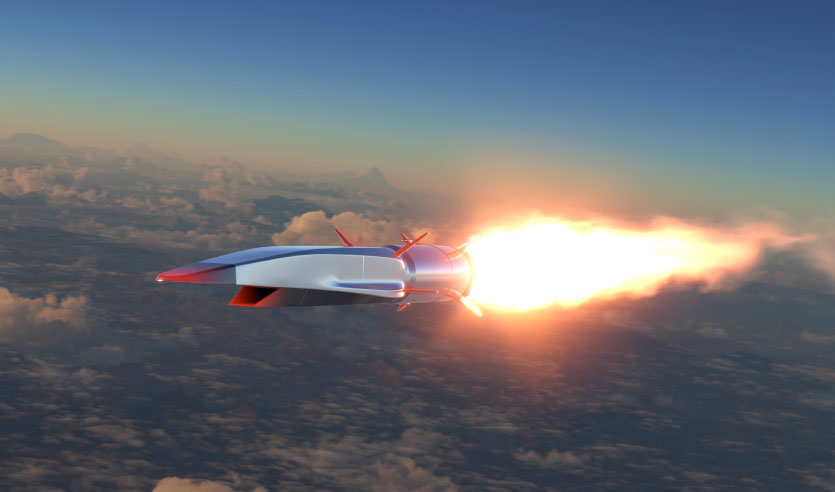
There are mainly three types of hypersonic weapon systems. These are ballistic missiles, hypersonic cruise missiles and hypersonic glide vehicles (HGVs).
Hypersonic Weapons
Ballistic missiles are projectiles that deliver a warhead and fly along a trajectory governed by aerodynamic effects. The missile is propelled, usually vertically with the help of the thrust achieved by the burning of liquid or solid fuel. After the burnout of the fuel, the missile flies along a ballistic trajectory, during the midcourse phase. Modern ballistic missiles are equipped with trajectory correction systems that increase the precision of the missile. Depending on the design and performance characteristics, the missile achieves hypersonic speeds at the terminal phase before impact.
Cruise missiles are weapon systems that perform level flight in a relatively straight line along their route, usually at very low altitudes to avoid detection. Cruise missiles are controlled by an autopilot that commands the maneuvers during flight. They are equipped with different types of sensors and guidance computers to achieve pinpoint accuracy. Until recently, cruise missiles of different countries have been equipped with jet engines that enable high subsonic or supersonic speeds. With the introduction of new propulsion technologies such as scramjet and turbine-based combined cycle (TBCC), hypersonic cruise missiles have become a reality. For comparison, the Tsirkon hypersonic missile is claimed to be able to strike a target at a range of approximately 2,500km in 20 to 30 minutes, whereas a Tomahawk missile, which has a maximum speed of around 885 km / hr can fly the same distance in about 3 hours.
Hypersonic glide vehicle (HGV) is an air vehicle carrying a warhead that glides towards the target at high hypersonic speeds, as high as Mach 20. HGVs in essence are not different from traditional ballistic missiles, which are launched usually vertically, and upon expending fuel carry the warhead along a ballistic trajectory to the target.
HGVs, like ballistic missiles carry the warhead to the upper stages of the atmosphere, mostly with an intercontinental ballistic missile (ICBM). However, unlike ballistic missiles, the warhead is released at comparatively lower altitudes. Once released the HGV flies along its route using the speed gained until a specified moment and executes maneuvers using control surfaces and thrusters.
The main advantage of HGVs on ballistic missiles lies in the capability to execute maneuvers, making it almost impossible to predict the impact point and therefore the target. Combined with excessively high speed, HGVs become virtually immune to anti-ballistic missile defense systems, early warning and tracking systems.
Hypersonic Weapon System Projects Around the World
AGM-183 ARRW (Air-Launched Rapid Response Weapon) – United States
ARRW is an HGV that is under development by Lockheed Martin for the United States Air Force (USAF). The $480 million development contract was signed in August 2018. Flight tests started in mid-2019 with a USAF B-52H Stratofortress bomber.
The ARRW is designed to fly at Mach 5 and the declared range is around 1,000 miles (roughly 1,600kms). The USAF states the main mission of the ARRW to enable the United States to hold fixed, high-value, time-sensitive targets at risk in contested environments from stand-off distances.
On May 14, 2022, the ARRW was released for the first time from a B-52. The test included separation from the aircraft, booster ignition and achieving Mach 5 speed.
Long-Range Hypersonic Weapon (LRHW) – United States
The Long-Range Hypersonic Weapon (LRHW) is being developed primarily for the US Army. Its stated development purpose is to provide a strategic attack weapon system to defeat Anti-Access/Area Denial (A2/AD) capabilities. Another designated user of the LRHW is the US Navy, which intends to acquire a ship/submarine-launched variant of the missile as part of the Intermediate-Range Conventional Prompt Strike (IRCPS) program.
The missile component of the LRHW is being developed by Lockheed Martin and Northrop Grumman. When the hypersonic glide body, which is designated as Common-Hypersonic Glide Body (C-HGB) is attached, it is referred to as the Navy-Army All Up Round plus Canister (AUR+C). The missile component is to serve as the common two-stage booster for the Army’s LRHW and the Navy’s IRCPS system, which is intended to be fired from both surface vessels and submarines.
The first test of the IRCPS Flight Experiment-1 was made on October 30, 2017. A missile capable of fitting in the launch tube of an Ohio-class ballistic missile submarine flew over 2,000 nautical miles from Hawaii to the Marshall Islands at hypersonic speeds. The C-HGB was tested in March 2020. In October 2021, booster rocket testing began, and live-fire testing is planned to take place in 2022.
3M22 Tsirkon - Russia
The Tsirkon is a scramjet powered hypersonic cruise missile, being developed primarily as an anti-ship weapon system.
The project was first unveiled during MAKS airshow in 1995. The first firing took place from a Tu-22M3 bomber in 2012, followed by ground launch tests in 2015. During a test in April 2017, the Tsirkon achieved Mach 8 speed. In November 2017, Russian Air Force Commander Viktor Bondarev announced the weapon to be in service. Russian President Vladimir Putin claimed during a speech in February 2019 that the Tsirkon can fly at a speed of Mach 9 and has a range of approximately 1,000km.
Between 2020 and 2022, a number of fire tests were completed from the Project 22350 class frigate the Admiral Gorshkov in the White Sea. In 2021, the first submarine launch was successfully completed from Project 885 class nuclear attack submarine, the Severodvinsk.
Project 1144 Kirov class Admiral Nakhimov cruiser; Project 11356R Admiral Grigorovich and Project 22350 Admiral Gorshkov class frigates will reportedly be equipped with the Tsirkon.
Kinzhal - Russia
The Kh-47M2 Kinzhal is an aircraft launched derivative of the 9M723 tactical ballistic missile which is used with the Iskander M system. The missile can be fired from MiG-31K, which is a specially modified version of the MiG-31BM, which itself is the upgraded version of the MiG-31 (NATO code "Foxhound") interceptor. The Tu-22M3M, a modernized version of the Tu-22M3 (NATO code "Backfire") bomber can also fire the Kinzhal.
Initial reports about an air launched version of the Iskander missile first surfaced as early as the mid-2010s. The first fire tests took place in 2017, followed by a ship-launched test in January 2020 during an exercise of the Black Sea Fleet. In June 2021, Kinzhal equipped MiG-31K fighters were seen at the Hmeimim air base in Syria, while participating in exercises in the Eastern Mediterranean. Kinzhal equipped MiG-31K's were also deployed to Kaliningrad this February, shortly before the start of Russian invasion of Ukraine.
Russian sources claim Kinzhal as having a range of more than 2,200km when fired from the MiG-31K and more than 3,000km when fired from the Tu-22M3M. The missile carries a maximum of 480kgs of conventional or nuclear warheads with an overall weight of 4,300kg. After launch, the missile flies at Mach 4 and is claimed to achieve speeds as high as Mach 10. The Kinzhal is also reported to have maneuvering capability to disrupt enemy air defenses, but it is unclear as to how it performs this capability.
Avangard - Russia
The Avangard, which was previously known as Object 4202, is an HGV that is carried by the UR-100NUTTKh (NATO code SS-19 Mod 3 "Stiletto"), RS-26 Rubezh or RS-28 Sarmat (NATO code SS-X-29) ICBMs. The Avangard has a reported range of around 6,000km with an overall weight of 2,000kg. It can be equipped with conventional or nuclear warhead.
The origins of the Avangard date back to 1980s, when the Soviet Union started to work on hypersonic weapon systems. After a pause caused by the dissolution of the Soviet Union, the program resumed in mid-1990s under the codename of Project 4202. The flight test period took place between 1990 and 2018, followed by the first live fire in December 2018.
DF-ZF- China
The DF-ZF, which was unveiled during the parade for the 70th anniversary of the People's Republic of China, is an HGV. It is designed to be carried by a DF-17, a solid fuel medium range ballistic missile (MRBM).
The flight tests of the DF-ZF began in 2014 and continued until 2017. It reportedly entered service in 2019. Technical specifications and capabilities of the weapon are unclear but Western sources estimate it being able to exceed well above Mach 5. It is also estimated to be equipped with either conventional or nuclear warheads, with primary targets being US Navy carrier strike groups.
There are assessments that the DF-ZF can also be mounted on DF-21 MRBM and DF-31 ICBM, to achieve ranges as much as 12,000km, making the DF-ZF a highly strategic weapon system.
BrahMos II - India / Russia
A hypersonic derivative of the joint Indo-Russian supersonic cruise missile BrahMos, the BrahMos II is under development by India's Defense Research and Development Organization and Russia's NPO Mashinostroyenia. The BrahMos II is expected to be able to achieve Mach 8 speed and have a range of around 1,000km. Indian sources claim some level of cooperation might exist with Russia based on the latter's experience from the Tsirkon project, though this claim is subject to confirmation. Flight testing of the BrahMos II was originally planned for 2020, but this milestone has been missed.
HVGP and HCM - Japan
Japan has been reported as developing an HGV, as a response to China and North Korea's achievements in missile technology. In 2020 the research and development plan was shared with the public in 2020 and the roadmap aims for local development and the manufacture of standoff hypersonic weapons. The plans confirmed that Japan is seeking incremental growth in capability and provides more details about the kinds of threats it is targeting with this new class of weapon.
According to the announced plans, Japan will develop two classes of standoff hypersonic systems, the Hypersonic Cruise Missile (HCM) and the Hyper Velocity Gliding Projectile (HVGP). The former will be powered by a scramjet engine and appears similar to a typical missile, albeit one that cruises at a much higher speed while capable of traveling at long ranges. The HVGP, on the other hand, will feature a solid-fuel rocket engine that will boost its warhead payload to a high altitude before separation, where it will then glide to its target using its altitude to maintain high velocity until impact