“In the PREVEZE Class We will Drop in New Periscopes!”
HENSOLDT Optronics’ (which emerged from Carl Zeiss Optronics) heritage in submarine systems dates back to the beginning of the 20th century. In 1903, the company developed and produced the world’s first fully functional periscope for the German Navy’s “Forelle” submarine. Since then, HENSOLDT Optronics have continuously been pushing technological boundaries and setting new standards in the field of periscope systems. Today, the company has successfully supplied and installed over 3,000 periscopes and optronic mast systems and is capable of offering a complete range of periscopes and optronic masts to meet the requirements of modern submarines, enabling them to meet the challenges of the future.
Defence Turkey talked with Harald HANSEN, Director Sales Maritime at HENSOLDT Optronics GmbH to get firsthand information on HENSOLDT Optronics’ activities in Turkey, their cooperation with Turkish companies and on the periscope and mast systems selected for the integration on Turkish and Pakistan Navy submarines.
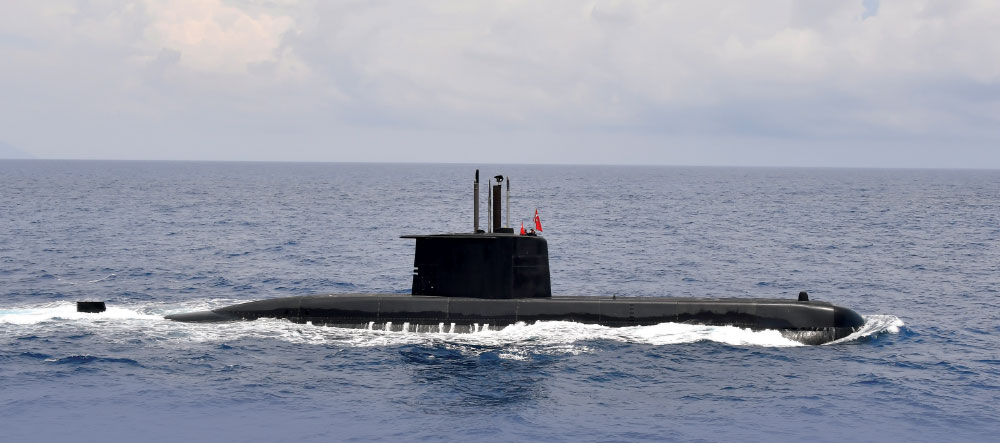
On August 5, 2019 HENSOLDT Optronics GmbH announced that it had received a contract from Savunma Teknolojileri Mühendislik (STM) under the PREVEZE Class (Type 209/1400) Diesel-Electric Submarines Mid-Life Upgrade (MLU) Project, to upgrade existing search and attack periscopes onboard four PREVEZE Class Submarines. Under this contract, HENSOLDT Optronics will provide a total of four SERO 420 Attack Periscopes and four SERO 430 Search Periscopes to replace L3 KEO (formerly known as Kollmorgen)’s Model 76 Search and Attack Periscopes ordered in 1987 which were integrated on the submarines during the early 1990s. The periscope upgrade of PREVEZE Class Submarines for the Turkish Navy is the third collaboration project of HENSOLDT Optronics with STM.
As the Prime Contractor of the AY Class (Type 209/1200) Diesel-Electric Submarines Modernization Program STM selected HENSOLDT Optronics and on March 30, 2011 a contract was signed for the delivery of two SERO 250-A Attack Periscopes and two SERO 250-S Search Periscopes to be installed on the TCG Doğanay (S-351) and TCG Dolunay (S-352) submarines. Following the completion of their modernization activities the TCG Dolunay was re-delivered to the Turkish Navy on April 9, 2014 and TCG Doğanay on April 22, 2015. Periscope modernization for the AY Class Submarines’ was HENSOLDT Optronics’ first project with STM. According to Mr. HANSEN this was a very professional and successful project with STM.
HENSOLDT Optronics has also been involved in Pakistan Navy’s Agosta 90B Class Submarines MLU Project, covering the comprehensive upgrade of three submarines, in which STM acts as the Prime Contractor. This is HENSOLDT Optronics’ second project with STM. For the Pakistan Navy’s Agosta 90B Class Submarines HENSOLDT Optronics is supplying OMS 200 Optronics Masts (Attack Periscope) and SERO 430 Search Periscopes to Prime Contractor STM under a contract awarded in October 2016. This project also was a very complex and was professionally managed and executed by HENSOLDT Optronics as well.
HENSOLDT Optronics was also selected by German Shipyard TKMS (HDW), the Prime Contractor of the Turkish Navy’s New Type Submarine Program (covering the construction of 6 REIS Class Type 214TN AIP Submarines at Gölcük Naval Shipyard) and secured a contract in July 2011 for the delivery of six SERO 420 penetrating Attack Periscopes and six OMS 100 non-penetrating Optronics Masts, coupled with Gabler’s hoistable mast systems.
Defence Turkey: Can you elaborate on the periscope and mast systems selected for the Turkish Navy and Pakistan Navy submarines?
Harald HANSEN: For the AY Class, we supplied the refit Periscopes SERO 250 Attack and SERO 250 Search. The difference is the addition of a Mid Wave Infrared (MWIR) capability on the search periscope’s mast. Recently we have identified the need for increased stealth on the Attack version of SERO 250 and are developing an Ultra Low-Profile mast solution known in the past as a “Needle Nose” head section.
For the NTSP a periscope and an optronic mast solution is preferred: a SERO 420 and a OMS 100. The Pakistan contract has a SERO 430 and a OMS 200. Since 2004, more than 45 submarines have been equipped with this classic combination of a Direct View periscope and a non-hull penetrating optronics mast. With the installation of the SERO 420 / OMS 100/150 paired systems, today’s submariner is able to undertake a wider range of important tasks in “All weather and All Light conditions” that was not possible with earlier systems.
The PREVEZE Class has both, a SERO 420 and a SERO 430. The difference between the SERO 420 and the SERO 430 is the IR. So the PREVEZE Class will have 2 periscopes. That’s the configuration for Turkey and the PREVEZE Class now.
Defence Turkey: Which one is an attack periscope, and which one is surveillance?
Harald HANSEN: At the moment they will be identical periscopes with Attack (Tactical) and Search (Surveillance) capability. Both will be fully integrated into the Combat Management System and given the professionalism of the Turkish Navy they will set up their concepts of operation (CONOPS) for the various mission profiles they will face.
Defence Turkey: You have also a Twin Optronic Mast solution. Can you elaborate on these solutions?
Harald HANSEN: The trend in the New Build SSK (diesel driven submarines) is towards Twin Optronic Mast installations. The change is driven mostly by the changes in the architecture and operation of the Combat Management Systems (CMS) and the way tactical operations will be conducted.
The loss in ability to hang on to an ocular box and see outside directly of the Direct View of a classical periscope necessitates a relook at the Human Machine Interfaces (HMI) of the Optronic Mast, especially regarding safe passage and coming to periscope depth. These challenges have now been addressed in our latest HMI solutions with the introduction of Quick Look Around, Panoramic View display and the transfer of video in real time and at full definition via Fiber Optics.
The OMS 150 and OMS 200 are a combination of non-hull penetrating optronic mast systems for new-built submarines. For modern submarine operations, the unique combination of OMS 150 and OMS 200 optronic masts represent the peak of technological innovation.
Defence Turkey: What is the benefit of this configuration? For example, even if your product portfolio includes both the hull penetrating Direct View periscopes and a non-hull penetrating optronic masts, like the Turkish Navy, most of the navies still prefer to have the classic hull penetrating periscope systems…
Harald HANSEN: It’s a long and difficult debate. If you speak to operators who have a lot of experience on a periscope, they just say that they will never give away a periscope, especially in the refit markets. Navies undergoing studies towards the definition of requirements for new build submarines, which will be delivered in the 2030’s are more orientated to twin optronic masts. Some navies like the Swedish only have got one optronic mast. SSBN and other larger submarines have long ago switched to twin optronic masts, as this best suits their operations mostly based on the principle of “Dive Deep Stay Deep”. However there we now experience that even these submarines are far more conscious of Stealth and are now asking for an Ultra Low Profile Mast for when they need to operate in confined waters like the Littorals.
The big debate is stealth, and one of the debates which is a bit skewed is visual stealth. As an Optronic Mast replacement for the Attack Periscope we developed the OMS 200 optronic mast with the same size tube as you would find in the periscope. The trend to increase visual stealth now is to go even smaller than this and produce tube sizes of less than 100mm. To meet this demand, we are in the design and development phase of our Ultra Low Profile Optronic Mast known as the OMS 300. The challenge here is to ensure that the mast from a visual detection point of view does not create surface disturbances such as wake and plume which is the focus of modern ASW periscope detection systems.
Defence Turkey: Are you cooperating with Gabler or Calzoni for masts?
Harald HANSEN: We mostly work with Gabler and Calzoni and hopefully soon MacTaggart & Scott in the UK, as a supplier (even under contract to Hensoldt Optronics) for the Mast Raising. As an example, in the case of the Agosta 90B Class Project, we are responsible for the supply of the lifting arrangement. So we subcontract Gabler. Now, in the case of the PREVEZE Class we are also are responsible for providing the material for the installation of the periscopes.
Defence Turkey: Are you going to select the OEM for the mast system, or will the end user make the decision on the mast system?
Harald HANSEN: This is very project dependent. In the New Build projects where a shipyard has the main supply contract the decision is that of the shipyard. In the refit project markets where HENSOLDT has the full responsibility either to a Navy or a company such as STM, the decision is normally ours. The decision is normally based on price and delivery lead time.
Defence Turkey: Is Calzoni in discussion for the Pakistan Navy’s Agosta 90B Class?
Harald HANSEN: No, the contracts are already in place. We went out an open tender to Calzoni and Gabler. Because bear in mind that the mast is not only for the periscopes, it’s also for the snort mast and the communication mast, so I think from an STM point of view they looked at the full portfolio. And finally, in consultation with STM we made the decision to go with Gabler for Agosta 90Bs.
Defence Turkey: What about the mast requirement for the PREVEZE Class Submarine MLU Project? Have you also selected mast systems provider for the PREVEZE Class?
Harald HANSEN: For the PREVEZE Class what we are effectively doing is taking out the existing periscopes solution and dropping in the new periscope. For a periscope solution, that’s the pressure hull, inside you have the yoke, on top of this you have lifting hydraulic rods. The other thing that needs to be done is in the pressure hull there are bearings over here, these three bearings need to be replaced and then on the pressure hull there’s a penetrator. It’s just effectively a box with a hole in it with a brass bush into which the periscope must slide. So that all exists, and we will just replace this with new. For the periscope replacement it is not a complex issue.
Defence Turkey: So, the existing mast system on the PREVEZE Class is Gabler’s product?
Harald HANSEN: Yes, the existing system is Gabler and so we’ll merely contract Gabler for the replacement of Bearings and Hull Penetrators Gland. It becomes a bit more difficult when you go to this mast (optronics mast such as OMS 200) because now what you have to do is you have to put on yag a complete lifting arrangement with a hydraulic ram that is sitting inside the yag, with the two stroke solution, so this is a lot of metal inside of there, and that is what we have to supply to be able to lift this mast on Agosta 90Bs. So, in the case of Agosta 90B Class, we strip out all of the existing systems and then we have to put in complete new solutions from Gabler.
Defence Turkey: Which one is cheaper?
Harald HANSEN: It has depended only on the complexity and scope of supply. Both are competent companies and our experience with both has been very satisfactory.
Defence Turkey: Can you elaborate on HENSOLDT Optronics’ existing cooperation with Turkish companies?
Harald HANSEN: We’ve got a lot of business with STM – it’s a good company and we work with them; we look for opportunities in which we could collaborate.
In the execution of our contracts and in fulfillment of offset obligations we also work very closely with other Turkish supplier such as Aselsan, AYESAŞ and others.
Defence Turkey: HENSOLDT Optronics and STM (BAUMIND) are further expanding their collaboration with the development of a Diver Optical Observation and Communication System (VIPERFISH). What can you tell us about VIPERFISH?
Harald HANSEN: The Bahçeşehir University (BAU), in Istanbul established a Research & Development organization called BAUMIND (BAU İnovasyon ve Danışmanlık A.Ş.), very professional engineers and scientist doing technology development, and R&D in underwater diver communication. We were developing a system known currently as VIPERFISH, which allows special operations divers to communicate easily with a submarine, whilst been also observed visually in infrared and optics. The development is an exciting activity between HENSOLDT Optronics, STM and BAUMIND are under the supervision and control of STM. The major principle for this is the ability to be able to see and communicate to divers in proximity to the submarine. So, we can visually observe the diver now and talk to the diver. It’s now going a bit further as on the surface we can even talk to special operation forces or even better we can start talking to diver vehicles.
We are still in the definition phase (with hardware ongoing evaluation on both sides with great success) and discussions with End Users (Navies) and shipyards are positive.
Defence Turkey: What about the range of VIPERFISH?
Harald HANSEN: The prediction for the communication range is 50m to 100m, which meets the requirement (given other longer-range communication in acoustics is possible but restricted), and it is always subject to environmental conditions. You want to talk to the diver when they are close. And the good thing is that they will be able to observe the diver.
We intend to install VIPERFISH as a stand-alone system on the fin. It will not be raised very high; its primary function is for under water communication. As operator interface we will supply a universal console. And in the diver solutions there will the capability, on the arm or around the goggles, to be able to communicate.
The big issue with the smaller submarines is that when the divers come back to the submarines they don’t know where they are, so they have to swim up to the platform and knock on the pressure hull to say “I’m outside, can you please pick me up”– now at least they can talk as they approach the submarine. It’s better to have a dedicated solution for divers. We’re building this only for diver communication.
Defence Turkey: Mr. HANSEN thank you for sharing your time for our readers





