Increasing Its Operational Capability, Replenishment at Sea (RAS) Capability is a Significant Force Multiplier for the Turkish Naval Forces
Turkey lies where three continents meet. Surrounded by three seas from the North (Black Sea), South (Aegean Sea) and West (Mediterranean Sea) Turkey has a coastline that spanning 8,484km. Its geo-strategic position and geopolitical situation obliges Turkey to be a maritime state and dictates it to have and sustain a powerful Naval Force.
In order to adapt to changing security environments the Turkish Naval Forces (TNF) has been continuously transforming, restructuring its organizational structure and carries out new tasks against the challenges of the new security environment, while maintaining and enhancing its conventional naval capabilities. The force and command structure of the TNF now provide the essential elements to perform both conventional naval tasks as well as constabulary ones.
The TNF’s primary mission is to defend the country against all maritime threats and risks and to protect its maritime interests both in times of peace and crisis while contributing to the maintenance of peace and stability in the region. In this context, in peace and crisis, the main tasks of the TNF are as follows:
Peace Support Operations
Search & Rescue Operations
Participation in Humanitarian Assistance & Disaster Relief Operations
Constabulary Operations
Protection & Control of Maritime Jurisdictional Areas
Non-Combatant Evacuation Operations
Presence & Flag Show
Sea Control & Sea Denial Operations
Protection of Sea lanes of Communications and
Power Projection
In order to effectively execute those tasks, the Turkish Naval Forces Command (TNFC) is organized into four major subordinate commands, which includes Fleet Command (Golcuk, Kocaeli), Northern Sea Area Command (Istanbul), Southern Sea Area Command (Izmir) and Naval Training & Education Command (Istanbul). As part of on-going transformation efforts starting from 2011 within Fleet Command three separate Task Group Commands (namely North, South and West) have been formed. And finally, in 2015 in order to assure coordination and cooperation among those three Task Group Commands, the War Fleet Command (covers frigates, corvettes and fast patrol boats) was established and subordinated to the Fleet Command. Today, the Fleet Command, which constitutes the striking power of the Turkish Naval Forces, is the largest of the naval components and consists of: War Fleet Command (Golcuk, Kocaeli), Submarine Fleet Command (Golcuk, Kocaeli), Mine Fleet Command (Erdek, Balıkesir), Turkish Logistic Support Ship Division (Golcuk, Kocaeli), Naval Supply Center Command (Golcuk, Kocaeli), Turkish Naval Forces Inventory Control Centre Command (Golcuk, Kocaeli) and Naval Aviation Command (Cengiz Topel, Kartepe/Kocaeli). Major Naval Bases of the Turkish Naval Forces are located at Golcuk (Main Base) and Erdek in the Sea of Marmara and Aksaz and Foca in the Aegean Sea. There are also naval bases in Bartin, Karadeniz Ereglisi and Trabzon (Camburnu, under construction) in the Black Sea, in Mersin and Iskenderun in the Mediterranean Sea, and at Istanbul and Canakkale in the Bosphorus and Dardanelles straits. As one of the most respected, powerful, and capable navies in the Mediterranean the TNF currently has Naval Air Bases at Cengiz Topel Kartepe, Canakkale and Dalaman.
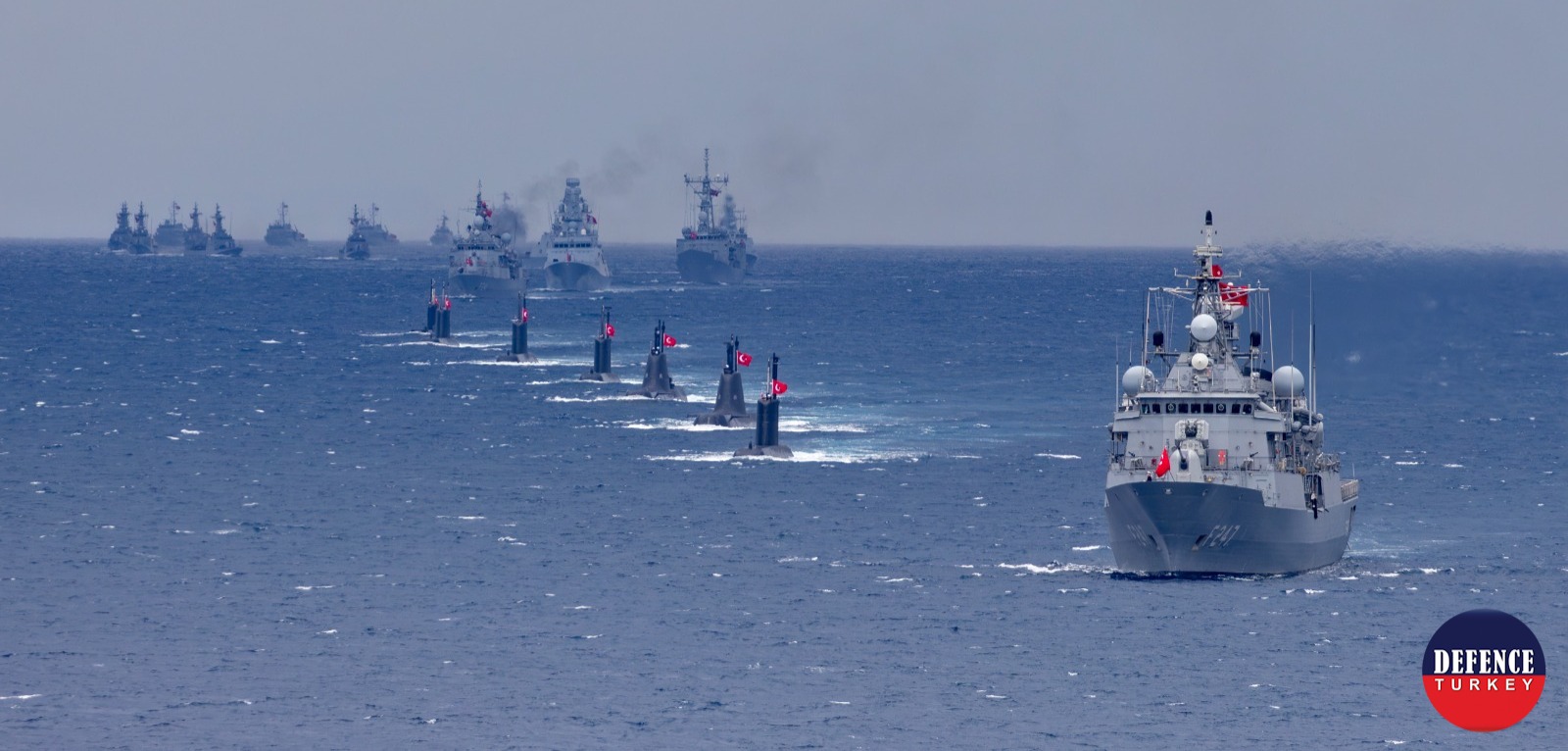
The TNF, with increasing effectiveness and synergy with other services and allies, is presently capable of conducting both Brown and Blue Water Operations. Today, the warships of the TNF wave the Turkish flag with great pride on the world seas from the Sea of Japan to the Baltic Sea, from the Persian Gulf to the Somali Basin, from Gibraltar to Panama, and from the North Atlantic to the Indian Ocean.
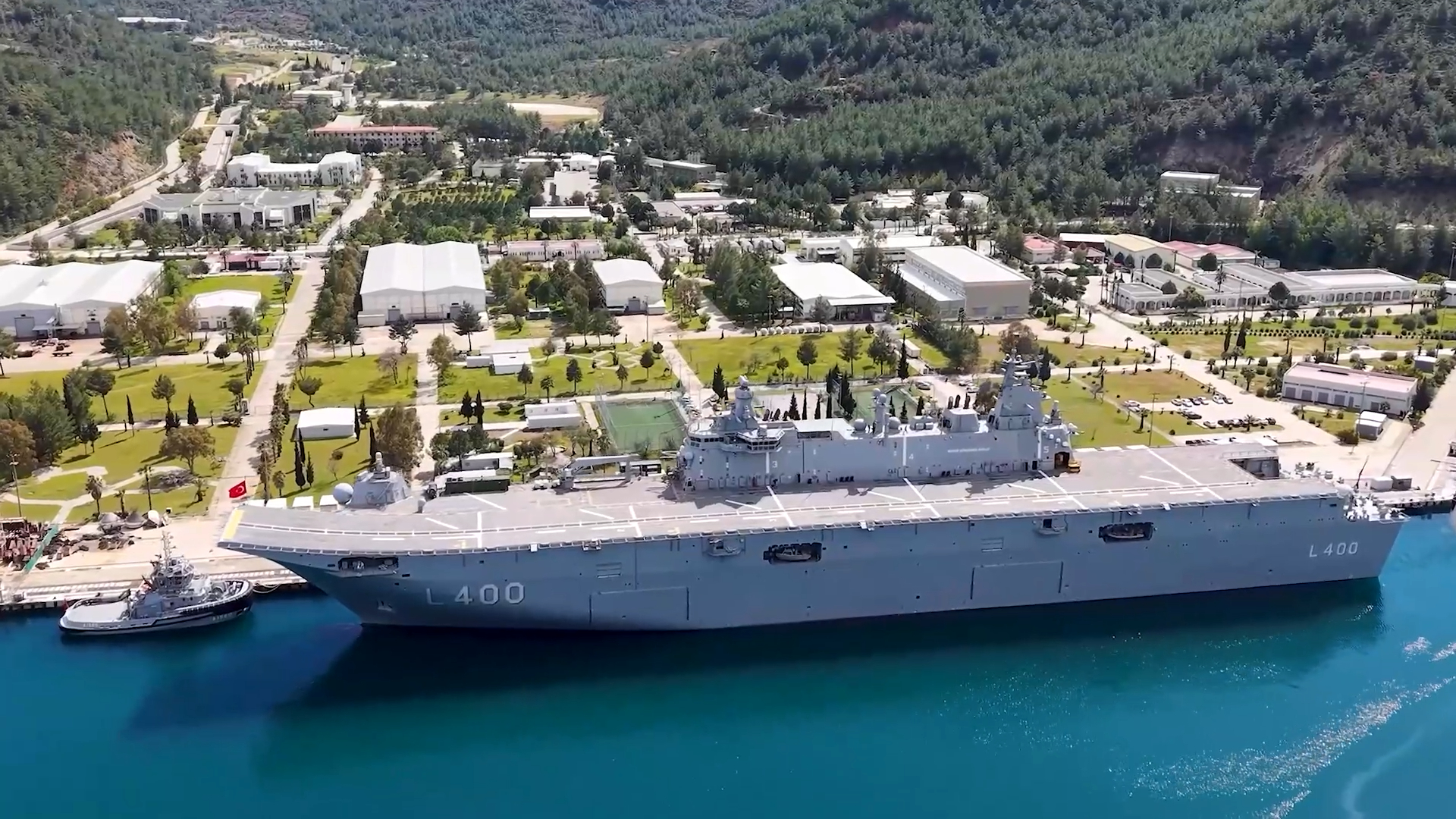
The TNF main surface fleet currently consists of 8 GABYA Class (ex FFG-7 OHP Class), 4 MEKO 200 Track I (YAVUZ Class) and 4 Track IIA and Track IIB (BARBAROS Class) Frigates along with 6 BURAK Class (ex A69 Aviso Class Corvettes) and 4 ADA Class Corvettes and 19 Fast Patrol Boats (4 DOĞAN Class, 4 RÜZGAR Class, 2 YILDIZ Class, 3 KILIÇ-I and 6 KILIÇ-II Class). As of March 24, 2021, the TNF’s submarine fleet consists of 4 AY Class, 4 PREVEZE Class and 4 GÜR Class Submarines. The deliveries of Type 214TN REİS Class Submarines will be completed during 2022-2027. Contracts have already been signed for the Test and Training Vessel (TVEG), İSTANBUL/İSTİF Class Frigates and TCG Anadolu (L-400) Multipurpose Amphibious Assault Ship (LHD), and construction efforts have been launched. Meanwhile the contract for the TF-2000 Air Defence Warfare (ADW) Destroyer Program is expected to be awarded by the mid-2020s.
The current efforts to renew the fleet with 4 new ISTIF Class frigates (the first TCG Istanbul [F-515] class is planned to enter TNF service on September 6, 2023), a test and training ship TCG Ufuk ([A-591] to be commissioned in 2021 and as the first intelligence [ELINT/SIGINT] ship of Turkey, she will act as “Turkey’s Eyes and Ears” in the Seas), 6 new generation AIP submarines (first of them TCG PiriReis [S-330] will be inducted into TNF service in 2022), Mid-Life Upgrade (MLU) of existing PREVEZE Class (Type 209/1400) Diesel-Electric Submarines and BARBAROS Class frigates, a 27,000 tons Multi-Purpose Amphibious Assault Ship (LHD) TCG Anadolu on which helicopters and UAVs/UCAVs will be deployed (scheduled to be commissioned in late 2022), a 22,000 ton Replenishment At Sea & Combat Support Ship (DIMDEG) TCG Derya (to be commissioned in 2024), 2 Logistic Support Vessels (expected to be inducted into TNF service in 2021 and 2022) and 2 (+2 optional) new Replenishment Tankers, indicates that Turkey wants to be even stronger in the high seas when far from the homeland.
Supporting of counter piracy operations on the coasts of Somalia and the Gulf of Aden, under the framework of the United Nations Security Council (UNSC) and the Grand National Assembly of Turkey (TBMM) since 2009 and touring the African continent with a BARBAROS Turkish Naval Task Group, these activities in 2014 were in essence the first sign that the Turkish Naval Forces (TNF) demonstrated that they wanted to be in the oceans, which was the primary motivation for the on-going new ships, submarines and missile projects that were launched to build future naval forces.
Turkish Naval Task Group
The “Turkish Naval Task Group (TDGG)” concept started in 2010 as a result of the “Open Sea” policy of the TNF. The Turkish Naval Task Group performed its first activation from May 10 - July 5, 2010, and this was one of the concrete indicators of transformation in the Turkish Naval Forces Strategy.
The Turkish Naval Task Group, which comes into view as a first initiative in history of TNF has been established as a high seas task group formed to operate in geographies far from homeland. The Turkish Maritime Task Group not only demonstrates the transformation in the TNF but also its determination to continue this transformation. From this point of view, it can be described as the implementation of the strategy focusing on the high seas. In the 2030s, when new platforms such as ISTIF Class Frigates, TCG Anadolu and her sister ship TCG Trakya LHDs, TCG Derya DIMDEG, TF-2000 Air Defence Destroyers and MILDEN Submarines are included in the inventory, the TNF is expected to establish an Open Sea Task Force.
The Turkish Naval Task Group, which does not have a permanent headquarters and force structure, performed its following activation in 2011, 2014, and in 2019/20. The TDGG operates in different regions during each activation period. In this context, it operated in the Mediterranean in 2010 (performed port visits in 9 countries), in the Red Sea, the Gulf of Aden, the Somalia Basin, the Arabian Sea and the Indian Ocean in 2011 (performed port visits in 8 countries), and the group travelled around the African continent in 2014. BARBAROS Turkish Naval Task Group, that deployed to the African Continent during March 17 and June 27, 2014 comprised of 2 frigates (TCG OruçReis and TCG Gediz), 1 corvette (TCG Heybeliada) and 1 fleet replenishment ship (TCG Yarbay Kudret GUNGOR). During this mission the BARBAROS Turkish Naval Task Group performed 25 port visits to a total of 24 countries (19 of these countries were visited for the first time by Turkish Naval units) on the African continent.
Starting from December 26, 2019 the Turkish Naval Task Group was tasked to provide ancillary support to Turkey’s ‘Operation Mediterranean Shield’ and ‘NATO’s Operation Sea Guardian’ as well as to demonstrate a presence & wave the flag in the Central Mediterranean Sea. Within the scope of this mission the Turkish Naval Task Group was activated four times during December 26, 2019 and October 1, 2020 under the command of the Southern Task Group Commander (December 26, 2019 – March 7, 2020), the Northern Task Group Commander (March 7, 2020 – July 16, 2020), the Western Task Group Commander (July 16, 2020 – August 25, 2020), and the Commodore of the 2nd Corvette Flotilla (August 25, 2020 – October 1, 2020) respectively. Since October 1, 2020 the mission was carried out by 2 frigates under the command of the Commodore of the 5th Destroyer Flotilla.
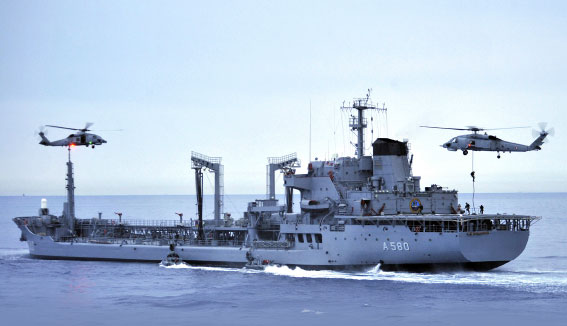
The Fleet Replenishment Ships of TCG Akar (A-580) and TCG Yarbay Kudret GUNGOR (A-595) that belong to the Turkish Logistic Support Ship Division based in Golcuk, Kocaeli supported the Turkish Naval Task Group during activation. However, due to their low constant cruising speeds (at 13kts) they could not keep pace with the frigates they escort, and this caused the Turkish Naval Task Group to navigate at a slower speed. Taking lesson from this experience, the TNF has requested the DIMDEG ship to have a higher cruising speed than the existing replenishment ships in the inventory.
Replenishment at Sea (RAS) & TNF’s Logistic Support Ship Programs
Given the realities of Turkey’s geostrategic situation and the TNF’s recent strategy and priorities, an afloat support capability is essential. Replenishment at sea (RAS, NATO) or underway replenishment (UNREP, US Navy) is a method of transferring fuel, munitions, and stores from one ship to another while holding a steady course and speed, generally between 12 and 16 knots. The ability to replenish warships at sea enables them to be on task for extended periods, which also significantly enhances their operational capability and flexibility. As a significant force multiplier RAS capability extends the range and sustainment of both surface combatants and amphibious vessels with embarked land forces.
RAS Ships provide greater reach and endurance and allow self-reliant and sustained operations to be conducted away from an onshore support base. This afloat support capability, which enables warships to provide an on-going presence and an immediate response to a developing situation, is vital for the TNF and Turkish Naval Task Group. Without an afloat support ship to replenish fuel and other essential consumable stores the TNF’s surface units are restricted to operating at distances no greater than their half-range from support. To achieve extended periods at sea, surface combatants/units must either have access to closer shore support or be accompanied by a replenishment ship. As demonstrated by the Turkish Naval Task Group, with suitable replenishment ships and the ability to resupply at sea, surface combatants/units can remain on station for weeks at a time. As a general indication, a surface combatant supported by a replenishment ship is limited only by crew rest considerations. In addition to their primary role of supporting maritime task groups in both open water and littoral operations, replenishment ships are also critical joint logistic assets. RAS Ships are not, however, just tankers. They are a ‘one-stop logistic shop’ and must carry several different cargoes concurrently to provide the full range of afloat support to surface combatants and task groups to increase both their range and sustainability. This not only includes diesel fuel, aviation fuel, oil, and lubricants, but also dries stores including food, refrigerated and frozen stores, general stores and spare parts, water, and ammunition.
Although the acquisition of new surface combatants and amphibious ships is important, being able to support them as part of the TNF’s capability to deploy locally, regionally, and worldwide, is also of crucial importance. In this context, along with surface combatants, the TNF also launched projects to renew its logistics assets. The TNF intends to expand its logistics fleet by 2025 with the induction of a locally constructed 22,000-ton Replenishment at Sea & Combat Support Ship (DIMDEG) TCG Derya, 2 medium-sized Logistic Support Ships and 2 (+2 optional) new Replenishment Tankers. These new logistic support ships will assist the existing fleet of TCG Akar (A-580, entered service in September 1987) and TCG Yarbay Kudret Gungor (A-595, entered service in October 1995, the first ship ever built for the Turkish Navy by a private Turkish shipyard) Fleet Replenishment Ships and TCG Albay Hakki BURAK (A-571) and TCG Yuzbasi I. TOLUNAY Liquid Fuel Tankers.
TCG Derya Replenishment at Sea & Combat Support Ship (DIMDEG)
The DIMDEG Project has was launched meet the Turkish Naval Forces Command (TNFC)’s new generation Fleet Replenishment Ship requirement, to ensure fuel and water transport and supply needs are satisfied for surface units in the open seas around the world.
The project comprises two phases: Contractual Design and Detailed Design & Construction. The ship’s initial design was carried out by the TNFC Design Project Office (DPO) located at the Istanbul Naval Shipyard, while some activities/tests required for the design phase were performed by STM under a contract awarded by the Presidency of Defence Industries (SSB) on October 1, 2012. For the Detailed Design & Construction Phase a tender was launched in May 2016 to select the main contractor and in May of 2016 the SSB received proposals from two Istanbul-based private shipyards, Sedef Shipyard and Sefine Shipyard. During the Defence Industry Executive Committee’s January 31, 2018 meeting (DIEC, Turkey’s top decision-making body on defence industrial procurement) Sefine Shipyard was selected under the DIMDEG Project and the SSB was given the green light to start contractual negotiations with the company. The DIMDEG Detailed Design & Construction Phase contract was signed between the SSB and Sefine Shipyard on June 28, 2018. According to the contract schedule, the TCG Derya Replenishment at Sea (RAS) & Combat Support Ship would be delivered to the TNF in the 58th month following the contract effective date.
On 25 January 2019 Sefine Shipyard signed a contract with Aselsan-Havelsan Business Partnership for the procurement and integration of combat systems (including Havelsan’s ADVENT Combat Management System [CMS], Ship Data Distribution System, Ship Information System and Message Operating System as well as Aselsan’s MAR-D Surveillance Radar, 25mm STOP Stabilized Naval Gun System, IFF System, Integrated Communication System, KIRLANGIÇ EO/IR Reconnaissance & Surveillance System, SatCom System, and 2x GÖKDENİZ CIWS) for the DIMDEG.
The TCG Derya RAS & Combat Support Ship will be a multi-purpose replenishment ship (AOR), which effectively combines the functions of a fleet oiler and stores ship. The platform will be used for replenishment at sea of fuel, water, food, spare parts, medical supplies, and ammunition for the platforms of the TNF. TCG Derya DIMDEG will have an overall length of 194.8 meters, a height of 7.2 meters, displacement of 22,000 tons and a beam of 24.4 meters. To be powered by two gas turbines (LM2500, in June 2020 GE Marine received a contract from Sefine Shipyard to provide two LM2500 marine gas turbines for DIMDEG) and two diesel engines, the TCG Derya RAS & Combat Support Ship will have a maximum speed of 24 knots, endurance of 30 days (minimum) and a maximum range of 4,500nm. The ship will also have a large helipad that will allow for take-off and landing in day & night conditions and can refuel helicopters. Thanks to its dual enclosed hangar facilities, two multi-purpose helicopters up to 15 tons can be embarked on the ship. To be able to serve as a command-and-control ship, TCG Derya DIMDEG will feature two separate CICs. The first one is for combat management purposes, the second one with numerous OPDESKs (they are commercial products rather than military standard OPCONs) can serve as a Joint Operations Command Center or in case of a natural disaster as a Natural Disaster Management Center.
According to a SSB statement, issued on July 13, 2018 many Turkish companies, including Aselsan, Havelsan and Turkish Loyd will take part in the DIMDEG Project and the ship will be integrated with ADVENT Combat Management System. “The Industrial Participation and Offset (IP/O) commitment in the DIMDEG Project will be realized at over 77%” the Presidency said in a statement. The TCG Derya RAS & Combat Support Ship will be inducted into the TNF’s service in 2024.
Logistic Support Ship Project
Covering the acquisition of two oil tankers from a local shipyard the Logistic Support Ship Project commenced in July 2012 to provide logistic support for the TNF’s surface combatants deployed in the TNF’s operational regions including the Marmara Sea, Black Sea, Aegean and the Eastern Mediterranean. The ships will provide combat support in terms of logistic support and will meet the liquid fuel (F-76 and JP-5), fresh water and food requirements of the surface combatants both at sea and ashore. Logistic Support Ships with their on-board capabilities can also support humanitarian aid and peace support operations.
Istanbul-based private shipyard Selah Shipyard was selected in May 2014 and the contact was awarded on November 4, 2014, with an advanced payment by the SSB which took place on November 24, 2014. According to the contract Logistic Support Ships should have been commissioned in 2018. Construction of the first Logistic Support Ship TCG Yuzbasi Gungor DURMUS (A-574), started in 2015 and the ship was launched on October 8, 2016 at Selah Shipyard. The second ship of the project, TCG Ustegmen Arif EKMEKCI (A-575) was launched on July 8, 2017.
In 2019 Selah Shipyard declared concordat due to the economic crisis and thus could not fulfil its commitments under the contract even though an agreement was made between the Turkish Naval Forces Command and Selah Shipyard for the delayed acceptance of the first ship TCG Yuzbasi Gungor DURMUS (A-574, which was stated to be 98% complete) in the Logistics Support Ship Project. During the second half of 2019 the SSB terminated the contract signed with Selah Shipyard under the Logistic Support Ship Project. In his opening speech at the 9th Marine Systems Seminar held at the METU Culture and Congress Center on October 14-15, 2019, Alper KOSE, Head of the SSB Naval Platforms Department, also shared information about the contract termination and said, “the Logistics Support Ship contractor declared concordat because of financial problems. We terminated the contract, but we will continue the project. So, there will be no loss in the project, there is a delay, but we will continue.” The SSB selected Savunma Teknolojileri ve Muhendislik Ticaret A.S. also known as STM for the completion and delivery of the Logistic Support Vessels. According to the current schedule TCG Yuzbasi Gungor DURMUS (A-574) will be delivered in 2021 and TCG Ustegmen Arif EKMEKCI (A-575) will be delivered in 2022.
With a displacement of 8,744 tons at full load, the 105.44 meter long Logistic Support Ships’ maximum speed would be over 12 knots and could reach 9,500nm at full load displacement, sea state 2. Equipped with conventional all diesel-CPP propulsion system, the Logistics Support Ships are powered by two diesel engines each generating 1,520kW. The Logistics Support Ships can complement a crew of 60 (53+12) personnel and are able to perform helicopter operations at Sea State 4 and fuel supply at Sea State 5. Featuring enough provisions for 30 days at sea, the Logistic Support Ships are fitted with Astern Fuelling Systems (AFS), which are capable of transporting fuel to a vessel sailing behind the replenishment vessel and able to carry 8 ISO containers.
The vessels have a capacity to hold 4,036 tons of F-76 diesel fuel, 336 tons of helicopter fuel (F-44/JP-5) and 594 tons of freshwater and at least 108m3 of food/meals. The platform is a mono-hull type vessel, all-steel construction, designed to meet speed, sea keeping manoeuvrability and stability requirements. The expected service life of these vessels is 30 years. The ships will have unlimited operation capability up to sea state 5 and will be operable with some limitations in sea state 6 or higher. The ships have 100% redundancy for critical systems and fully air-conditioned accommodations and provide Full Monitoring and Control of major ship systems from MCR and damage control stations, automatic stability and loading control system. For self-protection, the vessels will be armed with a pair of Aselsan 12.7 mm Remote Controlled Stabilized Machine Gun Systems (STOP). The ships also have a large helicopter deck that allows for take-off and landing and the refuelling of helicopters. The helipad allows day and night helicopter take-off and landing and is designed to support multi-purpose helicopters up to 15 tons. The ship has a hydraulic crane, which has a lifting capacity of 18 tons and an electrical crane, which has a lifting capacity of 2 tons.
Replenishment Tankers for Fast Attack Craft
Under the Replenishment Tankers Procurement Project, on December 9, 2020 the SSB issued a Request for Proposal (RFP) document to local shipyards for the procurement of 2 (+2 optional) new Replenishment Tankers along with spare parts, training service and related documents. According to the RPF document bidders should submit their proposals by March 15, 2021. According to the RFP, the main mission of these ships would be to meet liquid fuel requirements of Fast Attack Craft (FAC) in a safe and rapid manner in a possible naval operation and/or war, while they are in a waiting/hiding place. The Turkish Navy’s Albay Hakkı BURAK Class liquid fuel tankers TCG Albay Hakki BURAK (A-571) and TCG Yuzbasi I. TOLUNAY are currently providing afloat fuel support capability for the FAC in TNF service. Speaking at Defence & Technology Days event organized by ITU SAVTEK on March 24, 2021, Alper KOSE, Head of the SSB Naval Platforms Department disclosed that the SSB will soon launch a tender for the procurement of Replenishment Tankers Procurement Project