It is Expected to Take a Decision in FX Programme at Next Executive Committee Meeting
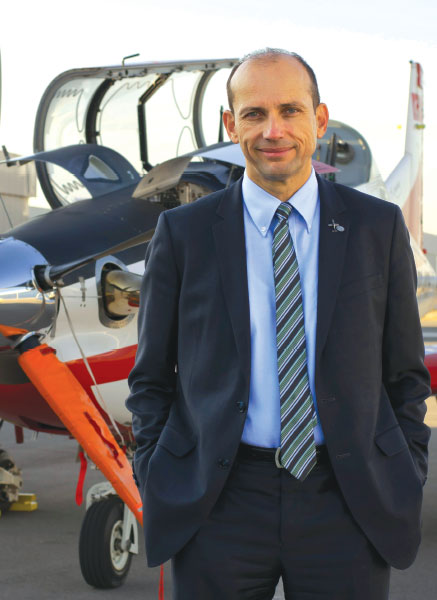
Defence Turkey: Dear Mr. Ertem, first of all I would like to thank you for your time. As TAI Plane Group Head, could you briefly inform us on the studies conducted within your department?
TAI Plane Group is in charge of fixed-wing manned aircrafts that depart our factory by flying. Basic Training Aircraft Hürkuş, F-16s that we are modernizing, C130 transportation planes and T38 training planes constitute some of these aircrafts. Peace Eagle programme, Meltem-2 and Meltem-3 Projects that we execute with our foreign business partners are also within the scope of our Group’s business segment. Our Group also conducts the studies related with our future National Combat Aircraft FX, Jet Training Aircraft TX and Regional Passenger Aircraft Projects.
Defence Turkey: National Combat Aircraft is, without question, one of Turkey’s most prominent programs. What would you like to express about the recent developments on this program named FX and the content of its conceptual design?
We introduced the FX Project in IDEF 2013 for the first time to public opinion within the limits allowed and have accomplished the two-year long conceptual design studies as of the end of last September. At this stage, Air Forces Command presented its operational needs for the next 20 years later in documents and TAI delivered a conceptual design of the aircraft accordingly. With this study we designed, calculated and drew three different types of aircrafts that would meet the future requirements determined. Besides we made a schedule and quotation for the development period and submitted the reports of these studies to the Undersecretariat for Defence Industries (SSM) and Air Forces Command (HvKK) by the end of September 2013. At the end of the ongoing evaluation period, Defence Industry Executive Committee (SSİK) will make a decision regarding the development phase.
Defence Turkey: You have just mentioned about three models; could you please elaborate these models?
The engineering team we formed assessed that Air Forces’ requirements could be met by three different models. These models have comparative advantages. Speaking of their main features, one of them is twin-engine where other two are single-engine aircraft. We have shared the sketches at IDEF 2013. One of the single-engine aircraft has conventional tail configuration while the other has canards. We shall see which will be selected during next phase.
Defence Turkey: Do you think a decision regarding this program will be made at the next SSİK meeting?
Actually our expectation is in this regard. The Project arrived at this stage gaining a great impetus. Therefore, if a decision for the continuation of this issue is made at the nearest SSİK meeting, we would be able to move onto the next stage without any interruptions.
Defence Turkey: What will be the process if an affirmative decision is made at the SSİK meeting?
This is a long-term program. FX is an aircraft that is planned to enter into the Air Forces Command’s (HvKK) inventory in 2030s. Its maiden flight is intended to take place in 2023, though the finalization of its armament and getting ready for its tasks will probably be in 2030s. Therefore, as the process is too long, deciding upon its budget and schedule within a single meeting might be difficult. So a decision that encompasses a four or five year period may be made through a progressive approach.
Defence Turkey: Are there any decisions made regarding the engine to be selected within the scope of the FX program? What could you say in this respect?
Two studies related to the engine are ongoing. In the first study, using existing engines or the future by-products of these engines is being taken into consideration. Production of this engine in our country is aimed. In parallel with this study, we are trying to see if we could design a Turkish engine and integrate it to the aircraft in the future. We shall see the results in time.
Defence Turkey: How is the Turkish Jet Training Aircraft TX program that is simultaneously conducted with the FX program proceeding?
The Training Aircraft that would train pilots for F-35 and National Combat Aircraft is defined in the TX Program. TAI engineers made a conceptual study and are getting ready to finalize and submit their reports.
Defence Turkey: What kind of a model do you intend to present with TX Program? At first, it was supposed to be delivered simultaneously with FX but the process lingered as you previously mentioned, which model is considered?
FX’s operational needs have been prioritized by our Air Forces. Therefore, defining these needs and following the TX program that will train pilots for this program was planned at first. This caused a phase shift. Our government will decide upon the model to be selected. I do not know whether they select a brand new design or purchase a ready platform and modify it according to Turkey’s conditions (engine, avionics, etc.) and put it into service.
Defence Turkey: When will the study regarding the TX be submitted?
The study is planned to be submitted within the first half of 2014.
Defence Turkey: Hürkuş successfully achieved its maiden flight at the end of last August. Could you inform us on the coming flights and test activities of Hürkuş?
Hürkuş accomplished its fifteenth flight on 19 November 2013. We shall continue our tests as long as the climate conditions allow us. I presume the tests for certification will be made within the following 1,5-2 year- period. We aim to complete our activities regarding Hürkuş-A model by the mid or end of 2015 and obtain the certificates both from Turkish General Directorate of Civil Aviation and European Aviation Safety Agency (EASA).
Defence Turkey: Decision for launching the contract negotiations with TAI for the mass production of Hürkuş-B was taken given at the last SSİK meeting. What would you like to say about production and delivery procedures with the signing of the contract?
We are proud of both our SSM’s and HvKK’s confidence and trust in Hürkuş and SSİK’s decree based on this trust. Following the signature of the contract, we shall be putting our orders to our foreign assistant companies. Hürkuş-B shall have the similar appearance with the A model. Only military type avionic systems will be used in the cockpit.
Defence Turkey: What novelties will Hürkuş-B military model have in terms of cockpit and avionics compared with the Hürkuş-A civilian version?
Hürkuş-A model has been designed for the civilian world and therefore it did not bear any military features as it would be certified accordingly. For instance, Hürkuş-A model does not feature the Head-Up Display which is considered as a standard in military aircrafts. Therefore this display will be our priority in Hürkuş-B. Besides each pilot shall have three big monitors in front of them. A single computer shall direct the whole system and all flight indicators, maps could be seen from these monitors. Even the shooting practice trainings could be done from these.
Defence Turkey: So you are preparing the infrastructure for Hürkuş-C in a sense?
Yes, indeed. The avionic solutions for Hürkuş-C model shall be formed in this way. Hürkuş-C will be our third type with reinforcing the wings with hangers and embedding the proper weapons. We will start such studies immediately within the scope of Hürkuş-B contract.
Defence Turkey: Though it may be too soon to say but do you think a program schedule for Hürkuş-C could be formed?
The primary issue will be the operation concept in Hürkuş-C. “Which tasks are to be done, which weapons should be carried, to what distance they should be carried, how should they be fired” will be the points to be studied. Our engineers will produce solutions for these requirements using the technical capabilities of the aircraft. We assess that this stage is more critical than the mass production and the expectations could be defined through a small budgeted project before the mass production starts.
Defence Turkey: One of TAI’s most important programs conducted with the Ministry of Transportation, Maritime Affairs and Communications is the Regional Passenger Aircraft program. What kind of a model did Turkey form within the scope of the Regional Passenger Aircraft program? What are your comments?
A General Directorate for Aviation and Space Technologies has been established within the Ministry of Transportation, Maritime Affairs and Communications (UDHB) and this Directorate assumed the coordination of the Regional Passenger Aircraft Project. We are supporting the studies together with State Airports Administration and THY Teknik A.Ş. General Directorate of Civil Aviation (SHGM) will certify this new aircraft. Within the scope of this project, issues such as obtaining the sales rights of this new aircraft and its release to the market after being updated are being worked upon. A brand new design could be prepared in 10-15 years’ period and market expectation is generally formed in 5-6 years. Under these circumstances, selecting an existing aircraft and furnishing it with engines consuming less fuel and more modern systems, getting certifications and releasing it to the market seem to be the only sound solution.
Defence Turkey: Which countries and companies are being negotiated within the scope of this Project?
All the airplanes in the world with 120 or less seat capacities have been examined under the coordination of Ministry of Transportation, Maritime Affairs and Communications. Existing platforms of various countries are being evaluated and the main approach is to establish the production line in Turkey, modernizing the plane and acquiring the sales rights.
Defence Turkey: What will be TAI’s role in this program?
Regional Passenger Aircraft Project was presented by our former Minister Binali Yıldırım to the Ministerial Cabinet and forming the main production line at TAI facilities was decided upon. TAI is expected to increase the number of sub-contractors which is currently nearly 100 and expand the production nationwide. But the civilian airlines market has its unique dynamics. Therefore a management company that would make agreements with airlines and rental companies, direct the financing of the project and provide lifetime support after the delivery of the aircrafts is required while TAI realizes the production.
Defence Turkey: Will Turkey has a Regional Passenger Aircraft before 2023?
Within the framework of the existing studies, renewal of the prototype aircrafts, altering their engines and systems and getting them certified are accomplished in 5-6 years’ time. Production line shall be formed in parallel with these engineering activities and the first aircraft will be ready within the same amount of time. The Regional Airplane Enterprises such as Lufthansa Regional, KLM Cityhopper, Delta Connection, United Express have to be ready to operate and complete their preparations for passenger transportation in this period.
Defence Turkey: Meltem-3 is one of Turkey’s most important programs. What is your opinion on the studies conducted for this program?
Meltem-3 program has a similar model with Peace Eagle. According to the agreement made by the Italian Alenia company with SSM, six ATR-72 Maritime Patrol Aircraft’s will be renewed at TAI’s facilities. First of these aircrafts arrived at our facilities and we launched the renewal process. Program is being executed in line with the foreseen schedule.
Defence Turkey: Within the scope of Turkish Air Force requirements you have assumed the avionic modernization and certification of C-130E/B military aircrafts as TAI. What would you like to tell about the studies conducted within the scope of the Program? Also could you inform us on the delivery schedule of the prototypes?
The contract we signed contained the renewal of one C-130E and one C-130B prototype in addition to our engineering activities. Our engineers developed the software that conducts all the systems. The aircrafts completed their acceptance flights and arrived to Kayseri in 2013. We are currently launching the mass modernization program.
Defence Turkey: What would you like to say about the latest status of the ongoing F-16 Mass Assembly Modernization program within the scope of Turkish Air Force needs?
This project contained 165 F-16s. The intensive period is over. Modernization will be accomplished in 2014 when the kits are provided by SSM.
Defence Turkey: What are your comments on Pakistan Air Forces’ F-16 Block 15 combat aircrafts’ modernization studies conducted in TAI and the delivery procedure of these aircrafts?
Pakistan F-16 Modernization is a project we won under international competition circumstances. Therefore, this project bears great importance for us. We are modernizing 41 aircrafts of our friend and ally country Pakistan.
Defence Turkey: Dear Mr. Ertem, we would like to express our gratitude for this interview. Are there any messages that you would like to convey to our readers?
An intensive period is awaiting us. We are fully aware of the obligations stemming from these projects which were given to our company with confidence. We have to work more now. Our sub-industry will have to function in our pace and we have to expand the stabilized growth rate we gained in these last eight years to all our aviation industry. We do not consider the products such as “Atak” “Hürkuş”, “Anka” merely as TAI’s products. They should be considered as our country’s products and power. This fills us with pride. We would like to express our gratitude firstly to SSİK, and to the Ministry of National Defence, Undersecretariat for Defence Industries and Turkish Armed Forces and to the Ministry of Transportation, Maritime Affairs and Communications we cooperated in Regional Passenger Aircraft for their trust.