Italy’s SAMP/T Reaches Initial Operational Capability (IOC)
Italian Army’s 4th Air Defence ‘Peschiera’ regiment has reached the initial operational capability (IOC) on the SAMP/T air defence missile system, with the activation of the first two air defence-capable batteries this December. The first live firings by Italian army’s personnel will be conducted next March (2013) in France, against both air breathing and ballistic missiles representative threats. Full Operationally Capability (FOC) will be reached in late 2013, with the activation of all five operational SAMP/T batteries ordered by Italian Army and equipped with Link 16 capability.
Stationed near Mantua, in Northern Italy, Italian Army’s air defence ‘Peschiera’ regiment is structured and being equipped to manage and support all SAMP/T operational batteries. "As already conducted with improved Hawk air defence batteries, our main duty is providing protection of land forces, but we also contribute to national air defence integrated network, including protection of important events, such as Turin Winter Olympic Games and support NATO forces, providing assets for both NATO Rapid Deployable Corps – Italy and UK", says Colonel Carlo Zontilli, ‘Peschiera’ regiment commander. An additional battery in a reduced configuration is kept for training duties in Sabaudia (near Latina), home of Italian army air defence command.
Developed by Eurosam, a consortium formed by MBDA and Thales, "SAMP/T missile system has been conceived to provide omni-directional, low-to-medium altitude coverage, multiple and simultaneous engagement against a range of demanding threats, characterized by low radar-cross section, fast speed and manoeuvring capabilities, including manned and unmanned air-platforms, air breathing weapon systems and nosedive targets (i.e. ballistic missiles). This is provided with other air defence assets interoperability, tactical and strategic mobility, limited manning and reduced operational and logistics support footprint", Col Zontilli explains.
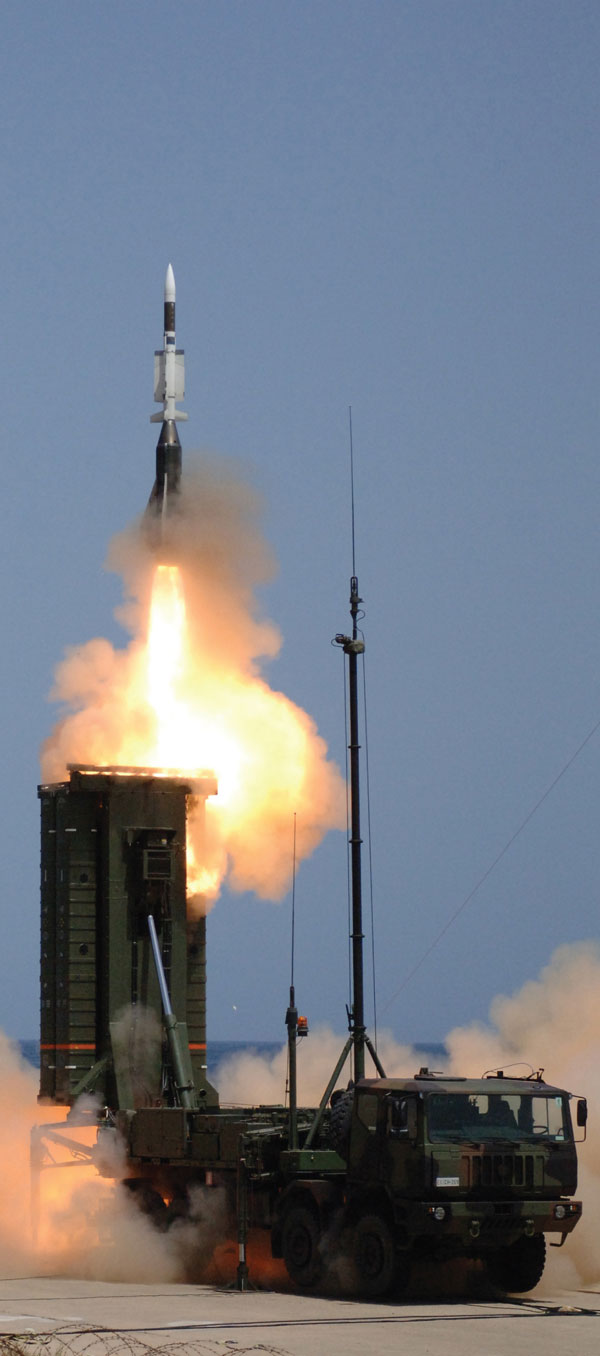
Each of the five batteries (also called fire units), of which the third is under advanced training while the remaining two will be delivered and become operational within next year, is composed of an engagement and fire control section including the Thales Arabel multifunction radar (MRI,) with its power-generation module (MGE), the engagement control module (ME), a battery command module (MC) and the launch section. The later is structured on four launch vehicles (MLT) with 8 ready-to-fire missiles each (the system is capable to manage up to six launchers) and up to two missile-reloading vehicles (MRT). Manned by a 16 operators baseline personnel component, all battery platforms are based on Iveco Astra high-mobility vehicles. "Italian Army SAMP/T batteries differ from the French air force’s counterparts for the addition of the command module (CM). The later provides a range of functions, including mission planning, such as the batteries distribution in the area of operation to provide the best air defence coverage, higher-echelon commands and platform interoperability, real-time diagnostics, maintenance and logistic support. It significantly reduces the workload of the engagement control module operators in high-threats scenarios, leaving them to focus on the acquisition, tracking, identification and firing procedures", reports Col Zontilli. Moreover, each battery is backed by a direct support unit, including 5 vehicles with containerized electronic and mechanic laboratories and spare parts.
According to Italian army presentation, Thales Arabel X-band 360 degrees complete rotating per second- radar with latest generation IFF module and counter-jamming capabilities, offers a 150km cued (60km in autonomous mode)-surveillance coverage, and the simultaneous engagement of 10 targets with 16 missiles in flight thanks to uplink radar module. "The latter doesn’t offer warning of lock-on-target until the missile activates its RF-based active seeker for terminal flight-phase", reports Col Zontilli, stressing the weapon system 50G+ manoeuvring and well over 100km range together with the 10 seconds required to fire all 8 missiles carried by each launch vehicle.
The SAMP/T battery is required to be ready-to-fire (RTF) after reaching the site of deployment in only 25 minutes, while ready-to-move (RTM) procedures requires 15 minutes. As part of the training activities Italian Army is conducting to reach the IOC, a regiment battery was deployed in nearby Mantua exercise site during the media visit, being able to be ready-to-fire in 21 minutes. The launch vehicles of the battery can be deployed and RF-linked with the engagement, radar and command modules cluster up to a distance of 10 km, while the later modules can be stationed in a 300m diameter range. "The SAMP/T represents a huge improvement compared to Improved Hawk system, providing better RTF and RTM and fire capability parameters together with 360 degree coverage (versus a 90 degree engagement sector) and reduced maintenance and direct support compared to Patriot PAC-2, the later however also offering TBM capabilities", said Col Zontilli.
Based on Italian Army conducted analysis on SAMP/T out-of area operations, a battery with 6 (instead of 4) launchers section could be deployed with C-130Js flights and be manned and supported to provide continuous operations by an around 80 personnel regiment detachment.
Italian Army is currently working with the Italian air force to plan tests scheduled for 2013, which will lead to full integration of the SAMP/T into the overall Italian air defence system, after reaching the IOC and the disposal of the improved Hawk remaining two batteries. Italian Air Force currently does not operate a medium-to long-range ground-based air defence system after the retirement of the Nike Hercules (MIM-14) system, which was to be replaced with the Medium Extended Air Defence System (MEADS), although its future is today threatened by U.S. Government expected pull-out of the program.
"To reach the IOC in the air defence mission, we already conducted initial tests with the Link 16 and we will soon evaluate the IFF set in the latest Mode 5 and S. Based on a technical agreement between the Italian and French MoD, we are sharing the test and evaluation campaign the two services are carrying-out on the SAMP/T system. In March 2013, we are to conduct a joint firing with French counterpart at Biscarosse test range. Although we haven’t decided yet if we will deploy our assets or only the personnel, according to latest plans, we will fire against both a conventional as well as a ballistic representative threat targets. The first live test will complete the IOC activities for air defence duties, while the later will be a joint firing which will validate the SAMP/T capabilities against the short-range ballistic missile (SRBM) threat, with information provided by an external early warning sensor to cue Arabel organic radar", reported Col Zontilli.
In June 2011, Italian and French MoDs formed a multi-disciplinary working group including representatives from government and industry, with the aim of suggesting areas where the SAMP/T, the naval version PAAMS and MEADS programs, could evolve and/or be combined to support joint decision-making in the field of anti-ballistic missile defence.