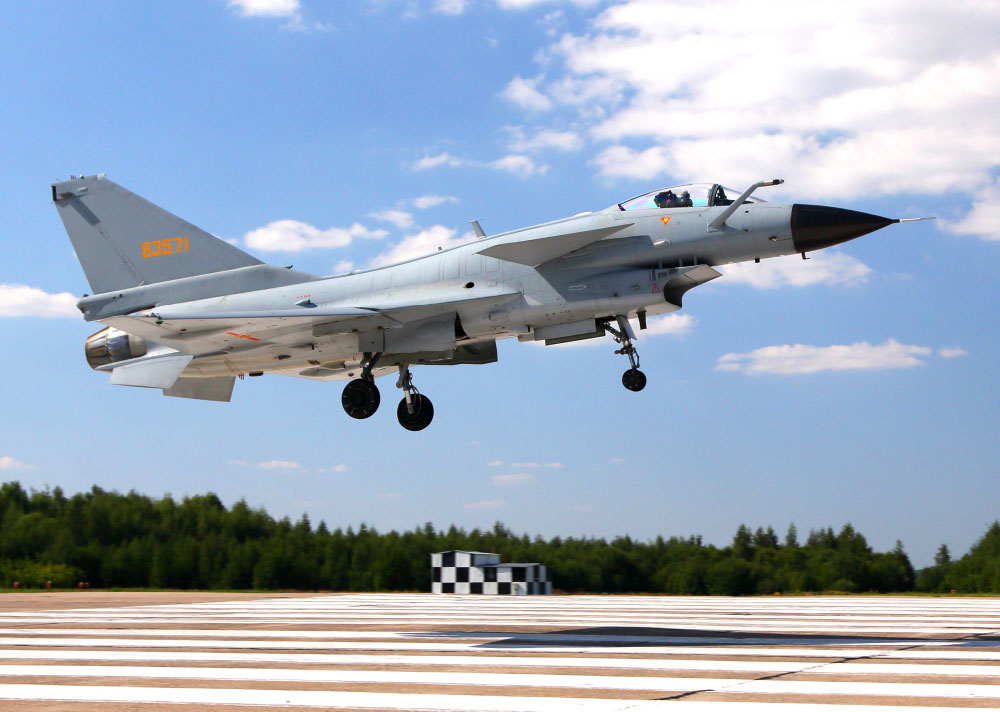
J-10 Meng Long Vigorous Dragon
The birth of the J-10 Meng Long (Vigorous Dragon) began with the need for a successor to the J-7 (Chinese license-built version of the Soviet Mikoyan-Gurevich MiG-21). Thus, one of China's most ambitious defense projects began, and the offer of Chengdu Aircraft Corporation (CAC) was accepted in 1984. In 1986, the final requirements for the aircraft were finalized, and long-term development activities began. When the project started, the J-10 was intended to be a fighter-interceptor aircraft.
During the design phase, it was decided to preserve the single-engine airframe with delta wings and canard layout, as in the J-9, an older project of Chengdu. The J-9 had two Mirage-style semicircular lateral air intakes on the fuselage sides featuring variable inlet geometry. The air intake design changed and was replaced with a single chin air intake under the fuselage. There are claims that China received aid from Israel while shaping the outlook of the fighter. In the early '80s, Israel started to develop its own fourth-generation fighter. Based on F-16 technology, IAI Lavi made its first flight in 1986. However, the project remained in the prototype stage and was later canceled. For political reasons, both countries denied cooperation between them. Although the overall geometry was similar, there were significant differences between the planes. The J-10 was larger and had a different wing plan form. Canards were set higher and further positioned on the fuselage. While the Lavi had a fixed-area air intake with a quasi-elliptical cross-section similar to the F-16, the J-10 featured a two-dimensional variable air intake. On the J-10, a rectangular air intake ramp and a splitter plate are located underneath the fuselage, which was designed to reduce incoming air to subsonic speeds before reaching the compressor and turbine blades of the jet engine. Also, the two aircraft were developed to meet different requirements. The Lavi was optimized for strike missions primarily, with air superiority as a secondary role. With the J-10, it is vice versa.
Like most fourth-generation fighters, it was designed to be aerodynamically unstable. Thanks to the digital FBW (Fly-By-Wire) control system and flight computer, the pilot can operate the aircraft without difficulty. The cockpit design is more similar to its modern western rivals than Eastern bloc aircraft. The J-10 incorporates the Hands-on Throttle-and-Stick (HOTAS) system, and the cockpit has a wide-angle Head-up Display (HUD) along with three liquid crystal (LCD) Multi-function displays (MFD). The bubble canopy provides 360 degrees of visual coverage for the pilot.
When the project was started, China's relations with the West were developing rapidly. CAC hoped to use western avionics and engines in the new aircraft. The 1989 Tiananmen Square incident and the subsequent embargo made this impossible. The designers had to look for alternative powerplants and eventually turned to Russia for help. The AL-31F turbofan engine used in the Su-27 Flanker was selected to power the J-10. However, there was an issue with the AL-31F, which generates 7,850 kgf (17,305 lbf) dry, 12,500 kgf (27,560 lbf) with afterburner. The engine was originally designed to be used in twin-engine configuration with the Sukhoi Su-27 air superiority fighter. The AL-31F had a dorsally mounted accessory drive gearbox, which was unsuitable for single-engine aircraft like the J-10. Thus, Lyulka-Saturn developed the AL-31FN version featuring a ventral accessory drive gearbox specifically for the J-10. China wanted to produce the engines locally under license, but Russia refused to sell the manufacturing rights, and the engines were produced in Russia. Later, China started to develop theWS-10 Taihang engine, a derivative of AL-31, to eliminate its dependence on foreign sources.
During the design process, the J-10 jet evolved to a multi-role combat aircraft. In line with this new role, the J-10 features 11 hardpoints to carry air-to-air and air-to-ground munitions. The most important feature that distinguished the J-10 from the previous generation Chinese aircraft was its radar and other avionics. In the late 1980s, China's electronics industry was in its early stages. The cooperation with Israel also included Lavi's avionics. The Elta EL/M-2035 multi-mode pulse-doppler fire-control radar used in Lavi had an advanced coherent transmitter and a stable multi-channel receiver. Israel wanted to use this radar in their F-16s, but the United States did not allow it. With technical support from Israel, China developed the KLJ-3 radar. The radar uses a dual-mode grid-controlled TWT Traveling-Wave Tube) transmitter, which significantly improves the performance of the radar. Other subsystems such as navigation, mission computer, imaging management subsystems, air data computers, and attachment management systems were also developed thanks to this support. These avionics projects laid a solid foundation for the J-10 to reach full operational capability and dramatically improved the R&D capabilities of the Chinese aerospace industry. The actual characteristics of the KLJ-3 radar are not disclosed, but we can deduce information about its performance from the KLJ-7 radar. The KLJ-3 has a larger antenna array and output power. The KLJ-7 radar used in Pakistan Air Force JF-17 aircraft has a range of 130 km. In TWS (track-while-scan) mode, it can simultaneously track 10 targets and guide SD-10A active radar-guided air-to-air missiles at two targets. The radar also features SAR/GMTI (synthetic aperture radar/ground moving target indication) capability against ground targets. This radar was used on the early model J-10A and J-10S aircraft.
The first prototype, '1001', is known to have made its maiden flight in mid-1996. After the first prototype, 8 more prototypes were built. The second prototype, '1002', was lost in a fatal accident in late 1997, while the third prototype, '1003', also crashed. The first official flight announced by China took place on March 23, 1998. After a long development and testing process, it entered the inventory of the People's Liberation Army Air Force (PLAAF) in 2004. The aircraft's modern, and therefore complex, avionics necessitated the development of a tandem-seat training version of the plane. Thus, in 2003, the J-10S (Shuangzuo - Two-seater) was born. It has the same avionics and weapons capabilities as the J-10A. The J-10S entered the PLAAF inventory in 2006. After seven batches produced over a ten-year period, production of the J-10A ended.
In late 2008, CAC revealed a highly upgraded J-10. The new version J-10B replaced the previous variable and complex air intake with a fixed stealthier Diverterless Supersonic Inlet (DSI) air intake. The old air intake was causing problems, so DSI solved both these problems and saved weight. Another important benefit is that it reduced the radar cross-section (RCS) of the aircraft. The radome also had changed. The J-10B has an AESA (Active Electronically Scanned Array) radar. The J-10B featured a redesigned vertical tail and an integrated EW (Electronic Warfare) suite atop the vertical stabilizer. The J-10B was also equipped with a Missile Approach Warning System (MAWS) under the drogue parachute fairing in the tail.
In July 2011, the J-10B prototype '1035' flew with a domestically produced WS-10B engine. The integration of the new AESA radar, IRST (Infrared Search and Track), integrated EW suite, and new software architecture into the aircraft took longer than expected. Although the prototype flew with the WS-10B, PLAAF ordered the AL-31FN Series 3 engines with 10kN more power (137kN) than the previous version with an increased service life