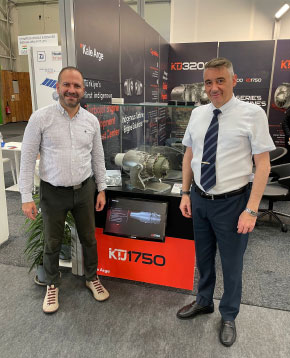
Kale Arge General Manager Cüneyt KENGER: “The KTJ-1750 is an exceptional engine on a global scale in terms of its weight, size, and thrust.”

Defence Turkey: The KTJ-1750 Turbojet engine, specifically designed for the ÇAKIR Cruise Missile and proven successful in its initial firing test last May, along with the KTJ-3200 engine developed with national resources, are making their first appearance at an international exhibition, the Paris Air Show 2023. What level of interest are the engines attracting at the exhibition?
Cüneyt KENGER: We are showcasing our KTJ-3200 and KTJ-1750 engines at this exhibition. As you may know, the KTJ-3200 engine is already in serial production, while the KTJ-1750 engine, though still under development, has already undergone a successful flight, proving its capabilities swiftly. Being well-known in the industry, our engines have garnered significant interest, drawing numerous foreign companies to our booth within the exhibition's first two days. Both engines cater to specific needs in their respective fields and categories. Notably, the KTJ-1750 stands out as an exceptional engine on a global scale, meeting a specialized demand within its class concerning weight, size, and thrust. As a result, we are attracting considerable attention at the exhibition.
Defence Turkey: Can you provide us the recent developments regarding the testing, production, and deliveries of the KTJ-1750 Turbojet engine, selected to propel the ÇAKIR Cruise Missile family developed by ROKETSAN using domestic resources?
Cüneyt KENGER: The KTJ-1750 stands as a remarkable success story, not only for our company but also for the history of Turkish aviation. From its design inception to its first flight, the engine's development took approximately 1.5-2 years, a notably short duration. The engine boasts superior features, with its impressive thrust capability achieved in a remarkably compact size. This characteristic is of utmost importance, as a smaller engine allows for the design of smaller missiles, resulting in reduced aerodynamic drag forces and enhanced agility. The uniqueness of the KTJ-1750 engine lies in its ability to deliver remarkably high thrust despite its small size. This quality becomes especially significant when considering that a larger engine would lead to the need for a bigger missile, resulting in a loss of overall performance. Over the past 1.5-2 years, we have made substantial progress in developing this engine, and while some activities are still ongoing, its successful first flight serves as a testament to its capabilities. Looking ahead, we have planned additional altitude tests, performance evaluations, and specialized qualification tests. Several tests, including water intake, hot operation, and cold operation tests, are part of the demanding qualification process required during jet engine development. We have already completed a majority of these rigorous tests.
The KTJ-1750 engine has made substantial progress in its testing phase, with only a few tests left to be conducted. On the other hand, the KTJ-3200 engine has successfully completed all its testing requirements.
Let me touch upon their production as well. At Kale Arge, once we have developed and prototyped our engines, we proceed with their serial production at Kale Aviation, our affiliated company. For instance, the KTJ-3200 is currently undergoing serial production at Kale Aviation. Once the components are assembled at Kale Arge, we thoroughly test the engines before delivering them to our customers. Following a similar process, the KTJ-1750 will enter serial production once the development phase is fully concluded.
Defence Turkey: Regarding the KTJ-1750, what possibilities and potential do you envision for its position in the global market?
Cüneyt KENGER: When we analyze the missile market, it becomes evident that there is a significant demand, particularly for engines with this level of thrust. We have high expectations of receiving a substantial number of orders from both Türkiye and international customers. As previously stated, there is substantial interest from foreign markets in these engines, leading us to anticipate a remarkably high sales volume.
KENGER: “KTJ-3200 is fully ready for serial production.”
Defence Turkey: During this exhibition, you are also showcasing KTJ-3200 engines, which are designed to power the SOM and ATMACA missiles. The development phase has been successfully concluded, and you have already commenced the serial production process. The next 1-2 years will see a significant increase in the serial production of KTJ-3200 engines. What are the plans for the serial production phase of the KTJ-3200? Are there any upcoming investments or capacity expansions scheduled for your production facilities and infrastructure?
Cüneyt KENGER: During the development phase of our engines, Kale Arge's production capacity is quite sufficient. When it comes to serial production, all components are mass-produced at our sister company, Kale Aviation, which possesses a significantly higher capacity. Since Kale Aviation already has the necessary capacity, there is no immediate need for expansion. Additionally, there won't be a significant requirement for additional investments.
Serial production of the KTJ-3200 has commenced, and concurrently, the qualification of the production line is nearing completion. As I mentioned earlier, this process falls under the expertise of Kale Aviation, which already manufactures parts for renowned aviation companies worldwide. Consequently, the production line qualification did not pose significant challenges. Nevertheless, it remains an intensive undertaking. Each part undergoes a First Article Inspection (FAI) individually, and these inspections have been successfully concluded. As a result, the KTJ-3200 is now fully prepared for serial production.
Defence Turkey: Another turbojet engine project initiated by Kale Arge with its own resources is the KTJ-3700. Recently, you released a promotional movie, unveiling the technical specifications of the product to the public for the very first time. Can you provide an update on the stages and testing procedures that have been accomplished thus far in the KTJ-3700 TJ Engine Development Project? Additionally, can you elaborate on the improvements being implemented in the Altitude Test System, the sole facility of its kind in Türkiye, located in a 2,000 square meter indoor area at the Kale Arge Tuzla Development and Test Center campus, specifically designed for testing higher thrust engines like the KTJ-3700 and ARAT?
Cüneyt KENGER: The KTJ-3700 is a higher thrust engine compared to the KTJ-3200, capable of delivering 3,700 Newtons of thrust. As a result, there are certain variations in the requirements between these two engines. KTJ-3200’s engine start-up and also flight envelope are different from the requirements of KTJ-3700 Turbojet Engine, Therefore, it is not sufficient to solely focus on engine development. Likewise, Utilizing the ARAT Project engine start-up & engine operating time are entirely different from the KTJ-3200 engine. We had to improve our test chambers to fulfil these conditions. We needed to ensure its capability to perform under various conditions. These enhancements are currently in progress and are expected to be completed within approximately six months. Thereafter, we are going to run our engine that required flight envelope and velocity.
Defence Turkey: As of today, Kale Arge has achieved complete self-reliance in the development, testing, and production of turbojet engines, eliminating the need for external companies. Can you elaborate on the significance of having ITAR-Free capability for the company's prospects in the export market? Additionally, can you provide an update on Kale Arge's current export activities and future expectations in this context?
Cüneyt KENGER: Having a jet engine without any export restrictions holds immense value. Unlike some of the world's top missile manufacturers who face limitations due to export restrictions on their engines, we enjoy a significant advantage in terms of sales potential, as our engine has no export restrictions. Being able to develop all parts of the engine in-house and manufacture it ourselves has provided a significant capability to the Turkish aviation industry. Our model involves starting the development of these parts at Kale, but as we enter the industrialization phase, we transfer the production to domestic companies. This means we no longer produce every part ourselves, and instead, we collaborate with other Turkish companies to manufacture these components. Through this approach, we are not only expanding our ecosystem but also sharing the know-how we have acquired with our stakeholders.
KENGER: “We plan to develop turbofan engines specifically designed for missiles.”
Defence Turkey: What is the future road map of Kale Arge to enhance technological advancements and introduce new technologies to our country? Over the next decade, what are the main targets and areas of focus for Kale Arge's capabilities and activities? Does your road map encompass the development of a small turbofan engine as well?
Cüneyt KENGER: In 2012, when Kale Group embarked on its jet engine journey, a strategic road map was devised right from the outset. This roadmap initially encompassed the development of small turbojet engines for missiles, followed by the progression towards more advanced and efficient turbojet engines with increased power. Subsequently, the plan involved exploring the development of small turbofan, turboprop, or turboshaft engines, and ultimately, large turbofan engines. At present, we are witnessing significant strides being made along this strategic road map that was drawn almost a decade ago. Currently, we have three turbojet engines in our portfolio, with a possibility of initiating development activities on a small turbofan engine for missile systems in the near future.
Defence Turkey: As a final message, is there anything you would like to share with our readers?
Cüneyt KENGER: Having worked in the aircraft engine industry for almost 30 years, I take great pride in witnessing the remarkable progress Türkiye has made during this time, thanks to the contributions of not only our Kale companies but also other esteemed firms in the country. Türkiye is making significant advancements in the field of engines, and it brings us immense joy to see the growing interest in our products as complete systems at various exhibitions. In the past, we were mere candidates for producing subcomponents of foreign systems, but now we proudly stand as system and product owners, and the attention and appreciation we receive are truly flattering