KF-21 BORAMAE (Hawk)
The Republic of Korea was looking for a new aircraft to replace the outdated F-4E Phantom II and F-5E/F Tiger II aircraft in its national inventory. During this process, in parallel with the development of the aviation industry, the country opted to build an aircraft using national resources instead of buying one already built. KAI (Korea Aerospace Industries) had previously developed the KT-1 and T-50 trainer aircraft, then produced the FA-50 aircraft (Advanced Jet Trainers & Light Combat Aircraft), and managed to export them to various countries, and established close ties with Lockheed Martin for the F-16 production and T-50 development projects. This close relationship would be their greatest asset during the design, development, and production of the KF-21.
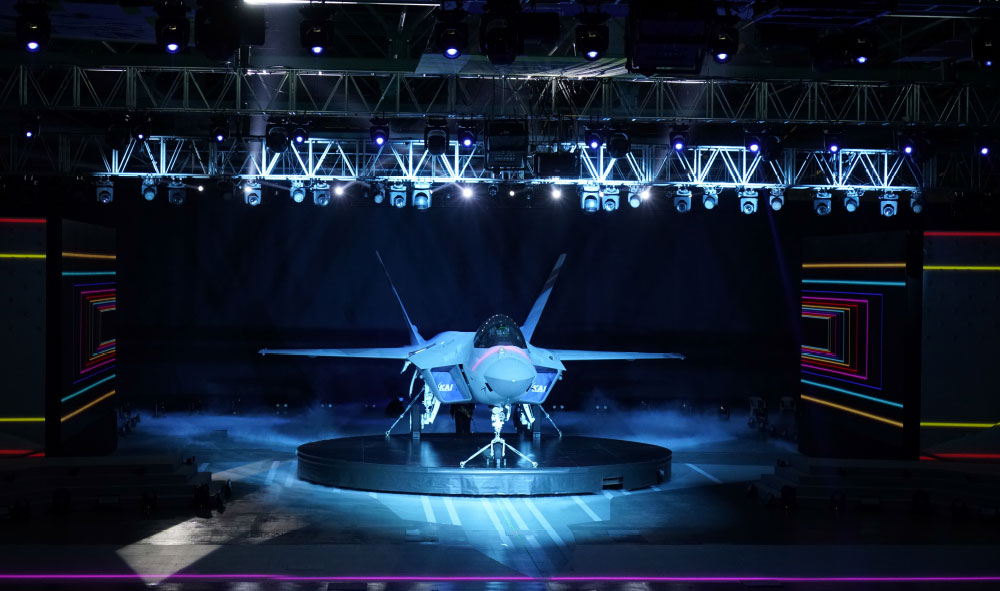
The next-generation fighter aircraft KF-X project was started by the Republic of Korea in 2010. For the Project's EMD (Engineering, Manufacturing, and Development) Program, businesses were chosen, and agreements were made in 2015. PDR (Preliminary Design Review) and CDR (Critical Design Review) were completed in 2018 and 2019, respectively. The roll-out ceremony of the prototype took place on April 9, 2021.
The KF-21 program, which saw its first flight on July 19, 2022, will have a total of six prototypes. Four of these will be single-seat and two will be two-seat. Following the completion of the development phase of the aircraft in 2026, it is planned to manufacture at least 120 aircraft in the serial production process.
The KF-21 is referred to as the 4.5th-generation aircraft, but it differs significantly from the 4.5th generation aircraft currently in production. In the inventory of the armies, 4th generation aircraft are upgraded to the 4.5th generation with the avionics improvements. The KF-21 is directly designed to be low observable. It incorporates the design features applied in 5th generation aircraft such as angled vertical tails, fuselage shape, and angular design. However, the KF-21 lacks the main features of the 5th generation aircraft such as stealth (engine, internal weapon bays, etc.) and advanced sensor fusion.
The KF-21 BORAMAE is equipped with two F414-GE-400K engines achieving 22,000lbf (97.9kN) thrust. This engine also powers the F/A-18E/F Super Hornet aircraft. A total of 15 engines for prototypes (6) are planned to be procured from GE Aviation. The plan is to produce those engines in South Korea under license while also using them in serial production. The KF-21 is expected to have a maximum take-off weight (MTOW) of 25,600 kg, an operational range of 2,900 km, a speed of 2,200 km/h, and a payload of 7,700 kg. KF-21 BORAMAE has a length of 16.90 meters, a height of 4.70 meters, and a wingspan of 11.20 meters.
The payload of the first serially produced KF-21s, known as Block-1, will be air-to-air missiles. It will be able to carry up to four Meteor or AIM-120 semi-buried under the fuselage, and up to four IRIS-T, AIM-9X, or AIM-120 on the wings. It is planned to move into the Block-2 model after 40 Block-1s to be produced. In the Block-2 configuration, the aircraft will also be able to carry air-to-ground missiles. These include KEPD 350 Long-Range Cruise Missile, CBU-105 Wind Corrected Munitions Dispenser (WCMD), Joint Direct Attack Munitions (JDAM), and AGM-84 Harpoon Anti-Ship Missile.
KAI was selected for the design of the KF-21 and preferred to use relatively simple subsystems. The subsystems (such as AESA radar, infrared search and track (IRST), electro-optical targeting pod (EO TGP), and radio frequency jammer (RF jammer) technologies, etc.) that could not be purchased ready-made were developed indigenously in collaboration with foreign partners. Here, the solid political and economic relations of the Republic of Korea have been of great asset for the manufacturer. More ambitious programs are being undertaken by other countries or manufacturers (such as the UK, India, Japan, Türkiye, etc.) that aspire to create new generation aircraft. This increases the risks and costs. With the use of this project model, KAI was able to complete the PDR and CDR phases rapidly, produced the first prototype, and conducted the first flight of the KF-21. With all the benefits of domestic production, the KF-21 promises to offer capabilities at least as advanced as those of the rival 4th and 5th generation fighters. Another benefit of this model is that by producing an aircraft that is faster than its rivals but relatively less competent (compared to the 5th generation), it introduces a new fighter aircraft for potential buyers. If it can receive orders, KAI will, in the long term, transform this initiative into a commercially profitable project.
This design and production strategy was not only a commercial decision, but also led to a design that properly meets the requirements of the Republic of Korea Air Force (ROKAF). Currently, the Republic of Korea Air Force (ROKAF) has both 4th generation aircraft such as the KF-16 and F-15K, as well as 5th generation aircraft such as the F-35 in its inventory. We can claim that it makes sense to design an aircraft that will fill the gap between these two generations and that can be serially produced.
As a result, the KF-21 will have a smaller radar signature than the ROKAF's multi-role F-15K Slam Eagle and many of its KF-16s, and its modern avionics will enable it to work more cooperatively with the 5th generation F-35. Furthermore, it will be able to carry more ammo than the F-35 due to its stealth trade-off.
The KF-21 BORAMAE is an aircraft that will satisfy the needs of the Republic of Korea and it has high export potential. Poland, which prioritized defense and armaments after the Ukraine crisis and selected the Republic of Korea as a partner in this regard, appears to be very likely to be the KF-21’s first customer. The KF-21 is also a program that Türkiye has to closely monitor. The similarities between TUSAŞ’s and KAI’s objectives, as well as between their experiences and capabilities, will undoubtedly serve as a model for us in terms of the problems encountered during the development stages of the KF-21 and the collaborations carried out. Naturally, if the political and economic challenges do not make this difficult...