LANDCOM Achieved Full Operational Capability in Exercise “TRLE14”
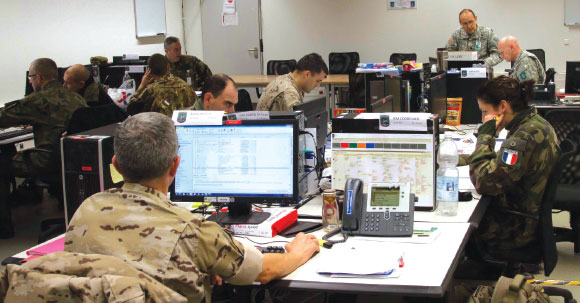
Lt.General John W.Nicholson, Commander Allied Land Command (LANDCOM) announced LANDCOM achieved Full Operational Capability (FOC) during exercise Trident Lance 2014 (TRLE14), which was conducted at the Joint Multinational Training Command, Grafenwoehr, Germany.
In a first of its kind exercise since the 1990; three corps-level sized military units, augmented by various international military support units & agencies, performed their core functions in a land-based operation, certifying LANDCOM’s ability to conduct command and control of multinational forces should the Alliance need to conduct a Major Joint Operation.
General Philip M. Breedlove, Supreme Allied Commander Europe delivered a speech and he stated that the message of this exercise is to all Europe, specifically 28 NATO Allies and it talks to the readiness of NATO to meet challenges at speed with capable forces. “As you have seen over the past few months, Russia’s aggressive actions in Ukraine have triggered the alliance to begin a series of assurance and adaptation measures to assure our Allies and adapt our military organizations to the new security environment in Europe. We are evolving in order to be more responsive to challenges to any part of our Alliance” he added.
Ambassador Francesca Tardioli, Deputy Assistant Secretary General from NATO’s Operations Division, attended TRLE14 and spoke on the behalf of the Secretary General Jens Stoltenberg, explaining the importance of exercise Trident Lance.“Trident Lance is a key event for NATO to maintain and train capabilities, in this case in particular land forces’ capabilities, to ensure that this Alliance remains ready to respond to any contingency, including obviously Article 5 collective defense. Exercises are of critical importance, especially as we move from a deployed NATO to a more prepared NATO. We shift from deployment to preparedness and in this context exercises are essential. It’s critical to maintain the right level of interoperability that we have achieved with a lot of efforts in our current operations” said Tardioli.
Lt. General Nicholson, Commander Allied Land Command explained this exercise tested LANDCOM’s ability to successfully execute complex ground to air operations and rapidly deploy those forces to threatened areas of the Alliance, if a threat arises.Multiple prior training exercises went into the two-year-process resulting in LANDCOM being the first deployable component command in the transformed NATO Force Structure. “So many men and women across the entire Alliance, 23 nations in this headquarters and augmentees for 21 nations, have worked very hard to support the exercise. So, I want to thank all of them of behalf of the Alliance. At LANDCOM we recognize the challenges associated with this, we’ve learned a tremendous amount from this exercise. But we are also confident that coming out of this exercise we are very capable, that we as an Alliance are capable, of conducting large scale land operations” said Lt. Gen. Nicholson.
With the completion of Trident Lance, NATO is looking to the future to build on its strengths and focus on a more prepared NATO.General Jean-Paul Paloméros, Supreme Allied Commander Transformation pointed out that There are more strategic exercises ahead [specifically] Trident Juncture 2015, with more than 25,000 troops in Spain, Italy, and Portugal which have high visibility.
LANDCOM: NATO’s Land Power
Headquarters Allied Land Command (LANDCOM), the newest single service command of the military arm of the North Atlantic Treaty Organization (NATO) is housed on the General VecihiAkın Garrison, Izmir, Turkey. As part of the Allied Command Operations (ACO) reformation, two former land force headquarters -- Forces Command Heidelberg (Germany) and Forces Command Madrid (Spain) -- deactivated in early 2013, their missions and resources realigned into a single land force headquarter to improve the NATO Force Structure (NFS) efficiency and effectiveness. LANDCOM was established December 1, 2012, in compliance with the 2010 NATO Strategic Concept, and consists of more than 350 personnel billets from 23 nations.Turkey has gone above and beyond to support the HQ and the mission, with regiment size Host Nation Support Group and the exceptional quantity and quality of the Turkish military and civilian personnel and this support is very much appreciated through all NATO command levels.
Upon the formulation this command in 2012, then SACEUR Admiral James G. Stavridisstated that interoperability within the Alliance is better now than it’s ever been because NATO forces have been training together consistently over the last 10 years. Pursuant to that mandate and on any given day, at least a third of LANDCOM’s assigned personnel are on temporary duty, dispersed across Europe, engaged in LANDCOM’s three lines of operations (LOO): Land Forces Operational Capability, LANDCOM HQ Operational Readiness, and Land Advocacy.
In peacetime, LANDCOM is the principal land force advisor for the Alliance, providing expertise in support of NATO’s land forces’ readiness, competency, and standardization. The headquarters is also responsible for their evaluation and certification. LANDCOM delivers a planning capability in support of higher headquarters, and recommends improvements to doctrine, training and exercises, and technology to improve interoperability between the Allied land forces (LOO 1). At all times, LANDCOM advocates on behalf of the NATO Force Structure (NFS) and national armies (LOO 3).
If directed by the Supreme Allied Commander Europe (SACEUR), LANDCOM will provide the core of a Joint Force Command Headquarters (JFCHQ), responsible for the conduct of land operations and the synchronization of land forces command and control (C2) in accordance with the Allied Level of Ambition (LOO 2).
When NATO’s political decisions have military implications, LANDCOM contributes to implementation of NATO core tasks (Collective defense - Crisis management - Cooperative security) acting within the NATO Command Structure (NCS). This command structure is based on functionality rather than geography, with three tiers of command: strategic, operational, and the tactical or component level.
At the strategic level, Allied Command Operations (ACO) is commanded by Supreme Allied Commander Europe (SACEUR). SACEUR is dual-hatted as the commander of the US European Command, which shares many of the same geographical responsibilities. The operational level consists of two Joint Force Commands (JFCs): one in Brunssum, the Netherlands (JFC BS), and the other in Naples, Italy (JFC NP). Each is prepared to conduct comprehensive operational-level campaign planning and deploy into theatre as a Joint Task Force HQ (JTF HQ). At the component or tactical level, NATO placed three single service component command headquarters alongside the two JFCs: Land Command (LANDCOM) in Izmir, Turkey; Air Command (AIRCOM) in Ramstein, Germany; and Maritime Command (MARCOM) in Northwood, United Kingdom. Now that LANDCOM has achieved Full Operational Capability (FOC), LANDCOM is the only deployable component in the transformed NATO structure and will be prepared to operate as the Land Component Command (LCC) in the JTF HQ.
The NATO Force Structure (NFS), subordinate to the NCS, consists of organizational arrangements that bring together the forces placed at the Alliance’s disposal by the member countries, along with their associated command and control structures. LANDCOM operations are conducted across all NATO nations (to include the Baltic Nations: Estonia, Latvia and Lithuania) to ensure all are fully capable to conduct interoperable maneuvers. These forces are available for NATO operations in accordance with predetermined readiness criteria and with rules of deployment and transfer of authority to NATO command that can vary from country to country. Within this NFS, nine multinational Graduated Readiness Forces for Land (GRF-L) support NATO’s land forces requirements and look to LANDCOM for advocacy as well as evaluation and certification. LTG Nicholson hosted LANDCOM Corps Commander’s Conference at Ramstein Air Base, Germany on Tuesday, 10 March 2015 to ensure better coordination and interoperability. Supreme Allied Commander Europe, General Philip Breedlove joined LANDCOM Commander and the Commanders of nine Army Corps Headquarters to discuss how the Alliance will move forward on contingency planning in support of NATO’s readiness reaction forces.
These GRF-Ls contribute land forces to the NATO Response Force (NRF) on a rotational basis, committing for a 12-month period. The NRF is a high-readiness, technologically advanced multinational force made up of land, air, maritime and Special Operations Forces components the Alliance can deploy rapidly when needed. Leadership of the NRF rotates between JFC BS and JFC NP. The NRF comprises a joint force of about 13,000 high-readiness troops provided by Allies.
Additionally, this command coordinates across European Union, Partnership for Peace, Mediterranean Dialogue, and Istanbul Cooperation Initiative nations to ensure all are also considerate of NATO interoperability with their respective land forces.
Recently, LANDCOM has hosted significant NATO Commanders and National Authorities at the HQ. Supreme Allied Commander Transformation (SACT), French Air Force General Jean-Paul Paloméros visited LANDCOM, Turkey 1 April 2015. The aim of the visit was to identify ways to improve the interaction between ACT and LANDCOM on topics of mutual interest. General Paloméros was briefed on LANDCOM’s mission, activities, achievements of LANDCOM and opportunities for further cooperation.
General Hulusi Akar, Turkish Land Forces Commander and General GalipMendi, the Aegean Army Commander visited LANDCOM on the 17th of April 2015. Gen.Akar and Gen.Mendiwere welcomed by Commander and Chief of Staff. The main focus of their meeting was the importance of the mutual support and interoperability between LANDCOM and Turkish Army.
One of the important events, the Headquarters of Allied Land Command LANDCOM hosted the North Atlantic Council on 21 April 2015, in Izmir, Turkey. NATO Secretary General Jens Stoltenberg and the 28 Permanent Representatives discussed the Alliance’s continuous adaptation in the face of new security challenges. The talks were also attended by Deputy Secretary General Alexander Vershbow and the Chairman of the Military Committee, General Knud Bartels.The ambassadors focused on current security developments to the Alliance’s east and south, reviewed the implementation of the Readiness Action Plan and discussed NATO’s continuous adaptation in the run-up to the Warsaw Summit in 2016. They also examined ways to enhance cooperation with partners in order to best address hybrid threats.