Latest Aegis Air and Missile Defense System Certified
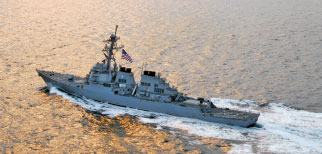
The U.S. Navy and Missile Defense Agency (MDA) recently certified the newest and most advanced version of the Aegis Combat System, Baseline 9, writing a new chapter in the legacy of the program. The certification milestone represents the completion of U.S. Government analysis and tests – including the successful Multi-mission Warfare series of tests aboard the destroyer USS John Paul Jones (DDG 53) – designed to demonstrate the operational capability of the system and verify that ship’s force can operate and maintain the system effectively.
Aegis Baseline 9 provides the U.S. Navy surface fleet with the most advanced air defense capability ever. The destroyer variant of the baseline, called Baseline 9.C1, also includes the most current generation of ballistic missile defense (BMD) programming, known as BMD 5.0 CU. Under the Baseline 9 configuration, Aegis merges BMD and anti-air warfare into its Integrated Air and Missile Defense (IAMD) capability using commercial-off-the-shelf and open architecture technologies developed by Lockheed Martin.
“The Aegis Combat System Baseline 9.C1 offers unprecedented capabilities, including simultaneous air and ballistic missile defense,” said Jim Sheridan, Lockheed Martin director of Aegis programs. “This Aegis baseline also improves Aegis networking capabilities, allowing Aegis vessels to automatically coordinate defense with input from satellite and ground-based radar assets—forming a true shield of defense over a wide area.”
The Multi-Mission Warfare tests, conducted in August, verified performance of the recent BMD upgrades. Over the course of the four test events aboard USS John Paul Jones (DDG 53), Aegis flawlessly detected, tracked, and engaged two ballistic missile and two air warfare targets. Each event resulted in the successful intercept of a single target. The tests were the culmination of years of successful live fire and tracking tests, each designed to probe the limits of new Aegis capabilities.
As a result of these tests, the United States Navy and Missile Defense Agency certified three variations on the Aegis baseline for 2015: 9.A0 for cruisers, 9.C1 for destroyers, and 9.B1 for Aegis Ashore, a land-based variant developed as part of the U.S. Government’s European Phased Adaptive Approach to protecting Europe from ballistic missile attack.
Aegis is the most deployed combat system in the world, and the only system capable of tracking and engaging ballistic missile targets. With more than 100 Aegis-equipped ships in service around the globe, Aegis Combat System has account for over 1,250 years of at-sea operational experience while expertly launching 3,800+ missiles in tests and real-world operations. International customers draw from the Common Source Library to apply the proven capability now and flexibility for future needs.
The central component of the Lockheed Martin-developed Aegis BMD Combat System is the SPY-1 radar, deployed on more than 100 ships worldwide— the most widely fielded naval phased array radar in the world. SPY-1 capability has been greatly enhanced with the introduction of a new Multi-Mission Signal Processor (MMSP). Together, the Aegis system, MMSP and SPY-1 radar provide the U.S. and allied nations with advanced surveillance and an unprecedented IAMD capability. In Baseline 9, the U.S. Navy also adds an X-band radar to pair with the S-band SPY-1 radar. The X-band radar excels in horizon search, allowing SPY-1 to concentrate on volume and long-range search and tracking.
The Dawn of Integrated Air and Missile Defense
Baseline 9 is the first and only naval system capable of integrated air and missile defense. The system is the result of decades-long investment in development and real operational testing of the capabilities in active systems. In developing the system’s BMD capability, the U.S. Navy, Missile Defense Agency, and Lockheed Martin have identified three principles of success:
Keep pace with the threat
Test in operationally realistic environments
Design and test for interoperability to leverage all theater assets
To keep pace with the threat, the Aegis program implements an evolutionary approach to incremental system development. Patterned after its “Build a Little; Test a Little; Learn a Lot” approach for the Aegis system development, the development of BMD capability has followed a similar evolutionary model, leading to a 10 year record of success in performing ballistic missile defense. Since the initial fielding of an Aegis tactical regional engagement capability in 2005, the capability has grown from being able to counter simple, liquid fueled, short and medium range unitary threats, to complex, solid fueled, short, medium and intermediate range separating threats -- as well as ballistic missiles in their terminal phase.
“Each generation of the Aegis Combat System adds new capabilities to keep pace with emerging threats, and these tests were really designed to demonstrate the compatibility of new BMD capabilities with the entire system,” said Sheridan.
Within each update of the system, the Aegis designers are focused on constantly improving the unique attributes that are required to successfully defend against ballistic missile threats. First and foremost, the radar must be capable of advanced discrimination. It must have the necessary radar sensitivity as well as the advanced algorithms to distinguish difficult targets. Next, the radar must have sufficient resources and margin to support the quality and timeliness of the data necessary for engagement. Early tracking is critical to support engagement timelines and the system must be capable of simultaneously protecting itself while it searches, tracks, and defends against ballistic missiles. Finally, and perhaps obviously, the system must be integrated with long-range, high-quality effectors/shooters to complete a missile engagement.
Aegis Common Source Library
One-way Lockheed Martin has been able to develop affordable and adaptable innovations for the Aegis Combat System is through the use of the Aegis Common Source Library (CSL). The library is a software database that implements capabilities and processes for rapid software development.
The library enables customers to reuse the software across the enterprise in a “build once, use many times” framework, allowing new capabilities to quickly enter service across the fleet. With CSL, Lockheed Martin can rapidly develop software improvements, enabling reuse across our customer’s enterprise. Any Aegis system can take advantage of the latest evolutionary upgrades and our customers can enjoy significant cost savings in up-front procurement and throughout the lifecycle of the program. This flexibility and accessibility of innovation allows Lockheed Martin to scale Aegis to the match the mission requirements of governments around the world.
The CSL enables technology insertions and software fixes to be used across multiple platforms, ranging from different types of ships to land-based systems. This includes platforms as diverse as the U.S. Coast Guard National Security Cutter or Freedom-variant U.S. Navy Littoral Combat Ships, which both utilize Aegis-derived systems for drastically different missions.
“Our open architecture models and Common Source Library enable our engineers to maximize common components, saving time and money for our customers,” said Sheridan. “Our approach enhances life cycle affordability by reducing costs for integration, test and certification and supports the Navy’s objective combat system architecture.”
For the U.S. Navy, it drives affordability and interoperability across the entire fleet. The CSL delivers continual dividends on the more than 40 years invested in growing the Aegis Combat System.
Engineering efforts are already underway for the next two upgrades to the Aegis system, called Advanced Capability Build (ACB) 16 and ACB 20. The U.S. Navy has defined a plan to build 70 additional Aegis vessels in the next 30 years, with continued investment to keep pace with threat evolution. As these new capabilities are developed, the CSL allows them to be affordably and quickly deployed to ships and land-systems of various configurations.
“We are seeing the benefits across the U.S. Navy enterprise, and these tests are proof that the process is working efficiently to deliver the most advanced Aegis capability ever,” said Sheridan. “As we launch new Aegis programs with our partners in Japan and South Korea, and with future international customers, they will all have world-class Aegis capability delivered while sharing in the investment made by the United States.”