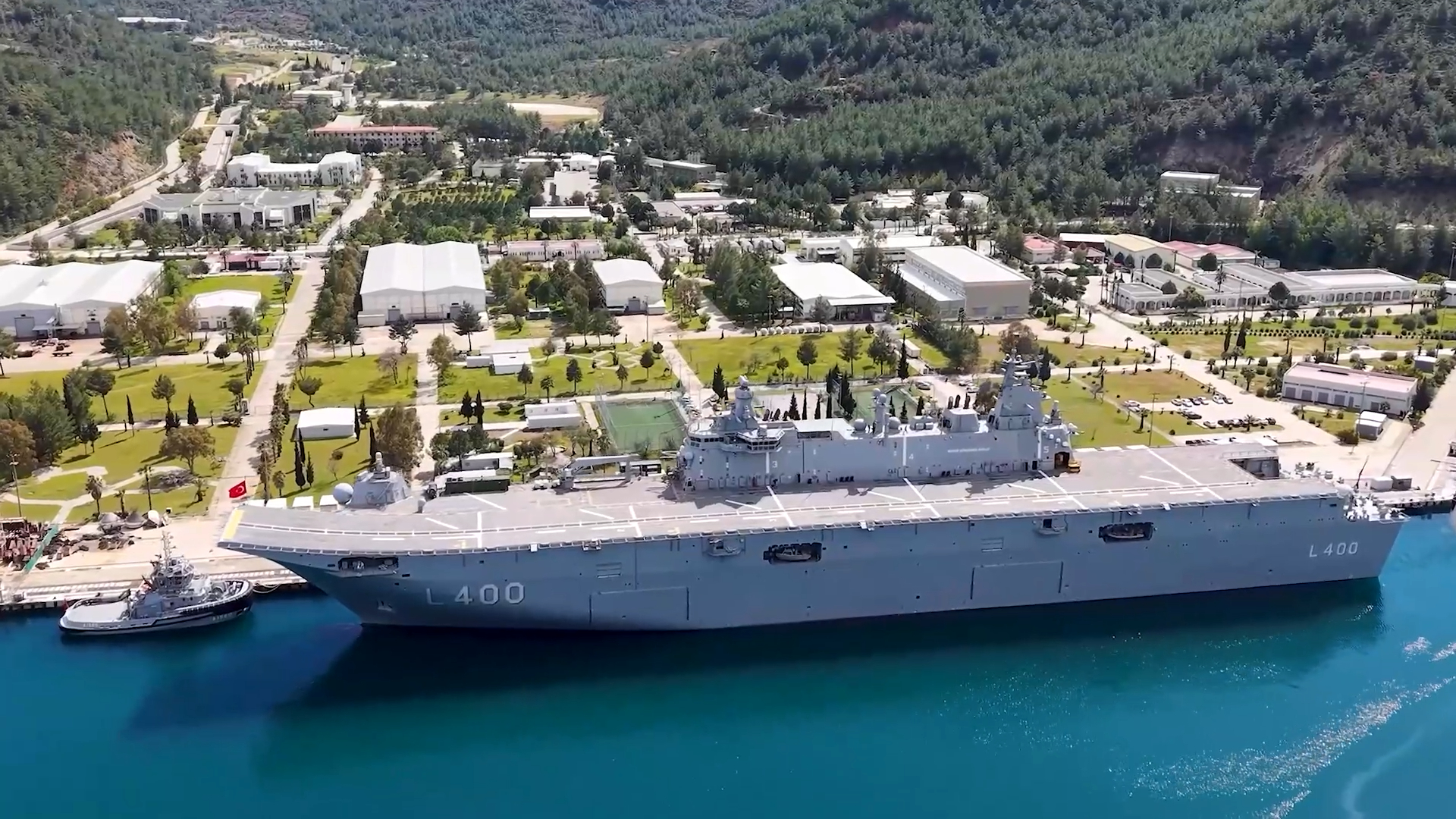
MAVİ VATAN NAVAL EXERCİSE 2025 AND A DAY ON BOARD TCG ORUÇREİS
The Turkish Navy conducted its flagship exercise, Mavi Vatan-2025, an ambitious training operation designed to test its capabilities in challenging scenarios and foster interoperability across military branches. The press were invited on two different occasions to witness the exercise.
Prior to the start of the exercise, Rear Admiral Kenan Kaan TÜRKKAN, Chief of Naval Operations Staff, outlined the scope and objectives of the exercise during a press briefing.
Held in January, Mavi Vatan-2025 was part of the Turkish Armed Forces’ annual exercise program. This large-scale event evaluated the Navy’s command and control capabilities, enhanced operational readiness, and sharpened decision-making skills in complex, multi-threat environments. The exercise also tested how seamlessly naval units could work alongside other branches of Türkiye’s military.
The exercise involved a robust lineup of assets, including 7 submarines, 8 frigates, 4 corvettes, 13 fast attack craft, 7 mine countermeasures vessels, 20 landing ships and craft, 13 patrol boats, and 22 auxiliaries. Additionally, 31 aircraft, 17 helicopters, 28 unmanned aerial vehicles, and 7 unmanned surface vehicles participated.
Specialized teams such as two SAT (Underwater Assault) teams with 8 personnel each and three SAS (Underwater Defense) teams with 5 personnel each also took part. In total, approximately 20,000 personnel were involved in the exercise.
Support from other branches of the armed forces added another layer of complexity. The Army contributed general-purpose and CH-47 helicopters, while the Air Force provided attack aircraft, early warning planes, and target-towing aircraft. Meanwhile, the Coast Guard deployed six patrol vessels.
The exercise unfolded in several phases. It commenced on January 6, with ships departing their bases. Preparations for operations took place over the next two days, followed by a Distinguished Observer Day at Aksaz/Marmaris on January 9. After port visits and logistical integration on January 10–11, live-fire training and operational exercises dominated the schedule from January 12–16. These final days focused on conducting operations in simulated high-threat scenarios.
Officers at the Exercise Control Center oversaw the coordination of Mavi Vatan-2025, ensuring the smooth execution of operations and introducing unexpected elements to enhance realism.
At the heart of the exercise was the Exercise Control Center, operating out of the Naval Warfare Center Command. Staffed by 115 personnel, the center oversaw and guided the exercise, ensuring it met its objectives through tailored scenarios and simulations.
Mavi Vatan-2025 also incorporated a comprehensive media strategy. The Naval Forces General Secretariat managed real press activities, while the Exercise Control Center simulated media coverage, including television and social media, through the military’s secure network.
Specialized training and firing activities added depth to the exercise. These included surface target firing using radar-acoustic targets, air defense firing with drone-towed targets, and shore bombardment. Naval aviation assets executed precision weapon launches, including MAM-C guided munitions and rockets. Patrol craft conducted depth charge and anti-submarine rocket firing. In the Finike region, electronic warfare training and chaff firing were carried out using the Pelikan EW simulator.
The Turkish Navy, with its modernized fleet and skilled personnel, continues to position itself as a formidable force in the region. Rear Admiral TÜRKKAN emphasized the Navy’s unwavering commitment to defending the nation’s maritime interests, both at home and abroad.
“As always, we draw strength from the Turkish people and our nation’s flag,” he said. “We stand ready to serve wherever we are needed, with determination, discipline, and pride.”
The second press involment was during the Distinguished Visitors and Press Day on 9th January. The participants were flown from Ankara to Dalaman on board a C-72 transport plane of the Turkish Naval Forces. Upon arrival at Aksaz Naval Base, they first boarded the frigate TCG Salihreis for the weekly press briefing before being transferred to the frigate TCG Oruçreis.
The day unfolded with various operations showcasing the Navy’s capabilities. As TCG Salihreis set sail following the arrival of Yaşar GÜLER, the Minister of Defence, along with the Turkish Chief of Staff and other commanders, the first activities focused on mine countermeasures. The TCG Anamur mine-hunting ship and an underwater defense team aboard an SH-70 Seahawk helicopter carried out a Tactical Claw operation, expertly identifying and neutralizing simulated mines.
Next came the amphibious operations—a thrilling display of precision and power. The Navy conducted an amphibious assault on a designated island, supported by airstrikes from attack helicopters. Amphibious assault teams and marine infantry were deployed both by sea and air to secure the island, capturing it with coordinated efficiency. The LST TCG Sancaktar served as the mother ship for the seaborne landing force, supporting the LCMs and Zaha amphibious armored vehicles.
Maritime control operations followed, featuring a fast-rope deployment from a helicopter onto the deck of the TCG Göksu as part of a maritime security operation.
Anti-submarine warfare was another highlight of the morning. The operation began with a sonar dipping exercise by an SH-70B Seahawk ASW helicopter, followed by the deployment of sonobuoys and UAV data relays. When the simulated target met engagement criteria, a P-72 maritime patrol aircraft launched a REXTORP exercise torpedo. The scenario concluded with the submarine TCG Dolunay surfacing near TCG Salihreis, demonstrating the Navy’s ability to detect, track, and engage underwater threats.
The morning ended with a replenishment-at-sea operation, where supplies were seamlessly transferred between TCG Salihreis and the Ada-class corvettes TCG Burgazada and TCG Büyükada.
In the afternoon, a Bayraktar TB-2 UAV launched a MAM-L munition onto a surface target, followed by simultaneous surface fire operations by four Kilic II-class fast attack crafts.
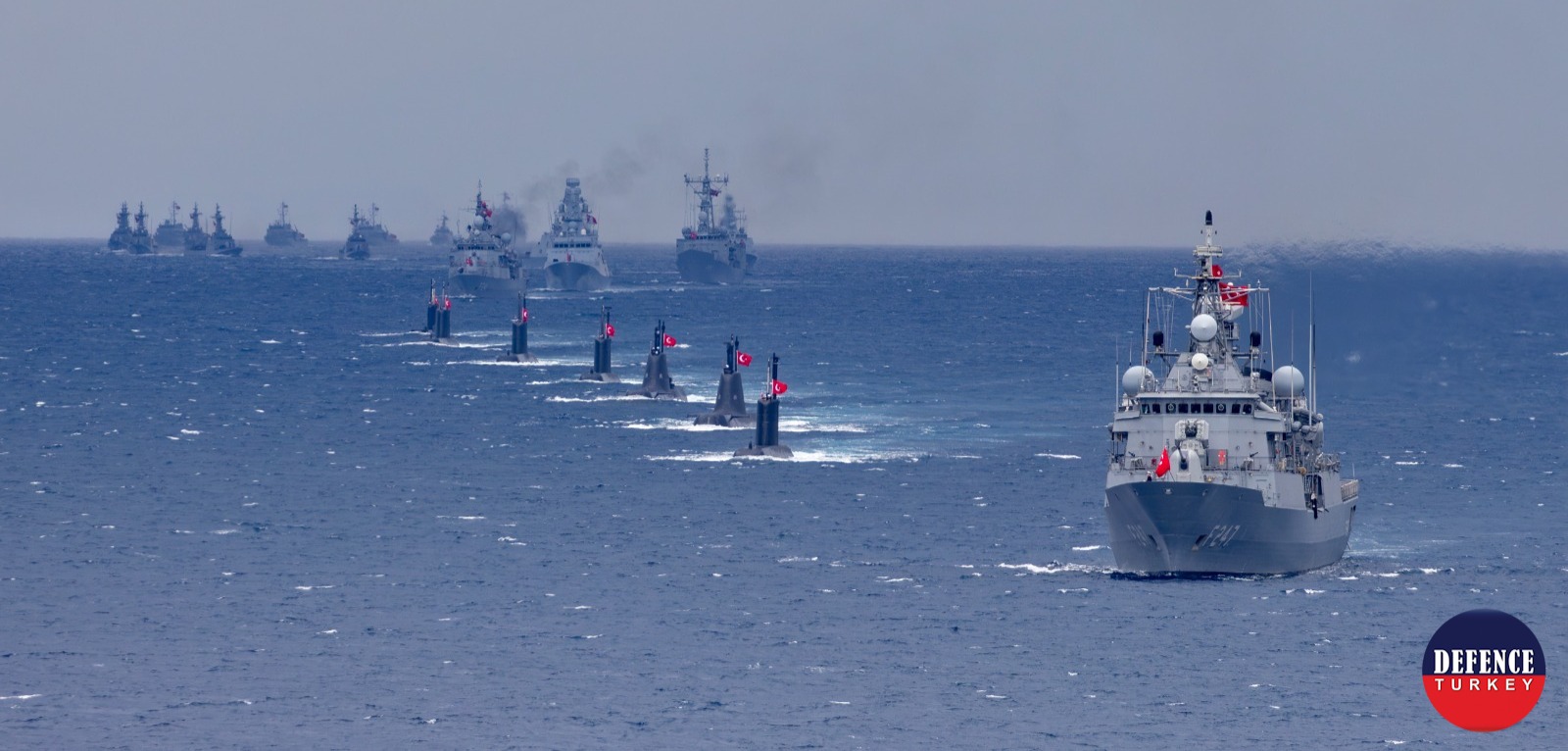
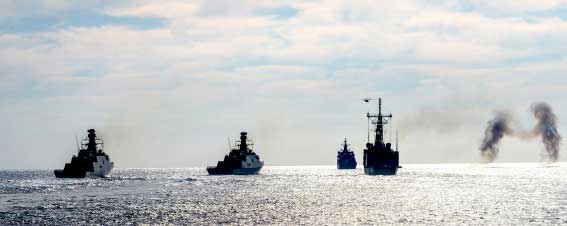
The day concluded with a naval parade featuring surface vessels, submarines, and aircraft in a coordinated display.
The highlight of the Distinguished Visitors and Press Day was being able to spend time on board of TCG Oruçreis. This ship had recently completed its Mid-Life Upgrade program.
Started in 2018 by the SSB, the Barbaros MLU program is the most comprehensive naval upgrade made to date in Turkey. The value of the contract signed by SSB and Aselsan – Havelsan joint venture was Euro 269 million. The work on TCG Oruçreis started in January 2022.
The Turkish Navy commissioned four Barbaros [MEKO 200 (Track IIA/IIB)] class frigates between 1995 and 2000. They received a mini modernization when Smart-S radar replaced older AWS-9 radars and the Track IIA frigates received Mk-41 VLS in place of the MK-29 Sea Sparrow launchers. The aim of the Barbaros MLU project is to keep these ships in service until 2040.
The major change in appearance is the new main mast. Unlike the lattice mast of the original frigates, the new mast is solid and shaped to reduce the radar cross-section. Its shape is similar to the main mast of TCG Istanbul. The Thales SMART-S Mk2 3D radar sits on top of the mast. In this position, the radar is higher than before, providing unrestricted coverage.
The Aselsan-made ARES-2N electronic support system and its distinctively shaped antennas are located just below the main radar. The combination of a 3D radar on top of ARES-2N antennas is set to become a hallmark image of the new generation of Turkish warships. The receiving and transmitting antennas of the AREAS-2NC electronic countermeasure and electronic attack system are located on both sides of the mast. These have replaced the original Cutlas / Scorpion ESM/ECM systems.
Despite the fact that the Akrep-300 radars, Gökdeniz and RWSC mounts have their own electro optical sensors, there additional electro optical systems mounted on the mast. The Piri IRST located on the main mast provides passive search, track and detection of air, surface vehicles and missiles. There are two Denizgözü Kırlangıç electro-optical reconnaissance and surveillance systems located on the main mast. These newly added systems provide much-needed electro-optical observation and detection capabilities, which the class previously lacked.
The two STIR fire control radars associated with the main 127mm/54 Mk-45 Mod2 gun and Sea Guard self-defence system on top of the pilothouse have been replaced by a single Akrep-300 fire control radar. The instrumented range of these radars is 120km. The fire control systems of the 127mm gun is also provided by Aselsan.
In addition to the two Akrep 300 radars there two Cenk 200-N 3D radars on board. The forward looking is located on the Gökdeniz turret while the aft looking is installed on a shorter mast just in front of the funnels. This multi-beam naval search radar is designed for short- to medium-range operations, providing air and surface surveillance as well as target detection. The radar features an active phased array antenna and solid-state power amplifier modules, making it modular, lightweight, and energy-efficient.
One of the major changes in armament is the replacement of the Sea Zenith mounts. The forward mount at the B position has been replaced by a Gökdeniz CIWS with its own fire control radar and E/O suite, while the two aft Sea Zenith mounts have been replaced by a single Mk 15 Phalanx CIWS on top of the hangar and two 25mm Aselsan STOP RCWS. These RCWS also enhance the ship’s protection against asymmetric surface threats. Another important change is the addition of eight Atmaca anti-ship missiles. The ship now carries eight Atmaca and four Harpoon missiles instead of the previous load of eight Harpoons.
For self-protection, the Aselsan Hızır torpedo countermeasure system has been installed. The drum for the towed torpedo detection array is located under the flight deck, while the TKAS launchers for the countermeasures are installed on both sides of the helicopter hangar, just aft of the two RCWS. The installation of the Phalanx necessitated placing the aft-looking Akrep 300 fire control radar in a higher position; therefore, it is now mounted on a small newly added structure. The satellite communication antennas have also been positioned higher and are now mounted on a small mast on the roof of the helicopter hangar. The Aselsan LIAS 200-D laser warning receivers have been added to various locations on board to enhance the ship’s awareness against enemy laser range finders, laser target designators, laser beam riders.
One of the important upgrades not visible happened underwater. The Aselsan Fersah 100-N/MF sonar suite replaced the legacy is a hull-mounted, mid-frequency sonar designed for anti-submarine warfare (ASW). It features a high source level and strong directional capability. The system operates in both active and passive ASW modes and includes a mine-like object avoidance (MAS) mode. Using advanced signal processing, it can detect, track, and analyze targets effectively in both active and passive modes.
While Aselsan has changed the sensors and the weapon systems, the other partner of the joint venture Havelsan changed the brain and the nervous systems of the ship. The company was responsible for modernizing the Combat Management System (CMS) and integrating new indigenous systems into the frigates.
As part of the modernization, the existing Thales Tacticos CMS was replaced with Havesan’s Genesis Advent CMS. This system features 20 Multi-Functional Operator Consoles (MOC), a 10GB network infrastructure for high-speed data exchange, and new ergonomic consoles and cabinets. The upgraded CMS integrates all weapon systems, sensors, and electronic warfare capabilities into a single platform.
Havelsan also provided the essential Ship Data Distribution System. SDDS is designed to centralize and distribute critical data to all subsystems onboard a vessel. Modern warships rely on the efficient collection and distribution of data from multiple onboard systems, including navigation, communication, combat management, weapons, and sensors. The ability to integrate and manage this data effectively is essential for ensuring safe navigation and operational effectiveness
The SDDS facilitates high-speed data acquisition from platform sensors, ensuring that essential information is gathered and processed efficiently. The system distributes data in various formats and frequencies, making it compatible with a range of onboard systems. The system also enables data recording, playback, transfer, and analysis, providing useful insights for mission evaluation and diagnostics