Meteksan Defence – Global Leader in Damage Control Simulator
Meteksan Defence has developed an exceptional Damage Control Simulator (DCSIM) and has become a global leader in this particular area. With the most advanced and modern solution, Meteksan continues to fulfill the requirements of Naval Forces worldwide. Meteksan Defence is to include an undisclosed Gulf country in its list of simulator customers. Upon the completion of the ongoing contract negotiations, in the upcoming days the company will be the first in the world to have accomplished Damage Control Simulator deliveries to four different countries.
Meteksan Defence recently won a tender regarding the Damage Control Simulator demands of the Naval Forces of the Korean Republic with the partnership it built with a local company, by leaving its international competitors behind. The contract of the project was signed on 24 February 2017. In the project, where the construction and installation of the facilities continue, the simulator delivery is planned to be conducted in the second half of 2018.
In order to achieve the utmost level of domestic participation within the scope of the project, the company has been collaborating with a company located in South Korea and within this context, the production of the Damage Control Simulator and the delivery of certain subsystems were conducted by local companies with the support of Meteksan Defence Company in the Republic of Korea.
The Damage Control Simulator of the Naval Forces of the Korean Republic will provide training in compliance with international and maritime standards on a true to life platform for the timely and full execution of response to damage occurring on board involved in accidents and those for water disposal and isolation activities. The system offers an adaptable difficulty level and automated controlled staff training options at all different levels ranging from the basic level to the advanced level with its contemporary technological design. It will also include evaluation, comparison and reporting facilities.
The Damage Control Simulator of the Korean Republic’s Naval Forces contains certain differences from the ones built for Turkey and Oman. This simulator is nearly 35 percent bigger yet the deck and the compartment numbers are the same. The size enables the training of multiple damage control teams at the same time in line with the preferred usage concept. The simulator has certain electronic system simulations such as the IPMS which used in modern ships, which is another distinction. The Integrated Platform Control and Management System (IPMSEPKIS) allows the processing of ship damage via an electronic board in a way to contain the automation and monitoring with this platform.
Meteksan Defence initially developed the Damage Control Simulator for the Turkish Naval Forces Command and accomplished its delivery. Following this success the company won the tender of the Oman Naval Forces in with a contract that entered into effect in August 2012 leaving behind behind rivals from the United Kingdom, Germany, Norway, Malaysia and India. The Damage Control Simulator will provide training opportunities to 24 students including a hangar containing the simulator. Within the scope of the project, 70% domestic added value was achieved and it was completed as a turnkey project. After 20 months, which was ahead of the planned schedule, acceptance tests were completed and it was delivered in 2014.
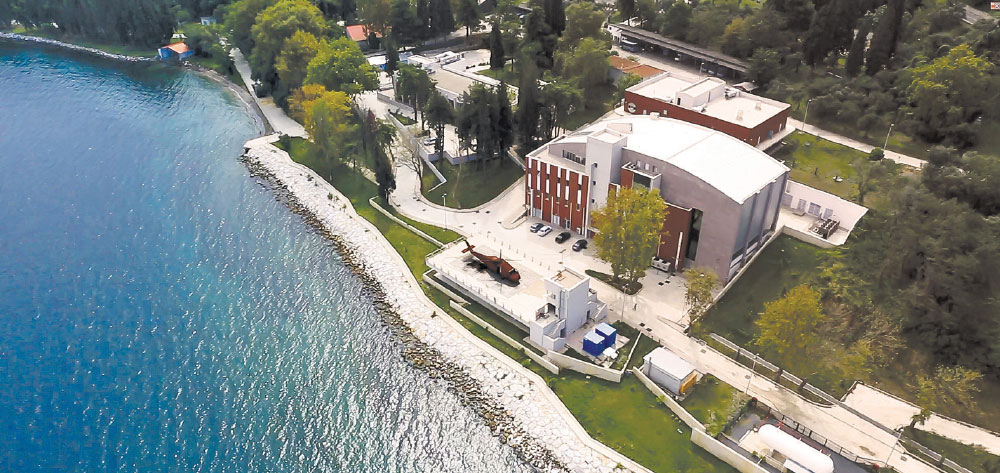
The Fire Fighting and Damage Control Training Simulators (YYES) were built in the Yıldızlar Surface Training Center Command which is attached to the Fleet Command located at Gölcük/Kocaeli in order to fulfill the fire fighting and damage control training requirements of the crew employed on the surface, subsurface, the air platforms and shore facilities of Turkish Navy. It was launched with the participation of the Naval Forces Commander, Fleet Commander, War Fleet Commander, Head of Dept. of Communications, Electronics, Data Systems at the Presidency of the Defence Industry of that period and other invitees on 16 June 2016.
Following the launch of the facility, the operation and maintenance activities of the Fire and Damage Control Training Simulators are being conducted by Meteksan Defence. With the help of the YYES, the previous certified training that is provided every two years is now possible biannually. So, presently the training is underway in line with an intense schedule.
Fire Fighting Training Simulator
The Fire Fighting Training Simulator was developed to fulfill training requirements regarding fire intervention and proper firefighting methods for the Naval Forces Command personnel employed on the surface and sub surface platforms, air platforms and facilities on shore. Platform fires of highly dangerous and destructive character may cause significant loss of life and property. The most critical factor in fighting such fires is having well - prepared crew who are ready for all types of potential scenarios. In order to prepare the emergency rescue staff and firefighting teams for real fire incidents, the Fire Fighting Training Simulator is a realistic training capability built by utilizing superior technologic facilities.
The Fire Fighting Control Simulator, where the compartment and fixture of the surface and sub surface vessels are simulated, and located in the building containing the effort test parkour, offers a training facility for real fire incidents with its fire scenarios with various flame heights and spread of fire within the same location or from one compartment to another in a realistic training environment. The simulator adopts safety as its initial priority and is able to provide a high level preparedness for the firefighting staff, enabling a more rapid and efficient response in actual fire incidents.
In the facility of the Fire Fighting Training Simulator of the Turkish Naval Forces the compartments such as the engine room, dining hall, radio room, CIC, medical room and damage control center are equipped realistically, and prepared accordingly to provide training for various types of fires. Similarly, various training opportunities regarding those that may occur in the cockpit, cabins and engine fires as well as different types of fires emerging from fuel spills on the platforms are offered with the helicopter simulator (exact scaled model) located similar to the helicopter platform existing at the BARBAROS Class (MEKO Track-II) Frigates in the Naval Forces Command’s inventory. Based on the GÜR class (Class 209) submarine, for the crew employed on such platforms, a fire training facility was established in which all the compartments of the boat are simulated among the areas of the Fire Fighting Simulator.
The Fire Fighting Training Simulator enables true to life execution of training on basic & advanced firefighting, individual&team training, also training regarding electrical/mechanical/fuel isolation applications, boundary cooling and smoke exhausting techniques in real environments. In addition to various lighting and sound effect applications affiliated with fire scenarios, providing training for operaterations conducted under limited sight conditions that may contribute to reality is also possible. The system is able to maintain the preparedness of the trainees in various environmental conditions through its scenarios with different levels of difficulty, and enables the repetition of similar fire scenarios until the trainee shows the proper behavior.
The command and control center of the simulator enables the preparation of the scenarios with various levels of difficulty. It follows and conducts communications between the control station and the fire control equipment, and at the same time monitors the simulator safety systems. Here, the individual and team performance in various scenarios built through the user’s selection are evaluated and the tracking and comparison of the previous training performance are executed.
Another capability acquired through this facility is the Damage Control Training Simulator that is among the platform simulators. The aim of Damage Control is to control and repair the damage that may occur in the vessels due to various reasons at times of peace, crisis and warfare within the shortest time while enabling the ship’s transfer to the nearest port for maintenance and repair by enabling ship’s mobility. As a part of ship’s availability for sailing, Damage Control capability is highly critical in terms of maintaining the integrity, stability and the maneuverability of the ship. The most crucial indicator of having such capabilities is the damage control training that is provided to the crew of the ship which is conducted in a realistic training environment and in line with high standards. For the realistic execution of the training in question, three decks (one open deck) and four compartments composed of an engine room, a pump room, a dining hall and a life space for staff are located within the simulator. The simulator is actualized completely through domestic design with 15 degrees of roll to both sides through the hydraulic system simulating potential situations in real sea environments. Limited sight and free water levels at various sea states can be simulated while training involving actual limitations in mobile and wet compartments are conducted. Similar to that of the Fire Training Simulator, in order to support such training, products with advanced levels of design are utilized and communications, safety, alarms, sound and light effects, artificial smoke and camera monitoring systems are included as well.
For the implementation of a realistic incident similar with that of boats taking on water, training in rising water level in a compartment up to 140 cm can be simulated. As part of simulator in the compartments there are 41 low pressure, 13 high pressure damage simulations, 4 of flange simulations, and making of these various types of damage isolation techniques like shoring, driving quoin and wedge, patching etc. are possible. At the same time, damage control organization, casualty power cable laying, smoke exhausting and water discharging, plotting, training for carrying injured staff and operation of mobile fire engines are available at the various compartments of the simulator.
Both the damage control and fire training simulator enable the execution of training which are difficult to perform at sea and on the platforms, providing a realistic environment located on shore while allowing the personnel employed at seas, platforms and coastal facilities to maintain the highest level of damage control capabilities.