Missile Warning Systems Integration for F-16 Fighter Aircraft
Several of today’s fighter aircraft such as F-16, F-18, Tornado, Harrier etc. were developed in the 1970’s timeframe. At that time the Electronic Warfare (EW) world was centered on Radio Frequency (RF) threats meaning that this generation of fighters typically was equipped with Radar Warning Receivers, Electronic Counter Measures/Jammers and Chaff/Flare Dispensers - which was a good suite at that time.
The Infra-Red (IR) threats were few and not very sophisticated so the IR self-protection was limited to the pilot visually (hopefully) seeing the hostile missile approaching his aircraft and then he could dispense flares and perform evasive maneuvering to decoy the homing missile.
Threat from ManPADS
Since then the threat scenario has changed dramatically. Several generations of IR missiles have been developed, including Man-Portable Air Defence Systems (ManPADS) including shoulder borne missiles. These missiles are typically self-contained and they can be operated by one man without any other infrastructure. They are often sold on the black market and thus totally un-controlled.
This means that when NATO or other coalitions deploy to secure peace, the threat from ManPADS represents a very clear and present danger since the missiles can be anywhere outside the deployed base, and they are almost impossible to detect before they are launched. With the above in mind, requirements for Missile Warning Systems (MWS) on fighter aircraft had to emerge and so they did.
As integration of EW subsystems is a core Terma competence it was natural to included MWS on fighter aircraft in the company’s portfolio of solutions.
Typically MWS needs to be electronically integrated with other on-board systems: interface to aircraft core avionics, interface to other EW systems such as flare dispensers, and interface to video and audio displays.
The structural integration of MWS, especially on F-16 aircraft, will typically be a major challenge as there is never any room for the MWS line-replaceable units (LRU’s). So modification of F-16 aircraft structure can be preventive expensive and very time consuming, but as Terma was already familiar with dispenser system installation on fighters, the company was able to identify affordable solutions for the structural integration of MWS also.
Terma initiated integration of MWS on F-16 in the mid 1990’s where the F-16 European participating air force (EPAF) countries and U.S. Air National Guard performed a technology demonstration program to evaluate the feasibility of installing an MWS in Terma modified F-16 wing weapon pylon. The program was a success even though it revealed that the MWS systems needed improvements to be compatible with the fighter environment.
ALQ-213 Electronic Warfare Management System
All the fighter MWS solutions have the Terma AN/ALQ-213(V) Electronic Warfare Management System (EWMS) in common. As the name implies, the ALQ-213 is an EW management system which integrates and controls the EW subsystems and provides interface to the core aircraft avionics. The system was initially developed in the 1980’s and it was later a baseline in the F-16 Mid Life Upgrade programs. The ALQ-213 is installed on several platforms including Fighters, Transport Aircraft and Helicopters. World vide more than 2,000 aircraft are equipped with the ALQ-213 solution.
In 2014 a new generation of ALQ-213 was launched. The new version features state of the art processing, memory and improved communications including a third MIL-STD-1553 MUX bus and Ethernet.
The ALQ-213 also features “Electronic Combat Adaptive Processing“ capability. This is a decision support solution which provides selection of the optimum response by coordinating sensor input and a library of tactics into a computer aided response.
Embedded Training is another feature of the system. The ALQ-213 can be put into training mode where the pilot can perform range-less training basically anywhere. As part of the mission planning artificial threats can be loaded into the system and the pilots will experience the same indications as if they were exposed to a real threat. The threat indications and responses are recorded and can be replayed after the mission for evaluation. This provides a very in-expensive and realistic training for the pilot.
Three Dimensional Audio System
The ALQ-213 also provides a 3D-Audio system which will alert the pilot by generating a warning tone in the true direction of a missile threat. This allows the pilot to focus his vision on the situation and perform his evasive maneuvers by “listening” to where the threat is rather than having to look at a display to determine and react to the scenario. This will save 1-2 seconds in reaction time, and when a missile typically takes 3-6 seconds to reach the target this is a major improvement.
Other features of the 3D-Audio system are that it offers a radio channel separation system meaning that the individual radio channels such as VHF, UHF etc. are presented to the pilot from different directions which make it much easier for the pilot to separate and discriminate the different channels. The human hearing has the capability to focus the hearing in a specific direction.
A third capability of the 3D-audio system is that it provides Active Noise Reduction. The function is similar to the commercial “noise cancellation” headsets available but this system is focused and optimized for a fighter environment. The 3D-Audio system has been operational for a few years and the pilots are very pleased with the performance
MWS operational in RDAF and RNoAF F-16’s
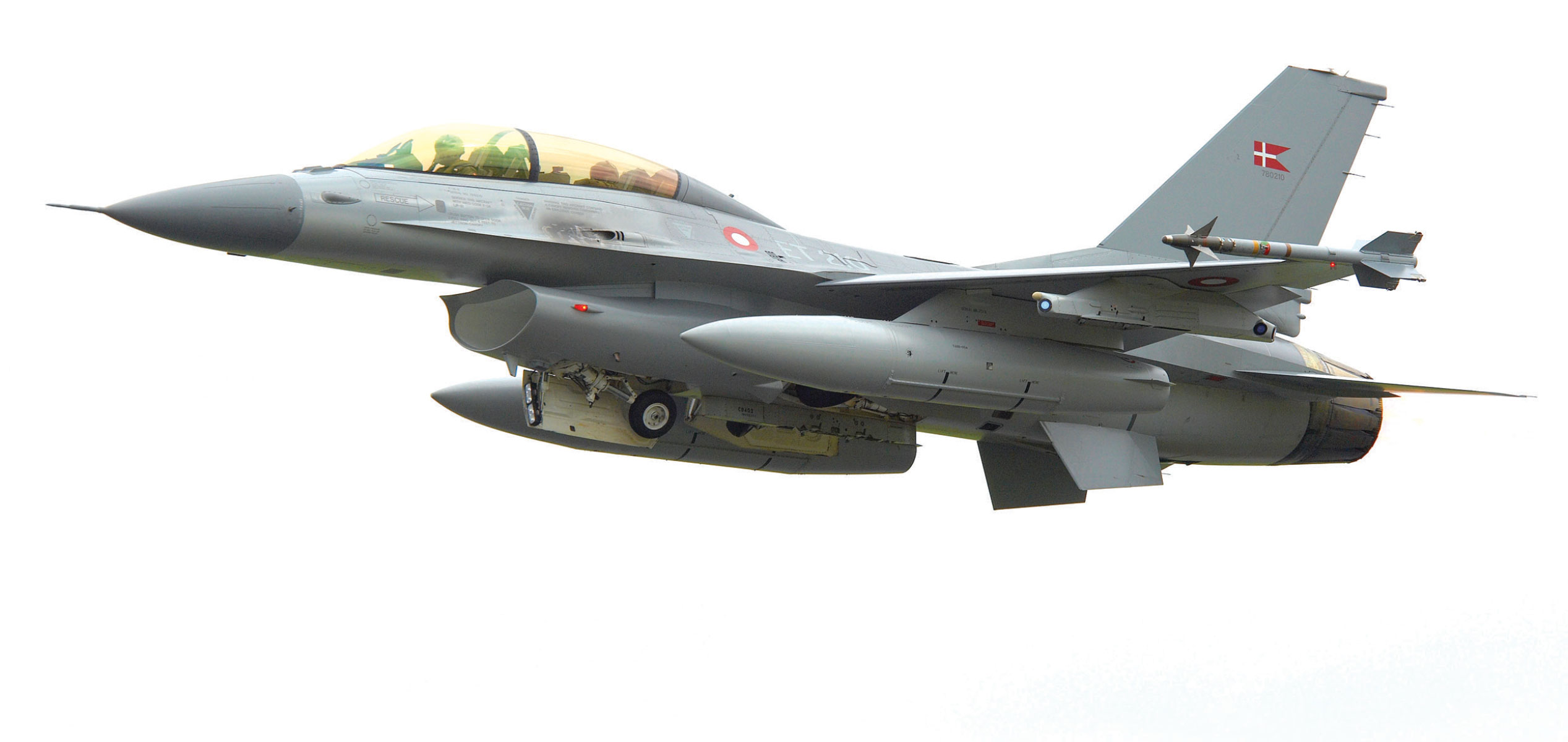
In the early 2000’s when “fighter” MWS’s became available, the Royal Danish Air Force (RDAF) launched a program to equip their F-16’s with passive UV MWS. The Airbus AAR-60(V)2 was selected and Terma was tasked to integrate the MWS both structurally and electronically. The hardware (sensors and processor) were installed in a modified F-16 Wing Weapon Pylon (PIDS+ - Pylon Integrated Dispenser System) and the MWS was electronically connected with the aircraft through the Terma Electronic Warfare Management System ALQ-213. The Royal Norwegian Air Force (RNoAF) later joined the program and the PIDS+ was US Air Force Seek Eagle certified jointly by RDAF and RNoAF. The system has been operational since 2013 and is much appreciated.
The concept of installing MWS in pylons has several unique advantages:
The pylon can still be used as a normal weapon pylon meaning that carriage of all conventional and certified weapons is not impacted
There is no or only minor aircraft modification – at maximum installation of a few harnesses but no structural or aerodynamic changes.
In many cases there is thus no aircraft downtime or at maximum a few days of harness installation depending on aircraft configuration.
The location and orientation of the sensors have been developed to assure maximum coverage in all aircraft load configurations.
The PIDS+ is fully certified by Lockheed Martin / US Air Force Seek Eagle Office on F-16 MLU aircraft so the installation can be executed without need for additional certification for many versions of the F-16.
Terma
Terma is a leading Electronic Warfare (EW) systems integrator with close to 30 years’ experience in providing combat proven survivability solutions on more than 2,000 frontline fighter, transport, and rotary-wing aircraft.
Terma offers customer-tailored EW solutions which are able to control and integrate any combination of sensors and countermeasures systems on any type of aircraft and make these subsystems work as one integrated system.
Besides EW solutions Terma develops products and systems for defence, non-defence, and security applications, including command and control systems, radar systems, self-protection systems for ships, space technology, and advanced aerostructures for the international aircraft industry.
The parent company Terma A/S is headquartered at Aarhus, Denmark, and maintains international subsidiaries and operations in The Netherlands, Germany, Singapore, United Arab Emirates, United Kingdom, India and the wholly owned U.S. subsidiary Terma North America Inc. headquartered in Arlington, VA maintaining offices in Warner Robins, GA, Ft. Worth, TX, and Norfolk, VA.