Naval Air Command and Ongoing Naval Aviation Projects
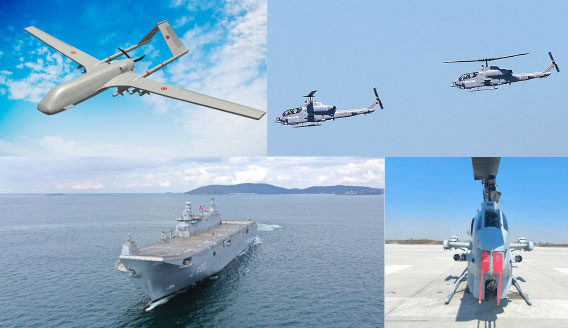
The Naval Air Command has become a rapidly developing capability of our Naval Forces. The Naval Air Command continues to serve with 9 different types of 64 aircraft stationed at its main base at Cengiz Topel and other bases in Çanakkale, Dalaman, and Geçitkale. Currently, we have 2 P-72 and 6 P-235 Marine Patrol Aircraft (3rd and 4th planes were delivered in December 2021, and the last 2 planes will enter the inventory in 2022), 3 C-72 Maritime Utility Aircraft, 4 TB-20 Trainers, 24 Seahawk ASW/ASuW Helicopters (equipped with AQS-18 and HelRas Sonars), and 9 AB-212 Helicopters in our inventory. We also operate a total of 16 UAV/UCAVs, which we can describe as force multipliers, including 9 BAYRAKTAR TB2s (it has been officially confirmed for the first time that 1 UAV was lost, there were 10 before. On the other hand, according to the Turkish Naval Forces website, there are 8 TB2s), 6 ANKA, and 1 AKSUNGUR (TCB881, which is the third AKSUNGUR prototype. The 2nd AKSUNGUR TCB882 was expected to be delivered in December 2021).
So what does the Naval Air Command do? The Naval Air Command carries out all training activities, especially Anti-Submarine Warfare and Anti-Surface Warfare in NATO Exercises, including our National Exercises, Sea Wolf, and Blue Homeland. It also performs the prevention of illegal immigration, medical evacuation, and Search and Rescue (SAR) activities. As part of our ongoing projects, in addition to the MELTEM-I and MELTEM-II Projects and the CASA CN235 aircraft in our inventory since the 2000s, our first P-72 Aircraft entered service at the Cengiz Topel Naval Air Station on December 14, 2020, under the MELTEM-III Project. We currently have 2 P-72 aircraft. In addition to these aircraft, 2 more aircraft will enter the inventory by the end of this year, and 3 more next year. With a total of 12 Maritime Patrol Aircraft, we will become a significant power, especially in our region.
Unlike CASA aircraft, our MELTEM-III P-72 Aircraft can stay in the air for longer periods, have higher speed, carry more sonobuoys, have Link 16 capability, and launch Mk-54 Lightweight Torpedoes. As I mentioned earlier, in addition to our ANKA, BAYRAKTAR, and AKSUNGUR UAVs, we are planning to acquire 21 additional UAVs in the future. We currently have 16 UAVs.
On October 20, 2021, our AKSUNGUR UAV entered our inventory in Dalaman. The most important feature of this UAV is its payload capacity. Carrying a payload of up to 750kg means that we can perform several different types of missions with this UAV. In this way, they will carry out various missions by carrying different pods, from anti-submarine warfare to electronic warfare. We hit our targets precisely during the firing drills. In the Blue Homeland exercise, we conducted this year, we successfully hit the target in the sea with a MAM-L munition from a distance of 15 km.
As you know, the Topel Naval Air Station is an old base, established in 1964. We need new equipment; we need a new flight-control tower due to the increasing air traffic density. We expect the building and tower construction to be completed within this month. Subsequently, with the integration of the communication equipment at the beginning of 2022, our tower will become operational.
Another important capability is the Helicopter Underwater Egress Training Facility (DUNKER) Project (the contract was signed between the SSB and METEKSAN DEFENCE). This may seem very simple, but it is really the only simulator of this quality in our region, perhaps in many parts of Europe, the Eastern Mediterranean, and the Middle East. Our simulator has a 25 meter by 30-meter pool. Different elements create a realistic environment, such as storm/wave simulations, day/night separation, and wind, wave, and rain effects can be used together or separately to simulate stormy weather. The simulator will consist of three different components. A platform that simulates escaping from a helicopter crashing into the water, a platform where ship abandonment training and taking the victims to the ship deck will be given, and another one that will simulate parachute landing on water and survival training. So this will be a significant capability increase. This makes us very proud.
As I mentioned before, in addition to our 3 main bases, we established the Geçitkale Naval Air Station on December 14, 2019. We performed our first flight with UAVs on December 16, 2019. Currently, our UAVs continue their duties in this region, in the Eastern Mediterranean.
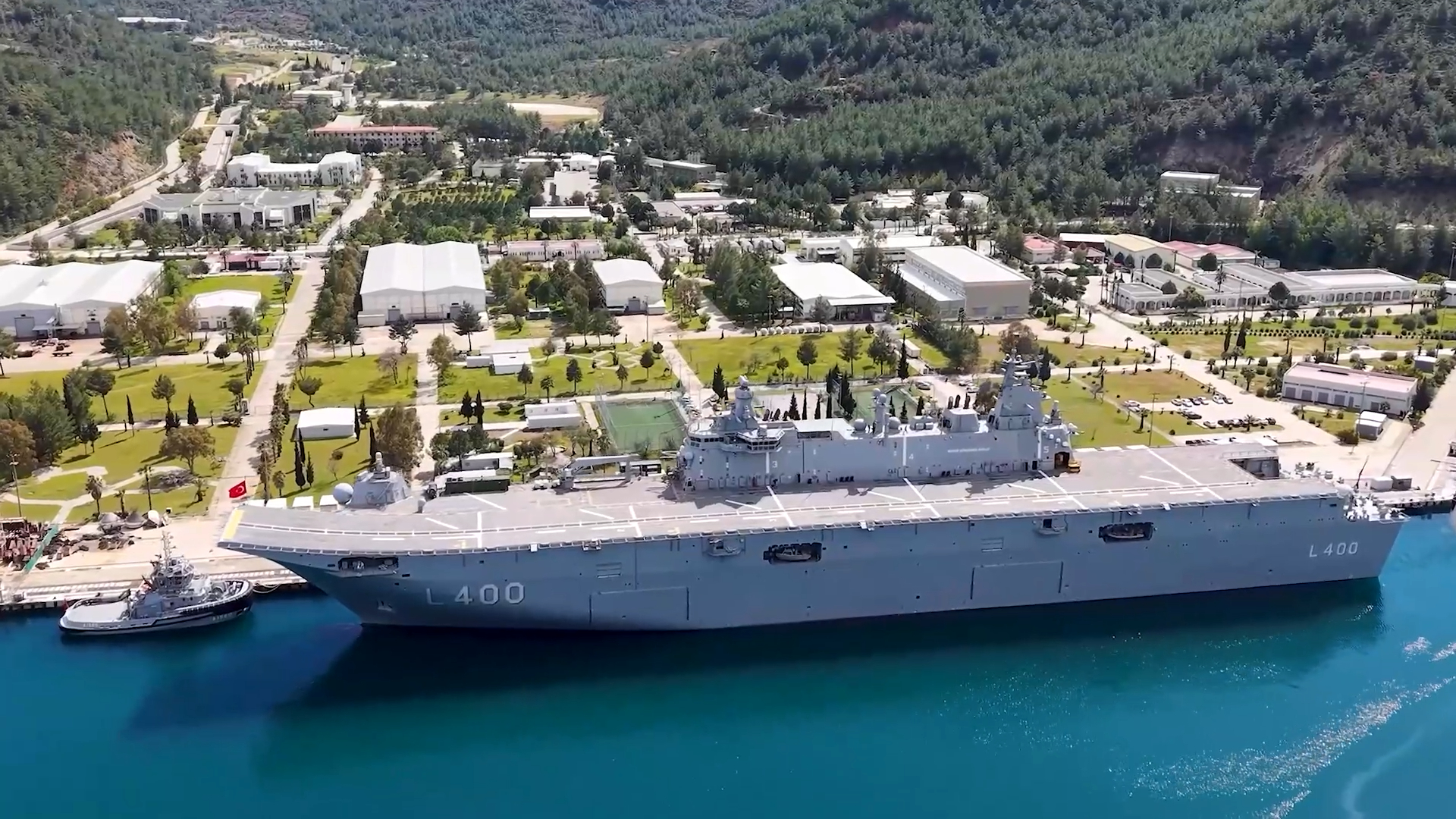
Our Multi-Purpose Amphibious Assault Ship (LHD) is at the forefront of our future projects. In addition to this, the number of our current 64 aircraft, from our New Generation Maritime Patrol Aircraft to our UAV/UCAVs to be procured in the coming years, will increase to 150 aircraft in total. This signifies a substantial capability increase.
I will talk about forthcoming projects. New Generation Maritime Patrol Aircraft. Our current planes are turboprops. We are planning to switch to the jet engine with the New Generation Maritime Patrol Aircraft. This will allow us to stay in the air for up to 14 hours, while our aircraft currently stay in the air for a maximum of 7 hours. In short, this means that we will be performing a mission with a single aircraft instead of two. Increasing our operational range from 1,400 miles to 4,500 miles will provide a huge advantage. In addition, we will be able to use air-to-surface guided missiles and, as you know, quickly move to the operational area because it is a jet-powered aircraft.
We are also continuing our efforts to deploy our locally developed HURJET Aircraft and National Combat Aircraft (TF-X) on our Multi-Purpose Amphibious Assault Ship (TCG Anadolu). In addition, we are planning to procure Medium-Lift Utility Helicopters for the rapid transfer of the Amphibious Units onboard our Multi-Purpose Amphibious Assault Ship and Airborne Early Warning Helicopters to control the airspace in the operational area (which can be deployed both on land or on the TCG Anadolu LHD).
(Editor's Note: Considering the Turkish Naval Forces' ongoing new surface warship projects and the TCG Anadolu Multi-Purpose Amphibious Assault Ship (LHD), which is expected to be commissioned in December 2022, additional helicopter procurement is needed. In this context, Naval Forces initiated the Multi-Role Utility (6, T70), Medium-lift Transport (23, such as TUSAŞ's 10-Ton Class T925 Utility Helicopter), Airborne Early Warning (3), Attack Helicopter (16, T129B ATAK Mk-I and T929 Mk-II), and New Generation Helicopter Projects (12, to replace AB-212 helicopters). The Multi-Role Medium-Lift Transport Helicopter Project and the Airborne Early Warning Helicopter Projects continue simultaneously, and it is planned to use the same helicopter platform. Under the projects, it is planned to receive a total of 26 helicopters gradually until 2030, with the first 4 helicopters to be delivered in 2024. Since the TUSAŞ product T925 Helicopter is not ready yet, an international tender is expected to be opened by the end of 2022 to procure 10 Medium-Lift Transport and 3 Airborne Early Warning Helicopters as an urgent need).
Hopefully, we will transfer 10 attack helicopters (AH-1W SuperCobra) into our inventory in March 2022, under the protocol we signed with the Land Forces. As I mentioned earlier, we have 9 AB-212 Helicopters. These helicopters are expected to be retired in the coming years, so we are continuing our New Generation Helicopter Project, especially to replace these helicopters. Under the Multi-Role Utility Helicopter Project, we aim to acquire 6 medium-lift helicopters. These helicopters will be used to transport materials and personnel from ship to ship or from land to ship.
As part of the Unmanned Aerial Vehicle Projects, Tactical UAV Projects, which are planned to be deployed on the TCG Anadolu LHD, are continuing rapidly. In addition, our Ship-Based Unmanned Aerial Vehicles project (26 fixed or rotary-wing UAVs in total) has now reached a certain stage.
As you know, our SH-70 Sea Hawk Helicopters use two types of guided missiles. Penguin and Hellfire. To replace Hellfires, we are acquiring TEMREN guided missiles with a range of 8 km (UMTAS missile. Land Forces Command names it "UMTAS." Naval Forces Command calls the same missile "TEMREN'"). In this context, our helicopters are undergoing equipment integration activities at the ASELSAN Akyurt Facilities. We expect to receive our first TEMREN certified helicopter in May 2022.
I have stated that our Maritime Patrol Aircraft have entered service since the beginning of the 2000s. We need to upgrade especially the tactical command system in these aircraft. We continue our studies under the coordination of ARMERKOM. We have made significant progress and performed our first flights. So we are getting close to the end. Likewise, we also need to upgrade the Thales product TMS-2000 Active/Passive Sonobuoy Processing System (which can listen to 16 Sonobuoys simultaneously) and adapt it to today's standards and current technology. In this context, we work with local companies under the coordination of ARMERKOM. We have made considerable progress in this project as well.
I would like to present this slide proudly. We met our pilot needs from the Land Forces and Air Force, but we wanted to meet our needs within our own organization. In this context, we established our 'Deniz Tayyare Uçuş Okulu' in 2018. Eight pilots in total graduated from this school in the last two terms. In addition, as a new capability, we made a protocol with the Land Forces to meet our fixed-wing aircraft pilot needs. We started to train our own pilots at the School of Army Aviation in Isparta with our own instructor pilots. They receive Initial Flight Training. Subsequently, they will receive their Basic and Advanced Training at the Cengiz Topel Naval Air Station and earn their pilot badges. This has become a source of pride for the Navy