Naval propulsion systems for 21st Century warships
Rolls-Royce, a world-leading provider of power systems and services for use on land, at sea and in the air, has established a strong position in global markets - civil aerospace, defence aerospace, marine and energy.
As a result of this strategy, Rolls-Royce today has a broad customer base comprising more than 600 airlines, 4,000 corporate and utility aircraft and helicopter operators, 160 armed forces, more than 2,000 marine customers, including 70 navies, and energy customers in nearly 120 countries, with an installed base of 54,000 gas turbines.
The Marine sector is currently second in terms of revenue only to the Civil-aero-engine sector. Rolls-Royce Marine includes Offshore, Merchant and Naval businesses. With the marine portfolio Rolls-Royce has the ability to match systems and products to each specific project or platform type, delivering cost effective solutions. As a global player, the company understands the need for strong effective partnerships with local Industry to ensure that the needs of the Government in terms of technology, engineering expertise and local content are met. It is Rolls-Royce policy to look at such undertakings with a long term view and not just programme specifics.
The latest addition to the Rolls-Royce marine gas turbine portfolio, the MT30, has been developed specifically for 21st century naval propulsion, and its attributes and characteristics offer a number of benefits to modern programmes. These opportunities are best demonstrated by using the systems engineering approach, which will also assist on the various cost versus benefit trade-offs, and should invariably evaluate mechanical, all-electric and hybrid-electro-mechanical propulsion during the Assessment Phase of a new surface warship programme.
The impact of hydro-dynamics and in particular the propeller design point should not be neglected, and again this is an area where Rolls-Royce is well placed to contribute in terms of design optimisation. Other modern equipment and sub-systems from the Rolls-Royce Marine portfolio, such as medium-speed diesels, electrical systems and underway replenishment systems are also mission-critical and are entirely relevant to modern naval programmes such as surface combatants, amphibious vessels and naval auxiliaries.
Rolls-Royce are strong advocates of using systems engineering to influence the design; to identify opportunities to optimise the design point of critical areas such as hydro-dynamics, to objectively evaluate a wide range of options, and to ultimately converge on the best solution in terms of cost versus capability in a transparent and repeatable way. The naval sector is currently experiencing a period of considerable change – and with change comes challenge - but also opportunity. Capital warships are not cheap assets, and given the rate of change in technology in areas such as weapons and sensors, one challenge is to ensure the design remains relevant for 30+ years in service. Rolls-Royce Naval experience in programmes like the Royal Navy’s Type 45 destroyer, Queen Elizabeth (QE) Class aircraft carriers, US Navy DDG1000, and Littoral Combat Ship, and in new naval programmes worldwide, provide the experience required to add value to modern Turkish naval programmes.
Experience in working at system level in worldwide Naval programmes
Rolls-Royce has supplied equipment into 70 navies worldwide, but also has a lot of experience in working at System Level with many worldwide navies – 24 in total and this figure is growing. The breadth of the Rolls-Royce marine product portfolio, which includes ship design, means that the company is uniquely placed to provide integrated systems and also to understand the cost versus benefit trade-offs, which naturally are programme-specific.
This experience has covered a variety of warships from 300 tonnes to 65000 tonnes displacement, and in terms of top speed from 15 knots to over 50 knots. The breadth of the equipment portfolio means that all options (mechanical, electric, hybrid electro-mechanical) can be considered objectively and without bias – ensuring the optimal selection of a power and propulsion system for each naval programme. Typical trade-off studies include technical aspects, cost and ship performance.
A marine gas turbine for 21st century warships
In order to achieve maximum benefit at platform and system level in modern surface combatants, navies need a high performance gas turbine.
The chart below shows the MT30 gas turbine output power versus ambient air temperature.
The unique feature is that 36MW of power is available at 100 degrees Fahrenheit (US Navy Day condition) … and up to 40MW can be available if necessary, which for some programmes can be the enabler to some exciting opportunities at system level;
- CODLOG / CODOG arrangements (‘OR’ instead of ‘AND’ systems - simpler, cheaper)
- Cruise engines or motors optimised for cruise speed
- Higher performance (speed) at end-of-life, deep & dirty displacement in a sea way
- Lower ship design margins by virtue of MT30 power output which is retained thru-life

|
8.60M |
|
|
|
2.96M |
Power density
The primary reason marine gas turbines are selected for warships is power density, which is the measure of the specific power per unit volume and mass, which for a marine gas turbine is relatively high compared to other engine options. The latest MT30 Compact Package – designed for 21st century warships like TF2000, makes the MT30 the world’s more power dense gas turbine.
MT30 technical overview
- High performance - up to 40 MW
- No degradation in power – rated power, fully retained through-life
- Greater than 40% thermal efficiency
- No operational limitations e.g. re-start time limit after ‘hot shutdown’ – crucial for a single-GT warship
- Design life 12,500 (hot end) and 25,000 hours (engine)
- USN qualification, certification to ABS, DnV & Lloyd’s Register
- The MT30 shares many of its component parts with the Trent 800, which entered service in 1997 on the Boeing 777
- Installed aero base and ongoing sales ensures long term supportability for Naval MT30
MT30 gas turbine has been adopted in recent naval programmes including the US Navy Littoral Combat Ship (Lockheed Martin mono-hull version) and DDG1000 programmes, and the Royal Navy’s Queen Elizabeth Class aircraft carrier.
Propulsion for Amphibious and naval auxiliary vessels
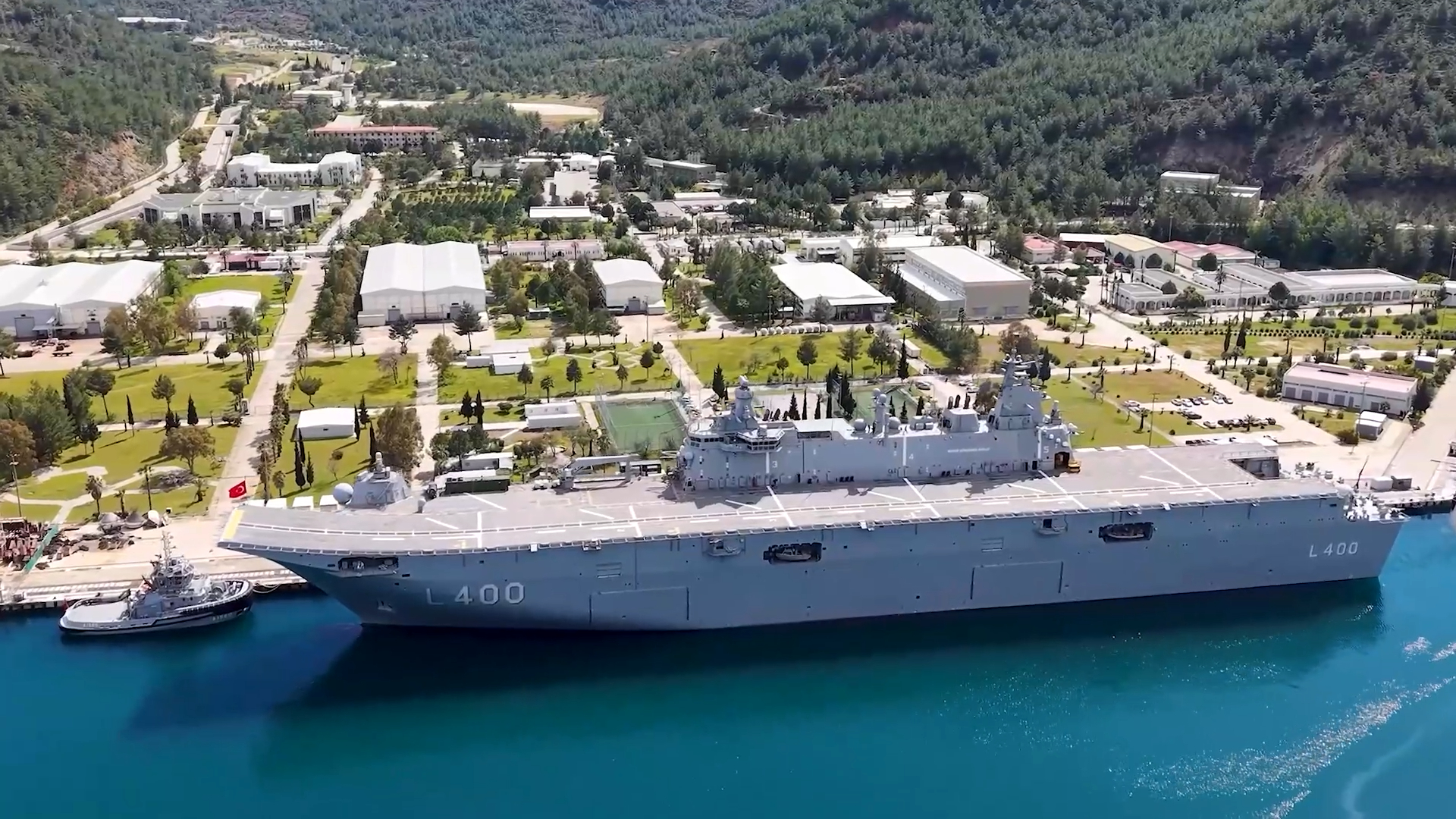
Some classes of warship do not need the power density offered by marine Gas Turbines. For example, for LPD, LHD and naval auxiliary ships, with top speeds these days often around 20 knots to maximize cost-effectiveness; medium-speed diesels are the natural choice. Rolls-Royce involvement in recent amphibious vessel and naval auxiliary ship programmes includes the French Navy Mistral class – using Mermaid podded-drives (a joint venture between Rolls-Royce and Converteam), RFA Argus – a UK Royal Fleet Auxiliary aviation training ship (with a Maintenance By the Hour (MBH) contract including availability guarantee for Rolls-Royce Diesel Generating sets), and the RNLN Joint Support Ship (JSS) programme.
JSS is a good example of a modern LPD programme for a European navy. The vessel will be equipped with four Bergen B32:40V12A generator sets and one B32:40L6A which will provide diesel electrical power and propulsion. The robust multi-function ship is specifically designed for maritime support, strategic sealift and sea basing missions in both open ocean as well as in littoral waters. At its disposal are capabilities for replenishment at sea, storage of supplies, transport of materiel and personnel, and for extensive medical, technical and logistical support.
The Rolls-Royce Bergen range of diesels are suitable for a variety of propulsion system configurations as prime mover or auxiliary generator sets in naval vessels, where reliability, fuel efficiency, through life cost, and environmental constraints, are significant factors. The modern engine designs are compliant to stringent IMO Tier II emission requirements without the application of common rail modifications, using diesel or gas fuel.
For modern naval auxiliary vessels with a typical naval operating profile, the most cost-effective option can be the Hybrid electro-mechanical system as shown, which strikes a good balance in terms of cost versus capability.
It uses LV for propulsion and generation/distribution, and therefore totally avoids the need for HV and its associated additional initial cost, safety cases etc…

|
|
C25:33 |
B32:40 |
|
Output |
1440-3000kW |
3000-8000kW |
|
Bore x Stroke |
250 x 330mm |
320 x 400mm |
|
Speed |
900 – 1000rpm |
720-750rpm |
|
Variants |
In-line: 6, 8 & 9 |
In-line: 6, 8 & 9, V12 & 16 |
Engine design criteria
The Rolls-Royce Bergen design is based upon the fundamental need for robust and reliable engines, with exceptionally high levels of availability. The offshore sector in particular has very similar needs to the naval sector, insofar as it has a very arduous, harsh operational environment within a safety-critical industry. The engine designs are certified to all the normal classification society commercial ship rules, and have recently been assessed and certified to Lloyd’s Register Naval Ship Rules (January 2010 edition).
The Rolls-Royce Bergen engines are modern in design and construction, and have many design features to ensure eminent supportability and availability through-life. The first delivery of a C25:33 engine was in 2002, with over 350 engines in-service/on order to date. The C25:33 engine has 30 per cent fewer parts compared to its predecessor. The lead engine has accumulated over 40,000 trouble-free hours. The B32:40 engine was first delivered to a customer in 2001, and to-date over 980 engines have been delivered/ordered.
Naval and coast guard references
Rolls-Royce Bergen engines are in service with more than 10 navies/coast guards worldwide, including the Royal Navy/Royal Fleet Auxiliary and the US Navy Military Sealift Command.
Electrical systems
Electrical systems have found increasing popularity in all marine sectors in the last few decades. The offshore sector is often where innovation is born, sometimes due to the complexity of its vessels; first generation Hybrid systems have been at sea for a decade or more, and Rolls-Royce is now pioneering the development of 2nd generation hybrid systems which will further enhance operability and lower through-life costs.
The good news for naval auxiliary vessels such as LPD, LHD, AO and smaller is that many offshore technologies and innovations are eminently suitable, and offer many of the benefits which are being realized by offshore operators to the naval sector. A good example is Hybrid propulsion with a feature called Hybrid Shaft Generator (HSG) Patent Pending. This allows the power take off / shaft generator to provide electrical power into the ship’s distribution system at the prescribed steady 50 or 60 Hz even though the main engine is operating in combinatory mode - variable engine speed with design (or close to design) pitch achieved on the controllable pitch propeller, thus maximizing propulsion efficiency. The potential benefits to naval platforms are summarized below;
- Through-life cost savings - enabled by lowering the dependence on the (high-speed) Diesel Generator sets. In a relatively small vessel like an OPV, these are typically 1500rpm (50Hz) or 1800rpm (60Hz) engines with poor efficiency AND require a lot more maintenance than the medium-speed main engines.
- Initial cost saving opportunity - so for a given flexibility/redundancy requirement, you could install fewer ship service diesel generator sets, which may be each rated at 400kWe to 600kWe in a typical OPV. With HSG, you could fit just 3-off or potentially even 2-off DGs and use the shaft generator as the additional generator(s) in either normal or reversionary operation.
Rolls-Royce electrical system capability also includes switchboards and other elements of LV distribution to commercial and naval standards, LV Diesel-electric propulsion (up to 5500kW per shaft), and a comprehensive power system integrator capability with complete oversight of electrical system level considerations such as harmonics, load flow, fault current and protection coordination.