Navantia: A Legacy of Excellence in Shipbuilding
Defence Turkey: How would you best describe the state-owned Spanish naval shipbuilder Navantia today? Even though its main line of activity is in the naval field, Navantia also designs and manufactures systems for the Army and the Air Force. Could you please provide some key facts about the company for our readers?
Alfonso Valea GONZÁLEZ: Navantia has the ambition to be a world-wide provider and is currently involved in several strategic projects and international collaborations. For example, it has reached an agreement to acquire the British shipyard Harland & Wolff, known for building the Titanic. This acquisition will allow Navantia to expand its construction capacity and secure jobs at several shipyards in the United Kingdom.
And is correct that Navantia not only excels in the naval sector, but also offers advanced solutions and integrated systems for the Army and Air Force, adapting to the specific needs of each client and project. For example, Navantia has developed the CATIZ Combat Management System (CMS) for naval vessels. This experience has been applied to develop systems for land and air applications.
Navantia is a state-owned company dependent of the Finance Ministry, among the leading Spanish companies in R&D investment. It employs more than 13,000 people between its own workforce and auxiliary workforce and designs and manufactures naval vessels and systems but also offshore energy applications.
Defence Turkey: Could you give us an overview of 2024 from Navantia’s point of view and could you elaborate on the company’s targets for 2025?
Alfonso Valea GONZÁLEZ: 2024 has been a very busy year in terms of commercial activities and advance of the programs. A new contract for the construction of three additional AVANTE 2200 Corvettes has been signed with Saudi Arabia Naval Forces and the production phase has already started. The big programs for the Spanish Navy are advancing according schedule: F-110 and S-80, but also the Submarine Support Vessel (BAM-IS), in production now, and the Coastal Hydrographic Vessels (BHC), in the phase of design. Also to mention the keel laying of the OPV for Marrocco and the advance in the design of the Fleet Solid Support Ship for the Royal Navy.
For 2025 we have several important challenges as it is the launching of the F-111 “Bonifaz” Frigate and the floating of the S-82 “Cosme de los Ríos” Submarine.
Defence Turkey: How would you describe the current position of Navantia, in both technological and commercial terms, in the global maritime sector?
Alfonso Valea GONZÁLEZ: Navantia is in a prominent position both technologically and commercially in the global maritime sector. Here are some key points:
Innovation and Technology: Navantia promotes investments in R&D+i through the improvement of its products with innovative solutions and the development of new products. The company is working on its "shipyard of the future," with technology and infrastructure that will enable significant industrial evolution to maintain its competitiveness and continue offering high-quality products. Furthermore, Navantia has extensive experience in Technology Transfer (ToT) programs and training activities with various programs for the Spanish Navy and foreign navies.
Integrated Systems: The defense industry is evolving toward a higher level of systems integration, and Navantia is at the forefront in this regard. The company offers comprehensive solutions that include not only naval platforms but also training and Through Life Support (TLS) services.
International Projects: Navantia is committed to the involvement of local industries in its programs as required by our clients. For example, Navantia has achieved an Australian industrial content of over 60% for the Hobart-Class Destroyers and has implemented numerous research and development (R&D) and supplier development projects with Australian companies. The company is also involved in collaborative projects with Canada, offering export opportunities for Canadian companies and establishing an Innovation Center for the Canadian marine sector.
Renewable Energy: Navantia Seanergies, a division of Navantia, is dedicated to the development of green energy, through the construction of elements for offshore wind farms and the development of hydrogen as an energy transport vector.
Defence Turkey: How much time, effort and money has Navantia allocated for R&D annually?
Alfonso Valea GONZÁLEZ: Navantia is committed with technology and the R&D is strategic for us. The inversion in R&D goes from 5% to 10% of the income, depending on the phases of the programs ongoing. In 2024, we have reached an exceptional 10,4% of our income. Our ratios are higher than the average in the industry.
Defence Turkey: Can you briefly introduce our readers to the major programs, local and international, that are keeping Navantia busy these days? What key geographical markets are your next targets?
Alfonso Valea GONZÁLEZ: Navantia is working now in two major programs for the Spanish Navy: five F-110 Frigates and four S-80 Submarines. As well it is building 2 Hydrographic Vessels and a Submarine Support Vessel.
For the international market there are two important programs going on: three Avante 2200 Corvettes (additional to the five already delivered) for Saudi Arabia, and three Fleet Solid Support Ships for the United Kingdom.
The key geographical markets are Kingdom of Saudi Arabia, Canada and Australia, besides Türkiye, one of the most important markets for many years.
Defence Turkey: Navantia has indeed made significant strides in the global defense and shipbuilding market over the past decade, reaching an impressive €10 Billion in exports. Can you elaborate on the evolution of the company's export activity and the factors contributing to its growth?
Alfonso Valea GONZÁLEZ: In this graphic you can see the evolution of the company in the last 25 years, in terms of internationalization.
A key factor contributing to this growth has been the consolidation of its own products. The company has evolved from constructing in Spain with foreign designs to shared designs, then to developing its own designs, and finally to exporting these designs while also enhancing its capability to construct abroad
Defence Turkey: Can you elaborate on the status of the Saudi Arabia’s AVANTE 2200 Corvette Program? Within the scope of the five-ship "Sarawat Project" signed between Saudi Arabia and Navantia Shipyard first of five corvettes, Al-Jubail, was delivered in 2022. And in October 2024, Navantia secured a follow-on contract for the construction of further 3 ships.
Alfonso Valea GONZÁLEZ: The contract for 5 Avante 2200 Corvettes signed in 2018 is now in its last stage of finalization, with a through life support period of five years for the 5 corvettes which have already been delivered and are fully operational with the Royal Saudi Naval Force.
The second contract for 3 additional corvettes signed in 2024 is underway and so far, a per schedule, with the keel laying of the first corvette in June this year. This contract will be finalized in 2028 with the delivery of the last corvette. These corvettes will be identical to the previous corvettes of the first batch, in terms of combat system and platform.
Defence Turkey: As a turnkey supplier able to go through all design, build, commission, and life cycle support phases, Navantia can assist any navy and international shipbuilders with a wide range of Transfer of Technology solutions. Saudi Arabia’s AVANTE 2200 Corvette Program also covered a wide range of Transfer of Technology (ToT) solutions both to the Royal Saudi Naval Forces (RSNF) as well as to the local Saudi industry. Can you elaborate on the ToT solutions that Navantia already supplied and continues to provide to Saudi Arabia within the scope of this successful corvette program.
Alfonso Valea GONZÁLEZ: Navantia provided the Kingdom of Saudi Arabia an extensive Transfer of Technology and knowledge. The creation of the joint venture SAMINavantia was done for the transfer of knowledge to Saudi engineers for the local development of the Combat Management System, Fire Control System, Integrated Platform Management System and the Integrated Communications System. Additionally, SAMINavantia was responsible for the installation and integration of the Combat System of the 4th and 5th corvettes in Saudi Arabia. Also, more than 150 maintainers from the Royal Saudi Naval Force were trained for the maintenance and though life support of the corvettes.
Furthermore, and associated to the recent contract for 3 additional corvettes, SAMINavantia will be providing the complete Combat System of the vessels, as well as the installation and integration of the Combat System for the 2nd and 3rd corvettes in Saudi Arabia. Additionally, several blocks of the 3rd corvette will be manufactured in Saudi Arabia by the local industry, including the training of more than 100 Saudi engineers in naval programs, naval shipbuilding, procurement, engineering, etc.
Defence Turkey: Collaboration and strategic partnerships are central to Navantia’s approach and the company has wide experience in collaboration. Can you discuss the company’s key synergies with national companies, SEPI group entities, and international partners? What are some of the significant collaborations currently underway?
Alfonso Valea GONZÁLEZ: Navantia is a leading industrial player and aims to seek synergies with strategic partners and collaborating industries, both nationally and internationally. For example, in the F-110 Program, more than 500 companies are participating, some as important as Lockheed Martin or Indra. The same can be said for the S-80 Submarine Program.
On the other hand, there are strategic partnerships with shipyards from different countries to which Navantia transfers its technology to enable local construction. The circle is completed in cases where Navantia, in association with governments or other companies, establishes itself in the country to design, build, and manage the lifecycle, as is the case with Navantia Australia, Navantia UK, or Navantia Arabia.
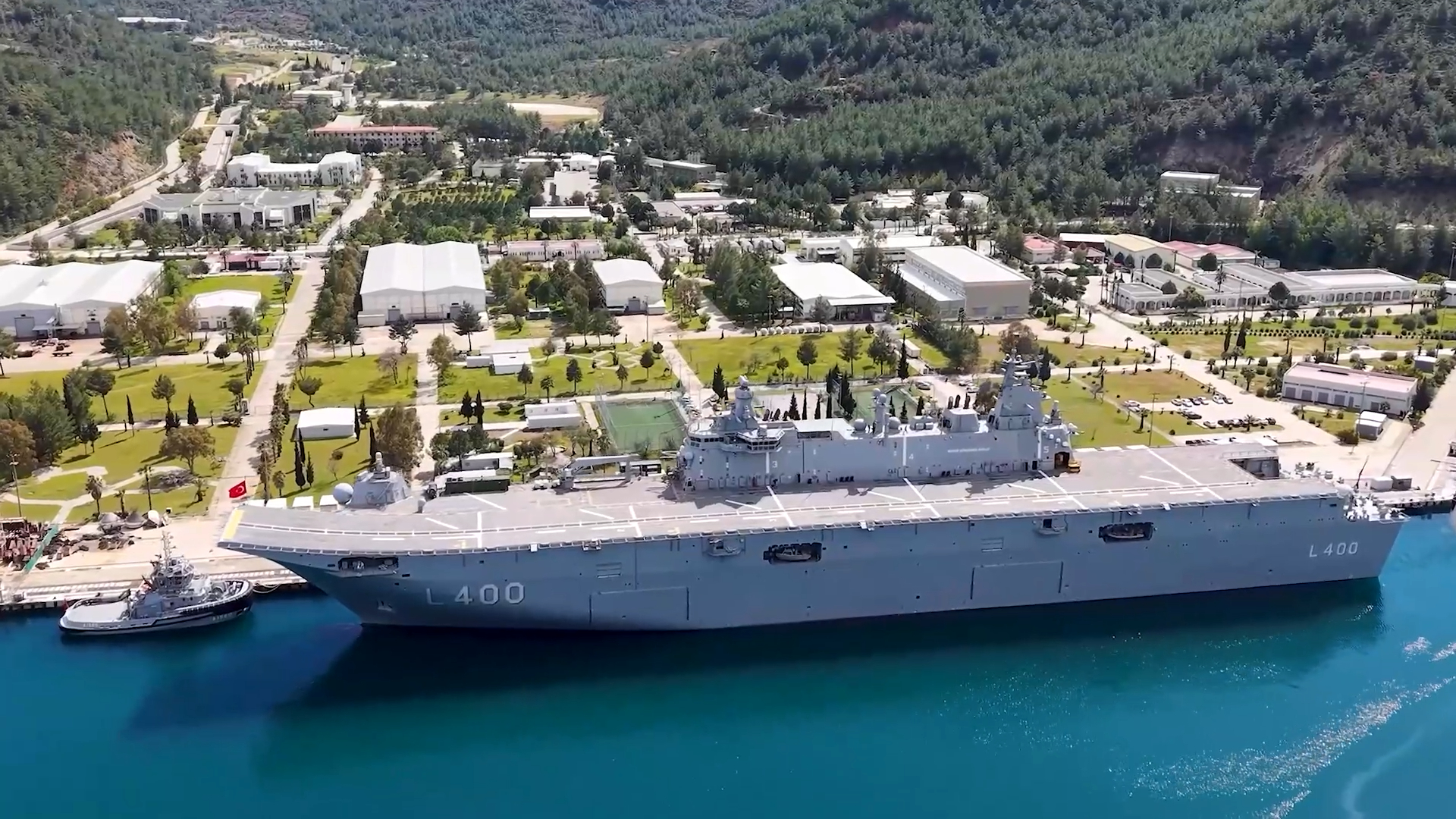
In Türkiye, the partnership with SEDEF that made possible the construction of the LPD Anadolu for the Turkish Navy, is a clear example of collaboration.
Defence Turkey: Can you elaborate on the current status of Air Independent Propulsion (AIP) powered S-80 (Isaac Peral Class) Submarine Program, covering the construction of 4 state-of-the-art submarines for the Spanish Navy?
Alfonso Valea GONZÁLEZ: The BEST-AIP System has undergone remarkable progress since the Factory Acceptance Tests (FAT) held in July 2023. These FAT marked the beginning of a series of important evaluations that would eventually lead to the integration and operational validation of this advanced technology. The FAT tests were succeeded by the Field Evaluation Trials (FET), where the AIP System was integrated with the S-81 Submarine. This phase was crucial as it demonstrated the seamless functionality between the AIP System and the S-81 Submarine systems. By November 2024, Navantia celebrated the embarkation ceremony of the equipment, marking a significant milestone in the development of the BEST-AIP System.
Navantia is preparing to launch the S-83 Section 3 trials in the second half of this year 2025. These trials will validate the full functionality of the AIP System in its real installation, replicating high-fidelity conditions that simulate actual operational environments, including realistic battery setups and simulations of bow and stern systems and navigation conditions (depth, speed...). Following the successful completion of the S-83 Section 3 trials, the system will be “ready-to-sail”, having confirmed its physical integration through these rigorous testing. Navantia anticipates that the S-83 Submarine will commence its trials in May 2027, after its launch, and will be delivered to the Navy by the end of 2028.
Defence Turkey: What can you tell us about the feed backs you have received since the induction of the S-81 into the Spanish Navy Submarine Flotilla in November 2023?
Alfonso Valea GONZÁLEZ: The crew of the S-81 has especially highlighted the ease of handling the platform, the precision of the steering system, and the excellent maneuverability of the submarine, combined with advanced navigation sensors and the sonar suite system. Regarding the Steering & Diving Control System (SDCS), its reliability and redundancy provided by its multiple modes have been proven, a system that has been evaluated as Fly-By-Wire according to US Navy standards. As for the Integrated Platform Control System, it allows for a reduced crew, controlling the platform entirely from command-and-control room, offering high reliability and easy control. It allows for a fully integrated knowledge of the platform's status, safety submerged navigation, and propulsion at all times, as well as including cybersecurity systems.
Defence Turkey: Starting from the Cosme García (S-83), the S-80 Submarines will be equipped with the revolutionary 3rd Generation 300+ kW (400 hp) Bio-Ethanol Stealth Technology (BEST) AIP System, using bio-ethanol fuel cells and an Ethanol Reformer, that generates the required hydrogen from ethanol through a reformer. The first and second submarines that built without AIP Systems will receive them during initial major overhauls. Can you elaborate on the AIP BEST System for the S-80 Submarines? How does it operate and how is it different from other AIP Systems in the market?
Alfonso Valea GONZÁLEZ: The use of bioethanol provides significant logistical advantages. It is widely available with a developed industry and easy to handle, using conventional means for transfer and onboard shipment with safety. This logistical experience is similar to fossil fuels and is cost-effective, contrasting the use of pure hydrogen and storage in metal hydrides. Additionally, bioethanol offers sustainability benefits, including a negligible carbon footprint and environmental impact in case of accidental spills due to its organic origin.
Navantia’s BEST AIP System is a disruptive technology that benefits from a higher energy density onboard due to the use of this liquid fuel. Bioethanol can be stored in structural tanks at ambient pressure and temperature. The primary advantage of this system is the production of hydrogen onboard when needed, without maintaining a hydrogen inventory onboard. Essentially, the generated hydrogen is consumed immediately. This capability extends the autonomy of conventional oceanic submarines like the S-80 from days to weeks maintaining the stealthy of the submarine.
The BEST AIP System also positively impacts the submarine's lifecycle, as there is no need for equipment replacement every 9,000 hours or until immobilization periods during major overhauls (every six years). This ensures the submarine can operate efficiently and sustainably over long periods without frequent maintenance interruptions.
In summary, the BEST AIP System for the S-80 Submarines is a unique and revolutionary solution that sets a new standard in submarine technology. It offers logistical, operational, and lifecycle benefits while enhancing the sustainability and efficiency of naval operations. This makes it the best option for oceanic submarines, providing unmatched performance and reliability.
Defence Turkey: What could you tell us about the international presence of Navantia in global conventional submarine sector, and ongoing marketing efforts under the Poland’s ORKA, Indian P-75(I) and Philippines Programs? Where do you see the strong points of Navantia in these programs/tenders? Can you elaborate on your proposals such as potential efforts in the indigenization of the submarine and on the technology transfer (ToT) under these three programs/tenders?
Alfonso Valea GONZÁLEZ: Navantia has established a significant international presence in the global conventional submarine sector, marked by its active participation in several key programs, including Poland’s ORKA, India’s P-75(I), and the Philippines Programs. Our strategic approach focuses on leveraging our advanced technological capabilities and fostering strong partnerships to meet the specific needs of each country.
Defence Turkey: What is the unique selling proposition of your submarine? What kind of technologies will you be able to transfer to the Polish, Indian and Philippines prime?
Alfonso Valea GONZÁLEZ: Navantia's unique selling proposition lies in our advanced technological capabilities, proven operational performance, and commitment to fostering strong partnerships through comprehensive technology transfer and indigenization efforts. Our submarines are designed to meet the highest standards of performance, reliability, and adaptability, making them an ideal choice for various international defense programs.
Defence Turkey: Technology has been evolving rapidly and there are many recent innovations that have not been incorporated yet in most of the existing conventional submarines. As a follow up to the S-80 Program, have you defined a roadmap including several innovation projects in order to evaluate the integration of certain technologies (such as Lithium-ion batteries and Vertical Launching System) and systems that could be part of future S-80 upgrades, evolutions for other customers or additional units in the class? If yes, what can you tell us about your roadmap?
Alfonso Valea GONZÁLEZ: Navantia maintains a policy of continuous capability insertion into the designed units, ensuring for instance that the S-84 submarine (currently in construction) will include improvements in sensors and systems over the first of class. Like any defense program with a prolonged lifecycle, Navantia and the Spanish Navy are monitoring obsolescence and will implement upgrades during scheduled immobilization periods. Additionally, although specific details cannot be disclosed, Navantia has a roadmap for integrating new technological developments in future evolutions of the S-80 reference design together with the Spanish Navy.
Defence Turkey: In the aerospace domain, next generation fighter jets will feature the flexibility to undertake manned and unmanned missions. Do you think in coming decade new generation/future submarines will also gain such capability? What can you tell us about Navantia’s approach to autonomous underwater vehicles and manned-unmanned teaming in the sub-sea domain?
Alfonso Valea GONZÁLEZ: A new generation of sensors with greater capacity to detect information and signals, as well as technology (ideally supported by Artificial Intelligence) that allows this information to be analyzed quickly and accurately. It is crucial to improve the perception system in underwater environments, as well as the precision in navigation (e.g., inertial systems). Additionally, advancements are needed in autonomous decision-making. This remains a challenge even for surface vehicles, making it even more complex in the underwater environment.
Underwater communications with greater range and stealth (which will be fundamental both for communication between different units and for their control). In this regard, Navantia is advancing in several lines:
Its Naval Advanced Integrated Autonomous Defense (NAIAD) System allows the agile integration of unmanned vehicles. This system is already available for surface vehicles and Navantia also has unmanned surface vehicles (USV) with autonomous capabilities (USV Vendaval and USV Poniente) with great operational capacity. However, fully autonomous decision-making in surface vehicles remains a challenge in the industry.
Navantia, through its R&D + Venture area, monodon, is working on the research and development of promising new technologies to achieve fast, stealthy, and cyber-secure communications from the ocean floor to space. In this regard, we are currently working on the TACTICS Project in collaboration with other technological leaders, research centers, and universities, for which we hope to obtain European funding soon.
In short, we do not know if in a decade we will have such capacity, but certainly the sector's roadmap is heading in that direction and Navantia is excellently positioned globally to offer this capacity, this technological superiority to our clients in the future.
Defence Turkey: Can you elaborate on Navantia’s approach to Turkish Navy’s MILDEN (National Submarine) Program? What kind of services and technologies that could be fitted in those submarines will you be able to transfer to the Turkish Navy and Turkish Industry?
Alfonso Valea GONZÁLEZ: Navantia's ToT model has been tested in multiple situations and diverse case studies. It is based on flexibility and adaptability to local shipyard, Turkish Navy and Turkish industry conditions, with a wide variety of viable technology transfer scenarios: main contractor, subcontracting, consortium, and alliances. Navantia offers its collaboration to the shipyard, contributing its knowledge and experience and ensuring the viability of the program in terms of cost and time.
As Navantia, we can offer shipbuilding management, design and engineering, systems capability, production, testing, and acceptance, supply chain management, integration of the anaerobic propulsion system (AIP), combat system integration, training, simulators, lifecycle support operations and digital services (SSI, digital twin etc).
Defence Turkey: Can you elaborate on the current status of the F110 Frigate Program for the Spanish Navy? The Spanish MoD signed a €4,3 Billion contract with Navantia on 23 April 2019 for the construction of 5 state-of-the-art multi-purpose escort vessels with anti-aircraft, anti-surface and anti-submarine capabilities that will enable them to perform their force protection and naval projection functions. What can you tell us about the technological advances that F110 design will incorporate compared to existing frigate designs?
Alfonso Valea GONZÁLEZ: The F-110 Program is progressing according to the scheduled dates, from the signing of the contract in 2019 to the delivery of the last unit in the series in 2032. Construction of the first unit (F-111) began in 2022 and is set to be launched around summer this year and delivered to the Spanish Navy in 2028. The remaining four frigates will be launched consecutively over the next four years. The keel of F-112 has already been laid in the slipway and construction of F-113 is also started.
The F-110 Program is a driver of digital transformation and includes advances as the digital twin, new trends in artificial intelligence, big data, and the Internet of Things, among other technologies.
Defence Turkey: The F110 Class Frigates will be smart ships, the first Spanish naval program designed to have a Digital Twin. What is your vision of technology in the naval vessel construction sector? Where do you see this headed and how are you positioning Navantia in this journey? What kind of new products and technologies do you see a demand for in the coming years? What can the industry expect to see on the horizon as new products and technologies from Navantia?
Alfonso Valea GONZÁLEZ: Navantia´s vision is highly focused in creating new capabilities to the customer based on a robust value proposal aligned with current and future customers challenges in terms of superior performance and resilience at sea. Technology in general is seen by us as an enabler for implementing that vision, and new digital technologies are disrupting opportunities. F110 shall have a new digital platform supporting a digital twin and an IoMT Backbone (Integrated Service System - ISS) in accordance with Spanish MoD use cases and requirements.
The need of a new reference digital architecture is paramount, and Navantia is pulling these efforts leading a common European collaborative and wide view through different on going EDF projects as EDINAF.
These digital solutions and experience position Navantia in an upfront place suitable to continue facing new incoming challenges of this digital journey, aimed to manage autonomous systems within a defense metaverse. Information Superiority is the key mission for allowing our customers taking the right decisions anticipating to Situational Evolution Awareness.
In the coming years, new products, technologies and services, anticipating changing client needs, and challenging price and delivery time will be driving naval industry evolution in all life cycle stages: design, production, and sustainment. Navantia foresees an increasing demand on high value solutions based on the digital architecture, generally known as digital assets and multidomain collaborative scenarios through the Naval Combat Cloud. Artificial Intelligence as well as Knowledge based are key drivers for multidomain operations including the cyberspace. Cybersecurity threats are growing together with the higher level of system’s interconnection and automation. Ensuring cybersecurity of naval systems is a key challenge during all ships and submarines life while operating in interconnected multidomain environments.
Related to this aspect, Navantia can offer currently standard digital solutions with a customization layer iaw specific main interest customer use cases and requirements. Some examples of these solutions are:
Digital Twinning: A ship’s digital twin, as the one that will be onboard the future F-110 Frigate is the key to a safe and optimized operation and sustainment throughout the ship’s life.
Navantia’s patented Integrated Service System (ISS) provides a digital infrastructure for the ship replacing traditional lighting fixtures by a highly technologically advanced device which conform a management and communication nervous system, which will permanently connect the crew to each other, and the crew to the ship’s systems.
Robotics and Automation: The future sub-block manufacture line at the Navantia Shipyard in Ferrol will gather these processes in a 45,000 m2 factory for the F-110 Frigates, achieving an unprecedented level of automation in shipbuilding.
Unmanned Vehicles: Navantia has developed the Naval Advanced Integrated Autonomous Defense (NAIAD) system for the tactical integration of unmanned vehicles (UxV).
Virtual and Augmented Reality (VR/AR) allows the immersion in the natural environment in NAVANTIS (NAVANtia Training Integrated System). Through the use of NAVANTIS and thanks to the digital training the entire crew can go directly on board from the Training Center and navigate safely.
Defence Turkey: Can you elaborate on Navantia’s approach to Turkish Navy’s TF-2000 Air Defense Warfare Destroyer Program? What kind of services and cutting-edge systems that could be fitted in those destroyers can Navantia offer to the Turkish Navy?
Alfonso Valea GONZÁLEZ: Navantia is willing to collaborate with the Turkish Navy on the TF-2000 Air Defense Warfare Destroyer Program, based on the needs of the Turkish Navy. We offer support in Design and Engineering, Equipment and Systems Supply, Lifecycle Support, Digital Twin (DT), and Integrated Service System (ISS).
Our service department can offer our portfolio of lifecycle support services to the Turkish Navy, including lifecycle management services, lifecycle support engineering, training and simulation services, both traditional and using digital technologies such as virtual and augmented reality, corrective and preventative maintenance services, remote technical assistance, and technology upgrades.
Defence Turkey: How would you assess the current level of Turkish Naval Ship Construction Sector and the level of cooperation between the Navantia and Turkish Industry? Do you believe Navantia, and Turkish Naval Industry can establish cooperation, at least at Technologic Support Provider (TSP) level, under both the MILDEN and TF-2000 ADW Destroyer Programs?
Alfonso Valea GONZÁLEZ: Navantia aims to collaborate with the Turkish Defense Industry in developing capabilities and gaining experience in our naval programs internationally, seeking partnerships with local companies. We have extensive international experience in engineering support, the supply of IPMS (Integrated Platform Management System) and engines, as was the case for the TCG ANADOLU Program.
Defence Turkey: Does Navantia have an aircraft carrier design other than ATHLAS 26.000 (Juan Carlos I/TCG Anadolu LHD) design? How does Navantia approach Turkish Navy’s MUGEM (National Aircraft Carrier) Program? Under the MUGEM Program, in which areas and to what extent can collaborations be established between the Turkish Naval Forces, the Turkish Naval Shipbuilding Industry, and Navantia?
Alfonso Valea GONZÁLEZ: Navantia has a huge experience in LPD/LHD. We have built two Galicia Class LPDs for the Spanish Navy, Principe de Asturias Aircraft Carrier and Juan Carlos I LHD, which contributed to our LHD concept. We have built two Canberra Class LHDs for the Australian Navy and TCG ANADOLU for the Turkish Navy. Navantia is a world leader in the amphibious ship market.
We continue our work to be included in the MUGEM Program, as we have design flexibility, the infrastructure that can adapt to the specific needs (as functional and detailed design support, systems supply, digital twin, integrated service system, and block construction) and standards of our customers.
Defence Turkey: Navantia has been present in Turkey for almost 30 years, confirming its commitment with the country with the opening of Navantia Turkey in 2013. How would you assess the current level of cooperation between Navantia and Turkish Industry?
Alfonso Valea GONZÁLEZ: Navantia's main objective is to be one of the few companies with full capacity in the design, development, production, integration, and integrated logistics support of platforms, propulsion, and naval combat systems, as well as the ability to deliver fully operational vessels.
The entire design process of the TCG Anadolu ship, the technical support and equipment and system supplies we have provided, together with our relations with the Turkish Defense Industry have become even warmer in each new condition. In the light of the close policy carried out between the two states as two NATO member states, both Navantia and the Turkish Defense Industry and companies continue their work at full speed. As the Navantia Turkey Office, our goal is to continue to play an active role in the Turkish market and to provide all the necessary coordination for cooperation and new project contracting in the regional field.
Defence Turkey: Following the deployment and flight tests of BAYRAKTAR TB3 UCAV on TCG Anadolu (L400) Landing Helicopter Dock (LHD), Spain showcased its interest in the same capacity and recently Navantia has an agreement with Airbus to investigate the integration of SIRTAP UAVs aboard the Spanish Navy’s Juan Carlos I multi-purpose LHD vessel. Can you elaborate on the coverage, schedule and current status of this integration effort?
Alfonso Valea GONZÁLEZ: Navantia and Airbus have signed a collaboration agreement for the integration of SIRTAP on board LHD Juan Carlos I. The study will focus on three primary pillars: Command and Control (C2), Combat System Integration, and Navigation Support, including specific attention to take-off and landing operations. Navantia and Airbus have already started to work together.
Defence Turkey: Looking ahead, what are Navantia’s strategic priorities and objectives for the future, particularly regarding growth, market expansion, and export ambitions?
Alfonso Valea GONZÁLEZ: Internationalization is one of our strategic priorities. We have delegations all over the world and recently Navantia has acquired four Harland & Wolff Shipyards in UK, with the intention of creating an exceptional platform for growth in terms of capabilities and markets.
Defence Turkey: Thank you for sparing your time for our readers?