Navatia Offers More Advanced Submarine to Potential Customers
The S-80 program was launched in collaboration with IZAR (currently Navantia), the Spanish Navy and the Ministry of Defense on 25th March 2004 to construct four submarines which were initially scheduled for delivery in respectively 2011, 2012, 2013 and 2014. Due to a serious deviation in the vessel’s overweight control and also technical deficiencies of design as well as AIP system, the program was delayed several times. These boats acquired a notorious reputation for being 70 to 100 tons too heavy at one stage of the design process. The US submarine constructor General Dynamics Electric Boat was involved in the project as consultants to make the submarines buoyant again. Navantia selected General Dynamics (GD) Electric Boat for technical assistance to fix the overweight and design failure of the submarine in May 2013. This collaboration was not entirely included in technical assistance within the scope of this agreement, technical and organizational restructuring were actualized, and new methodology and guideline were also adopted to overcome the deficiencies.
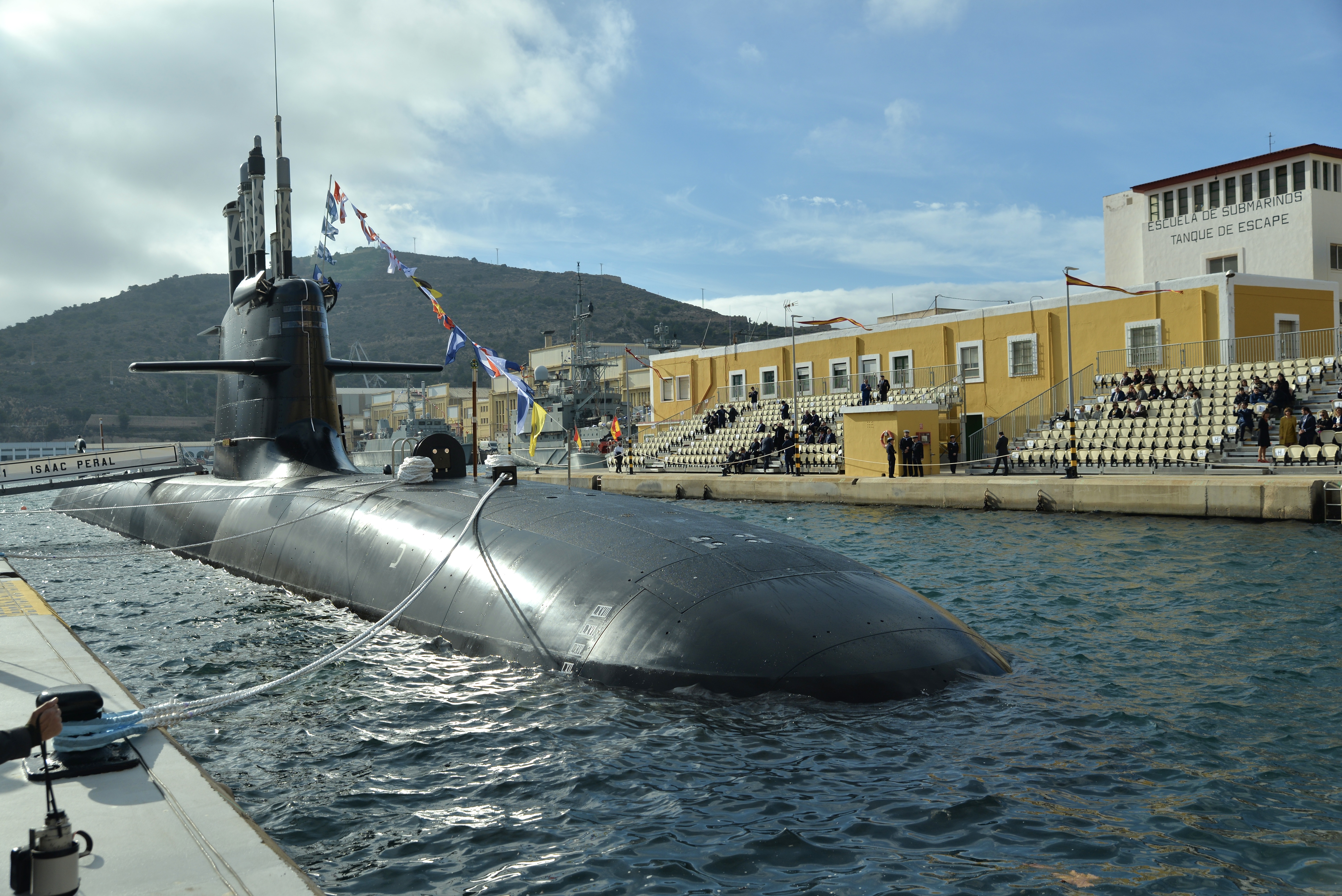
Under this new model SSR (System Requirement Review), SDR (System Definition Review), PDR (Preliminary Design Review) and July in 2016, the CDR (Critical Design Review) was accomplished by Navantia. On December 19th 2018, the Complementary Execution Order for the S-80 Submarine program was signed. The pressure hall of the first submarine “S-81” was completed in December 2019. The “Isaac Peral “was launched in April 2021.
The S-80 submarine is a conventional submarine designed to be capable of going on expeditions. The submarine has an overall length of 80.8 meters, pressure hull diameter of 7.3 meters, and a submerged displacement of 2,965 tons. With a draught of 6.3 meters and a range of 8,500nm, its maximum speed when submerged can exceed 19 knots, surface speed 10 Knots and the maximum operating depth over 300 meters.
The hull of the submarine is optimized for very low acoustical signature. It has a single hull with several watertight layers/surfaces. With a crew of 32 submarines the boats have spare berthing for 8 special forces personnel.
The main propulsion is based on 3,500kW Electric Motor (MEB). Three groups of 1,200 kW diesel generators that produce the power needed to power MEB and charge batteries on-board.
The S-80 Plus class submarines will possess an Air Independent Propulsion (AIP) system that were developed and produced in Spain. AIP system will have two components, the PEM and the bioethanol processor. The 300Kw fuel cell power module, supplied by the American company UTC Aerospace, will generate electricity by a chemical reaction from the mixture of pure oxygen in a gaseous state and pure hydrogen. The S-80 Plus has a hydrogen production system on board as reformed bioethanol. The Spanish Ministry of Defense (MoD) decided to go with bioethanol instead of ethanol as bioethanol can be produce in country thus eliminating the dependence on international ethanol production.
The main advantage that using AIP gives the modern submarines over other conventional submarines is that it allows them to operate independently underwater for longer periods of time.
While the system is active, it does not need to climb to periscope depth to recharge the batteries using diesel generators and the 'snorkel system' (a tube used to feed air into the motors). This system improves the submarine's indiscretion ratio, meaning the possibility that it will be detected by other vessels, which is greater when 'snorkel' is being used. AIP therefore improves the discretion of submarines in situations where they need to navigate silently.
“BEST AIP System is Currently the Most Advanced AIP on the Market”
Navantia has been developing its own AIP System with local and multi-national partners for almost two decades, called BEST (Bio-Ethanol Stealth Technology). The first power generated in AIP in September 2018 and the Full integration test simulated on the sea environment and full integration test of naval equipment test was completed between 2018-2019. Eventually, BEST AIP successfully passed FAT in September 2023, and the dream turn into a reality. BEST AIP is dubbed as the most advance AIP system on the market by Navantia Executives.
BEST-AIP, an atmosphere-independent propulsion system based on bio-ethanol reforming technology and Spain will be the first country to utilize the bio-ethanol reformer in the world. Unlike the conventional AIP Systems, it offers many advantages in terms of facilitating the supply of required fuel from an operational aspect. The submarine generates its own hydrogen on board thanks to with bio-ethanol reformer system. Bio-ethanol is produced from agricultural waste. It can be easily supplied with the necessary reagents, bioethanol and liquid oxygen anywhere in local or international ports worldwide. According to Navantia executives, the military use of Bio-ethanol brings the end-user a cost-effective solution. When you use it on military side, you can get it tax-free or you can pay less than one €1 per liter. In addition, bio-ethanol fuel storage is safer during operation than the pure stored flammable hydrogen in the pressure hull.
The BEST AIP system generates electric energy that is required to charge electric motor batteries (main propulsion system) while submerged. Thanks to chemical reaction composed by hydrogen and liquid oxygen tanks (supplied by Air Liquide with a net capacity seventy tons) the generation of water and carbon dioxide in the system is achieved. While the water is stored for usage on board, the carbon dioxide is discharged from the boat through special equipment located under the hull. The Spanish company BIONET is responsible for developing the technology that allows the perfect dilution of gases emitted by ocean waters. During, the discharge of carbon dioxide, the bubbles generate a noise from the vessel. The noise and decibel can be detected by hostile surface and underwater units equipped with advanced sensor systems. Navantia has been working for many years to dilute the sound created by the bubbles. The Managing Director of Navantia's Submarine Business, Germán Romero Valiente, explains these activities: "We are working on the development of the carbon dioxide removal system. The almost crystalline water with a minimum number of bubbles, we've been working over the years in our research program, first to correlate the bubbles with the noise and then to check in our facilities how the number of bubbles and the size were created. So, we've been working on the correlation, first in the medical simulation to correlate them with the noise, and then in the physical evaluation. We can simulate this process in our facilities, and we have support to verify the number and size of the microbubbles and then give us an idea of the decibels that will be created at the end of the day to the noise of the submarine".
BEST AIP supplies the ship with electrical power at any depth so that it can remain underwater for weeks. Thanks to this system, the S-80 is expected to be able to operate independently underwater for up to three weeks.
However, this AIP system is based on a bio-ethanol reformer and PEM fuel cells will be initially operational on the third boat S-83. The BEST AIP systems will be installed on S-83 ‘COSME GARCIA’ & S-84 ‘MATEO GARCIA’ from the scratch (construction phase). The liquid oxygen tank are already incorporated into the S-81 “ISAAC PERIAL” and S-82 “NARCISO MONTURIOL” submarines. The first two boats will be delivered without the BEST AIP system. The S-81 & S-82 will be fitted with the BEST AIP System during their first major overhaul in next 6 years following commissioning and according to overhaul schedule, it will take at least 1.5 years. Unlike cutting the pressure hull, the BEST AIP system will be installed in an exclusive hatch over the submarine.
The BEST AIP System is expected to be installed the S-83 “COSME GARCÍA” in the first quarter of 2024.
The S-80 Plus class submarines have an Integrated Combat System (ICS). This integrated Combat System was developed by Lockheed Martin and Navantia Sistemas. It compromises seven multi-function operator consoles (MFFC), one large tactical display (LTD), two navigation and network system cabinets (NNSC), two weapon processor units (WPU), six weapon interface (WIU) units, one sonar array suite (SAS) and one own-noise monitoring system (ONMS).
The ICSC allows the combat system’s weapons and sensors to be highly integrated to ensure optimal management of both information about operations and the command-and-control center. It enables all the necessary information to be gathered, assessed and displayed for offensive, defensive or intelligence actions that take place at any time. This includes using weapons and countermeasures and their launching devices. Thanks to this, the combat system is able to find and track multiple targets in different scenarios and simultaneously manage several components.
Specifically, it can manage short, medium and long range active and passive sonars for exploration, attack and navigation tasks; electronic, optronic and electromagnetic detection systems for combat missions or intelligence operations; precise navigation aids; integrated communication systems, including satellite links and tactical data links with other naval vessels through ‘Link-11’ and ‘Link-22’, and weapons systems for operations at sea.
Lockheed Martin developed both cylindrical sonar for hull and the side-can sonar, passive ranging sonar (PSR), which is a sonar for passive location and distance measurement; the navigation sonar for detecting obstacles and mines and the sonar interceptor for detecting sonar emissions.
Spanish company SAES is also in charge of developing two acoustic system; long-ranged the towed array sonar (TAS) and ONMS own-noise and vibration monitoring system, which detects cavitation and other potential noises, as well as the cancellation of its own noises, especially by the Flank Array Sonar. ONMS provides warnings and alerts in case of anomalous noise and vibrations in order to control the acoustic signature of the submarine. SAES has also developed the graphical interface (HMI- Human Machine Interface) of the S-80 sonar suite and other related systems such as the simulator-stimulation and the tactical simulator.
The Naval Suite of S-80 Submarines
The Naval suite of S-80 class submarines are provided by Indra. The S-80 was equipped with EW PEGASO RESM/CESM System, ARIES-S Low-Probability -of- Intercept (LPI) Radar, Friend and Foe Identification System (IFF) Mode 5, Band X & Band Ka Satellite Communication System and PERCOSUB Multisensor Optronic Mast.
The ARIES-S radar is High Resolution Radar is able to detect and track low radar cross section surface targets, in several sea clutter environments. The radar uses continuous waveforms and large bandwidth, allowing long detection ranges with minimum peak transmission power, low probability of intercept (LPI) performances and high robustness against external interference. ARIES-S was designed to be installed in a non-hull penetrating mast and the transmitter/receiver unit has been reduced in size to fit inside the pedestal.
PEGASO RESM CESM system’s family is a scalable and modular Electronic Warfare System that represents the integrated radar and communications bands solution for the next generation of submarines. It incorporates the advantages of True Wideband (6th Generation) Digital Reception as well as highly integrated hardware and constitutes a unique instrument to successfully face the new electromagnetic warfare scenarios. The PEGASO family goes from a baseline configuration (2-18 GHz) with standard DF accuracy measurement (PEGASO RESM BASIC), up to complete configuration (1.6 MHz – 40 GHz) with a complete RESM, CESM, ELINT and COMINT functionality. The RESM most relevant operational capabilities include: Outstanding warning capability of pulsed and continuous wave signals based on wide-band digital receivers; extremely high probability of detection, accurate identification and tracking of targets and advanced deinterleaving and library matching algorithms for accurate identification. The CESM functionality includes detection, classification, short time signals processing, monitoring, technical analysis, tracking and analysis of communication band emissions within the HF, VHF and UHF frequency bands with direction finding within the 120 MHz to 1 GHz. Optionally can be included: ELINT and COMINT subsystems providing intelligence gathering capabilities. Performing ELINT or COMINT processing during mission time or recording data for subsequent further analysis. These options provide the PEGASO system with the capability to extract parameters from collected signals, as well as storage capability and training capability for the operators.
Toguether with Navantia, Indra and SAES are also providing S-80 tactical & platform simulators in order to train the crew. The tactical simulator (SIMTAC) for the submarines in the S-80 series is a system that aims to train students, crew members and ship commanders on how to use the combat system. The Central Gangway and starboard side of the S-80 submarine’s command chamber, including attack periscope, tactical screen and seven multi-function consoles have been replicated. The simulator also includes an area next to the command chamber that serves as a torpedo chamber and contains the on-board management of weapon launches and tube control.
SIMPLA is a full motion replica of the command and control room of the submarine (port side) that presents the crew with all kinds of incidents, failures and emergency conditions. This simulator provides the Spanish Armada with a complete tool for training the crew in normal and emergency procedures.
S-80 Submarines are Ready to Gain Land Attack Capabilities with Tomahawk UGM-109E Block IV AUR
The Weapon system includes six torpedo launchers and the capacity to load and stow 18 weapons which will be able to be used to launch multi-purpose, heavy long-range torpedoes, smart mines and anti-ship missiles. The main offensive weapon of the submarine will be the Atlas Electronic made DM2A4 torpedo. This fiber cable guided weapon can be used against both surface and submerged threats, and it has a 50km range and is capable of traveling at speeds of over 50 knots. It can be guided by a fiber optic wire and has a sonar with a wide coverage, both in frequency and space (horizontal and vertical), which also enables it to reduce the amount of maneuverability required during search and recognition and thus save battery power. The weapon has also multiple guidance modes, in which controlled by the submarine, and self—guidance mode.
The combat management system on board can control various stages of the DM2A4 heavyweight torpedo (HWT) such as pre-launch, launch and post-launch. The combat management system also allows this weapon to be fired in different types of launches: deliberate, volley (up to six torpedoes), emergency, urgent and ‘jettison’. These can be controlled both remotely from the combat systems multifunctional control panels (MFC) or using the built-in control units on the torpedoes themselves.
The vessel will also accommodate the UGM-84 Harpoon missile on-board. This is an encapsulated version of the successful Harpoon missiles used by surface ships. The Advance Harpoon Weapon Control System is integrated to the combat management system of these boats. This provides missile control and launch guidance, the ‘Block 1’, ‘1B’, ‘1C’, ‘1G’, ‘Block II’ versions and future compatible versions of the ‘Harpoon’ missile. The submarine is expected to use the ‘Block II’ version. This will allow it to combat surface threats and limited land attack capability with the help of GPS to improve navigation accuracy.
Currently, the Spanish Armada does not operate Tomahawk UGM-109E Block IV All-Up-Round (AUR) land attack missiles. This weapon is the encapsulated version of the Tomahawk Land Attack Missile (TLAM) and is launched horizontally from submarines. The vessel’s design includes volume and weight for TLAM missile launch guidance equipment, as well as for its main interfaces with the platform, combat system and inertial navigation system. But the decision makers in Spain had not yet made a decision to acquire the TOMAHAWK missile, as of December 2023.
Additionally, S-80 has been carried out the mining operations. Demining Launch Direction (DLT) actions are coordinated with the Multi-Function Command Consoles of the combat and ejection system, which has been developed based on the parameters of a generic mine.
The SAES company will equip the S-80 class submarines with the latest generation smart mines. The second contract signed between parties on 30th November on the delivery ceremony of S-81 ' ISAAC PERAL'. Within the scope of the €15.5 million contract, a vast number of smart mines (moored mines, shallow-water mines and cylindrical bottom mines) will be delivered to the ARMADA in next five years. The first contract was signed between the parties at the end of 2022 for the supply of multi-influence bottom mines in their training version (known as dummy), for an amount of €650K and a duration of two years. They are used for training tasks in the mining area and are prepared for launch from the torpedo tubes of the submarines, an activity that has been successfully carried out as part of the S-81 ' ISAAC PERAL' acceptance test schedule.
All Sections of S-83 to be joined at the at the first quarter of 2024
The submarine consists of five sections in total. The activities of each section have been carried out at the construction plant. The first section is accommodating the propulsion system, second section is accommodating the diesel room, electric cabinet and AFT auxiliaries, third section is composing of AIP System, LoX (liquid oxygen tank), fourth section consists of the control room, forward and central auxiliaries is accommodating weapons, batteries and accommodations.
Following the delivery ceremony, we made an exclusive tour of the construction plant. During this tour, we observed the outfitting activities of the second ship “S-82” and also the welding activities of “S-83” were going on at full speed. Sections 2-3-4 of S-82 were already joined, section-1 and section-5 activities were continuing.
The torpedo tubes of the second ship “S-82” were expected to be integrated by the end of December 2023. All Sections will be joined by the first quarter of 2024. The S-82 is expected to be launched during the final quarter of 2024, and its commissioning is anticipated by the conclusion of 2025.
Following the second ship S-82’s passage from the assembly line, the welding activities of the fourth ship S-84 will be launched at the construction plant.
If all activities go well, all deliveries will be completed by 2028.
The S-80 submarines are expected to capture significant attention of the international market in the coming years